


Kapital ist gefährdet. Sie können Ihr gesamtes Investment verlieren. Die vollständigen Risikohinweise finden Sie hier.
Why Did Nvidia Board Reinstated Jensen Huang?
On November 23, Nvidia announced that its board had unanimously voted to reinstate Huang following a series of discussions and meetings. Directors said they had received input from senior US government officials and were confident that his return did not pose a national security risk.1
The White House played a central role in bringing Jensen Huang back as Nvidia CEO, with President Donald Trump and Vice President JD Vance viewing his leadership as critical to maintaining US competitiveness in artificial intelligence.
Huang is an important supporter of open-source AI models, which offer greater flexibility, customisation, privacy and lower costs, and his influence is a counterweight to the growing dominance of closed-source AI developers. Trump and Vance reportedly worked through the weekend to secure his return.2
The decision removes an immediate leadership vacuum, but it also raises questions about corporate governance andcc the influence of political pressure on board decisions.
How Did Nvidia Shares React to Huang Return?
Nvidia shares surged 31.5% on Monday, November 23, after the company reinstated co-founder Jensen Huang as CEO, just 11 days after his resignation. The dramatic reversal eased concerns over leadership stability and restored investor confidence, although the relief proved short-lived.
The rally was largely driven by the return of Huang rather than a broader recovery in AI stocks. Investors continue to value his central role in the strategy of Nvidia, product development and relationships with major technology companies. However, national security investigations, export restrictions and governance concerns remain unresolved.3
Monday's euphoria has since faded, with Nvidia struggling to extend the gains. Fresh tariff threats from the Trump administration have added to market uncertainty. The short-term rally has reversed course, and Nvidia share price is likely to trade sideways between $125 and $170 in the near-term.
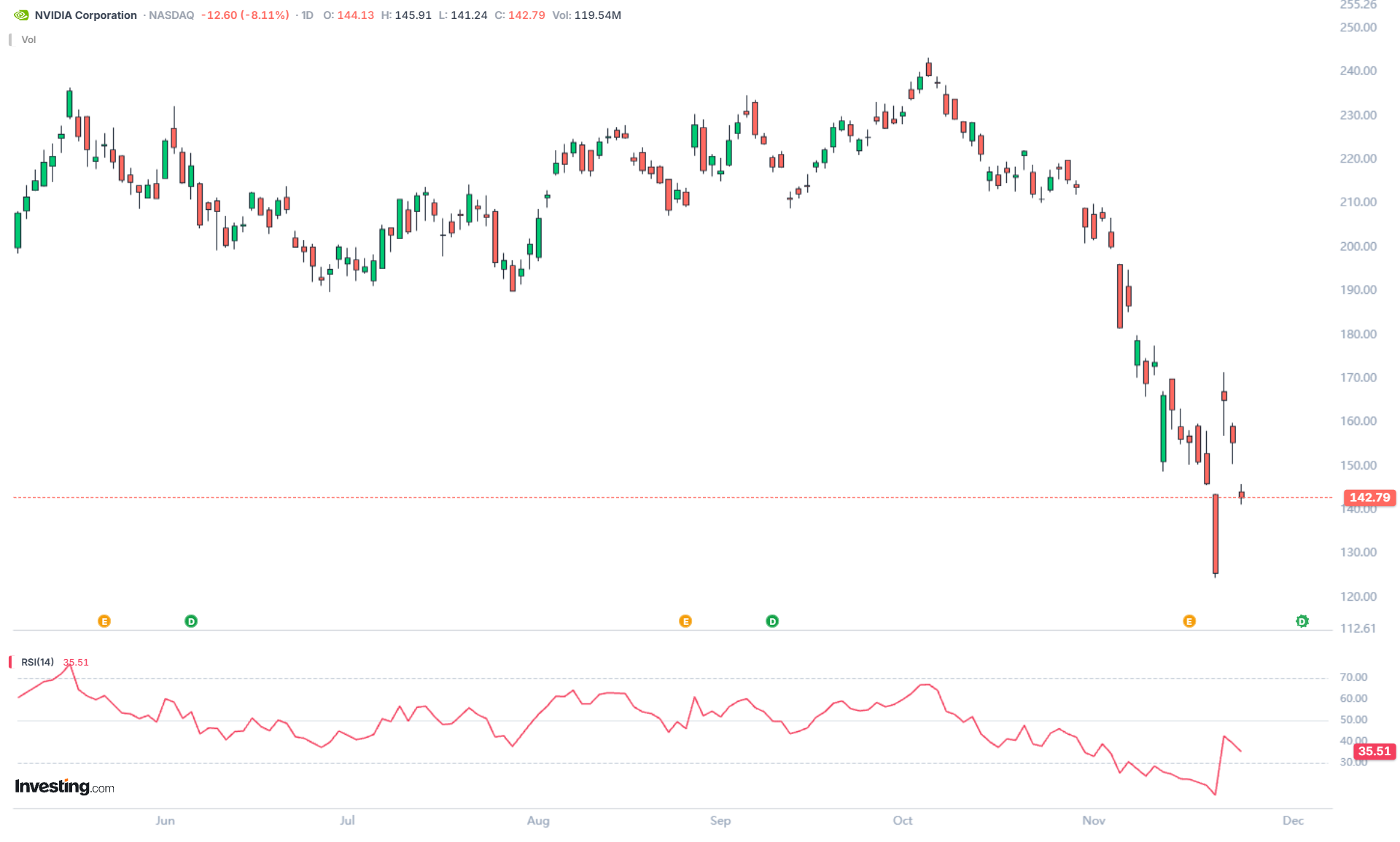
Source: Investing.com. Nvidia daily price chart as of November 25, 2026.
Nvidia Business Outlook
Behind the leadership turmoil, Nvidia financial performance remains exceptionally strong.
For the third quarter of fiscal 2027, ended October 25, revenue reached $115.8 billion, an increase of 103% from a year earlier. GAAP net income rose 105% to $65.3 billion, while non-GAAP net income increased 109% to $64.9 billion.4
Data centres remain the main growth engine. Revenue from the division reached $107.6 billion, up 110% year on year, reflecting continued investment in AI infrastructure by cloud providers and technology companies.
GAAP gross margin was 74.8%, highlighting its pricing power and ability to generate substantial profits from its dominant position in AI computing.
The outlook is equally ambitious. Nvidia expects fourth-quarter fiscal 2027 revenue of approximately $130 billion, plus or minus 3%. Importantly, this forecast assumes no data centre compute revenue from China, suggesting that the company is already factoring in significant export restrictions when assessing its near-term prospects.4
The figures demonstrate that demand for Nvidia AI chips remains strong despite growing concerns about the cost, financing and long-term returns of AI infrastructure investment.
What Risks Remain for Nvidia?
Huang reinstatement does not bring the investigations to an end. The independent board investigation will continue, while Nvidia has committed to cooperating with ongoing government inquiries.1
China remains one of the biggest uncertainties. Meanwhile, several countries, including Indonesia, Malaysia, Singapore, Thailand and Brazil, have introduced additional export licensing requirements for advanced chip shipments.5
Nvidia has also indicated that it is not shipping its Hopper-based data centre products, including the H200 processor, to China.6
Political scrutiny is likely to remain intense. Congressional committees are seeking answers about the company relationships, export-control procedures and potential national security exposure. Huang and other senior Nvidia executives are also facing questions from US lawmakers.7
There is another issue that investors should watch: how the AI boom is being financed.
Nvidia has also attracted scrutiny over so-called circular financing arrangements, in which the company invests in AI businesses that subsequently use the funding to purchase its chips and infrastructure. These deals can accelerate AI development and support demand, but they also raise questions about how much of the reported growth is driven by genuine end-customer demand and how much depends on financing provided by Nvidia itself.8
Conclusion
The return of Huang removes an immediate leadership risk, but it does not provide a clean break from the controversy. Nvidia board has restored the executive most closely associated with its success, while simultaneously strengthening oversight of national security, export controls and compliance.
The investment case remains supported by extraordinary revenue growth, strong margins and continued demand for AI computing. However, investors must also consider the political and regulatory risks surrounding the company's China business, as well as growing questions about the economics of AI investment.
The rebound on Monday shows how important Huang remains to investor confidence. But the next test will be whether Nvidia can maintain its financial momentum while addressing the concerns that led to his departure in the first place.
Key Takeaways
· Huang is back as CEO: Nvidia board reinstated its co-founder on November 23, just 11 days after his resignation.
· Shares surged 31.5%: Huang return triggered a major relief rally, adding nearly $1 trillion to Nvidia market value.
· Strong growth, but risks remain: Third-quarter revenue jumped 103% to $115.8 billion, but China-related restrictions, investigations and concerns over AI financing remain key risks.
Professional investors looking for magnified exposure to Nvidia may consider Leverage Shares +3x Long NVIDIA or -3x Short NVIDIA ETPs.
Footnotes
1. Nvidia, NVIDIA Board Reinstates Jensen Huang as President, CEO and Board Director, as of November 23, 2026.
2. Yahoo Finance, Trump says he would welcome Jensen Huang’s return as Nvidia CEO, as of November 16, 2026.
3. CNBC, Nvidia skyrockets 30% on Huang's return as CEO, recovering nearly all the losses since he disclosed affair, as of November 23, 2026.
4. W.Media, Nvidia declares first results after Huang's exit: Revenue doubles YoY driven by AI demand, as of November 23, 2026.
5. Al Jazeera, Nvidia dismisses calls to reinstate Jensen Huang amid blockbuster earnings, as of November 23, 2026.
6. South China Morning Post, Nvidia board says it has no plans to reinstate Jensen Huang as CEO, as of November 23, 2026.
7. WUSF, Nvidia board says it does not intend to reinstate Jensen Huang as CEO, as of November 23, 2026.
8. Swissinfo, Tech stocks rally as Anthropic IPO fuels AI trade: markets wrap, as of November 19, 2026.
Kapital ist gefährdet. Sie können Ihr gesamtes Investment verlieren. Die vollständigen Risikohinweise finden Sie hier.
 Market Insights

