



Kapital ist gefährdet. Sie können Ihr gesamtes Investment verlieren. Die vollständigen Risikohinweise finden Sie hier.

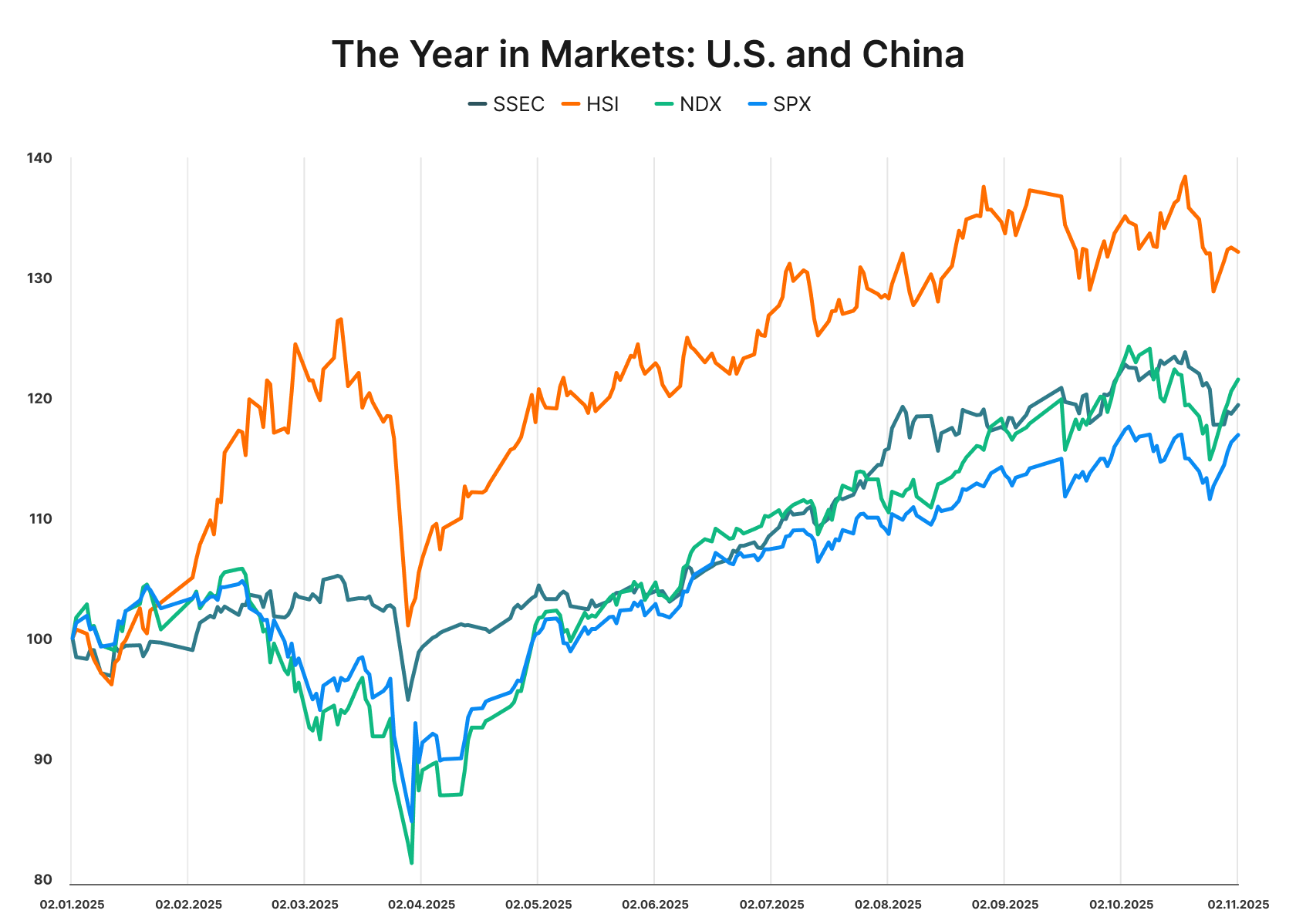
Through most of the year, the Hang Seng Index (HSI) and the Shanghai Composite Index (SSEC) have seemingly outperformed their U.S. counterparts Nasdaq-100 (NDX) and S&P 500 (SPX).
Source: Leverage Shares analysis
However, there are some interesting distinctions in performance driven by the share class structure in the People’s Republic of China: while HSI constituents are readily purchasable by overseas investors via the Hong Kong Stock Exchange (SEHK), the SSEC is almost completely dominated by A-Shares – which are subject to enhanced scrutiny and regulations that generally favour the domestic investor over the overseas. While HSI soars over the other three indices, SSEC has generally kept pace with the U.S. indices.
This difference can best be exemplified by three Chinese companies that are dual-listed in Hong Kong as well as the U.S.: Alibaba, Inc (US ticker: BABA), Baidu, Inc (US ticker: BIDU), and JD.com Inc (US ticker: JD).
Domestic Investors Bearish, U.S. Investors Neutral?In the recent earnings season, Alibaba was up 3% YoY in its fiscal year, with Cloud Intelligence revenue rising 30%, while quick commerce grew 37% YoY. While its core business – e-commerce – registered a 12% growth in revenue principally propped by the instant commerce segment – such as food delivery – EBITDA margins remained under pressure due to costs of AI buildout and the vanishingly low returns on the instant commerce segment. E-commerce EBITDA was down 47% YoY but somewhat sustained by the 31% YoY growth from Cloud, leading to a 44% drop in consolidated EBITDA. Management reaffirmed its commitment to aggressive AI+cloud and consumption-led growth strategies.
In a similar vein, JD.com posted a nearly 18% YoY growth in revenue, which was driven by a 17% growth in general merchandise and 24% in marketing services. Here too, margins were under pressure due to its continuing competition with Alibaba and Meituan in the instant commerce space and the expansion of its discount supermarkets – new businesses (i.e. instant commerce) delivered a 143% growth YoY while operating margin was down 90%. The company also highlighted AI and international expansion as strategic priorities.
Meanwhile, Baidu – the centerpiece of internet search in China and a prominent AI champion – witnessed an 18% decline in online marketing (ad spends) in YoY terms, which led to net revenues being down 7% YoY. Within the results, however, AI-related segments such as AI-native marketing and Cloud Infra saw a 262% and 33% surge YoY while Apollo Go delivered 3.1 million driverless rides (+212% YoY).
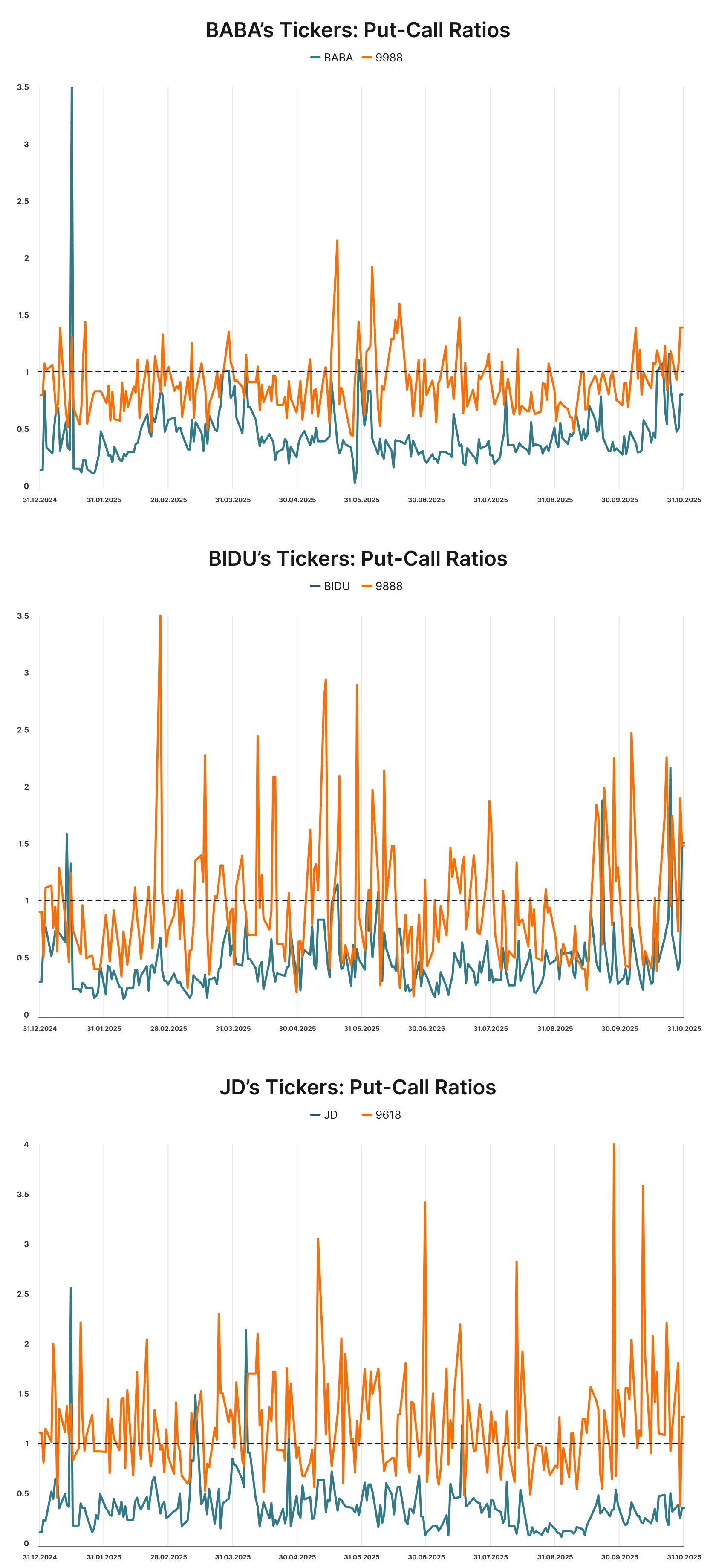
The preponderance of AI across these three companies is a strong selling point among overseas investors who remain fixated on the prospect of diversification within the AI Hype that has been the dominant flavour of investor conviction in 2025. When measuring this conviction in terms of put-call ratios seen in these companies’ tickers in the U.S. and Hong Kong, there is a palpable difference:
Source: Leverage Shares analysis
Through the year till the end of November, Alibaba’s U.S. ticker registers an average put-call ratio of 44% while the Hong Kong ticker’s is at 89%. In Q4 so far, the U.S. put-call ratio average shows a slight increase to 52% while the Hong Kong ticker rises to 94%.
Meanwhile, JD’s put-call ratio average is 38% and 119% in the U.S. and Hong Kong in the YTD and 30% and 136% in Q4. Baidu’s is 47% and 95% for the YTD, with the averages rising to 62% and 105% for Q4 in the U.S. and Hong Kong respectively. Investor sentiment in the U.S. ticker, thus, stands at odds with that in the Hong Kong ticker.
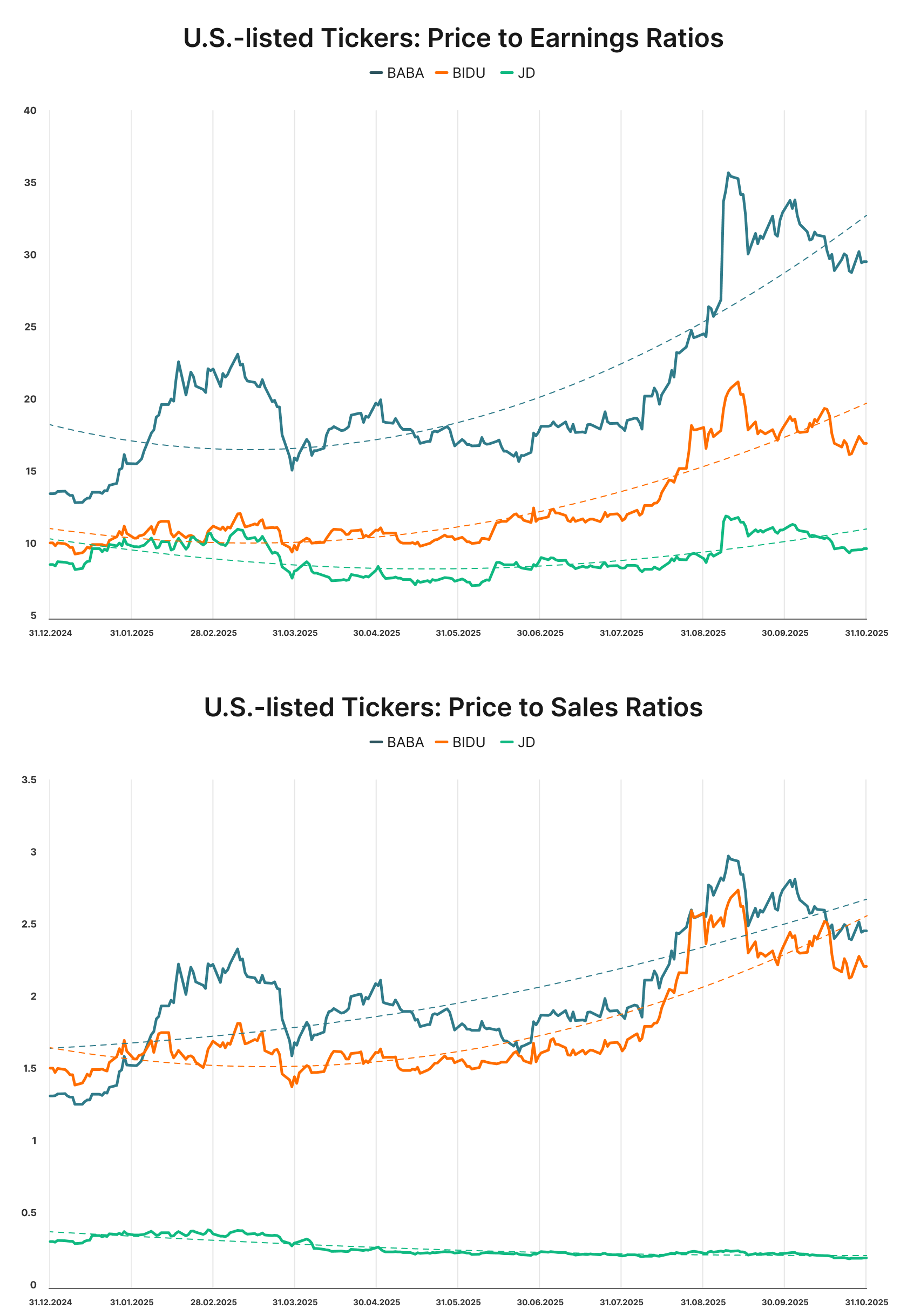
The three companies’ U.S. tickers have seen a rapid growth in Price Ratios across the year, with Alibaba leading by some margin in Price-to-Earnings (PE):
Source: Leverage Shares analysis
Price appreciation relative to revenue, on the other hand, shows increasing signs of flattening. While new businesses bring in revenue and AI investments would be ascribed higher revenue shares, the fact remains that they tend to be a drag on earnings. When enmeshed with the high convictions in AI, revenue achieved at a cost to earnings due to investments in new infrastructure would be a prime example of heavily mixed signalling for the market.
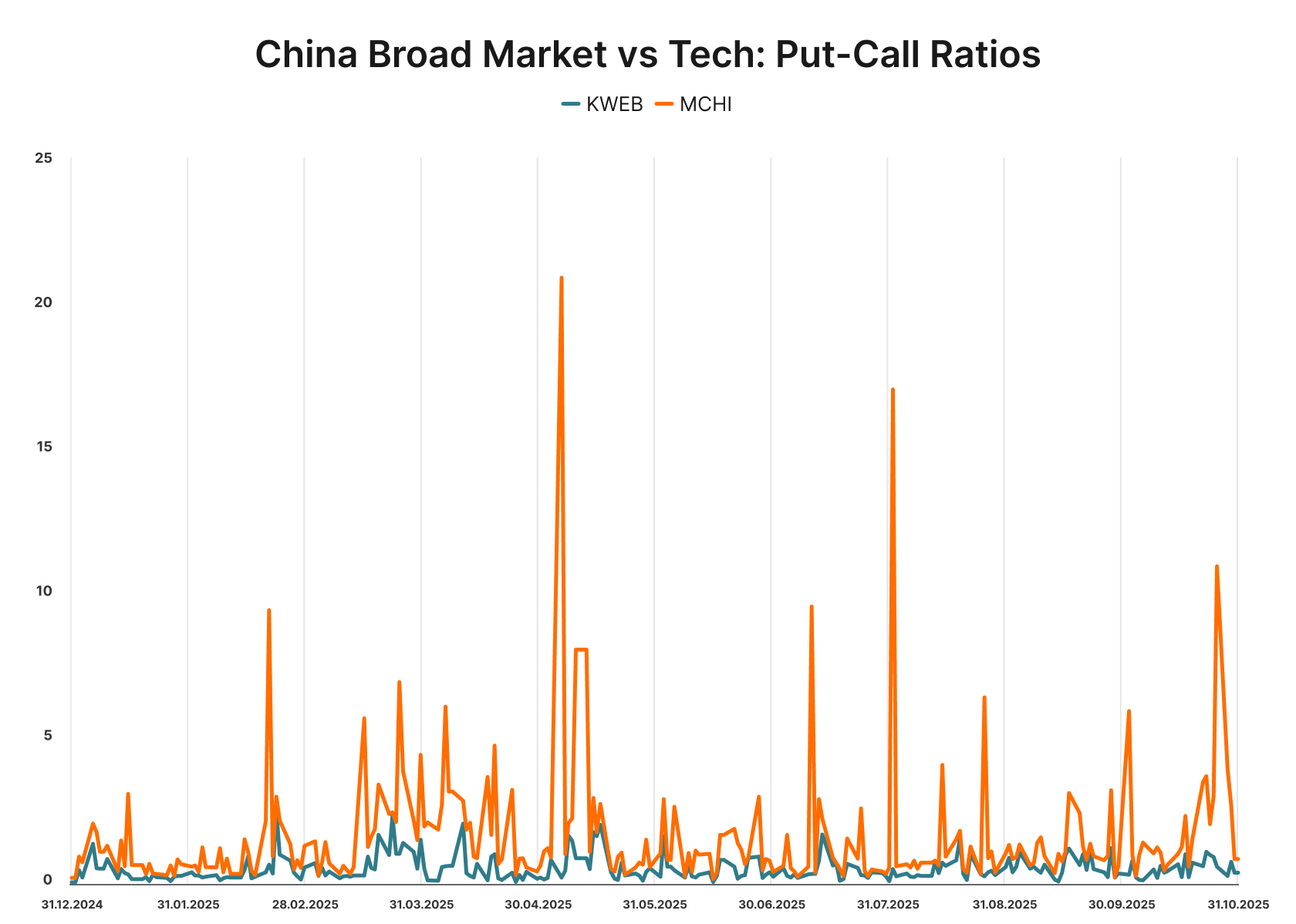
Messaging across AI seems to be driving interest in the U.S. tickers, which is arguably exemplified in the sentiment in KraneShares CSI China Internet ETF (KWEB) versus the iShares MSCI China ETF (MCHI) – effectively representing the “tech” sectors versus the “broad” market – that are eligible for investment by overseas investors.
Source: Leverage Shares analysis
In the year till date, KWEB’s put-call ratio averaged at 52% while MCHI’s stood at 114%. In Q4 so far, this changed to 57% and 107% respectively.
Looming Anticipation vs HypeDespite the heavy difference in put-call ratios, ticker performance – be it in the U.S. or in Hong Kong – hasn’t seen a significant variation in overall performance. For example, Alibaba has witnessed a massive 85% growth in value in both tickers.
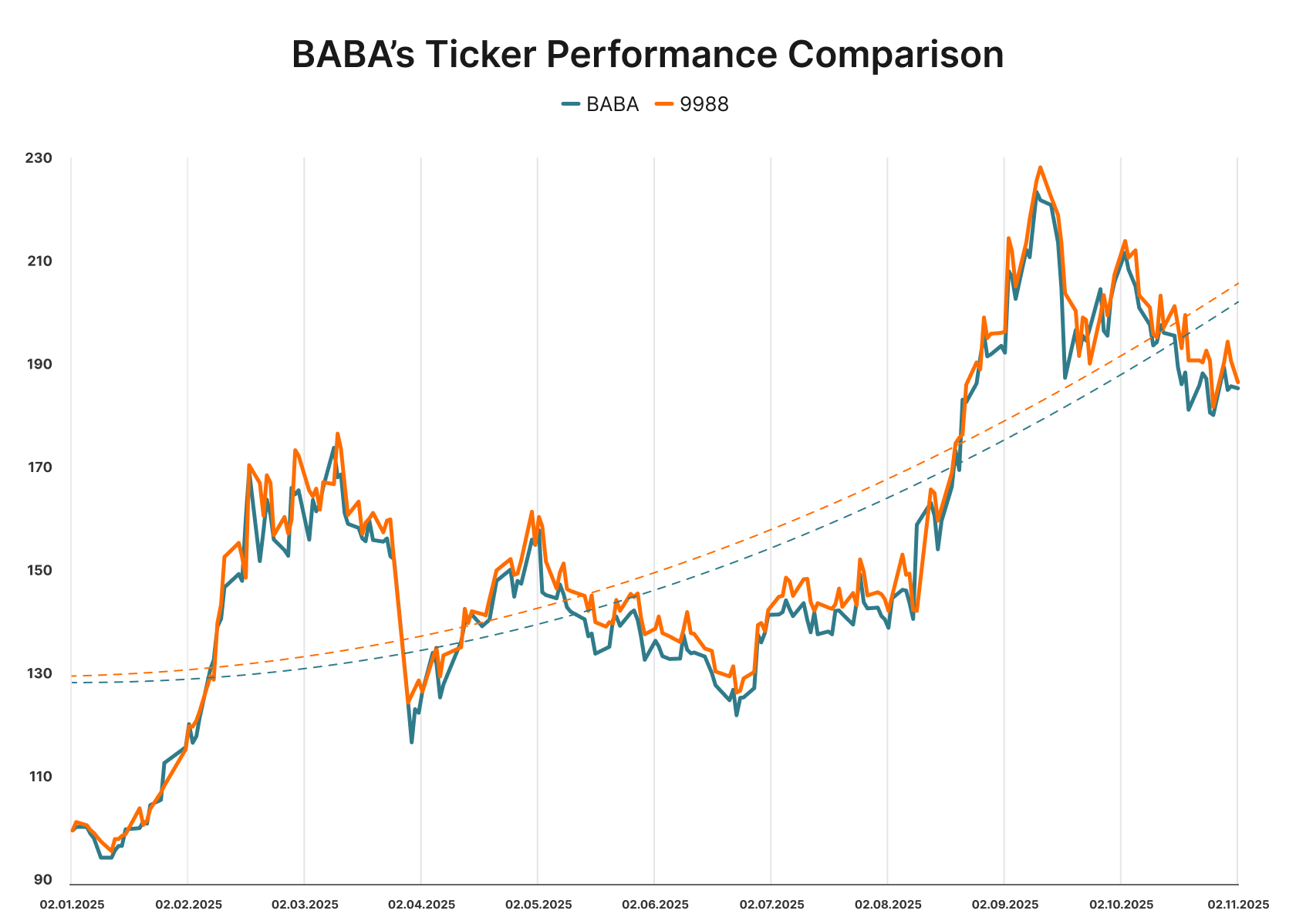
Source: Leverage Shares analysis
This is arguably explainable along two factors: firstly, resilient overseas investor outlook boosts the U.S. ticker, which is essentially a certificate comprised of a fixed number of Hong Kong-listed stocks. As a result, this boost trickles into the Hong Kong ticker the next day. Secondly, the AI theme which played across the U.S. equity universe lies heavy on select Chinese stocks – given they also offer diversification benefits.
However, the tale being hinted at by Hong Kong investors’ sentiment stands at odds with the generally benign one being relayed by overseas investors. Hong Kong investors are examining the ongoing softness in domestic consumption and statements about revenue growth very critically, and seem to be persisting with the conclusion that the bull run is overplayed. While they’re seemingly content with making hay while the sun shines from the sentiment being injected into top-of-the-line stocks by overseas investors, this doesn’t shake their conviction with what they see on the ground – which they’re in a better position to analyze than investors outside of China.
Professional investors in Europe might consider the +3x Long Alibaba ETP (BAB3) and the -3x Short Alibaba ETP (BA3S) during bullish and bearish trends in Alibaba’s U.S. ticker. Also available are the +3x Long Baidu ETP (BID3) and the -1x Short Baidu ETP (BIUS) for Baidu’s stock as well as the +3x Long JD.com ETP (JD3) and the -1x Short JD.com ETP (JD1S) for JD.com.
For a distributed exposure to market trends, the +3X Long China ETP (CHI3) and the -3X Short China ETP (CHNS) aim to delivered magnified exposure to MCHI while the +3X Long China Tech ETP (KWE3) offers magnified exposure to KWEB.
Furthermore, the Alibaba Options ETP (BABY) seeks to generate monthly income for investors by directly investing in Alibaba’s U.S. shares and selling put options on them.
Kapital ist gefährdet. Sie können Ihr gesamtes Investment verlieren. Die vollständigen Risikohinweise finden Sie hier.
 Market Insights

