Article by Edward Sheldon
The Oura IPO: What You Need to Know Before Trading It
September 24, 2026 | Research Insights
On September 3, 2026, smart ring maker Oura filed a Form S-1 with the SEC, announcing its plans for an IPO on the Nasdaq1. While no official IPO date has been set yet, the listing could take place very soon.
In this article, we are going to provide a concise overview of Oura, covering its core business model, growth drivers, revenues, valuation, and risk factors. Here’s what you need to know before trading the IPO.
Who is Oura?
Oura is a healthcare technology (wearables) company that offers smart rings. Its rings enable users to track a range of personal health and wellness metrics including sleep quality, heart rate, daily activity, and stress levels.
Founded in 2013 in Finland, the company is headquartered in San Francisco today. Its mission is to empower people to live healthier, longer.

Oura’s Market Opportunity
In its Form S-1 filing, Oura states that it has a broad addressable market. It also says that its market penetration is low today.
In terms of the potential market size, the company states that the categories in which it currently participates in or may participate in the future – including fitness trackers, health and wellness coaching, digital care management applications, digital therapeutics, and selected connected biosensor categories – represent a global market opportunity exceeding $90 billion in 20261. It views this figure as its serviceable addressable market (SAM).
As for market penetration, it notes that global shipments of wearable devices totaled approximately 212 million units in the 12 months ended June 30, 2026, according to International Data Corporation (IDC). Of this, it had approximately 2% penetration with 3.6 million smart rings sold over the period1.
It’s worth noting that Oura believes that it is capturing market share at present. According to the company, around 30% of new members report replacing their existing wearable with an Oura ring1.

Oura’s Financials
Zooming in on the financials, Oura’s revenue for the first nine months of its 2026 fiscal year was $1.21 billion1. This represented 74% year-over-year growth.
Breaking this revenue figure down, hardware accounted for around 80%. Recurring membership subscriptions represented the other 20% of revenue.
Net income for the nine-month period was $60.8 million. That compares to $1.6 million in the prior year period1.
However, the company notes in its Form S-1 that it has a “history of operating losses". It adds that there can be no assurance that it will maintain profitability in any future period.
In terms of a valuation, reports indicate that Oura could seek a valuation of up to $16 billion2. That would put the stock on a trailing price-to-sales ratio of around 18 as its 2025 sales were $908 million1.
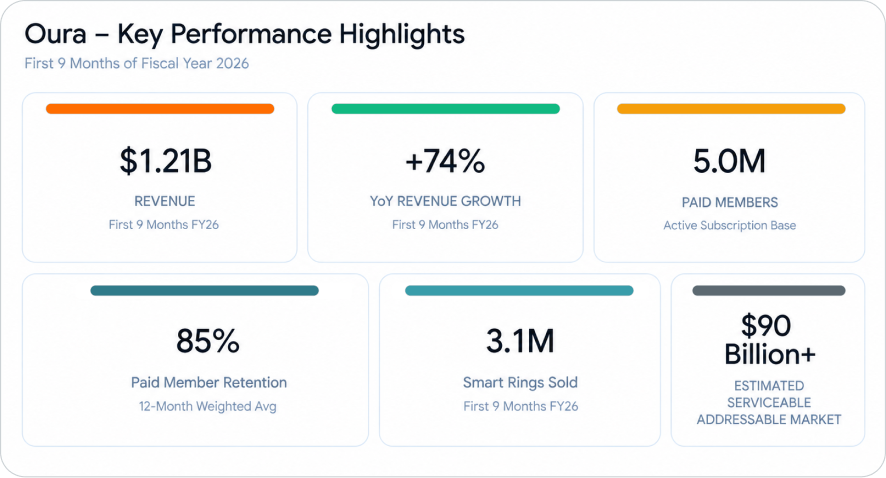
Source: SEC, Oura Inc, Form S-1, as of September 3, 2026
The Bull Case for Oura
The main pillars of the bull case for Oura stock are highlighted below:
- Oura is a trusted brand operating in a growth industry: According to GlobalData, the wearable tech industry could be worth $232.2 billion by 2030, up from $117.4 billion in 20243.
- Revenue growth is strong: In the first nine months of its fiscal 2026, Oura’s revenue rose 74% year-over-year to $1.21 billion1.
- Potential for increased market share: Oura believes that it can increase its market share through continued product innovation, brand awareness, and distribution expansion.
- International expansion opportunities: Today, the bulk of Oura’s hardware revenues come from the US. Looking ahead, the company plans to expand into underpenetrated markets using a disciplined, localized go-to-market approach.
- Hardware-plus-software subscription model: Oura operates an integrated hardware-plus-membership business model that combines strong upfront unit economics with recurring, high-margin subscription revenue. As of June 30, 2026, the company had 5.0 million paid members, and its weighted-average 12-Month paid member retention was approximately 85%1.
- Large-scale datasets powering AI models and insights: Over the last decade, Oura has amassed huge biometric datasets in consumer health, tracking over 50 health and wellness metrics and representing nearly 42 billion hours of physiological data1. These datasets power its AI and machine-learning models, which decode complex physiological patterns and improve in accuracy, personalization, and predictive capability as member histories deepen – creating a compounding data advantage that is difficult to replicate.
The Risks
In its Form S-1 filing, Oura lists a number of risks for investors to consider. These include:
- Competition from rivals: Oura notes that it operates in a highly competitive market and that it is up against larger companies with greater resources, brand recognition, and distribution capabilities. Some of its competitors include Apple, Samsung, Garmin, and Whoop.
- Changes in consumer spending levels: A consumer slowdown could result in less demand for its products.
- Higher operating expenses: Oura expects its operating expenses to rise in the future as it increases its sales and marketing efforts, continues to invest in research and development of new hardware features, builds out its operating infrastructure, and expands into new geographies. It also expects to incur additional legal and accounting fees when it becomes a public company.
- Customer concentration: For the nine months ended in June, its two largest retail customers accounted for 12% and 10% of its total revenue, respectively1.
- Potential for defects and warranty claims: The company notes that safety issues with its products – including issues relating to battery performance, skin irritation, inaccurate health data, or hardware failures – could lead to warranty claims, product replacements or recalls, reputational harm, regulatory proceedings, or litigation, which could adversely affect its business, financial condition, and results.
- Trade tensions and tariffs: These could increase supply chain costs.
Going Long Versus Going Short
In summary, the Oura IPO represents a classic high-growth hardware-plus-SaaS opportunity. While there is potential for upside in the long run as the company scales up, there are also significant downside risks tied to intensifying Big Tech competition, potential subscription churn, and hardware commoditization.
Ultimately, investors looking to trade the Oura IPO must carefully balance the company’s revenue trajectory against the risk factors. This is not easy – compelling arguments exist for both long and short positions.
Footnotes:
1SEC, Oura Inc, Form S-1, as of September 3, 2026
2Quartz, Oura is seeking up to $3 billion in an IPO that could value it at $16 billion, as of August 25, 2026
3GlobalData, Wearable tech to become $232 billion industry by 2030, forecasts GlobalData, as of February 9, 2026