Article by Jonathan Hobbs, CFA
How To Short Anthropic Stock: Three Ways Compared
September 28, 2026 | Education
There are three main ways to short Anthropic stock. You can sell the shares short, buy put options, or buy an inverse Anthropic ETF. Each one aims to gain when Anthropic’s share price falls. They differ in what you need to start, what they cost to hold, and how much you could lose.
Anthropic is the company behind the Claude AI models. This guide explains each method in turn, with a hypothetical $1,000 example, and then compares the three in a table.
1. Short selling Anthropic stock
Short selling means borrowing Anthropic shares through your broker, selling them, and aiming to buy them back later at a lower price. The difference, before costs, is your potential gain (or loss).
You'll need a margin account to do this. That's an account where your broker can lend you money or shares against the cash you hold. The broker also has to find shares to borrow before you can sell them, which can be more difficult in the weeks after an IPO. Companies typically sell only a small share of their stock at IPO, so brokers may have fewer shares to lend.
You'd pay a borrow fee for as long as the position stays open. It works like interest, usually quoted as a yearly rate that builds up daily. That rate can rise when shares are scarcer. If the stock rises instead of falling, the broker could also ask you to add more cash to the account.
There's no cap on the loss with short selling, because there's no limit on how far a stock could rise. In a hypothetical example, a $1,000 short position would gain $100 on a 10% fall and lose $100 on a 10% rise, before costs. If the stock kept rising, the loss would keep growing.
2. Buying put options on Anthropic stock
A put option gives you the right to sell Anthropic shares at a set price before a set date. If the stock falls below that price, the put could gain value. If the stock stays above it, the put would expire “worthless” – and you'd lose what you paid for it. That price, known as the premium, is the most you could lose.
Each standard US put contract covers 100 shares, and your broker has to approve your account for options trading before you can buy one. Put prices are usually higher when traders expect big swings, which is often the case just after an IPO. Options on a newly listed stock can start trading from the second business day after it lists.
Puts also come with a deadline. For a put to gain value, Anthropic has to fall below the set price by more than the premium – and it has to do so before expiry. The put tends to lose value as that date gets closer, even if the stock doesn't move.
3. Buying an inverse Anthropic ETF
An inverse Anthropic ETF aims to move in the opposite direction to the stock each day, before fees. A 1x short ETF aims to match the daily move in reverse, while a 2x short ETF aims to double it. On a hypothetical $1,000 position, a 10% fall in Anthropic would gain $100 in the 1x short ETF and $200 in the 2x short ETF. On a 10% rise, each ETF would lose those same amounts.
Inverse ETFs trade as shares on an exchange, so you can buy one through a regular brokerage account. That means no borrowing, no margin account, and no expiry date. An inverse ETF can also list within days of the stock, although early on it may not hit its daily target as closely as normal. These ETFs charge an annual expense ratio, deducted from their value a bit each day. Losses in an inverse ETF are capped at the amount invested, although a shareholder could lose their entire investment. A 2x short ETF could lose its full value if Anthropic rose more than 50% in one day.
The trade-off is the daily reset. An inverse ETF resets at the close of every trading day, so its return over weeks or months compounds day by day. That could erode value in a choppy market, which is why these ETFs are designed for short-term trades.
Our guide to Anthropic leveraged ETFs explains how each one is built, and our daily rebalancing and compounding guide explains the math.
Shorting Anthropic Stock: the Three Methods Compared
The table below sums up the three potential ways to short Anthropic stock.
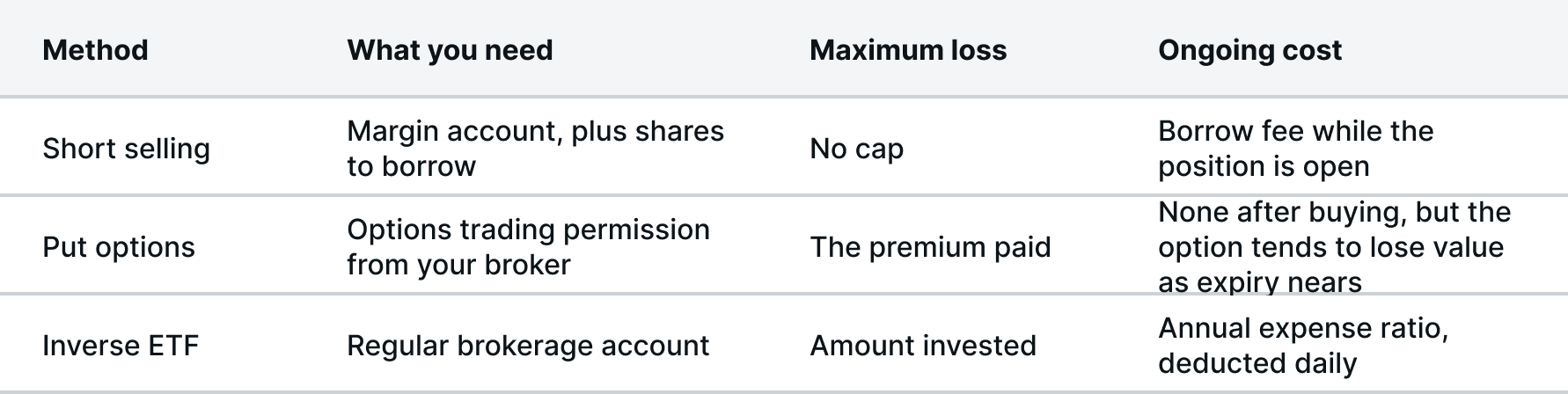
Illustrative comparison. Costs and availability vary by broker.
Leverage Shares offers leveraged single-stock ETFs on US stocks such as Nvidia, Tesla, and SpaceX.
See our full ETF range for current listings.
Key Takeaways
- The three ways to short Anthropic stock are short selling, buying put options, and buying inverse ETFs. Each aims to gain when the share price falls.
- Short selling has no loss cap. A put can't lose more than its premium, and an inverse ETF can't lose more than you invest.
- Over one day, a 1x short ETF aims to match a short sale's gain or loss without borrowing.