Article by Jonathan Hobbs, CFA
Anthropic Leveraged ETFs Explained: Long And Short
September 10, 2026 | Education
Anthropic leveraged ETFs are exchange-traded funds that aim to multiply Anthropic's daily share price move. The three main types are a 2x long ETF, a 2x short ETF, and a 1x short ETF. Each one targets one day's move in the stock, before fees and expenses. It then resets its leverage factor at the end of each trading day, so it's ready for the next one.
Anthropic is the company behind the Claude AI models. This guide explains how each leveraged ETF type is designed to work, over a single day and longer holding periods.
What is an Anthropic leveraged ETF?
An Anthropic leveraged ETF is a single-stock ETF, which means it tracks one company rather than an index. Its shares trade on an exchange like any other stock, so a trader can get leveraged exposure without borrowing from a broker. Our guide to leveraged ETFs covers the general mechanics, and our Anthropic IPO guide covers the company itself.
The ETF doesn't need to own Anthropic shares to do its job. Instead, it can use swap agreements with banks and listed options to get its target exposure. Leverage Shares used that approach for its SpaceX ETFs, which listed within days of the SpaceX IPO in June 2026.
The table below sums up the three types of Anthropic leveraged ETFs.
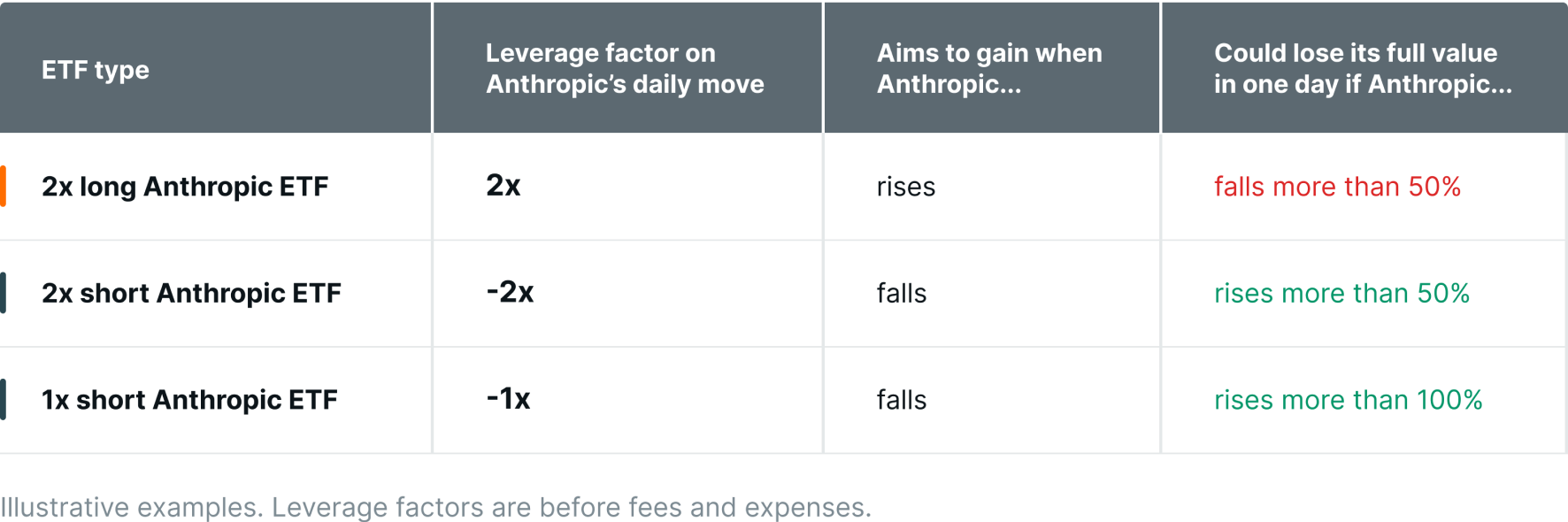
How each Anthropic ETF aims to move in one day
The clearest way to compare the three is a $1,000 position over a single trading day. Assume Anthropic's share price moves 5% by the close, and ignore fees. The table below shows what each ETF would be worth by the end of the day.
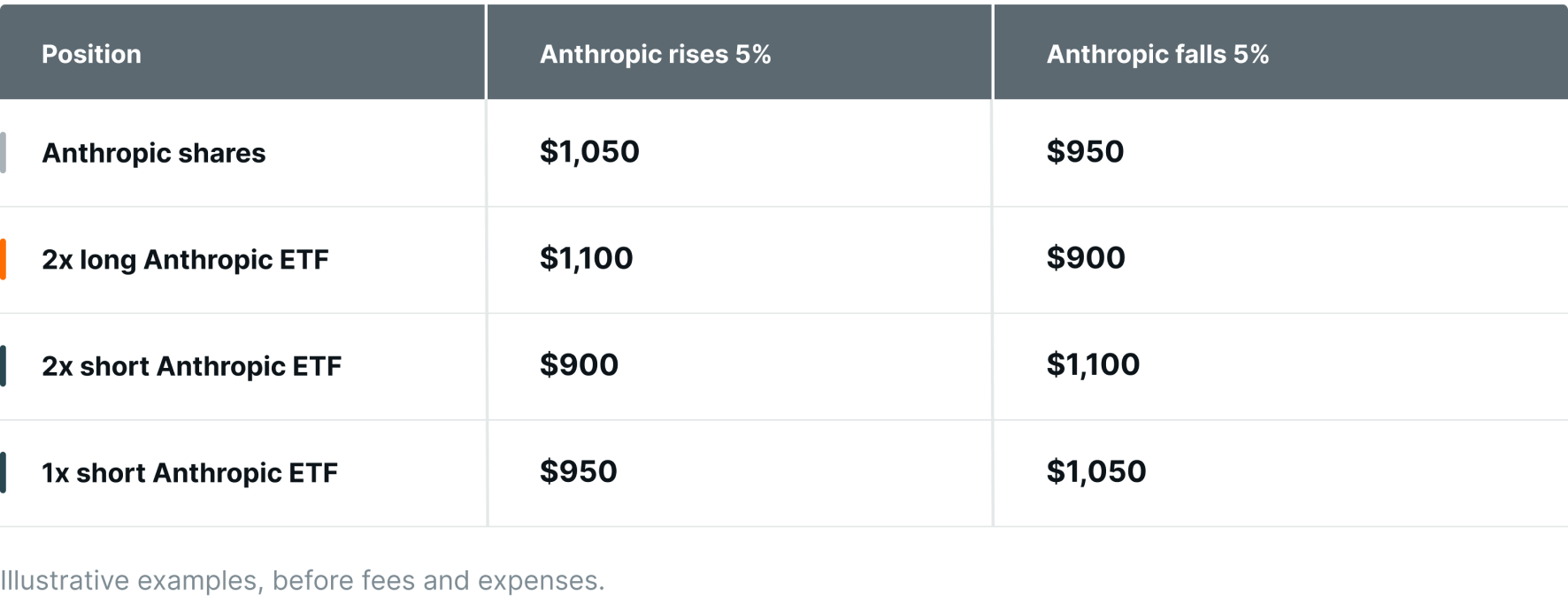
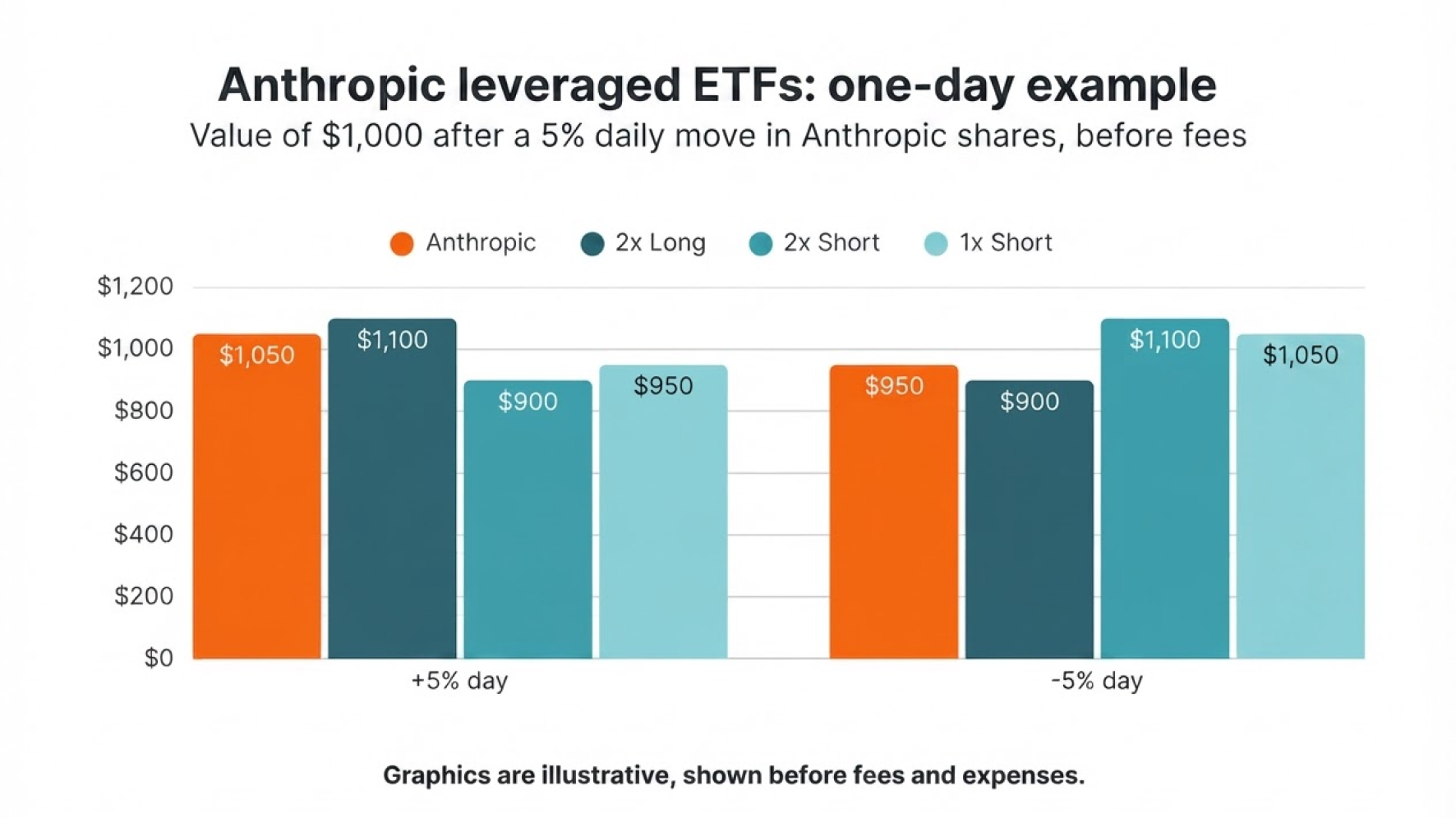
The 2x long and 2x short ETFs aim to mirror each other on any one day. Whatever one gains, the other aims to lose. The 1x short aims to move half as far, which can give a bearish trader the direction without the extra leverage.
Note: the 2x applies from one market close to the next. If you buy partway through the trading day, your return runs from your buy price. So it may not be exactly double that day's move.
Daily rebalancing and compounding risk
Daily rebalancing means each ETF resets its exposure to the target multiple at the close of every trading day. That reset keeps the leverage on target: the ETF aims for 2x of today's move, whether you bought yesterday or last month. Over a week or a month, the return is the compounded result of each day's move. That's not the same as 2x the stock's move over the period. The difference is known as compounding risk.
Compounding tends to help in a steady trend and hurt in a choppy market. If Anthropic rose for five straight days, for example, the 2x long could gain more than double the stock's five-day return. Each day's gain would build on a bigger base. But if the stock swung up and down and ended flat, all three ETFs would tend to lose value. Each swing eats into the base. That erosion is called volatility drag, and our daily rebalancing and compounding guide walks through worked examples.
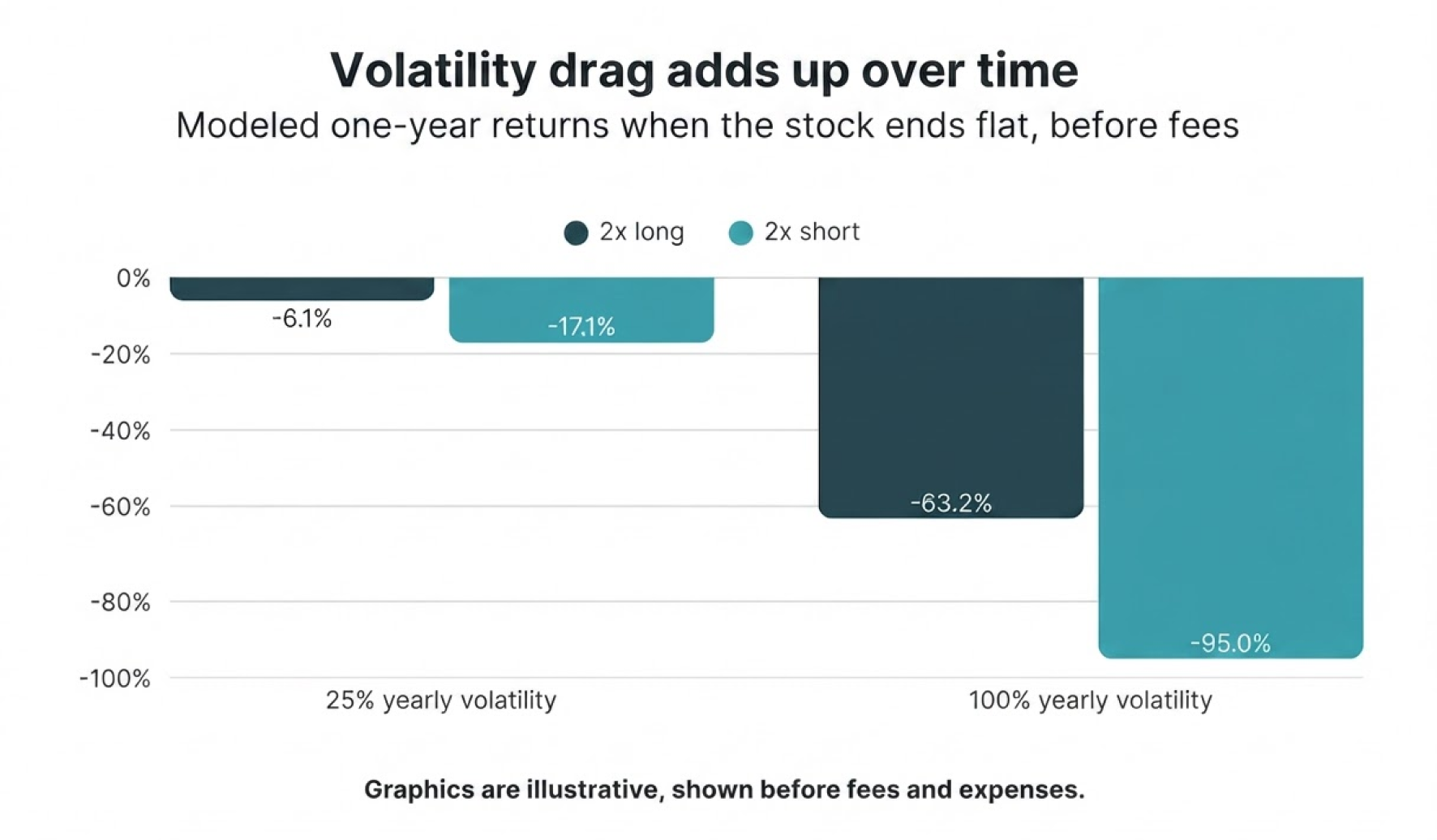
Volatility drag is why these ETFs are designed for short-term trades rather than long-term holds. Leverage Shares fund documents for 2x daily single-stock ETFs model what a year of drag could do. If the stock ended the year flat and annualized volatility was 25%, a 2x long ETF would be expected to lose 6.1%. A 2x short ETF would be expected to lose 17.1% under the same conditions. At 100% annualized volatility, those expected losses rise to 63.2% and 95%. Over a day or a few days, the drag has less time to build – but it could compound over months.
Costs and risks of Anthropic leveraged ETFs
Fees: a leveraged ETF charges an annual expense ratio, deducted from its net asset value a bit each day. For short-term traders, bid-ask spreads and broker commissions can also affect returns. Spreads can be wider in an ETF's first days of trading if volumes are lower. Our leveraged ETF fees guide explains the costs in detail.
Total loss in a day: a 2x ETF could lose its full value if Anthropic moved more than 50% against it in one session. A 1x short ETF could do the same if the stock more than doubled. Losses in the ETF itself are capped at the amount invested, although a shareholder could lose their entire investment.
IPO liquidity: swaps and options on a new stock can take days or weeks to become available at reasonable prices. Until they do, an ETF may not reach its full target exposure and may track the stock less closely. The ETF's own shares could also trade above or below their net asset value while trading is thin.
IPO price moves: hot IPOs can jump on day one, and a short ETF would lose on that jump. Pre-IPO shareholders are usually barred from selling for around six months. The price could move again when that lock-up ends.
Counterparty risk: the swaps are contracts with banks, so an ETF carries some risk if a bank fails to pay.
FAQs
Can you trade an Anthropic leveraged ETF on IPO day?
Possibly, although the ETF may list a day or two after the stock. From its first day of trading, you can buy and sell it through a regular brokerage account. Early on, the ETF may not hit its daily target as closely as normal.
What's the difference between a 2x short and a 1x short Anthropic ETF?
A 2x short ETF aims to double Anthropic's daily move in the opposite direction, while a 1x short ETF aims to match it. The 1x short carries less compounding risk, and only a larger one-day jump in the stock could wipe it out.
Is an Anthropic ETF the same as buying Anthropic shares?
No. The ETF aims to give leveraged or inverse exposure to the daily price move only. It doesn't give shareholders voting rights in Anthropic. Over longer periods its return could differ a lot from the stock's, because of daily rebalancing and leverage.
Leverage Shares offers 2x daily leveraged single-stock ETFs on US stocks such as Nvidia, Tesla and SpaceX. See our full ETF range for current listings.
Key takeaways
Anthropic leveraged ETFs aim to multiply the stock's daily move by 2x, -2x or -1x, before fees.
Daily rebalancing means returns over longer periods compound and can drift from the stated multiple, especially in volatile markets.
A newly listed stock has limited price history, and the ETF's building blocks can be in short supply at first. That can mean the ETF misses its daily target by more than normal in the early days.