Article by Edward Sheldon
The Anthropic Bear Case: Could the Stock Fall After the IPO?
September 1, 2026 | Research Insights
The Anthropic IPO is shaping up to be a blockbuster public listing. With the company generating prolific revenue growth amid an enterprise AI spending boom, excitement surrounding the potential listing is running at a fever pitch.
However, investors should be aware that there are numerous risks with this IPO. Here’s a look at the bear case for the stock.
A Sky-High Valuation
A core pillar of the Anthropic bear case is the company’s rumored $2 trillion1 IPO valuation. That kind of valuation would instantly make Anthropic one of the largest companies in the world.
At that valuation, the company would be bigger than SpaceX, Meta Platforms, Tesla, JP Morgan Chase, and Berkshire Hathaway2 – all of which have been around far longer than the AI firm. The only US companies that would be bigger would be Nvidia, Apple, Alphabet, Microsoft, and Amazon2.
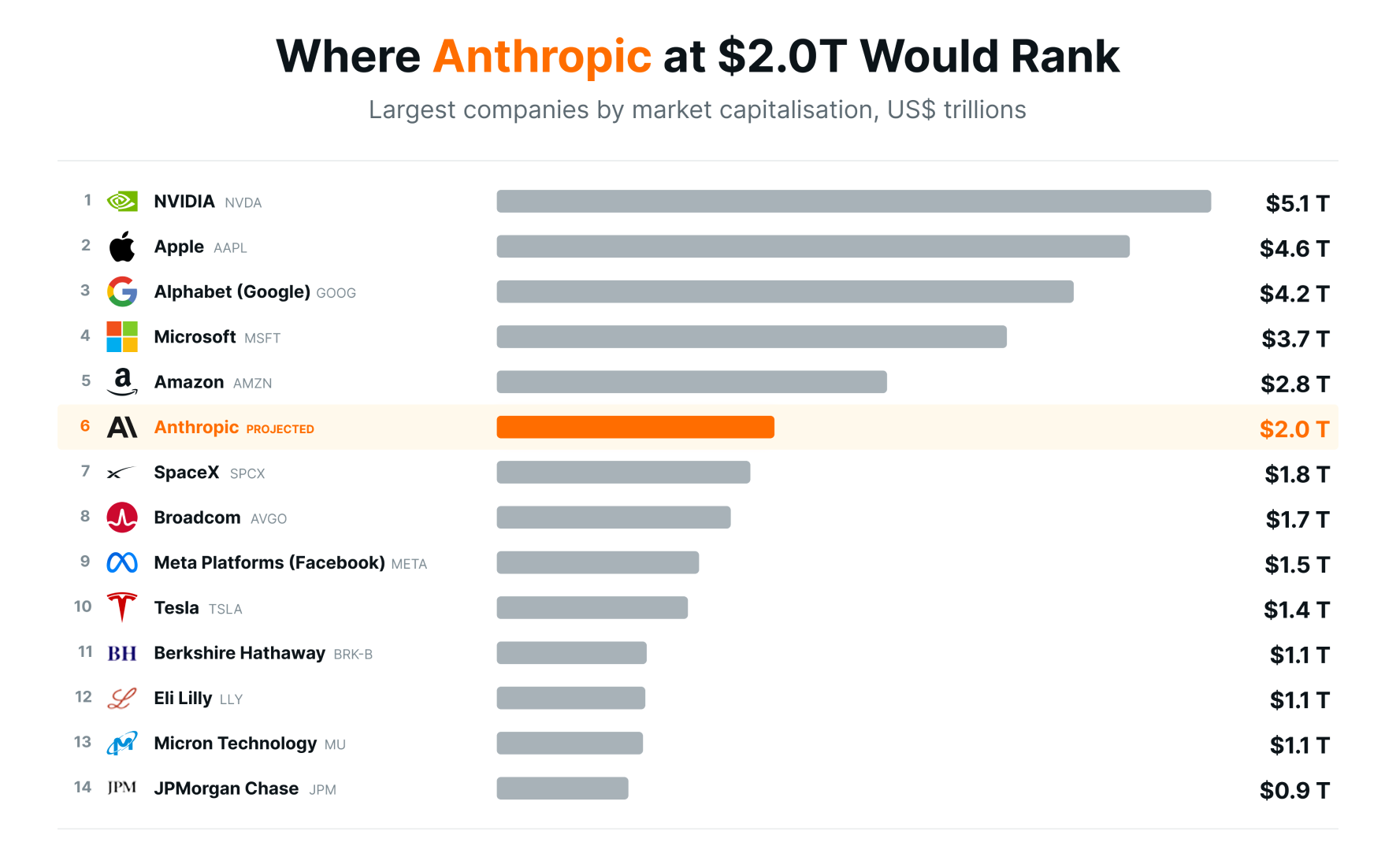
Source: Companiesmarketcap.com, as of August 26, 2026
Note that a $2 trillion market cap would equate to a forward-looking price-to-sales ratio of more than 30 (as of August 2026 Anthropic had an annualized revenue run rate of around $65 billion1). That’s high.
There are other software companies that have similar or higher price-to-sales ratios today – Palantir and CrowdStrike are some examples3. However, that kind of sales multiple leaves minimal room for a growth slowdown or an operational setback.
Model Commoditization and Rising Competition
One factor that could potentially lead to a growth slowdown for Anthropic is AI model commoditization. While its Claude model is a market leader today, competitors are quickly narrowing capabilities gaps.
As AI intelligence becomes commoditized, pricing per token may come under pressure. This could negatively impact the company’s level of revenue growth.
Another factor is competition from rivals. While Anthropic has carved out a dominant position in the enterprise space, companies like Google and OpenAI are aggressively trying to capture market share.
It’s worth pointing out that Gemini Enterprise reached over eight million paid seats across 2,800+ enterprise organizations in Q14, an increase of 40% quarter-over-quarter. This signals that it is having success on the enterprise front.
Escalating Compute Costs and the Impact on Profitability
A second major pillar of the bear case is uncertainty in relation to profitability. Like other businesses in the frontier AI space, Anthropic faces fundamental structural challenges in generating sustainable, consistent profits.
One issue is that building and training frontier LLMs requires billions of dollars in hardware, power, and data center contracts. Another is that, unlike traditional software software-as-a-service (SaaS) – where serving an extra user has a marginal cost near zero – running complex AI queries (inference) incurs significant cloud GPU compute costs for every single request.
Now, Anthropic did achieve positive adjusted operating income in Q25. This shows that it is capable of generating a profit.
However, investors shouldn’t expect the company to post a profit for the full year or the years ahead. In May, it said that profitability may not hold for the full year as data center spending is set to rise in the second half of 20265.
Hyperscaler Partnerships
One other factor that the bears point to is Anthropic’s heavy reliance on Amazon and Google Cloud. In recent years, both tech giants have poured billions of dollars into the AI company in exchange for a commitment from Anthropic to spend on their AI infrastructure.
This has a number of implications. First, multi-billion-dollar compute commitments to cloud partners mean a significant portion of revenue is going to flow back into infrastructure costs rather than shareholder capital.
Second, relying on third-party cloud infrastructure leaves Anthropic exposed to compute prices set by the providers. This could limit its long-term gross margin potential compared to companies building proprietary infrastructure.
Third, both Amazon and Google are investing heavily in their own internal AI models. If these companies prioritize native first-party models or alter cloud pricing, Anthropic could face structural distribution and cost handicaps.
History Suggests the Stock Could Fall Post IPO
Finally, it’s worth highlighting the fact that companies involved in hyped-up IPOs often see stock price weakness in the months and years following the IPO. In recent years, we’ve seen this happen with names such as SpaceX, Cerebras Systems, CoreWeave, Circle Internet, Snowflake, and Airbnb3.
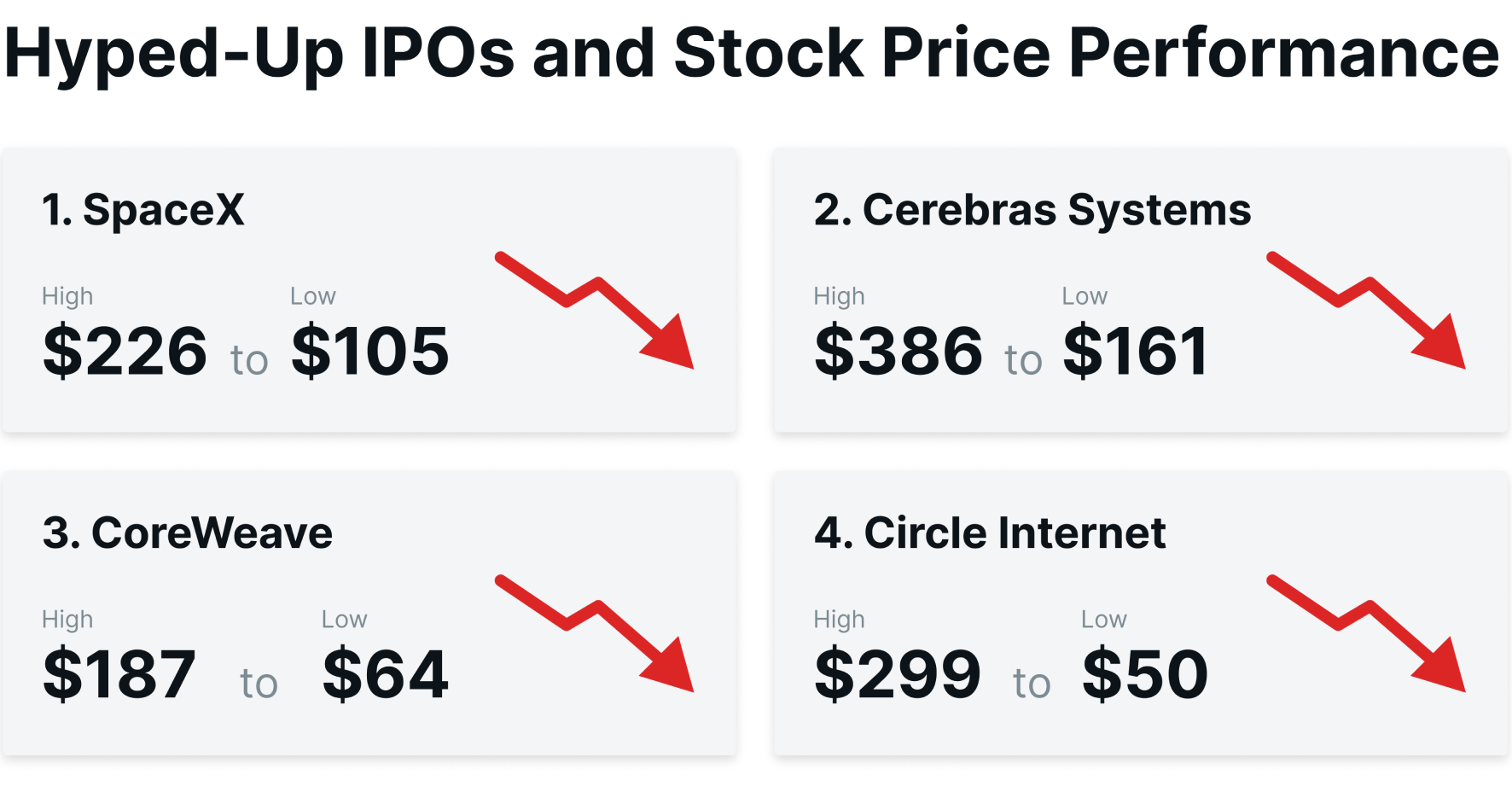
Source: LSEG, as of August 26, 2026
If history is anything to go by, Anthropic stock could potentially decline as IPO hype dies down. As investors focus more on fundamentals, they may reprice the stock to reflect realistic valuations rather than speculative enthusiasm.
The Bear Case Summarized
In summary, while Anthropic is a leader in the generative AI space, its stock is in no way a sure bet. With compute costs soaring and competition rising, there are material risks to the investment case.
If compounding these operational headwinds is an astronomical reported valuation, which leaves virtually zero margin for error. At a rumored $2 trillion price tag, investors are paying for years of flawless execution upfront.
Footnotes:
1TechCrunch, Anthropic’s annualized revenue surges to $65B, as of August 17, 2026
2Companiesmarketcap.com, Largest American companies by market capitalization, as of August 26, 2026
3LSEG, as of August 26, 2026
4Margen, GOOGLE GEMINI STATISTICS 2026: USERS, AI OVERVIEWS REACH & GROWTH, as of July 2, 2026
5Forbes, Anthropic Posts First Profitable Quarter In Frontier AI, as of August 17, 2026