Article by Violeta Todorova
Nscale IPO: What Investors Should Know About the Risks
August 31, 2026 | Research Insights
Nscale is one of the most talked-about names heading toward a US stock market listing this year. The pitch is exciting: a young British company riding the AI boom, backed by big-name investors, preparing to raise billions of dollars. But before deciding whether to invest, it's worth understanding both what Nscale actually is and the risks behind the hype.
Nscale: Building the Infrastructure Behind the AI Boom
London-based AI infrastructure company Nscale is preparing for a US initial public offering as early as September 2026, after telling prospective investors it has secured around $51 billion in total contracted revenue.1 Goldman Sachs and JPMorgan are reportedly advising on the listing, and the company is targeting a raise of up to $3 billion.1
Founded in 2024 by Josh Payne and spun out of Melbourne crypto miner Arkon Energy, Nscale is scaling towards 10GW of data centre capacity and nearly 289,000 active and contracted GPUs, including roughly 194,000 Nvidia Vera Rubin chips.2 In plain terms: Nscale builds and runs the physical data centres and computer chips that power AI companies like OpenAI. This is sometimes called a "neocloud", a newer, AI-focused alternative to giants like Amazon Web Services or Microsoft Azure.
The company's most recent funding round, a $2 billion Series C in March 2026, valued Nscale at $14.6 billion and also delivered a listing-ready board, adding former Meta COO Sheryl Sandberg, former Yahoo president Susan Decker, and former UK deputy prime minister Nick Clegg as directors.3 That is a serious lineup, and it signals real institutional confidence in the company.
The growth opportunity is compelling, but the question is whether the valuation adequately compensates investors for the risks involved. Here is what to consider.
Risk 1: The Headline Number Is Bigger Than the Actual Business
The $51 billion “contracted revenue” figure is one of the biggest numbers in the pitch of Nscale. But it can also be misleading because it does not mean Nscale has already made $51 billion.
The figure includes the value of multi-year contracts signed with customers. That money will only be recognised as revenue as Nscale delivers the services over time.2
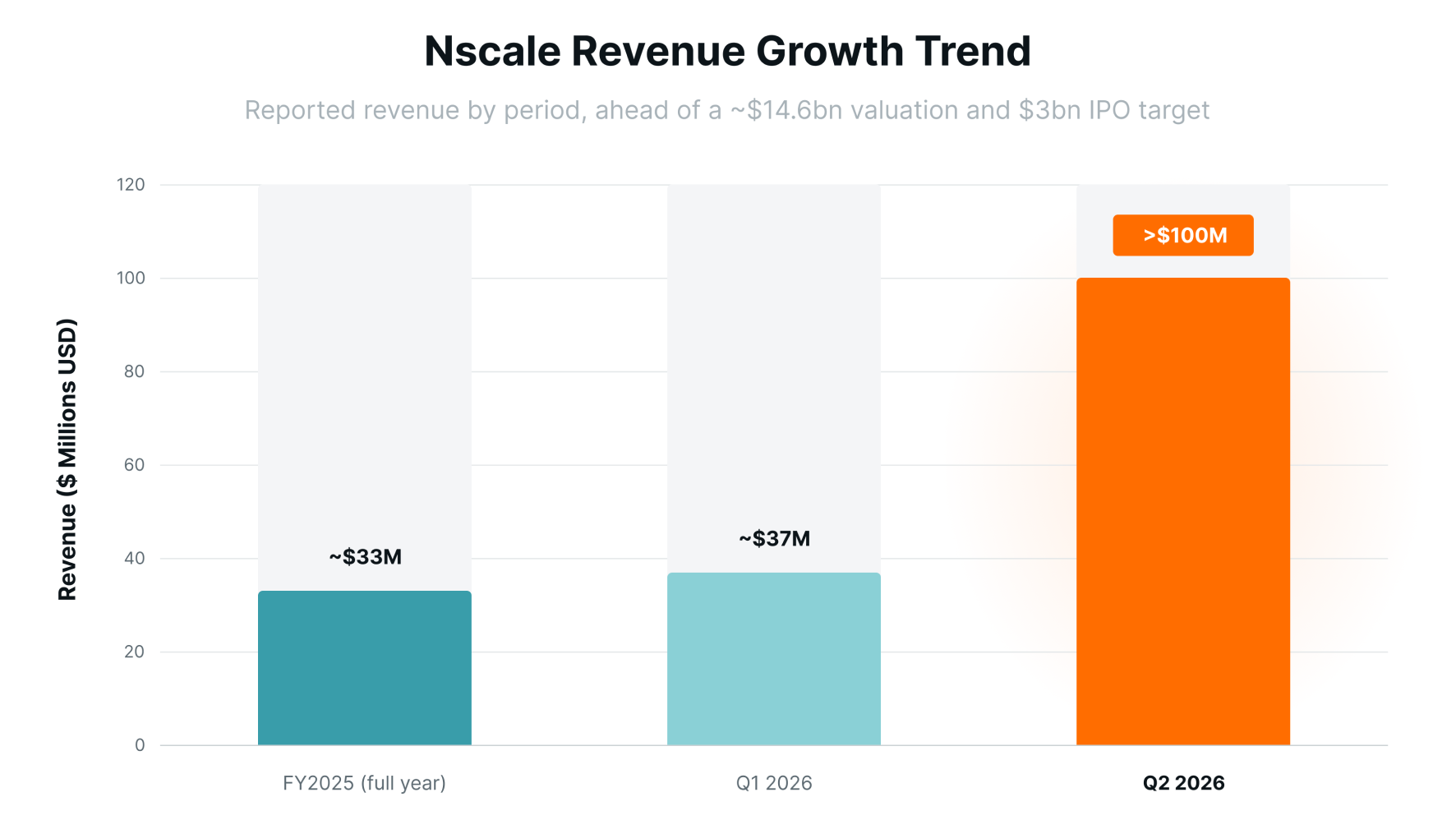
The actual reported numbers are much smaller: around $33 million in 2025, about $37 million in Q1 2026 and just over $100 million in Q2.2 That puts the current annualised revenue run rate at roughly $400 million to $500 million.
That is very strong growth from a small base, but it is a fraction of the $51 billion headline and a small number next to the $14.6 billion valuation.
Source: Dealroom News, as of August 26, 2026
Risk 2: The Business Runs on Debt
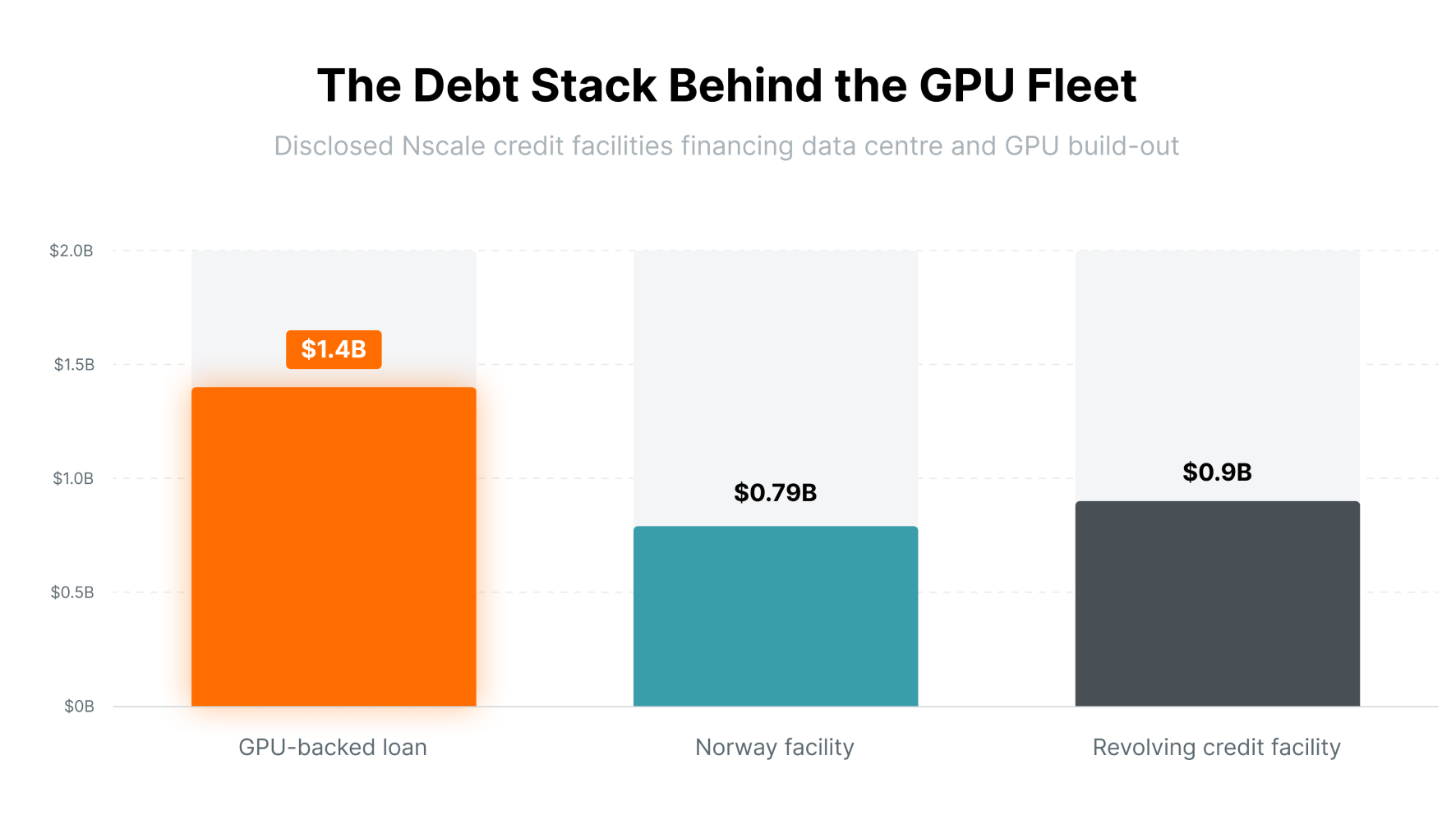
Nscale is building its data centres and buying GPUs largely with borrowed money rather than cash generated by the business. The company has taken on a $1.4 billion loan secured against its GPUs, a $790 million facility in Norway and a $900 million credit line signed in July 2026.4 That adds up to roughly $3 billion of financing against a business generating only a few hundred million dollars in annual revenue.
The concern is what happens if GPU values fall faster than expected. Much of this financing assumes the chips will remain valuable and useful for five to six years. But AI hardware is evolving quickly, with newer and more powerful chips arriving regularly. If older GPUs lose value faster than expected, the assets backing the debt could be worth less than lenders originally assumed.
That raises concerns about GPU backed AI businesses, especially if they are relying on assets that depreciate quickly to support debt.
Source: Nscale, as of August 26, 2026
Risk 3: Some of the Big Announcements Don’t Match Reality
Nscale announced in September 2025 that it had secured a site in Loughton, Essex, where it planned to deploy more than 23,000 Nvidia chips by early 2027. But when a Guardian journalist visited the site in March 2026, construction had not yet started.5 The timeline has since been pushed back, with delays to the grid connection cited as one reason.6
That is not necessarily unique to Nscale. Building large data centres is difficult and connecting them to the UK power grid can take seven to thirteen years in some areas, and is a problem affecting the whole industry.6 That is a useful reminder that press releases and ambitious announcements don't always match what is physically happening on site, and that gap is worth watching closely as the IPO approaches.
Risk 4: A Major Customer Already Put a Project on Hold
In September 2025, Nscale, OpenAI and Nvidia announced Stargate UK, a major AI infrastructure project in Britain unveiled during Donald Trump’s state visit. Seven months later, OpenAI paused the project, citing high UK energy costs and regulatory uncertainty.7
This is important because Nscale depends on customers committing to large, long term contracts. If a high profile project can be put on hold because of costs and regulations outside Nscale’s control, it shows that contracted demand is not necessarily guaranteed demand.
Risk 5: Bigger Rivals Could Undercut the Business
Nscale is not competing in a vacuum. Microsoft, Google and Amazon are spending hundreds of billions of dollars on AI infrastructure and data centres. The more computing capafcity these companies build themselves, the less they may need from specialist providers like Nscale.
The bull case is that demand for AI computing will grow so quickly that even the biggest cloud companies will need additional capacity from companies like Nscale. The bear case is that Big Tech builds capacity faster than expected, leaving Nscale with expensive GPUs and data centres that are not being used enough to generate the returns investors are expecting.
The Bottom Line for Retail Investors
None of these risks means Nscale is a bad business. Revenue is growing rapidly, Nvidia is a significant strategic partner and demand for AI computing remains strong.
The concern is the price investors are being asked to pay for that growth. A $14.6 billion valuation leaves little room for major execution problems. Nscale needs to build capacity on time, keep its GPUs productive, convert its contracts into actual revenue and maintain strong customer demand.
Before investing in the IPO, it's worth asking three questions: How much of that $51 billion backlog will realistically turn into cash? How exposed is the company if chip values fall faster than its lenders assumed? And how much of the growth depends on a small number of customers who can, and sometimes do, change their minds?
As with any IPO, it's sensible to read the official prospectus once filed, and consider position size carefully given how much of the current price already assumes things go right.
Footnotes:
1Dealroom News, Nscale eyes $3B US IPO in AI data center listing rush, as of August 21, 2026
2Dealroom News, "Nscale eyes September US IPO on $51B AI contract backlog," as of August 2026
3Wikipedia, Nscale, as of August 2026
4Fortune, Nscale has raised billions to power Europe’s AI ambitions. Now the startup must prove the hype can survive reality, as of June 3, 2026
5The Next Web, OpenAI apparently never visited the site of its flagship UK AI project, as of July 4, 2026
6Data Centre Review, "Nscale's £2bn Essex data centre hit by grid delays," as of July 14, 2026
7Sifted, "OpenAI pauses Stargate UK in blow to Nscale and government," as of April 2026