



On the 28th of January 2026, EV carmaker and Magnificent Seven constituent Tesla Inc (ticker: TSLA) released its Q4 2025 earnings release, which had a first for the company: its first FY revenue decline in year-on-year (YoY) terms.
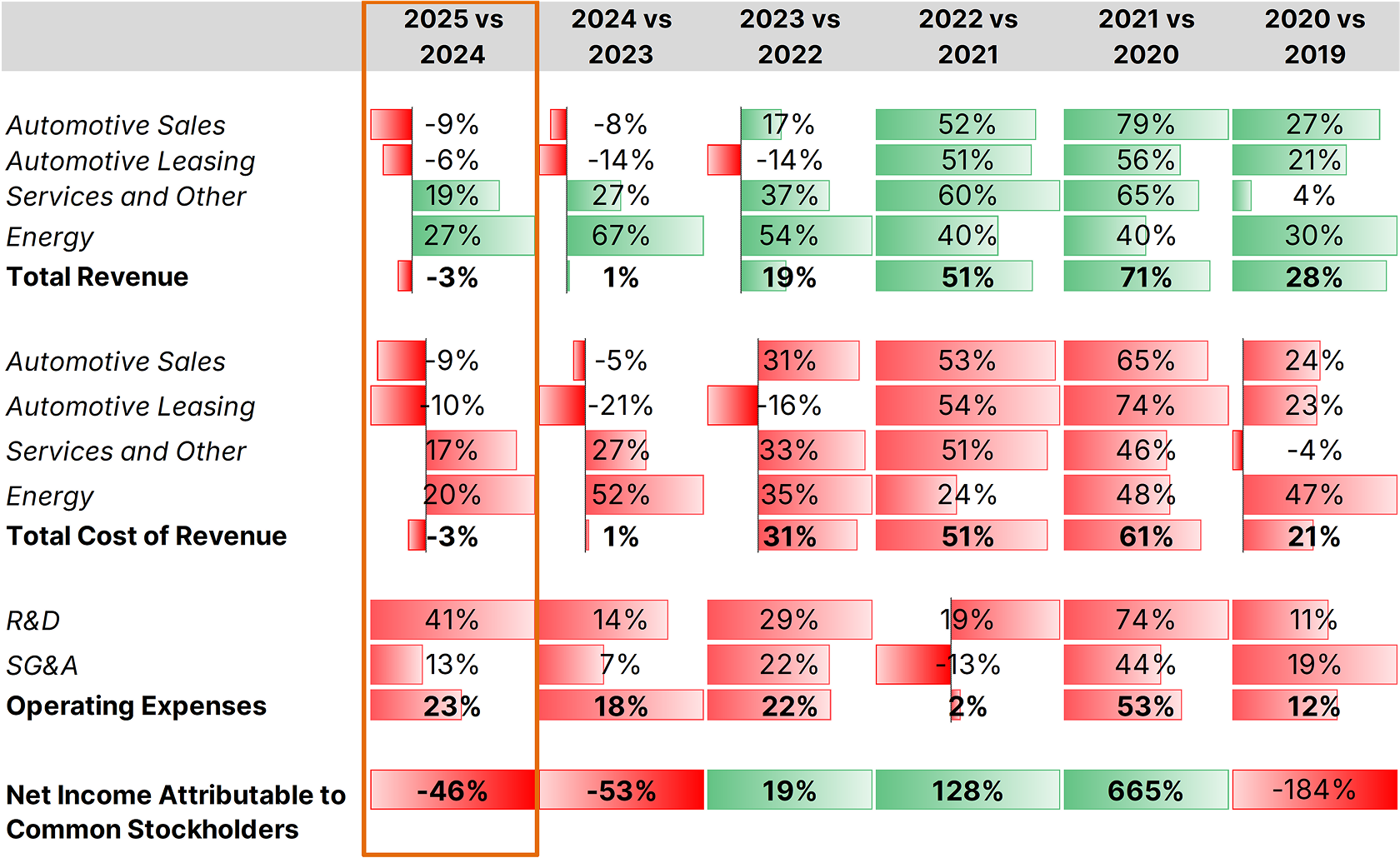
Trend Analysis2025 saw the repetition of 2024, in that revenues from sales and leasing of Tesla vehicles were registered lower than the previous year’s.
Source: Company Information; Leverage Shares analysis
Meanwhile “Services and Other” – constituting maintenance services, part sales and Supercharging network uses – continues to rise, as does Energy, which constitutes the company’s energy storage products.
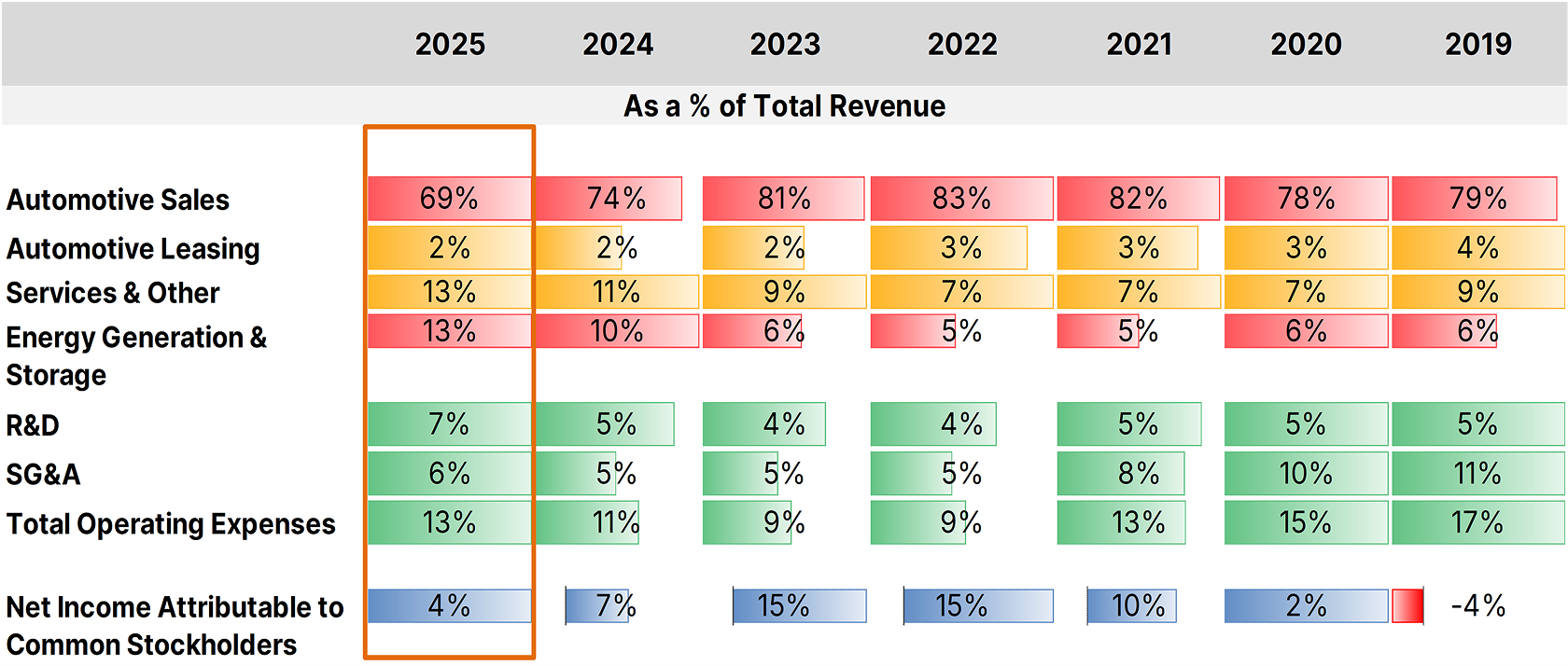
The drop in sales is met by a nearly-similar drop in cost of revenue. However, what tipped the bottom line was a substantial increase in operating expenses, which was mostly led by increasing spend on Research & Development (R&D). As a result, for the second year in a row now, net income attributable to shareholders is down by half of that from the previous year.
The company’s ongoing reliance on automotive sales remains a source of non-diversified risk: despite advances made by both “Services” and “Energy”, large swings in automotive sales remain the clearest barometer on bottom-line benefit to shareholders.
Source: Company Information; Leverage Shares analysis
Overall production and deliveries in 2025 fell by 7% and 9% respectively from the volumes achieved in 2024, which themselves were 4% and 1% lower from 2023.
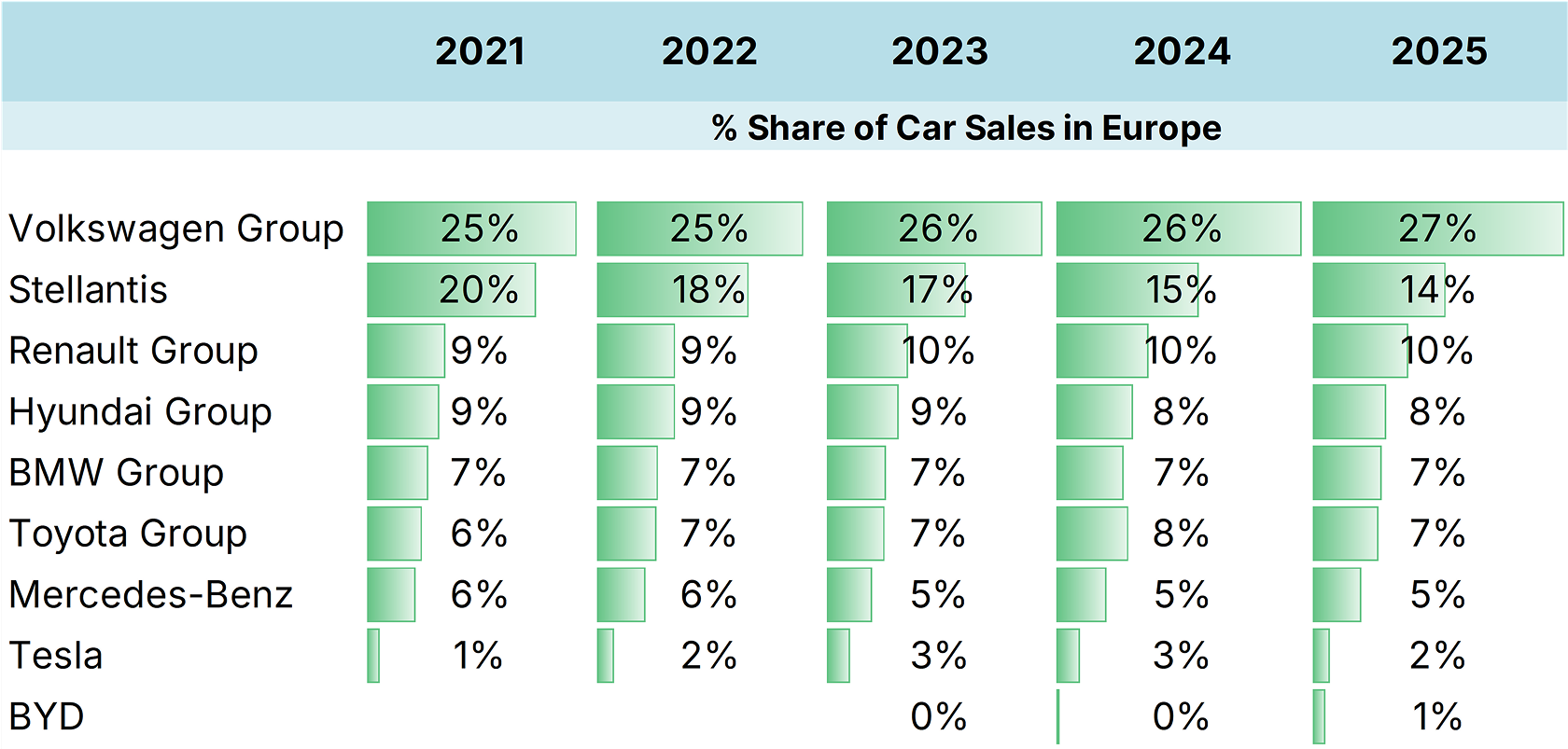
While the company states that they achieved record deliveries in the Asia-Pacific (APAC) region, Europe is likely a significant factor in the loss of sales: Chinese automaker BYD has made massive strides in penetration while Volkswagen continues to consolidate sales in the Continent.
Source: European Automobile Manufacturers' Association (ACEA); Leverage Shares analysis
Nearly 1 in 10 vehicles produced by Volkswagen globally are Battery Electric Vehicles (BEVs) and around 76% of VW’s BEV sales were in Europe, a market that continues to show resilient growth in sales.
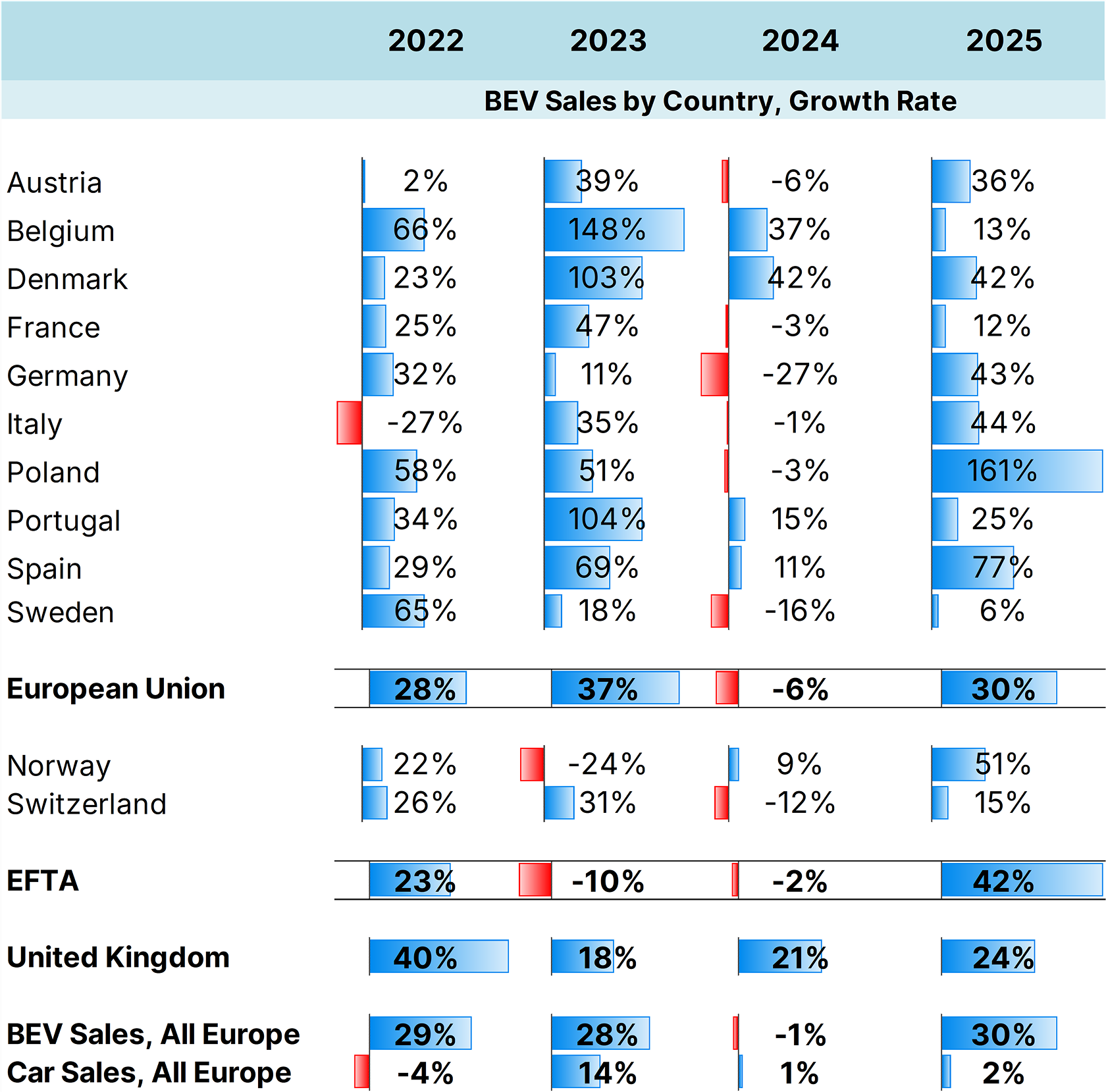
Source: European Automobile Manufacturers' Association (ACEA); Leverage Shares analysis
While petrol- and diesel-powered vehicle sales have been running nearly flat for two years, BEV sales have returned to double-digit growth percentages in 2025.
Interestingly, the company’s free cash flow – calculated as the difference in net cash from operating activities and the net cash used in investing activities – has now seen a massive surge to $6.2 billion, which essentially recoups the previous two full years of negative flows. On top of that, the company has ambitious plans for 2026.
What’s Ahead for TeslaTesla indicated that it intends to achieve new milestones in its transformation from an “EV manufacturer” to a massive "AI and Energy" company. In the first half of 2026, it plans to more than double the size of onsite computation capacity in Texas by building out Cortex 2, a massive AI computation cluster for training its Optimus humanoid robots as well as providing an end-to-end neural network for its “Cybercabs”, purpose-built, fully autonomous two-seaters designed specifically for Tesla’s "Robotaxi" service. While Tesla intends to operate the majority of these vehicles, individual owners will also be allowed to join the network. Tesla has already logged over 650,000 miles in its pilot robotaxi service in Austin, Texas.
The company also stated that it intends to start production of the Optimus, a general-purpose bipedal humanoid robot, before the end of 2026. Conceived as an augment for human manual labour, the company states that its mass production-ready “Gen 3” will be unveiled in Q1 2026. The eventual production capacity is planned to be 1 million robots per year.
Managing the robots and Cybertaxis in the future will be the AI5 and AI6 inference chips developed in-house, with production planned for 2027 and 2028 respectively and which also potentially limits its client relationship with Nvidia in the future.
Over on the battery pack front, the company stated that it has begun to produce the “4680” cells and electrodes needed to manufacture battery packs. It expects to begin production of Lithium Iron phosphate (LFP) batteries as well as the cathodes for said battery packs in U.S.-based facilities in 2026.
If the relative staleness of Tesla’s catalogue was potentially a factor in the downturn of sales over the past two years, the company assures that there might be cause for cheer: “production ramps” – meaning a move from protypes to scaling production lines for high-volume output – of Tesla Semi and Cybercab are both commencing in the first half of 2026, as is the production of the next-generation Roadster.
In ConclusionWhile the continuing fall of BEV sales is certainly a cause for concern among investors seeking a foothold in the EV boom, the lineup being announced makes the value proposition for Tesla as "just" an EV manufacturer a lot more complicated: both Semi and Cybercab are commercial products more suited for fleet operators than individual owners. On the one hand, commercial buyers are more resilient than individuals. On the other, it requires a lot more deftness in managing relations, service and more.
The stated rollout of Cybercabs under Tesla's banner, i.e. as an owner-operator of fleet services, is an interesting development. But it remains uncertain as to exactly how extensive this fleet can be; most jurisdictions in the United States (or anywhere else, for that matter) have been resistant to the risks inherent with fully-autonomous driving.
The stated plan to begin producing robots for consumption (presumably first in industrial settings) is yet another evolution that is quite far removed from its value proposition as a carmaker. Whether these robots can truly augment manual labour on a factory floor remains to be seen. So far, Tesla has only stated using these robots on their U.S. factory floor.
It might be entirely in order to stop considering Tesla as just a carmaker and think of it as an enterprise exploring complex high-tech endeavours in general. But that might mean the stock goes from being a "value" ticker to a more speculative ticker that essentially promising growth with no history to back said narrative.
In the leadup to the earnings call, professional investors with access to European exchanges and a tactical bent of mind might want to consider the 3X Tesla ETP (TSL3) during upsides of the stock’s trajectory and the -3x Short Tesla ETP (TS3S) during the downsides.
Another method of buying into Tesla's trajectory to potentially generate income is the Tesla Options ETP (TSL), which generates monthly income by buying Tesla shares, selling up to 5% ‘out-of-the-money’ (OTM) weekly put options on Tesla and paying a return on the premia collected.
 Education

