


However, there is potentially some qualified solace for long-time Tesla bulls: early trends in FY 2026 – strictly in balance sheet items – indicate that it will (at best) mirror trends in the previous two FYs, without any immediately apparent signs of worsening.
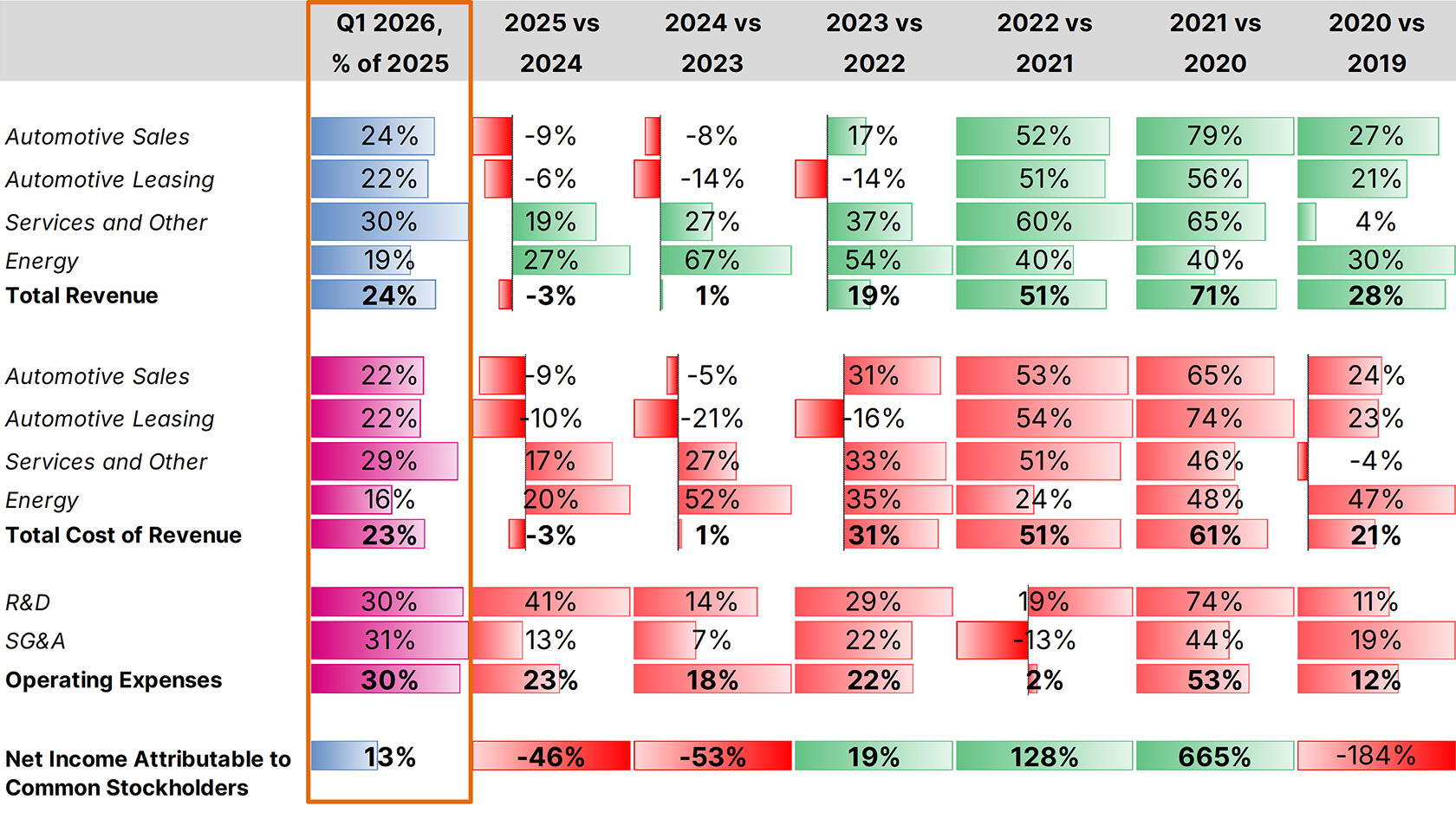
Trend AnalysisEarly trends indicate that overall revenue is poised to be weakly negative-to-flat relative to the past two FYs:
Source: Company Information; Leverage Shares analysis
While total cost of revenue is inching towards showing signs of improved efficiency – particularly in automotive sales, leasing and energy – spends on R&D takes overall operating expenses towards at least a 20% growth over the previous FY – in line with general trends since 2023. If early trends in the bottom line (i.e. earnings or net income) continue, net income shrinking will largely mirror the past two FYs with a 48% reduction relative to previous FY.
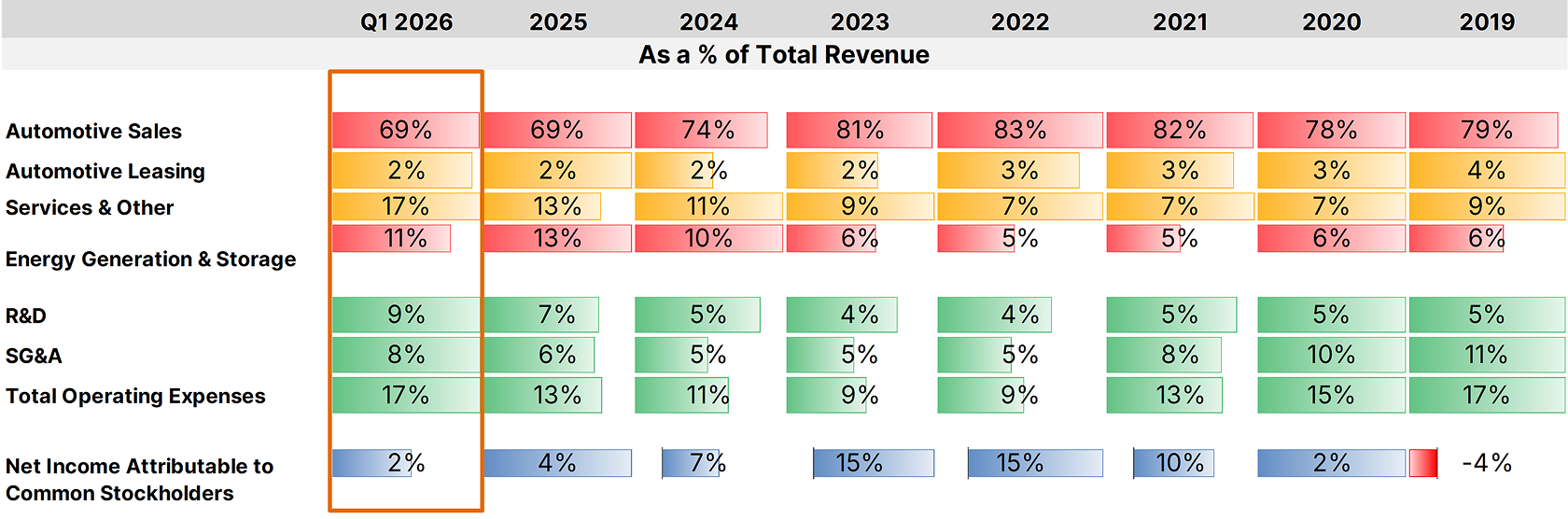
Interestingly, in terms of line item percentage share of total revenue, the company is arguably a picture of stability relative to FY 2025:
Source: Company Information; Leverage Shares analysis
Like the previous FY, automotive sales and leasing account for a little over 70% of all revenue while the likes of the Supercharging network, service operations on the massive quantities of vehicles sold over past years and so forth continues to progressively inch up in meaningfulness towards revenue contribution.
In overall production and delivery mix, little has changed since FY 2025. Model 3/Y continue to account for 97% of all vehicles produced and overall production is almost exactly a fourth of volumes produced across FY 2025. Other models, however, spiked to 5% share of deliveries in the quarter and might possibly smooth out into to the 3-5% share seen since 2021.
This "lack of worsening" did appear as a surprise relative to analysts' consensus estimates. While it ordinarily would have registered as a positive signal for the stock, the market likely digested the news in context; alongside an overall chill in new vehicle sales evident across the U.S. (Tesla's main market) and the massive premium the stock enjoys relative to other carmakers, there was little impetus to or appetite for the stock.
That is, if the company were to be considered a "carmaker" – a notion that Elon Musk has been hard at work in an attempt to dispel over the past several quarters.
New and Risky DirectionsA positive development in the quarter was a strong $1.44 billion in free cash flow. However, CFO Vaibhav Taneja cautioned that free cash flow will be negative for the rest of the year as the company spends on its ongoing endeavours that support Musk's bid to reframe the Tesla story: its ongoing work in AI, robotics, autonomous driving and – now – chip fabrication.
The earnings release highlighted that the Cortex 2 AI Training Compute cluster – needed for both autonomous driving and its humanoid robot project – is now online and has started training workloads. The first-generation production line for its Optimus humanoid robots – with a designed capacity of 1 million robots a year, will be replacing the Model S and Model X lines in Fremont and scheduled to begin in Q2 2026. The second-generation line under development in Gigafactory Texas is designed for long-term annual production capacity of 10 million robots.
In April, the company completed the final chip design of its next-generation AI5 inference processor and, in partnership with SpaceX (also led by Musk), is preparing to build the world's largest chip fabrication facility – one that will take the vigorous vertical integration paradigm Tesla has taken in vehicle manufacturing into the chip space by integrating logic, memory and packaging.
In the vehicle space, the company also announced that work continues in its new battery and material factories – which spans from LFP cells in Nevada to cathode material and lithium refining in Texas. However, the company also states candidly that battery pack capacity continues to be a limitation on vehicle production ramp-ups.
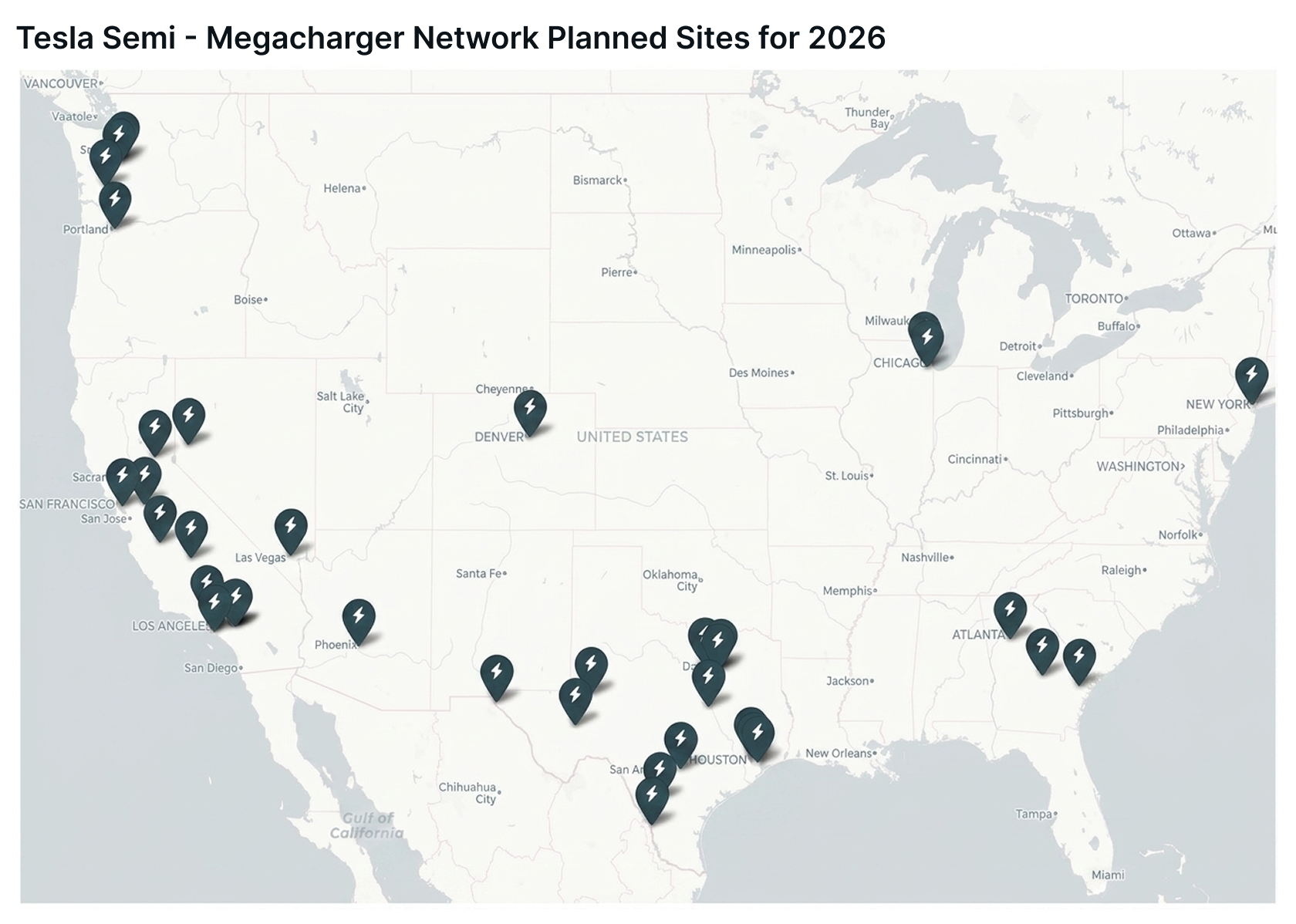
In line with the upcoming launch of the Tesla Semi – the all-electric Class 8 semi-trailer truck designed for freight transport – the company also announced that will be deploying public Megachargers: ultra-fast, high-power charging stations specifically designed for the Tesla Semi.
In the Q4 2025 report, the company has indicated a prospective map for Megacharger locations in 2026:
Source: Tesla Q4 2025 quarterly update. Image redesign by Leverage Shares
California and Texas are projected to have the highest density of these facilities as of now.
In ConclusionThe overall picture is decidedly a mixed bag. The large-scale commitment to manufacturing humanoid robots designed to supplant or augment human workforces is a bold and risky bet, especially when the question remains if the combined cost of AI compute and the robot fleet truly provide a cost differentiator against human labour.
Also in question – and in roughly similar terms – is the repeated commitment to building a fully autonomous Cybercab arm. While operating a "robotic Uber" is attractive on paper, regulatory approvals for large-scale deployment are still far away and a sizeable roadblock to surmount.
On the other hand, owning and operating a chip fabrication facility alongside a design lab is a definite long-term positive that opens up multiple addressable markets regardless of whether AI for robots or autonomous driving works out or not.
Another positive in a similar vein is the buildout of battery manufacturing for both vehicles and energy grid solutions. Electric Vehicles (EVs) are here to say and owning strong capabilities opens up interesting avenues in monetization in the future.
While the production of the Semi has been long-awaited, the relative paucity of charging infrastructure across the length and breadth of the land is poised to limit adoption in much the same way it did for passenger vehicles. While corporate fleet solutions are a tidy supplier demand, there is still a cap in competing or supplanting the diesel-powered armadas of trucks rolling through the world's highways. A long ramp can be expected before the Semi becomes an attractive proposition worthy of consideration for investors.
However, in present-day terms, the fact remains that early trends in production volume stability indicate that the company is at an impasse in passenger EVs while other brands are registering some growth despite an outlook indicating a potential chilling effect looming on vehicle sales in the U.S.
All in all, it's a company promising potential like it did during the 2010s while the market expects a steady translation of market share into value and the company sinks cash into new, bold, and potentially risky endeavours.
Professional investors might consider the 3X Tesla ETP (TSL3) during upsides of the stock’s trajectory and the -3x Short Tesla ETP (TS3S) during the downsides.
Also available is the Tesla Options ETP (TSL), which aims to generate monthly income by buying Tesla shares, selling up to 5% ‘out-of-the-money’ (OTM) weekly put options on Tesla and paying a return on the premia collected.
 Education

