


A 3x ETP aims to deliver three times the daily move of its underlying asset. Yet its return over a full year can appear far above or far below three times the benchmark return. This article shows how, across different market years, compounding and volatility decay pull a full-year return above or below the simple 3x figure, and what that means for how you hold the position.
What is compounding?
Compounding means returns building on returns. A 3x ETP delivers 3x the daily move of its benchmark, and it resets every day. The daily reset means returns compound over time. Each day, the leverage applies to a new base value, not the original starting point. Therefore, over a year, each day's return stacks on the last, so the final result depends on the path the market took, not only on where it finished.
The core idea. Over one day, a 3x ETP gives 3x the move. Over a year, it gives 3x each day's move, compounded. That helps in a steady trend and works against you through a round trip.
How one year of leverage plays out across market conditions
To see how this plays out in practice, the four charts below use Nasdaq-100 daily data from 2025, 2024, 2023 and 2022, with the 3x ETP modelled as three times each day's index move, reset daily and compounded. The four years cover the main cases: a sharp drop that recovered (2025), a steady climb (2024), a strong trend (2023) and a falling market (2022).

Source: Yahoo Finance. The 3x ETP is modelled as three times each day’s index move, reset daily and compounded; it excludes management fees, borrowing and financing costs, and tracking error.
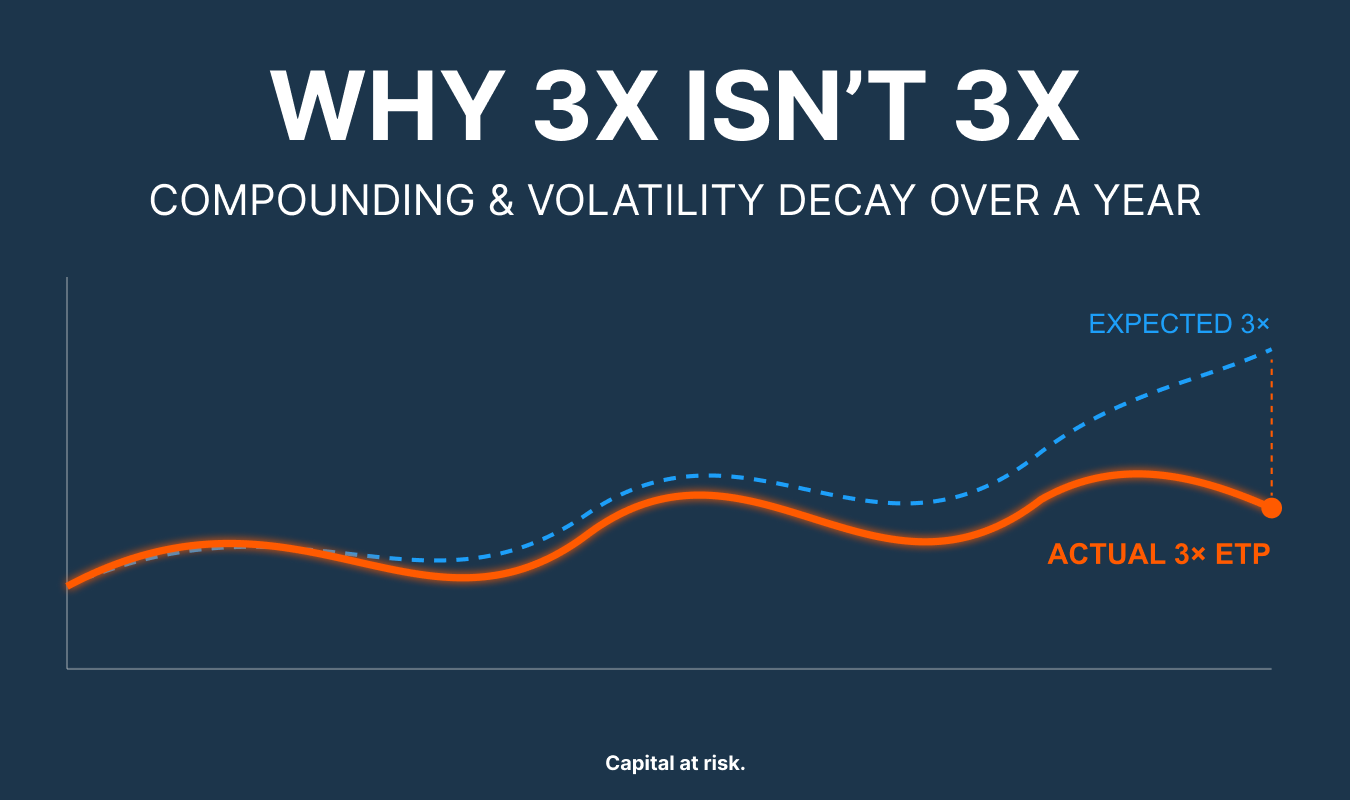
The outcome depends on whether the market trends or reverses. In a steady trend, each daily reset builds on a bigger base, so gains grow faster than 3x: the index rose 55% in 2023, but the ETP returned about 237%, well past the 165% a simple triple suggests. A reversal does the opposite, building on a smaller base after each loss. That is why 2025 stands out: the index fell sharply before ending the year up about 20%, yet the ETP finished up only about 49%. The same effect hit hard in 2022, where the ETP fell about 79% against the index's 34% drop.
Annual return: 3x ETP vs. three times the index

The pattern is consistent. A clean uptrend pushes a 3x ETP past three times the index, because gains compound on a rising base. A volatile round trip leaves it short even when the index finishes higher, because each reversal resets exposure lower. And a falling market is where leverage hurts most. In 2022 the ETP lost about 79% against the index's 34% drop. A simple triple would imply −101%, but losses cannot exceed 100%, so the gap reflects arithmetic. In a choppy decline, volatility drag can still take the ETP down more than three times the index. What decides the outcome is not the direction of the market but the path it takes to get there.
What is volatility decay?
Volatility decay, also called volatility drag or beta slippage, is the structural cost of the daily reset. Because exposure is rebalanced each day, an up move and an equal down move do not offset: the gain applies to a larger base and the loss to a smaller one, so the pair closes below where it started. Across a choppy period this asymmetry accumulates, and the ETP can trail three times the index even when the index itself ends flat. Compounding and decay are therefore the same mechanism, working for the holder in a trend and against them in a range.
The core idea. Compounding rewards directional moves and penalises reversals. The effect scales with both volatility and holding period: the choppier the path and the longer the position is held, the more volatility decay erodes a 3x ETP's return.
A common question is how the index can end roughly flat while a leveraged position is down. The mechanism is the repeated round trip. Consider an index that alternates between a 10% gain and a 10% loss each day: it drifts down only slightly over time, while the 3x ETP declines far faster as each reversal compounds against it. Volatility itself causes the shortfall.

What drives volatility decay?
On a flat benchmark, the drag is captured by a simple approximation:
Drag ≈ −½ · L · (L−1) · σ² · T
where L is the leverage factor (3 for a 3x ETP), σ the volatility of the underlying and T the holding period. Drag scales with the square of volatility, so doubling volatility roughly quadruples it, and grows linearly with time. The L(L − 1) term amplifies both: for a 3x ETP it equals 6.
Over a single day the drag is essentially zero, the horizon these products are designed for. Extend the holding period into months of turbulent markets and the accumulated drag can exceed the value the leverage adds. This is why 3x ETPs are built for short-term positioning rather than buy-and-hold: the longer and choppier the path, the more the daily reset works against you.
Key takeaways
- A 3x ETP targets three times the daily move of its underlying asset.
- Daily leverage resets mean returns compound over time and can diverge sharply from simple 3x expectation.
- The path the index takes matters as much as where it ends up. A trend can push the ETP past 3x, while a round trip or choppy stretch can leave it well short, even when the index finishes higher.
- Because the position resets and drifts daily, these products are designed for short-term trading and active monitoring, not long-term holding.
 Education
 Market Insights

