


Like the previous quarter, Elon Musk-led Tesla, Inc's (ticker: TSLA) release of its first quarter (Q2) earnings for its Fiscal Year (FY) 2026 after market close on the 22nd of July didn't seem to have inspired a lot of confidence in the stock, which dropped in after-hours trading. In early trends on the 23rd, the stock has substantial bearish momentum developing during the pre-trading session. On the 23rd, the “Magnificent Seven” stocks collectively lost over $797 million1 in a single day as the market dropped.
While the selloff affected practically every tech and tech-adjacent stock, the biggest drop among the arguably overvalued (and thus potentially volatile) “Magnificent Seven” constituent was Tesla with a 14.7% loss – nearly double that of the next worst performer, i.e. Google (-7.13%). The reason behind this is potentially tied to a sea change within Tesla: it aims to not be just a carmaker anymore.
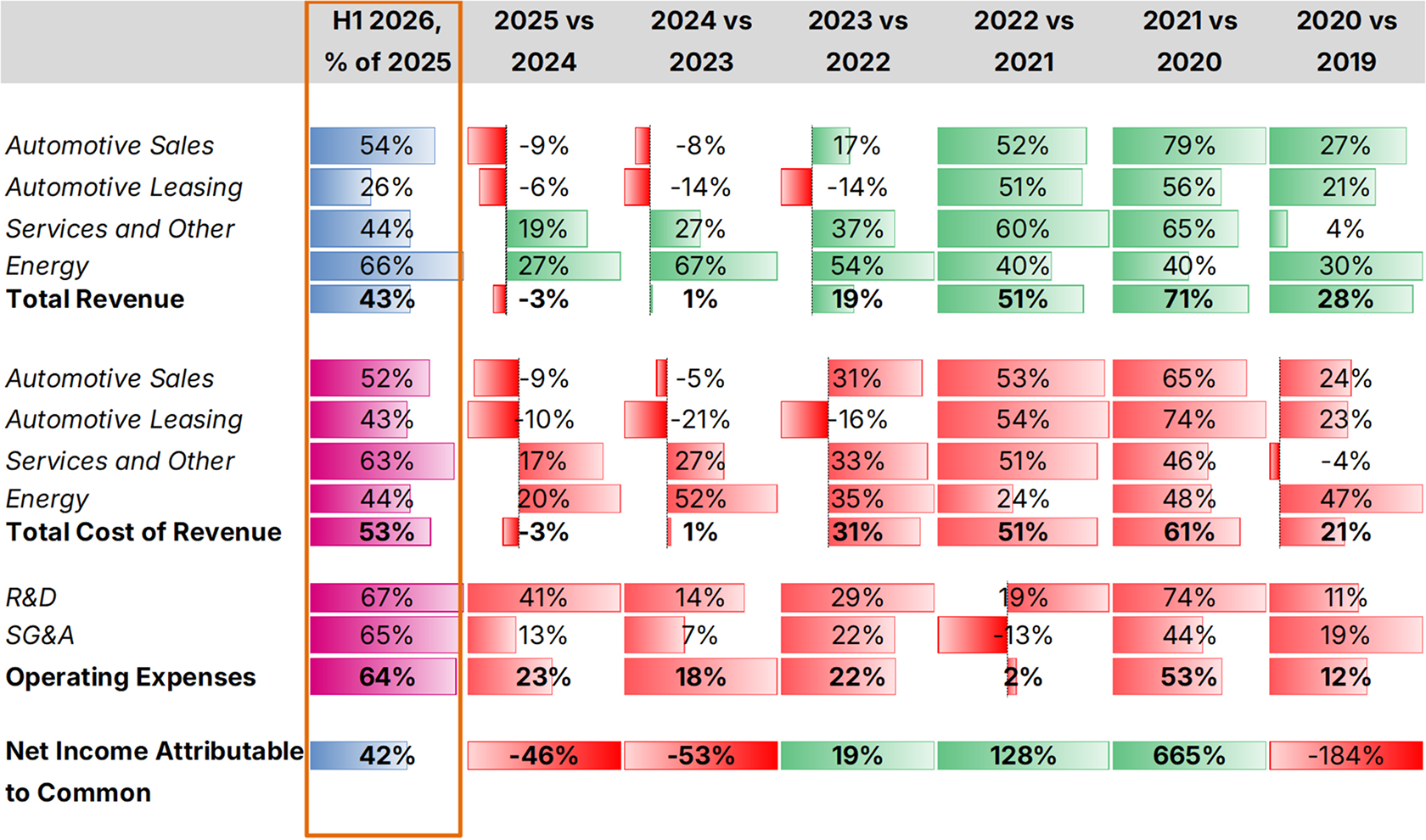
Trend AnalysisAs of the first half (H1) of Fiscal Year (FY) 2026, trends indicate that net revenue is poised to be much lower relative to the past two FYs:
Source: Company Information; Leverage Shares analysis
While total cost of revenue is poised to be 6% higher than the past year’s, revenue is trending to be 14% lower. Meanwhile operating expenses are trending to be 28% higher and net income is set to be 16% lower.
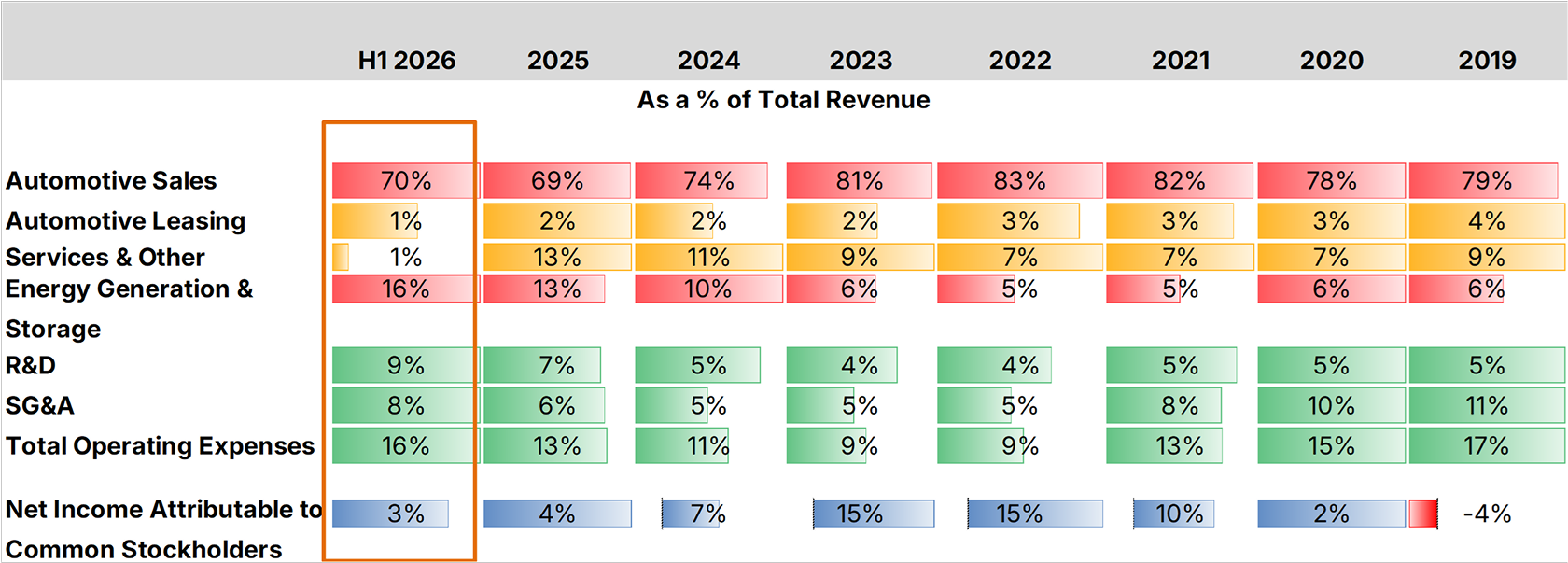
When considering line item percentage share of total revenue, the company exhibits the lowest level of passthrough into net income attributable to common stockholders since 2020.
Source: Company Information; Leverage Shares analysis
In H1 2026, revenue via automotive sales spiked towards a trend that indicate it will close the year 8% higher than the previous FY’s, which breaks the pattern of downtrends over the past two FYs. While Tesla’s Q2 deliveries of 480,126 vehicles represent a 25% year-over-year jump, this was achieved via steep price cuts and consumer incentives that dragged automotive gross margins (excluding regulatory credits) down to 16.3%. Meanwhile, Federal tax policy shifts have now reduced the fuel-economy demands that used to be a point in favour of buying EVs over ICE-powered vehicles.
While Energy Generation and Storage shows the strongest growth via-a-vis the best downtrend in cost of revenue, it only accounts for 16% of total revenue. Energy Generation has been a consistent growth segment that has typically been dwarfed by revenue generated by car sales. The fact that it has been breaking through and growing in stature since 2024 is a significant indicator.
Across H1 2026, Model 3/Y deliveries accounted for 97.4% of all vehicles produced and 96.6% of all deliveries. The slight downtick in production/delivery share in Q2 2026 indicates that the incentive scheme was largely more effective in moving a slightly greater volume of the premium end of the catalogue.
So, the overall picture is very mixed: net revenue is trending downwards while the dominant revenue segment – car sales – were achieved by incentive schemes (i.e. lower margins). Meanwhile, the energy segment’s sustained rise in what is fundamentally a carmaker remained a reliable cautionary signal.
On top of this, CEO Elon Musk stated that the company is entering into what he called the company’s “largest investment period” which arguably has little to do with cars.
From Carmaker to AI ConglomerateIn Q2 2026, capital expenditure (capex) more than doubled year-over-year to $5.79 billion, with full-year 2026 capex guidance now locked in to exceed $25 billion. Tesla is aggressively building out its Cortex 2 supercomputer cluster, expanding its Terafab chip-research joint venture with SpaceX, and ramping up Robotaxi/Optimus production lines. Operating expenses climbed 47% to $4.35 billion, which were also burdened by stock-based compensation from the CEO pay package Musk had negotiated earlier.
The positive free cash flow of $1.44 billion shown in Q1 2026 has now flipped into negative territory at -$1.1 billion, in line with CFO Vaibhav Taneja’s warning in the previous quarter. CFO Taneja also stated that Tesla has now secured debt facilities that will allow it to borrow up to $30 billion to bridge the next two to three years of infrastructure builds.
The consequence of this level of borrowing, made possible by the massive ratio premium that company enjoyed over other carmakers to this day, is that loan repayments will resonate and dilute earnings for years to come.
The end result: Tesla will progressively be less of a carmaker and more of an AI conglomerate with a car division.
In ConclusionNearly every single endeavour is fraught with risk. The Robotaxi project depends on authorizations being granted for large-scale deployment, which no region in the U.S. or China (Tesla’s next biggest market) has granted. Similarly, the question of whether AI-driven robots will bring manufacturing at scale and pared costs to compete globally is also a massive question mark.
What can be reliably said is that the battery manufacturing and chip fabrication machinery the company would need to (and has begun to) acquire is arguably an interesting and durable asset. Whether Tesla can dent a market dominated by established foundries and designers is a question mark. Whether it can manufacture chips or batteries as cost-effectively as global leaders do is a bigger question mark.
The transition to AI is arriving at the market at what is likely a turning point in the markets wherein the AI-driven euphoria that had fuelled record highs in past quarters has clearly waned. This quarter, the market is demanding immediate financial justification for massive artificial intelligence capital expenditures. While Tesla's earnings fell short of estimates, what actually caused the stock into an outsized bleed in the midst of the market rout was the announced pivot into AI field with heavy spending as opposed to buttressing its position as a premium carmaker for all – the USP that had yielded its high ratio premiums.
The market's reaction to this within the drop on the 23rd is striking and is an emphatic underline. Investors are exhibiting the classic AI scepticism that have tinged most other stocks (such as ASML and TSMC) this season so far regarding the company’s high-capex structural pivot where the AI payoff is pushed out multiple years into the future while its core business' margins are squeezed. Tesla's stock valuation is likely to seek pillars to support numerous rounds of discounting over the course of the present quarter at least.
Professional investors might consider the 3X Tesla ETP (TSL3) during upsides of the stock’s trajectory and the -3x Short Tesla ETP (TS3S) during the downsides.
Also available is the Tesla Options ETP (TSL), which aims to generate monthly income by buying Tesla shares, selling up to 5% ‘out-of-the-money’ (OTM) weekly put options on Tesla and paying a return on the premia collected.
Footnotes:
"'Magnificent 7' stocks erase $797 billion in market value in worst day since April 2025", Yahoo! Finance, 24 July 2026
 Education

