Article by Edward Sheldon
Nvidia to $268? Here are Analysts’ Forecasts After GTC 2026
March 18, 2026 | Research Insights
In mid-March, Nvidia held its GTC conference. This event – which in the past has been called the “Super Bowl of AI” – provided some major insights into the chip company’s roadmap for the future and its long-term growth potential.
Here, we are going to cover some highlights from CEO Jensen Huang’s GTC keynote1. We’ll also take a look at Wall Street’s price targets for Nvidia stock after the event.
The Rubin Platform: A Powerful New AI Supercomputer
Jensen Huang’s GTC presentation was defined by several major hardware and software reveals. On the hardware front, its new Vera Rubin platform was a key area of focus. This platform – which is now in full production and will be available to customers in the second half of the year – features seven different Nvidia chips operating together as one AI supercomputer. It’s designed to power every phase of AI – from pretraining, post-training, and test-time scaling to real-time agentic inference.
A major advantage of this platform is its computing efficiency. According to the company, it offers up to 10x more inference throughput per watt and one-tenth the cost per token compared to current generation Blackwell systems. Relative to Blackwell, Huang called it a “generational leap." His view is that it will kick off the “greatest infrastructure buildout in history."

In terms of demand, Huang said that he expects $1 trillion in cumulative revenue through 2027 between Rubin and current generation Blackwell chips. Note that in late 2025, the company said that it was expecting $500 billion in revenue between the two chip technologies.
Groq 3 LPUs: Solving the Inference Speed Challenge
In his keynote, Huang also introduced the Groq 3 Language Processing Unit (LPU). Part of the Rubin platform, this is an ultra-high-speed inference chip designed to meet the low-latency and large-context demands of agentic systems. This product should fill a critical performance gap in the "inference economy" by addressing the memory bandwidth bottleneck that prevents GPUs from reaching extreme speeds for real-time AI. Alongside this product, the company is launching the Groq 3 LPX platform, a server rack powered by 128 individual Groq 3 LPUs.
NemoClaw: An Agentic AI Solution for the Enterprise
To solve challenges in relation to the large-scale deployment of AI agents, Nvidia has launched the NemoClaw software platform for OpenClaw. This is designed to provide privacy and security controls for companies using OpenClaw and make AI agents more secure. With this tool, enterprises can operate AI agents in a sandbox, preventing them from accessing files or network locations that are off limits, and mitigating the risk of an autonomous agent going rogue or accidentally deleting sensitive data. Note that Huang compared OpenClaw to Windows or Linux, predicting that every company will soon need an "agentic strategy" and that software-as-a-service (SaaS) will evolve into agent-as-a-service (AaaS).
New Autonomous Driving Partnerships
In the automotive space, Huang announced four new partners for Nvidia’s DRIVE Hyperion platform – Nissan, BYD, Geely, and Hyundai. These companies – which together build 18 million cars per year – are developing level 4 autonomous vehicles on its robotaxi-ready platform.
Huang also provided more details on the company’s previously announced partnership with Uber, announcing that the ride-hail company will launch a fleet powered by Nvidia’s DRIVE AV software across 28 cities in four continents by 2028, starting with Los Angeles and San Francisco next year.

Latest Price Forecasts for Nvidia Stock
After Huang’s GTC keynote, a large number of Wall Street firms reiterated their buy ratings and price targets2 for Nvidia stock. These price targets are shown in the table below.
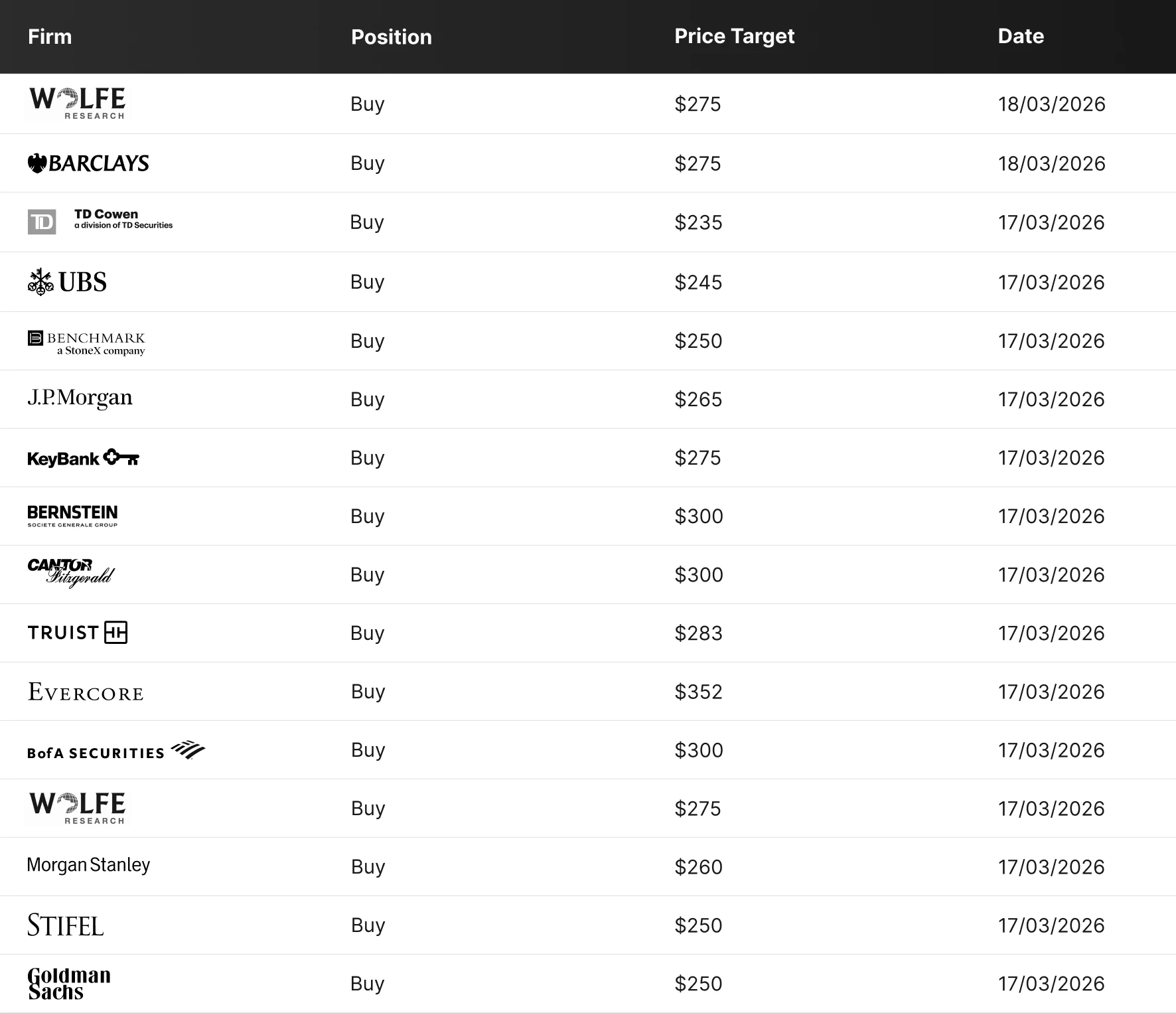
The average price target for Nvidia is currently $268. That is almost 50% above the current share price.
Footnotes:
Disclaimer: The author has positions in Nvidia
1NVIDIA YouTube Channel, NVIDIA GTC Keynote 2026, as of March 17, 2026
2Investing.com, NVIDIA Corporation (NVDA), as of March 18, 2026