Nvidia's Q4 Financial Results and Outlook Exceed Expectations
Once again, Nvidia's earnings produced the kind of figures that impact international markets. In order to further solidify its position at the forefront of the artificial intelligence revolution, the AI chip giant released fiscal fourth-quarter results that exceeded Wall Street's expectations for both revenue and profit. It also provided better-than-expected guidance for the next quarter.
Nvidia reported $68.1 billion in revenue for Q4, up 20% sequentially and 73% year over year. At $1.62, earnings per share easily exceeded analyst estimates of $1.53. Nvidia's growth trajectory has been remarkable, as evidenced by the company's $39.3 billion in revenue and $0.89 in EPS a year ago1.
Despite the solid result, the shares dropped more than 10% after the earnings release, as has become customary with Nvidia's earnings over the past two quarters.
Nvidia Q1 Outlook Raises the Bar
The real headline wasn’t just the Q4 beat. It was the forward guidance.
Nvidia projected first-quarter revenue of $78 billion (±2%), well above Wall Street estimates of roughly $72-73 billion1. Importantly, that forecast does not include any Data Centre compute revenue from China, effectively boxing geopolitical uncertainty into a disclosed assumption and leaving potential upside unmodeled.
In a market conditioned to expect big numbers, Nvidia didn’t just clear the bar, it raised it again.
Data Centre Revenue Drives AI Surge
As expected, Nvidia’s Data Centre business remained the growth engine. Revenue from the segment reached $62.3 billion, beating analyst projections and climbing 75% year over year1.
Hyperscalers, including companies like Amazon, Microsoft, Alphabet, and Meta accounted for slightly over 50% of Data Centre revenue. However, Nvidia noted that growth was increasingly diversified across enterprise and other customers, suggesting the AI buildout is broadening beyond a handful of tech giants.
Breaking it down further, compute revenue grew 58% year over year, while networking revenue surged 263% to nearly $11 billion. Nvidia is no longer just selling chips, it is shipping full AI systems, networking infrastructure, and tightly integrated platforms.
The scale is beginning to resemble industrial logistics rather than a typical semiconductor cycle.
Margins Signal Pricing Power
Gross margins remain an important point for investors. Nvidia reported GAAP gross margin of 75% for the quarter, a level that continues to show strong pricing power despite a massive hardware transition to its Blackwell architecture1.
Full-year margins dipped compared to fiscal 2025 as the company scaled production and absorbed transition costs, but the quarterly stability reassured investors that profitability remains intact even as volumes explode.
In another important move, Nvidia announced it will begin including stock-based compensation in its non-GAAP results starting fiscal 2027. Tightening its own reporting metrics while guiding higher revenue shows that management is confident in the durability of growth.
AI Capex and the 2026 Buildout
The debate around AI spending is far from settled. Some investors question whether the current pace of capital expenditure can be sustained. Others argue that the AI infrastructure cycle is still in its early stages.
Major hyperscalers are expected to invest hundreds of billions of dollars in AI infrastructure in 2026 alone, with a substantial share of that spending flowing directly into Nvidia’s ecosystem, from advanced GPUs to networking and full-stack systems.
The key question for markets is: Are we still early in the AI buildout, or closer to the midpoint of the cycle? If it is still early, Nvidia’s growth runway could extend for several more years. If the cycle is more mature, expansion may gradually moderate.
For now, the latest earnings suggest momentum is accelerating rather than fading.
Gaming and CPUs
Outside its core Data Centre segment, Nvidia’s gaming revenue came in at $3.7 billion, slightly below estimates1. However, reports indicate the company may soon launch its own laptop CPU, potentially competing more directly with Intel, Advanced Micro Devices, and Qualcomm2.
While PC chips would not match Data Centre profitability, such a move would further cement Nvidia’s ecosystem dominance from AI supercomputing clusters to consumer gaming laptops.
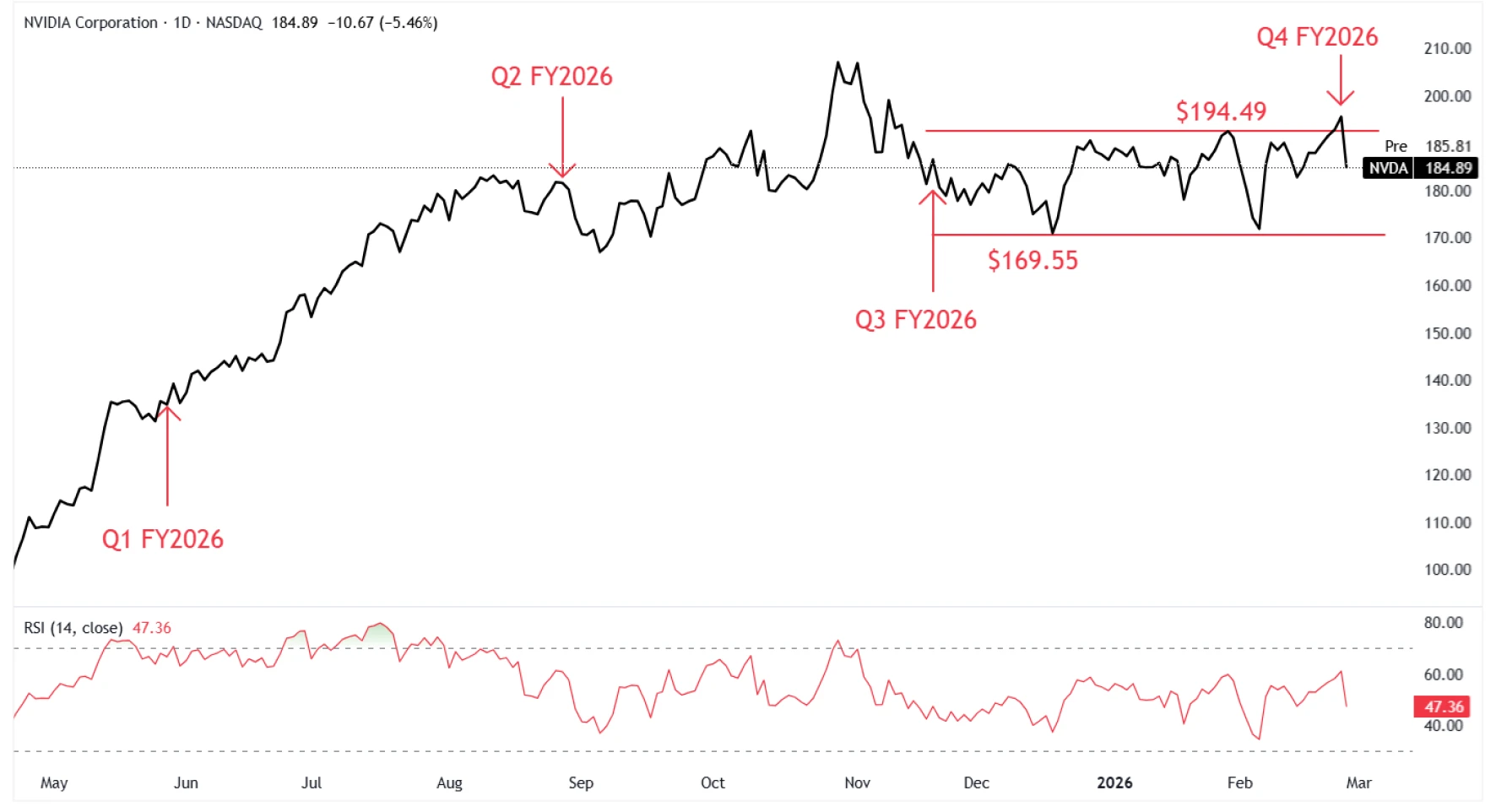
Source: TradingView. Nvidia daily price chart, as of February 26, 2026
Nvidia Stock Performance and Market Sentiment
Despite blockbuster earnings, Nvidia stock has gained only modestly year-to-date compared to its explosive performance over the past two years. Thursday’s price action plunged more than 10% but the stock still remains within its three month range between $169.55 and $194.49. A subsequent break will determine the direction of the next short-term move. Despite the initial negative market reaction, we see levels towards $245.00 as achievable over the long-term.
Nvidia earnings have effectively become macro events, rivalling jobs reports and inflation data in their market-moving impact. With a market capitalization above $4 trillion, even small percentage moves carry massive implications for indices and global equity flows.
What Nvidia Earnings Say About the AI Boom
The central question surrounding this earnings season has been whether AI spending is producing tangible economic returns.
Nvidia’s results suggests that demand for AI infrastructure remains robust. Inventory levels and supply commitments show the company is preparing for sustained demand beyond the next several quarters.
CEO Jensen Huang described the moment as an “agentic AI inflection point,” positioning Nvidia not just as a beneficiary of AI growth, but as the infrastructure backbone powering it.
Nvidia beat on revenue. It beat on earnings. It guided higher. It maintained margins. And it excluded China from its forward numbers, leaving room for potential upside. The only question left for investors is the one that follows every strong quarter: Can Nvidia do it again and even faster?
Key Takeaways
Nvidia beat expectations with Q4 revenue surging 73% year over year to $68.1 billion.
The company guided Q1 revenue to $78 billion, well above Wall Street forecasts.
Strong Data Centre growth and 75% margins confirm AI demand remains robust.
Footnotes:
1NVIDIA Newsroom, NVIDIA Announces Financial Results for Fourth Quarter and Fiscal 2026, as of February 25, 2026
2CNET, Nvidia Set to Launch Laptop Chip in the First Half of This Year, as of February 23, 2026