


Capitale a rischio. Potreste perdere tutto il vostro investimento. Consultate l'avvertenza completa sui rischi qui.

Key takeaways
Gold prices stabilize after a sharp correction.
Interest rates remain the main short-term obstacle.
Central-bank demand supports the longer-term outlook.
Gold at a Crossroads as Rate Pressures Mount
After surging to record highs above $5,500 an ounce in January 2026, the precious metal has experienced a sharp correction as rising U.S. Treasury yields, a stronger dollar and expectations of further Federal Reserve tightening have challenged its safe-haven appeal.¹
Yet the latest pullback has not erased the forces that supported the extraordinary rally of gold. Geopolitical tensions, concerns over government debt and continued central-bank purchases remain important pillars of demand. But these structural drivers have not overcome yet the immediate pressure from higher interest rates.
While the latest recovery is encouraging, it does not yet confirm that the correction has ended. Gold remains caught between two competing forces: demand for protection against financial and geopolitical uncertainty, and the opportunity cost of holding an asset that pays no interest. The next sustained move is likely to depend on which force dominates.
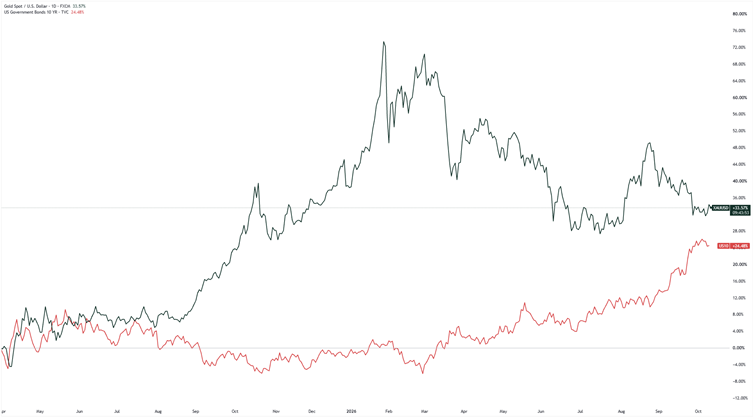
Source: TradingView. Daily chart of gold vs. US 10-Y Treasury yields, as of October 12, 2026.
Rising Treasury Yields Put Gold Under Pressure
Interest rates remain one of the most important short-term drivers of the gold price. Unlike government bonds or cash deposits, gold generates no regular income. When Treasury yields rise, investors can earn more from interest-bearing assets, making bullion comparatively less attractive.
The U.S. dollar adds another layer of pressure. Because gold is priced internationally in dollars, a stronger greenback makes the metal more expensive for buyers using other currencies and can weigh on demand. This relationship was evident during the recent sell-off, when a stronger dollar and rising Treasury yields pushed spot gold to approximately $4,108 on 7 October.²
Therefore, the next moves from the Federal Reserve will be very important. On 9 October, futures markets indicated a 19% probability of an October rate increase and an 84% probability of at least one 25-basis-point increase by December, according to CME FedWatch figures.¹ These expectations leave gold vulnerable if inflation proves persistent and policymakers signal that monetary conditions must remain restrictive.
However, the relationship between gold and interest rates is not mechanical. If higher yields reflect rising inflation expectations, deteriorating fiscal confidence or financial instability, investors may continue to seek gold as a store of value. The key distinction is between nominal yields and real yields, which measure returns after inflation. Sustained increases in real yields generally create a stronger headwind for gold than nominal yield increases driven primarily by inflation expectations.
Central Bank Gold Purchases Rebound in Q2 2026
Central banks remain a major part of the investment case for gold. Governments and reserve managers have used bullion to diversify reserves, reduce reliance on individual currencies and protect against geopolitical and financial risks.
According to the World Gold Council, central banks bought a net 289 tonnes of gold in the second quarter of 2026, up 62% year on year. Purchases accelerated after a slower first quarter, with Poland and China among the reported buyers. However, first-half net demand remained below the pace seen in recent years, highlighting that official-sector demand is strong but not immune to fluctuations.³
The World Gold Council expects central banks to remain significant buyers during the second half of 2026, although annual purchases are likely to finish below the 2025 total. Investment demand, including over-the-counter activity and Asian buying, is expected to be a key source of support. Western gold exchange-traded fund flows, meanwhile, may remain sensitive to interest-rate expectations and the dollar.⁴
This demand helps explain why gold has remained resilient despite higher Treasury yields. Central bankers continued to emphasise the role of gold as a reserve asset amid concerns over global debt and geopolitical instability.³ The structural case is therefore broader than expectations of Fed rate cuts: some buyers are accumulating gold for strategic diversification rather than short-term trading.
Geopolitical Tensions Could Reignite Demand for Gold
The safe-haven appeal of gold is being tested by renewed tensions involving the United States and Iran. The conflict has disrupted energy markets and raised concerns about shipping through the Strait of Hormuz, helping push oil prices above $100 a barrel at points during the recent escalation.
The initial market reaction has been complicated. Higher geopolitical risk can support gold, but an oil-driven inflation shock can also push Treasury yields and the dollar higher. If investors expect the Fed to respond to persistent inflation with tighter monetary policy, gold may fall even as geopolitical uncertainty increases.
That tension is central to the current outlook. A credible de-escalation could reduce demand for immediate protection, but it could also ease oil prices, inflation expectations and bond yields, creating a more supportive environment for bullion. Conversely, a prolonged disruption to energy supplies could intensify inflation concerns and keep interest rates elevated, limiting the recovery of gold.
Investors should therefore look beyond the headlines. The effect on gold will depend on how geopolitical developments change expectations for inflation, real yields, the dollar and financial stability, rather than on the level of uncertainty alone.
Gold Price Outlook and Key Levels to Watch
From a technical perspective, the downtrend from the January high has found support around $4,000 with a potential higher low forming on the chart. The Relative Strength Index (RSI) indicator has moved into bull market range, suggesting that internal momentum conditions are improving and raising the prospect of a trend reversal. Despite the improvement in momentum, a decisive break above resistance of $4,755 is required to confirm that a new uptrend is underway.
While our long-term outlook on gold remains bullish, the near-term one remains two-sided. The rebound of gold from the $4,000 area suggests that buyers are willing to step in after the recent correction, but a sustained recovery will require more than bargain hunting.
We expect a broadly rangebound trading in the next few months under the current macroeconomic environment, while identifying weaker economic growth, renewed geopolitical shocks, lower interest-rate expectations and renewed buying as potential upside catalysts. A resilient growth, rising yields and calmer markets could keep prices under pressure.
A sustained move towards $4,500 would require improving momentum, a more supportive interest-rate outlook or renewed investment demand. By contrast, another test of $4,000 remains possible in the short-term if inflation surprises on the upside, the dollar strengthens further and markets increase expectations of further Fed tightening. A decisive break below that level would put the durability of recent buying to the test.
Three indicators will be particularly important over the coming weeks: U.S. inflation data, movements in Treasury real yields and the dollar, and evidence of continued central-bank and investment demand. These will help determine whether the recent rebound marks the start of a recovery or simply a pause in the correction.
Footnotes
Reuters, Gold hits one-week high, heads for weekly gain on bargain hunting, as of October 9, 2026.
Reuters, Gold slides to two-month low as robust dollar, yields add pressure, as of October 7, 2026.
Reuters, Gold retains key reserve status despite surging bond yields, central bankers say, as of October 5, 2026.
World Gold Council, Gold Demand Trends: Q2 2026, as of 30 July 2026.
Capitale a rischio. Potreste perdere tutto il vostro investimento. Consultate l'avvertenza completa sui rischi qui.
 Market Insights
 Education

