


Capital à risque. Vous pouvez perdre la totalité de votre investissement. Consultez l'avertissement complet sur les risques ici.

German industrial production unexpectedly rises 2.1% in February
German economy is likely to recover gradually from recent stagnation
ECB policy decision in the spotlight this week
This week an unexpected revival in German construction, led the industrial production to a 13-month high, indication a potential end to the stagnation of the largest European economy.
Industrial Production Surge
German industrial production soared by 2.1% in February, following a revised 1.3% increase in January, marking a second consecutive monthly increase. The reading was much higher than the 0.3% expansion economists had forecasted. Industrial production declined 4.9% on an annual basis, improving from 5.3% the prior month.
This growth was attributed by almost all sectors, but the primary drivers were the construction and car industries, with construction benefiting from mild weather conditions and real estate sector improvements.
Despite February’s increase the improvement in the German industry is cyclical not structural, with overall production still 8% below pre-pandemic levels, as the key manufacturing sector faced high energy costs since the war in Ukraine.
While the data is encouraging, the German economy might not be at the start of a significant recovery yet, as demand for German industrial goods have not turned the corner. However, upcoming interest rate cuts from the European Central Bank (ECB) and lower electricity prices should improve the economy in the year ahead.
German Exports Fell More Than Expected
While monthly exports dipped 2% in February after January's gains of 6.3%, imports saw an increase of 3.2%, narrowing the trade balance from January. Despite this, on an annual basis, exports declined 1.2% from 1.6% rise while the decline in imports slowed to 6.7% from 7.5%, reflecting ongoing shifts in global trade. Adjusted for inflation, annual exports have declined around 5% and imports around 9%.
ECB Meeting Looms Large
The ECB is scheduled to meet on Thursday to provide insights into the path of its monetary policy and the economic outlook for the Eurozone. While inflation in the Eurozone has been moderating with March CPI declining to 2.4%, which is the lowest increase since November 2024. Still, the current rate of inflation is still above the ECB’s target of 2% and the market is widely expecting the ECB to hold rates steady in April. Despite the cool down in inflation, wage growth and rises in service prices remain a concern for the central bank.
Markets see an almost 100% chance the ECB will cut interest rates by 25 basis-point in June and comments by President Christine Lagarde will be closely monitored. Policymakers have pointed to June as the date of a first move and the latest data showed that Eurozone inflation declined to 2.4% in March cementing expectations for a rate cut.
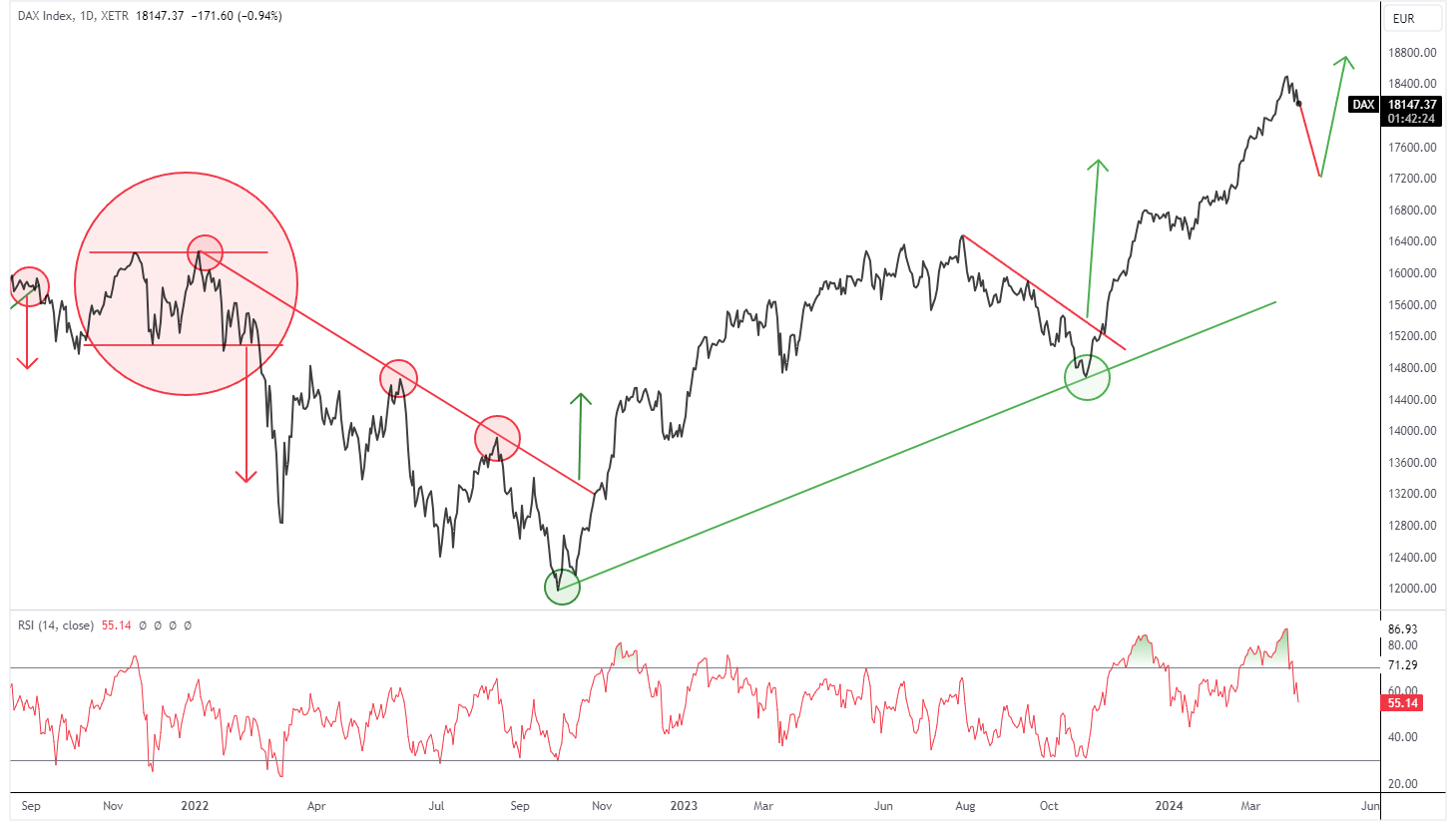
Source: TradingView
Technical Analysis
The DAX 40 index rallied 20% in 2023 and is up 8% year to date. The daily and weekly Relative Strength Index (RSI) indicator has reached strongly overbought territory suggesting that the German benchmark index is well and truly overdue for a pull back. The market retreated from its record high of $18,567 ahead of the ECB meeting. While the current short-term pull back could be deeper than the previous one, the overall long-term uptrend remains intact, and we favour higher levels in the year ahead.
Conclusion
While recent data offers a glimmer of hope for Germany's economic recovery, structural challenges persist. Industrial production is now up on the quarter, and the increased activity in the construction sector sends an encouraging signal. While private consumption in the first few months of the year has been a concern, this week’s data provides hope that the economy may no longer be in stagnation.
Professional traders looking for magnified exposure to the DAX 40 index may
consider Leverage Shares
+3x Long Germany
or
-3x Short Germany 40
ETPs.
Destatis Statistisches Bundesamt
Capital à risque. Vous pouvez perdre la totalité de votre investissement. Consultez l'avertissement complet sur les risques ici.
 Market Insights

