


Capital à risque. Vous pouvez perdre la totalité de votre investissement. Consultez l'avertissement complet sur les risques ici.
Key Takeaways
Easing US-Iran tensions are reducing the geopolitical premium in oil prices.
Rising global supply and weaker demand could limit a sustained WTI recovery.
Middle East disruptions remain the biggest upside risk for crude oil.
WTI Prices Come Under Pressure Amid Easing Geopolitical Risks
The outlook for West Texas Intermediate (WTI) crude oil is becoming challenging as markets reassess the balance between global supply and demand. After a strong rally driven by the war in Iran, oil prices have reversed sharply, with investors starting to price in a potential recovery in supply and a reduction in geopolitical risks.
On 10 November 2026, WTI futures fell to around $85.00 per barrel, down 2.43% on the day. The decline followed a sharp sell-off on Monday, after US President Donald Trump indicated that further military action against Iran was not necessary at this stage.1 Brent crude also fell below $90 for the first time since August.
WTI has now declined more than 19% from its October highs, driven by a rapid reduction in the geopolitical risk premium that had supported prices. While the market is not yet free from supply risks, particularly around the Strait of Hormuz, the break below key support of $88.75 points to a potential decline towards $80 in the short-term.
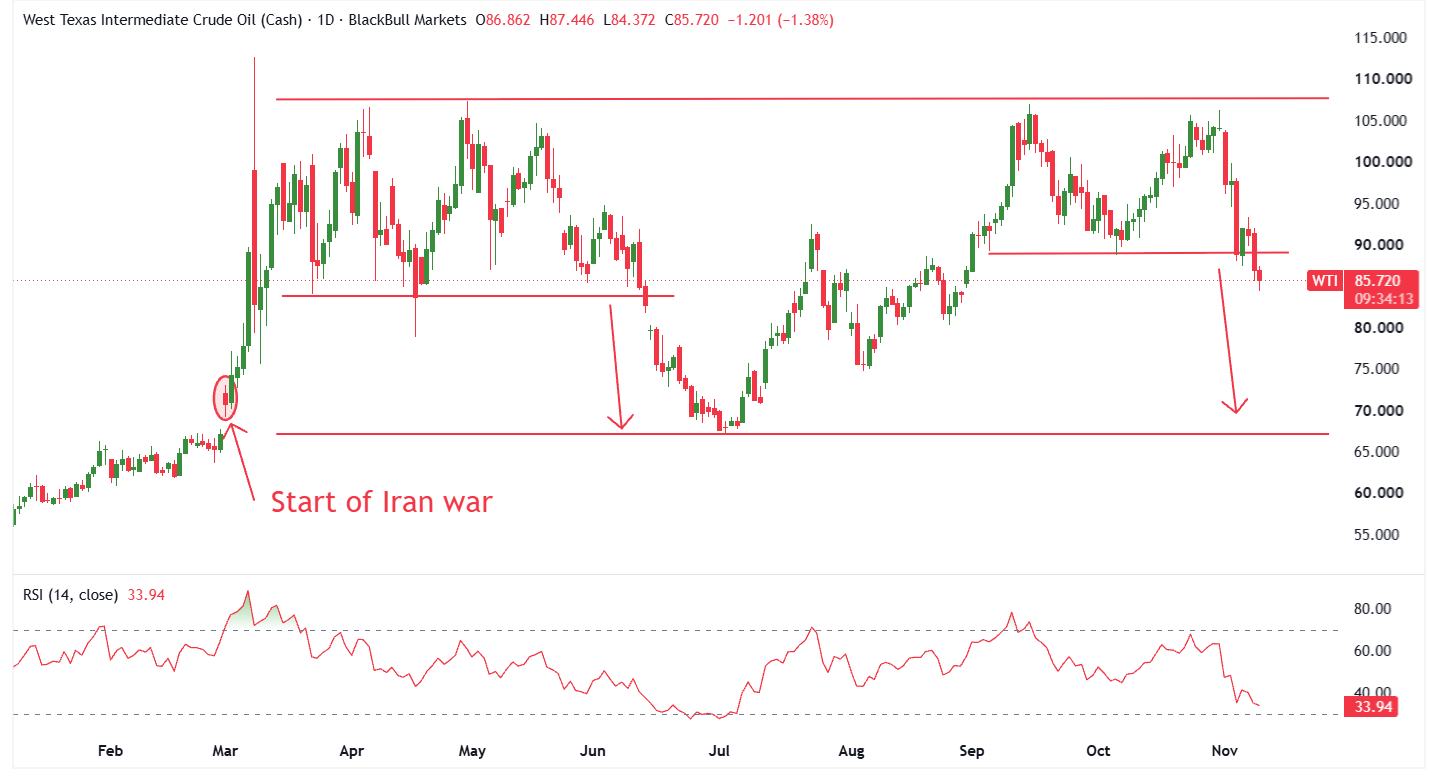
Source: TradingView. WTI oil daily price chart as of November 10, 2026.
US-Iran Tensions Remain a Key Driver of WTI Prices
Developments in the Middle East remain one of the most important factors influencing crude oil prices.
The war in Iran disrupted oil production, exports and shipping routes across the Strait of Hormuz, which provides a major route for global oil shipments.
However, diplomatic signals from Washington have started to change market sentiment. President Trump has indicated a willingness to hold back from further military strikes against Iran, reducing fears of a prolonged escalation. This has encouraged investors to unwind some of the geopolitical premium built into crude oil prices.
Crude exports from the Persian Gulf have recovered to approximately 90% of pre-war levels, including pipeline volumes. The recovery in refined product shipments has been slower, reaching around 35%–40% of previous levels.2
A sustained recovery in oil exports would increase available supply and put additional downward pressure on WTI prices. However, any renewed military escalation, attacks on energy infrastructure or disruption to tanker traffic could quickly reverse the recent decline.
For now, the market appears to be pricing in a more optimistic geopolitical scenario, although a comprehensive agreement between Washington and Tehran has yet to materialise.
Rising Oil Supply Could Put WTI Prices Under Pressure in 2027
Beyond geopolitical developments, the global supply outlook is improving. Higher production from OPEC+ members, combined with increasing exports from the Middle East, could create a more comfortable supply environment over the coming months.
OPEC production increased in October, led by Saudi Arabia, Kuwait and Iraq. The International Energy Agency (IEA) also expects global oil supply to increase substantially in 2027. Its October Oil Market Report projects an increase of 7.7 million barrels per day next year, following an estimated decline in 2026.3
Although the recovery remains vulnerable to further disruptions in the Middle East, rising production could exert downward pressure on oil prices.
Weak Global Demand Adds Pressure to Crude Oil Prices
Demand is another important factor shaping the outlook for WTI crude oil.
Higher energy costs, weaker economic activity and uncertainty across major economies have affected consumption. Expensive fuel can also encourage businesses and consumers to reduce usage, particularly in price-sensitive markets.
The IEA expects global oil demand to decline by 2.6 million barrels per day in 2026. Although consumption is expected to recover partially in 2027, the agency projects global oil use to remain below 2025 levels.3
This suggests that the recovery in demand may not be strong enough to absorb a substantial increase in production.
China will remain particularly important. As one of the largest oil importers globally, changes in Chinese industrial activity, transportation demand and economic growth can have a significant impact on crude oil prices.
China imported 9.88 million barrels of crude oil per day in October, up 9.4% from September and the highest daily rate since March. However, imports remained 13.3% lower than a year earlier, reflecting supply disruptions linked to the US-Israeli war with Iran. Imports of oil products also increased to 3.15 million tonnes from 1.85 million tonnes in September. Despite the monthly rebound, China crude oil imports fell to 27.15 million tonnes in January–October, down from 34.19 million tonnes a year earlier.4
A continued recovery in Chinese consumption would provide support for WTI. Conversely, weaker industrial activity or disappointing economic data could reinforce concerns about excess supply.
WTI Crude Oil Price Outlook
The near-term outlook for WTI remains cautious, with the balance of risks tilted towards further downside pressure. Our base case sees prices drifting towards $70-75, as long as the risk premium fades and Gulf output keeps recovering.
We expect Middle East oil flows to improve gradually, although continued constraints and lower global inventories could keep prices volatile. We lean towards a potentially softer oil market in 2027, but not necessarily a sustained collapse in prices.
Three scenarios for WTI
Bullish: If Gulf output in 2027 stays 3.5 million barrels a day below its 2025 average, WTI could reach $120 next year.
Base case: Middle East supply recovers gradually through mid-2027 and inventories rebuild, pulling WTI toward the $70s next year.
Bearish: If Gulf output rises 2.5 million barrels a day above 2025 levels and no new disruption occurs, WTI could fall to $55.
The Bottom Line
WTI oil is caught between two drivers. Diplomacy is pulling prices down fast, while the physical market, with missing Gulf barrels, OPEC+ producers below quota and shrinking US stocks, is still tight. Until there is a lasting US-Iran agreement, we expect sharp swings in both directions with headlines capable of adding or erasing $5 a barrel in a single day.
Professional investors looking for magnified exposure to WTI oil may consider Leverage Shares +3x Long WTI Oil or -3x Short WTI Oil ETPs.
Footnotes:
1. Reuters, Oil falls below $90 as Trump downplays prospect of escalation with Iran, as of 10 November 2026.
2. ING THINK, The Commodities Feed: Oil slides on easing Middle East tensions, as of 10 November 2026.
3. International Energy Agency, Oil Market Report - October 2026, as of 14 October 2026.
4. Asharq Al-Awsat, China’s October Crude Oil Imports Rise to Highest Level Since March Amid Middle East War, as of November 10, 2026.
Capital à risque. Vous pouvez perdre la totalité de votre investissement. Consultez l'avertissement complet sur les risques ici.
 Market Insights

