



Capital en riesgo. Puede perder la totalidad de su inversión. Consulte la advertencia de riesgo completa aquí.

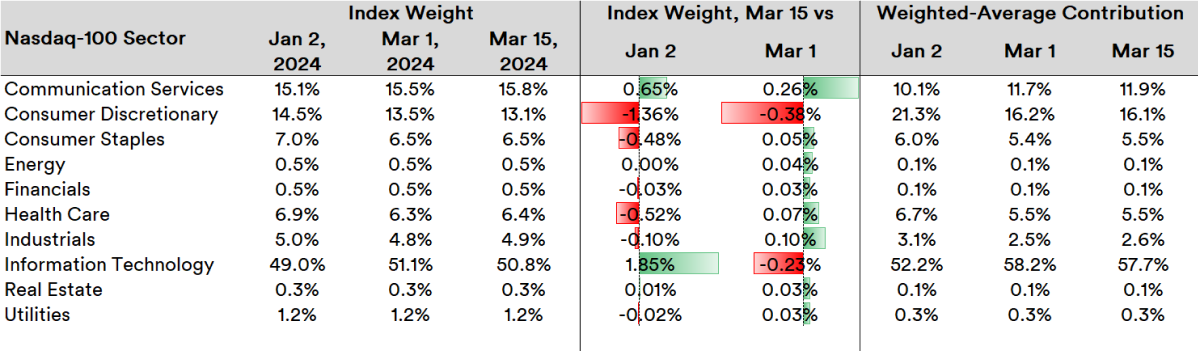
Given that a volume of economic data relating to 2023 was released throughout February, signs of a market impact did manage to emerge in recent weeks. The "tech-heavy" Nasdaq-100 (NDX or QQQ), which has fewer constituents than broad market indices, closed the first week 1.6% down and the most recent week 1.2% down. Within the index's sectors, there are seemingly growing trends of a reshuffle:
Source: Leverage Shares analysis
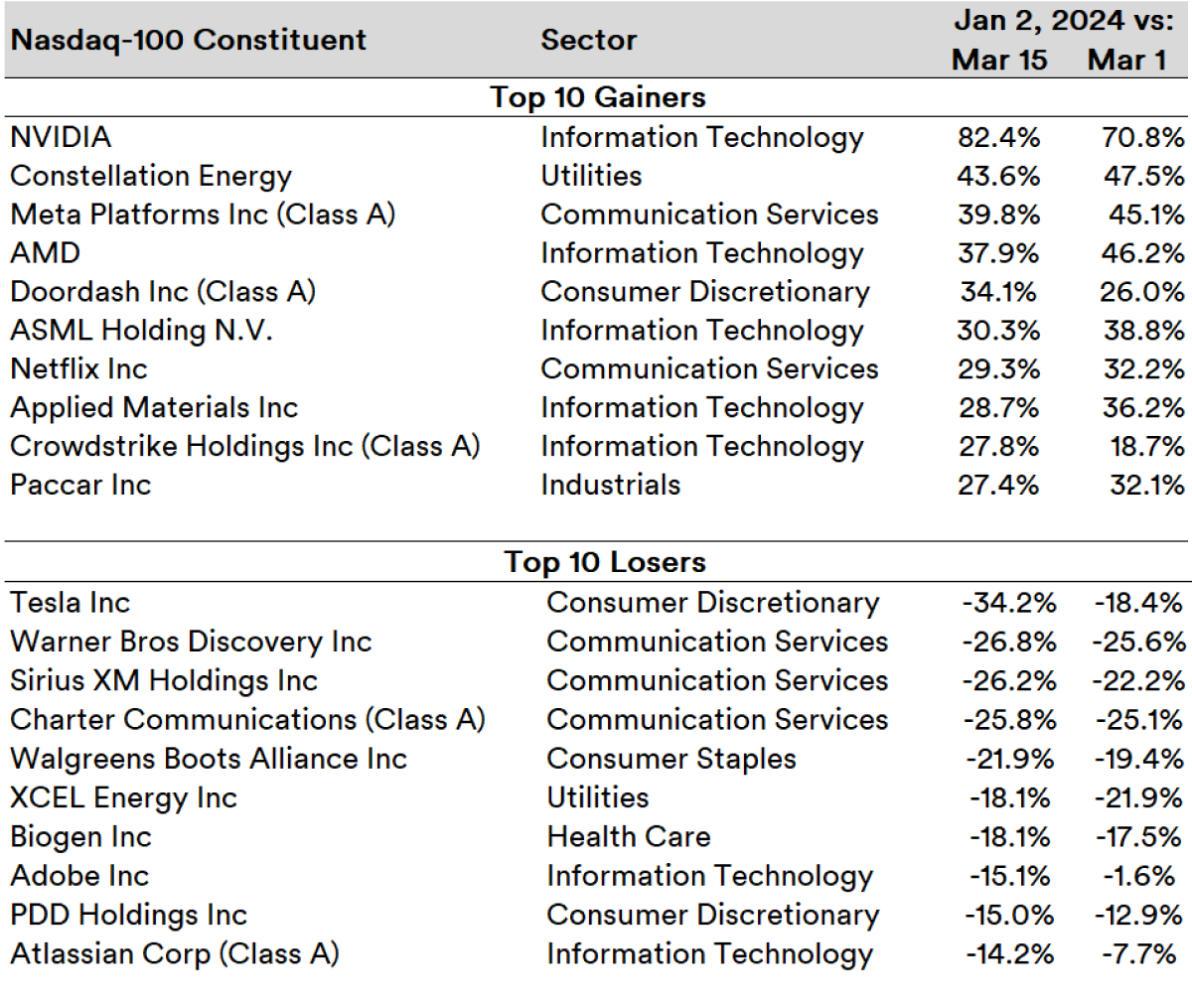
Both Information Technology and Consumer Discretionary are down relative to the first week of March while nearly every other sector is showing weak signs of a rise. Despite this, relative to the start of the year, Information Technology is still up while Communication Services shows resilience in both windows. When examining the list of top winners and losers in the same windows, however, trends aren't strictly sector-driven:
Source: Leverage Shares analysis
The index shows "chip" stocks leading a resilient rise with a handful of stocks from beleaguered sectors included. Tesla is by far the biggest loser in valuation in the Year Till Date (YTD) while communication stocks such as Sirius XM and cable service provider Charter Communications form the middle lineup of the loser list. "Tech giant" Adobe has been in major correction territory over the most recent week, along with Atlassian which doubled its loss over the past week.
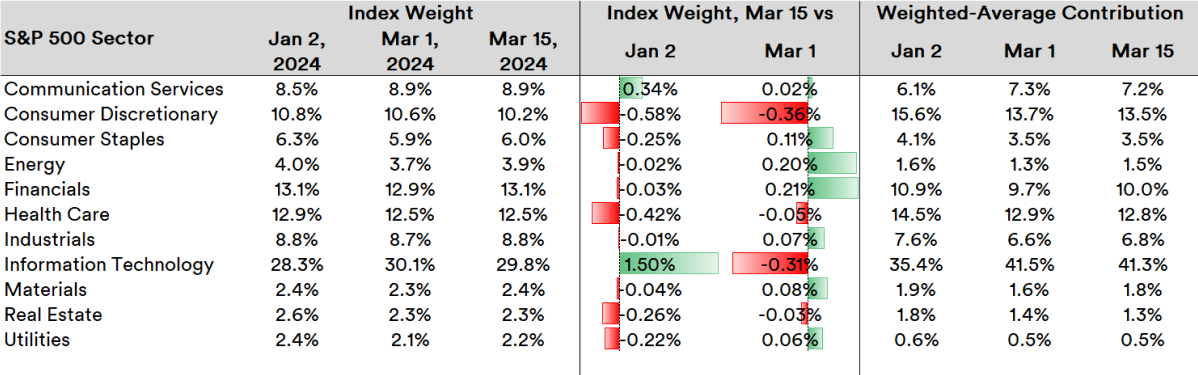
An examination of March's trends in the broad-market S&P 500 (SPX or SPY), which holds nearly five times the number of constituents as the Nasdaq-100, ordinarily could have helped further contextualize market trends. But the index only fell by 0.4% in the first week of March while in the second week, it largely remained flat. Sector-wise, however, the tale writ is largely similar:
Source: Leverage Shares analysis
In the most recent week, nearly every sector except for Communication Services and Information Technology were in retreat relative to the start of the year. Relative to the first week, the most recent week shows nearly every sector showing signs of a rise, with the exception of Information Technology. Consumer Discretionary, which includes everything from the likes of Walmart to Tesla and closely indicative of consumer outlook, remains bearish in both windows.
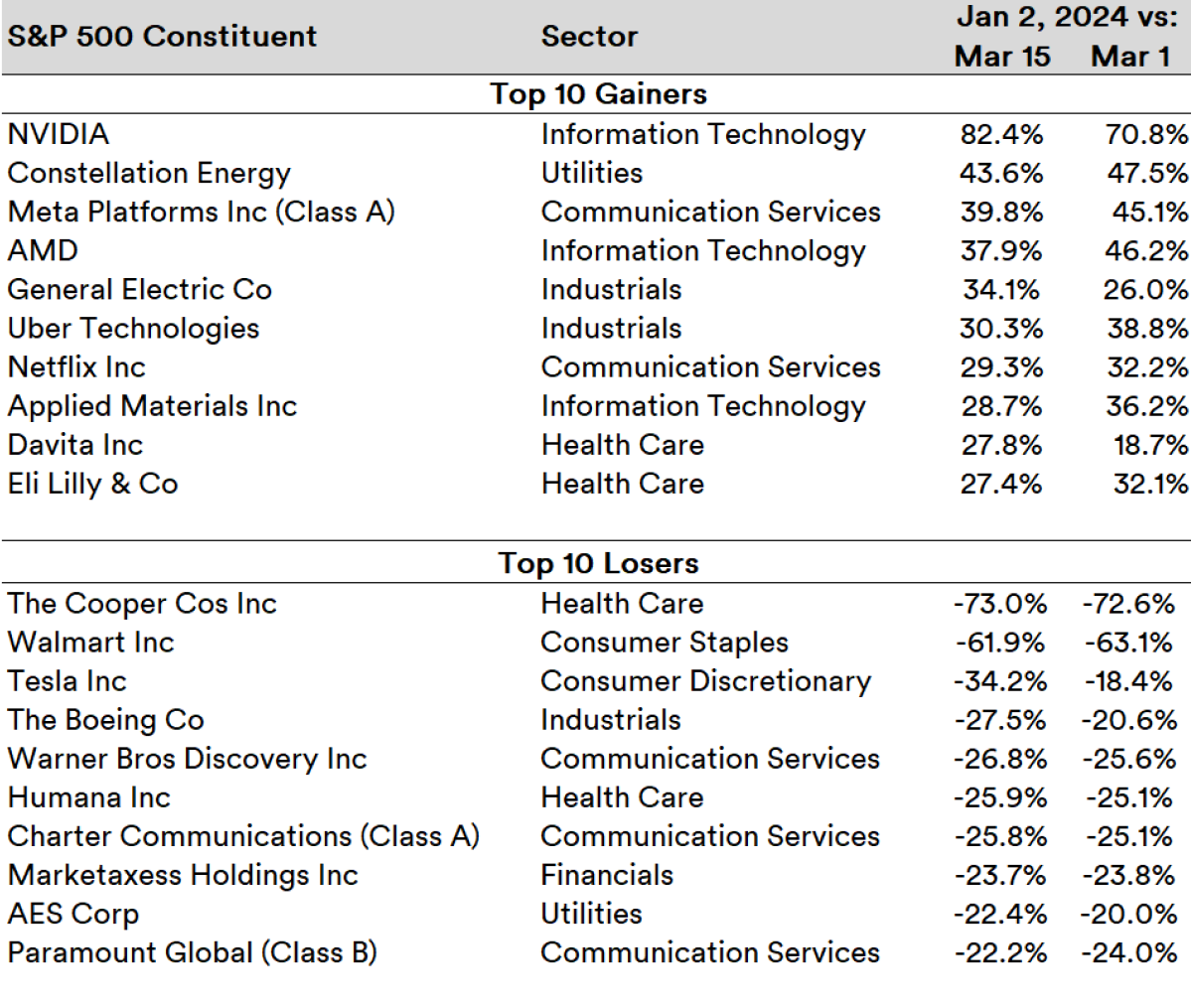
Consumer Discretionary and Information Technology hold the vast bulk of the index's highest-conviction stocks. In the start of the year, they accounted for 51% of the index's price. By the end of the most recent week, Information Technology continued to grow at the expense of nearly every other sector except for Communication Services. However, not every stock in these two rising sectors is created equal nor is every stock in the "beleaguered" sectors sinking together.
Source: Leverage Shares analysis
While "chip" stocks such as NVIDIA, AMD and Applied Materials easily feature in the Top 10 Gainers, a small group of industrial stocks and utilities - two of the most beleaguered sectors relative to their weights - are resilient and consistent winners.
Being in Communication Services - one of the strongest performing sectors in the YTD - didn't help Warner Bros Discovery or Paramount; both companies have continued to hemorrhage value. Gloomy consumer outlook affects both Walmart and Tesla, which are two radically different companies, while a steady line of aircraft failures hammer away at Boeing, one of the few remaining major aircraft manufacturers in the post-Cold War world.
In ConclusionInstead of a sector rotation - which could be construed as market participants rationalizing away from overwrought valuations in "tech"-related sectors in light of improving economic conditions - major trends highlight that market breadth continues to be hammered with investors flocking to a small set of stocks independent of sector. The key takeaway from large-scale economic data1 strongly suggests that "consumer-facing" companies are in for a rough ride in the next few quarters. In contrast, the likes of major "chip" stocks and communications firms that have a preponderance of "corporate" clients are being favoured since corporations are expected to be more resilient spenders going forward. Hence, market breadth is expected to be bleak.
But there are limits to how far forward-looking valuations can be stretched, particularly with the "high tech" constituents of the Nasdaq-100 which have progressively emerged as the strongest drivers behind index trajectory. Even with "corporate"-facing stocks leading the way for the index, there is ample potential for snapbacks and bearish volatility. Professional investors would do well to consider two Exchange-Traded Products based on the QQQ ETF (which tracks the Nasdaq-100): QQQ5 offers a 5X exposure to the upside of the index's trajectory while QQ3S offers a 3X exposure to the downside.
Footnotes:
"U.S. Debt In 2024: A Major Crisis Is Brewing", Leverage Shares, 19 March 2024
Capital en riesgo. Puede perder la totalidad de su inversión. Consulte la advertencia de riesgo completa aquí.
 Market Insights

