


We previously discussed the effects of daily compounding and stated that when it comes to leveraged single-stock ETPs, “the trend is your friend.”
However, some investors might have a hard time deciding between the two leverage factors, namely 2X and 3X. When in doubt, go big (i.e. 3X) or stay moderate (i.e. 2X)? Well, it all depends. This article will take apart what it means to have a “trend” and how deeply it affects an investor’s portfolio value with regard to the two leverage factors we offer. We will use product performance data of two crowd-favourites: the 2X Tesla ETP (TSL2) and the 3X Tesla ETP* (TSL3) against the performance of their underlying stock, Tesla (TSLA).
*The data for the 3X ETP is simulated and based on backtested values since it was listed on March 17, 2021
The Case for 3X
Let’s “invest” into three products on the 29th of December 2020: TSLA, TSL2 and TSL3. Over the next 8 trading days, TSLA skyrockets over 32% in value, with not a single day of a “slide back”.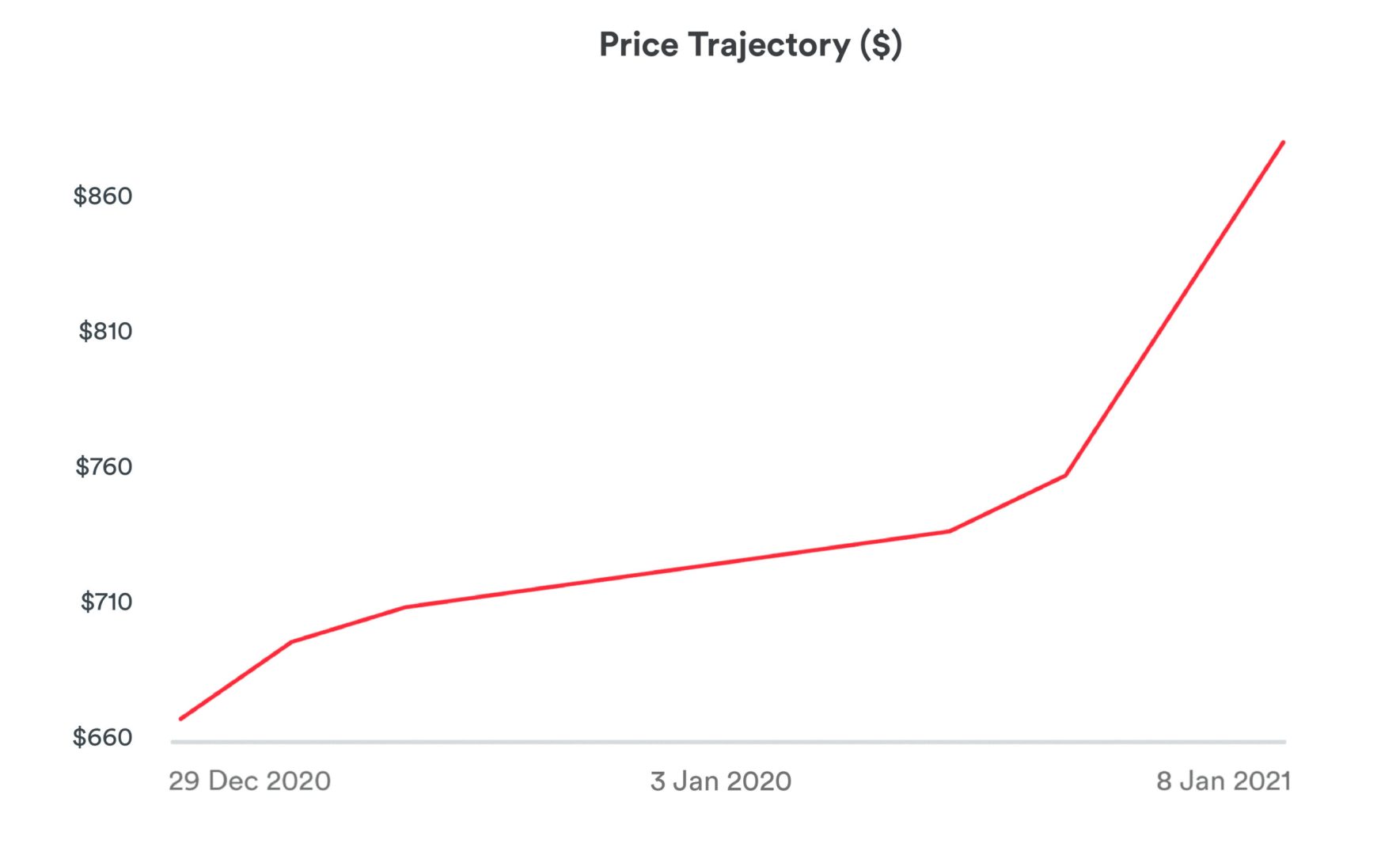
We see a relatively weaker trend till the 5th and then a big jump upwards and beyond till the 8th. Both TSL2 and TSL3 show a corresponding trend in performance across the period, climbing in value by 75% and 121%, respectively:
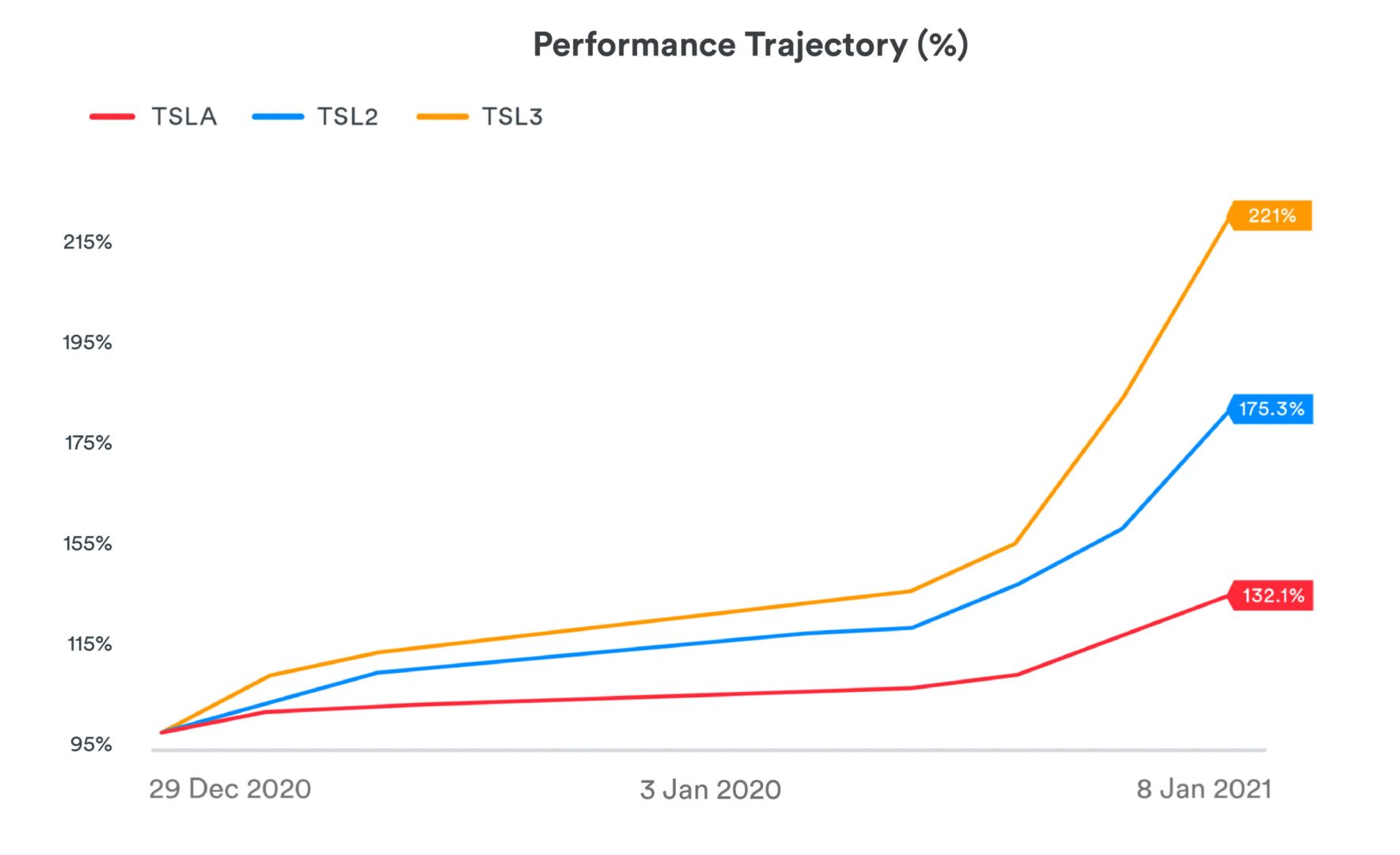
As this case demonstrates:
“If the underlying asset increases in value day-on-day, a higher leverage factor may potentially lead to higher returns than a lower leverage factor, though this also comes with increased risk.”
But hindsight is always 20-20. When this is not the case, making a choice gets a little more complex.
The Case for 2X
Let’s “invest” into three products on the 29th of July 2020: TSLA, TSL2 and TSL3. Over the next 11 trading days, TSLA has a modest (by its standards) climb of 3.7%. However, between these days, TSLA’s trajectory is anything but modest:
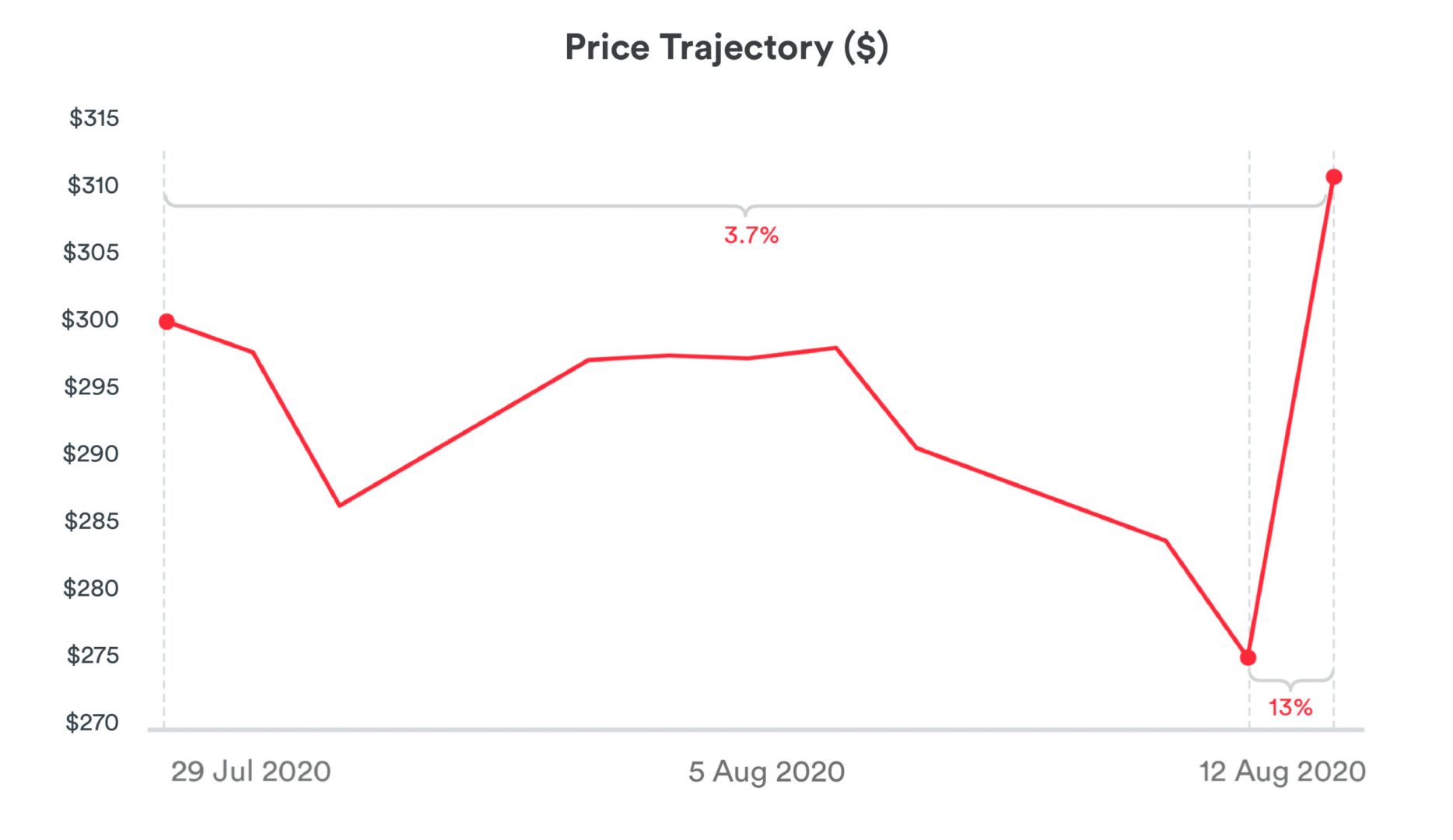
We see a drop by 5% by the 31st and a meandering recovery until the 11th, which precedes a dramatic 13% spike, to gain an overall rise of 3.7%. Both TSL2 and TSL3 show a corresponding trend in performance across the period, climbing in value by 5.4% and 5.9% respectively:
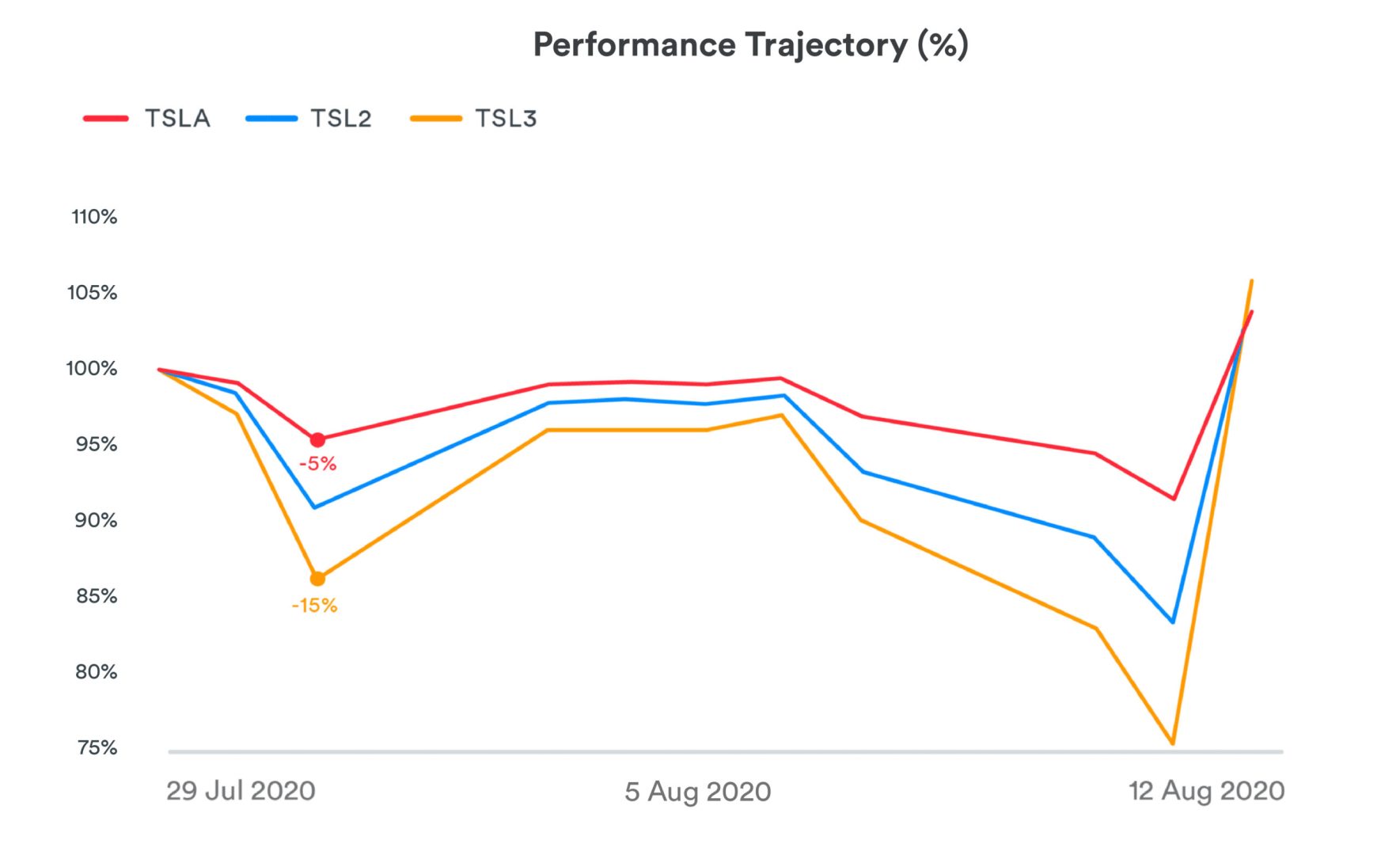
Until the 11th, the value of a 2X investment is clearly visible: the 3X doesn’t really recover lost ground after the 15% drop in value by the 31st, while the 2X crawled closer to the underlying after the 31st until the 11th. The 13% spike on the 12th enabled the 3X to draw up par with the 2X.
Let’s consider another more recent case of a similar nature to further exemplify this behaviour.
Let’s “invest” into three products on the 4th of March 2021: TSLA, TSL2 and TSL3. Over the next 5 trading days, TSLA climbs up 7.5%. However, between these days, TSLA’s trajectory is – like in the previous case – rather dramatic:
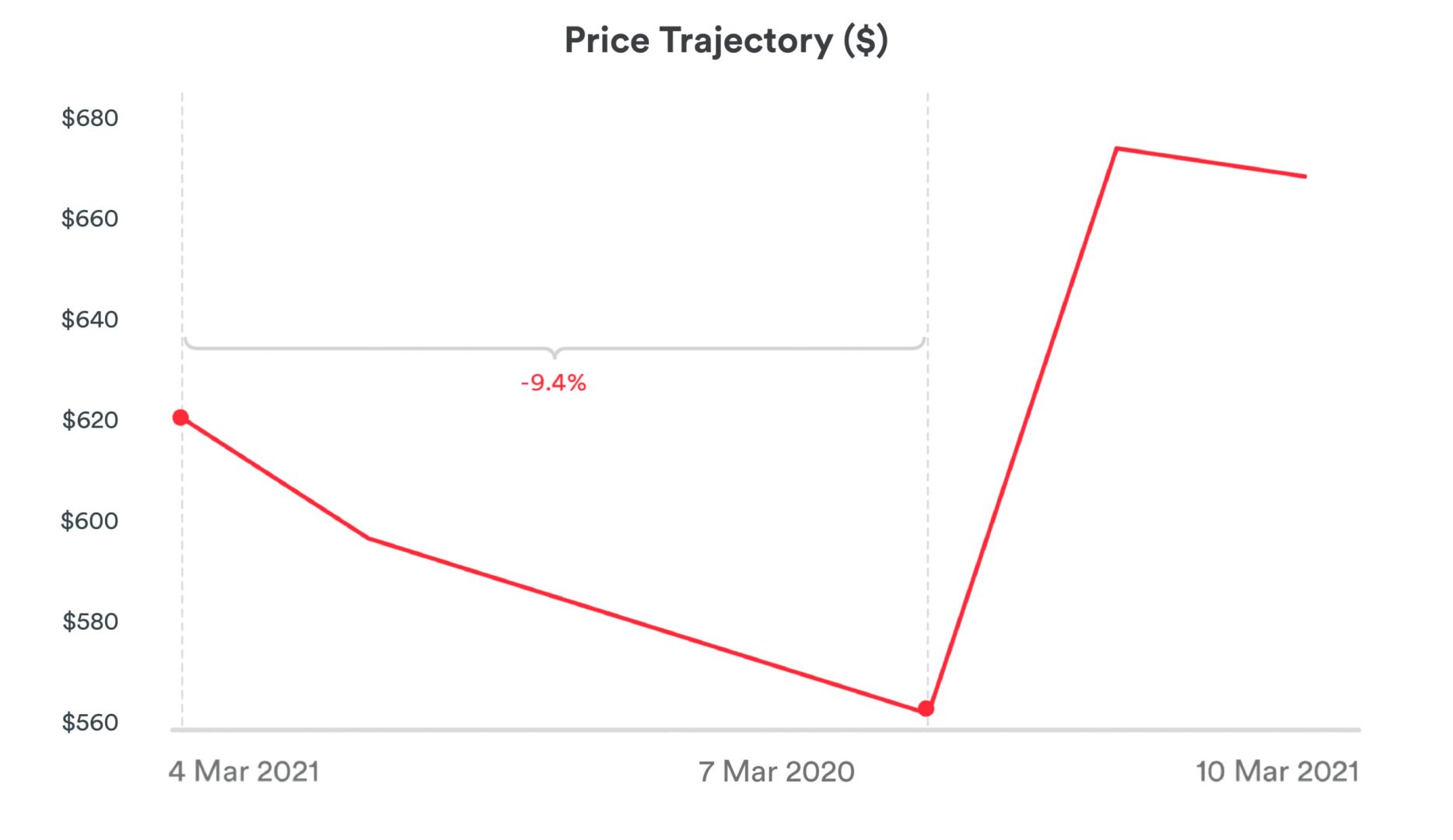
We see a drop by 9.4% by the 8th, a sharp recovery of nearly 20% the next day and then a slight fall of under 1% the day after that. Both TSL2 and TSL3 show a corresponding trend across the period, climbing in value by 11.8% and 13.1% respectively:
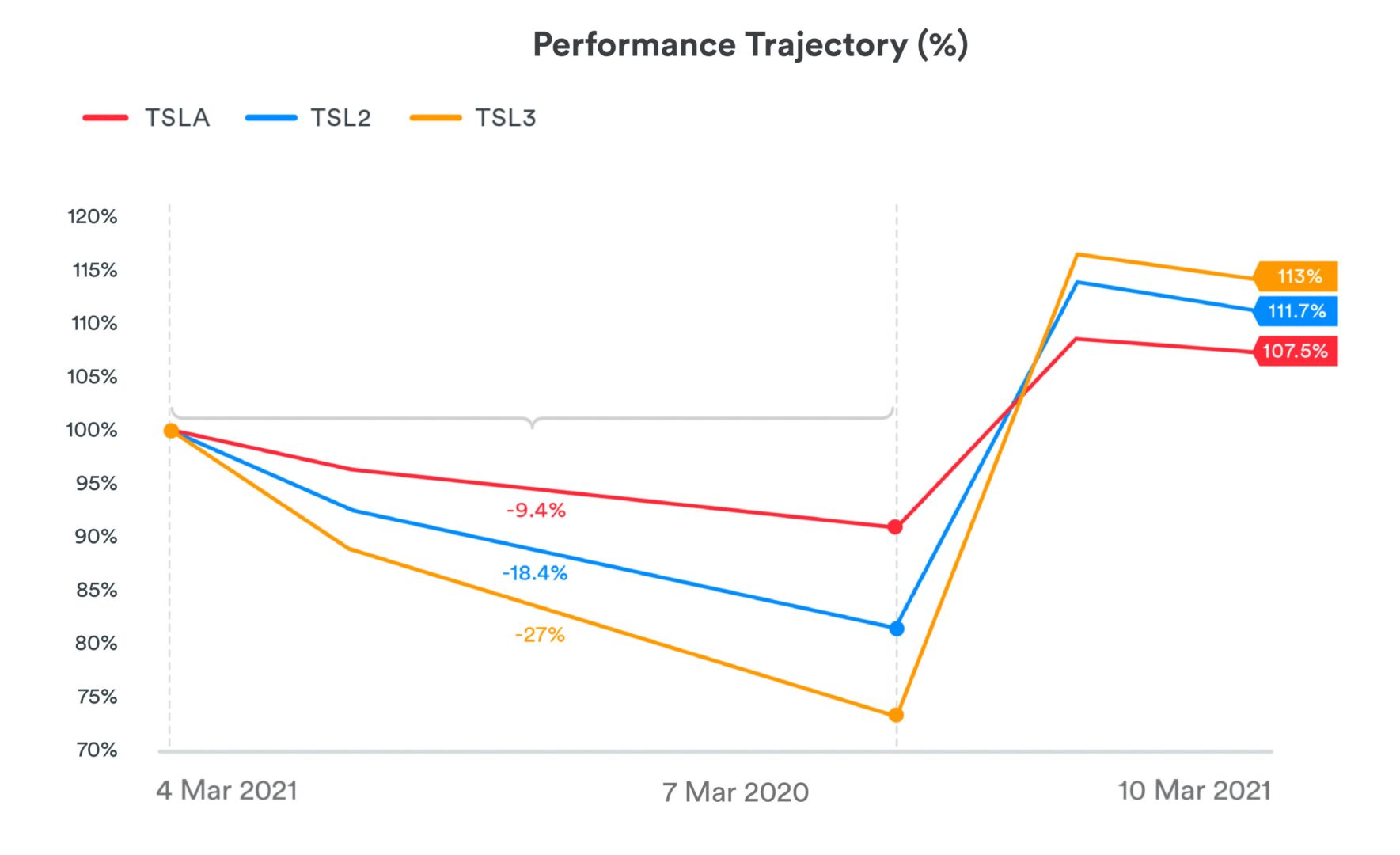
Like in the previous scenario, the value of the 2X investment is clearly visible: while the 3X had lost nearly 27% of its value by the 8th, the underlying and the 2X had lost 9.4% and 18.4% respectively. In fact, the drop is so profound that even the single-day 20% increase in the underlying only gives the 3X a 2.5% edge in gains over the 2X, which now has a net gain of almost 14%.
In Conclusion
Examining the behaviour of the 3X and 2X over these scenarios, the argument on the choice between the 2X and 3X can be summarized thus:
“When it comes to choppy markets, a lower leverage factor has a significantly less pronounced value decay than a higher leverage factor”
It also bears noting in the choppy market scenarios in the case made for 2X, there was one single day where the underlying has a massive snap back in value. This illustrates the damaging effects of “value decay”: the 3X just about draw par to the 2X after several days of a loss in value that was greater than that seen in the 2X.
In that regard, the 2X investment was, in fact, the better choice to make a leveraged bet simply because it lost less value than the 3X and ended up par with the 3X after the recovery.
The seasoned investor would know that dramatic snap back in value is certainly not strange for Tesla but it’s relatively less pronounced for most other ‘mature’ stocks on days other than those immediately following an earnings call or major news. However, “choppy market” scenarios are a common feature to almost every stock.
Leveraged investments are risky plays, generally short-term investments and require active management. Ultimately, it is up to the investor to make a judgement call on what sort of days are up ahead with their investment and make a leveraged play.
 Education

