Article by Edward Sheldon
Exploring the Case for a SpaceX/Tesla Merger
October 30, 2026 | Research Insights
Talk of a SpaceX-Tesla merger is heating up as industry watchers debate the potential of a single corporate powerhouse. By uniting the two companies, Elon Musk could create an unprecedented technology and manufacturing empire spanning AI, robotics, orbital communications, and next-generation transportation.
In this article, we’ll explore the benefits of a SpaceX/Tesla tie-up along with the challenges and risks associated with a merger. We’ll also look at what a potential merger could mean for investors.
A Multi-Planetary Technology Powerhouse
A SpaceX-Tesla merger would offer many advantages for the two companies. For a start, they could share technologies. For example, SpaceX’s Starlink satellites could provide communication services for Tesla's robotaxis, autonomous systems, and humanoid robots. Meanwhile, Tesla's battery and energy-storage products could help support SpaceX's growing AI power needs.
A tie-up could also help to strengthen and streamline supply chains. A unified company could command massive order volumes for silicon accelerators, microcontrollers, and sensor arrays. Additionally, it would enable pooled procurement of critical raw materials such as battery-grade lithium, nickel, cobalt, stainless steel, and rare-earth elements. Additionally, we could see joint manufacturing initiatives and shared tooling and equipment.
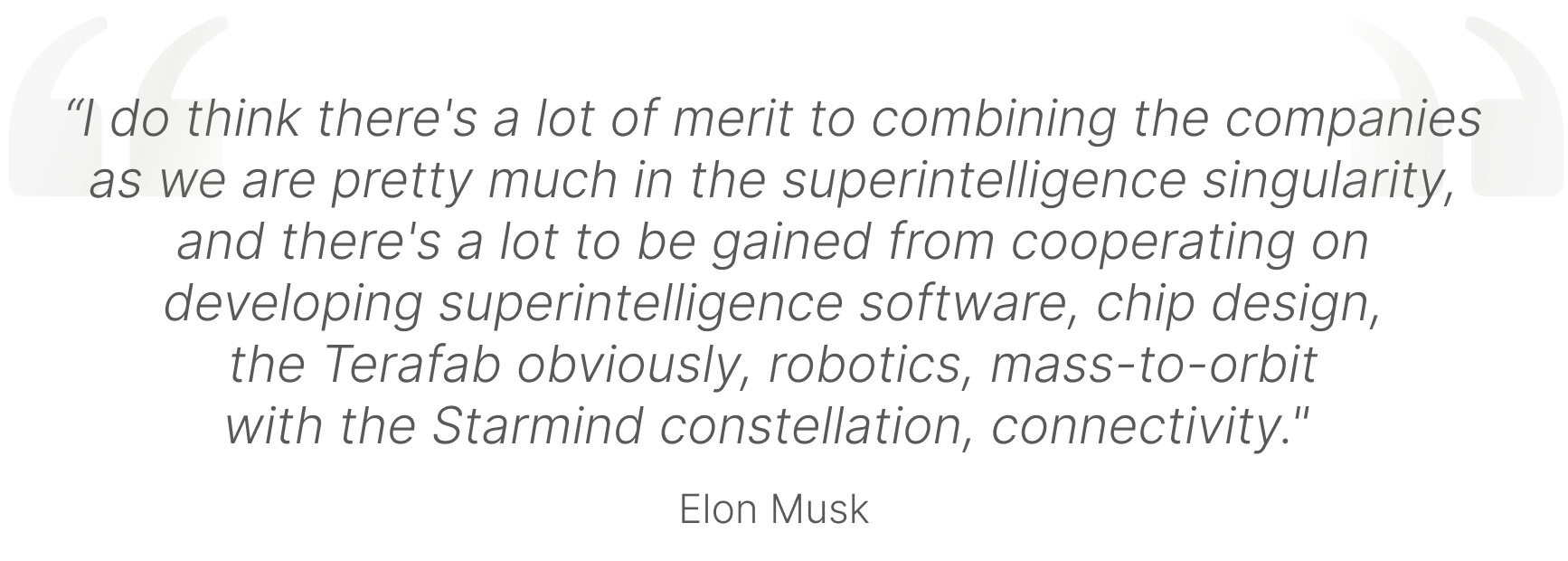
It’s worth noting here that Musk has already announced one major Tesla-SpaceX collaboration and that’s Terafab. Located in Grimes County, Texas, this is a semiconductor and AI-computing project aimed at producing the advanced chips needed for Tesla's autonomous vehicles and humanoid robots, as well as SpaceX's AI and data-center ambitions. Unlike traditional chip manufacturers that rely on globalized sub-contractors, Terafab is designed to be a fully integrated facility. It aims to combine chip design, silicon fabrication, memory module production, advanced thermal packaging, and final testing under a single unified roof.
One other advantage of bringing the companies together is that it could hugely simplify decision-making and corporate governance. At present, joint ventures are a challenge because they require Elon Musk and board members to step aside from negotiations to avoid self-dealing lawsuits. A merged entity would remove legal barriers, allowing unified leadership to approve joint projects immediately. A merger could also help to streamline capital allocation decisions as the two companies would not have to maintain distinct balance sheets, meaning capital could be shifted instantly between automotive, space exploration, satellite deployment, and AI computing.
The Risks and Challenges
In terms of the risks and challenges associated with a merger, one key issue is geopolitics. Today, SpaceX is a major contractor for the US military, intelligence agencies, and NASA. Meanwhile, Tesla has significant operations in China. So, a tie-up could lead to heightened scrutiny from US regulators and national-security officials as well as from the Chinese government.
Execution risk is another issue to consider. Starship rockets, robotaxis, humanoid robots, and orbital infrastructure are all expensive, technically challenging initiatives. In a tie-up, the combined company would have to manage an unprecedented level of technical complexity. It may also have to manage enormous capital expenditures.
Of course, a merger would also face shareholder and governance hurdles. Investors in both companies would need to be convinced that the advantages outweigh the risks. Meanwhile, the boards of both companies would have to navigate complex conflicts of interest, agree on a unified leadership structure, and fulfill their fiduciary duties to distinct investor bases with potentially conflicting priorities. Note that on SpaceX’s recent earnings call, CEO Elon Musk said that a deal was up to the special committees of both companies and that because he is a “conflicted party,” he can't actually be in the discussions of the special committees.

What Would a SpaceX/Tesla Merger Mean for Investors?
As for the implications for investors, Tesla shareholders would gain access to SpaceX's rocket launch operations, Starlink satellite broadband ecosystem, and AI compute operations while SpaceX investors would gain ownership of Tesla's electric vehicle, autonomous driving, energy storage, and robotics businesses. So, a merger would offer unprecedented exposure to a massive, diversified ecosystem of frontier technologies.
That said, shareholders on both sides would also inherit significant operational execution risks, heavy capital expenditure demands, and complex regulatory scrutiny. And a combination could be a problem for some institutional investors as a multi-industry conglomerate structure may no longer fit their mandate guidelines.
In terms of size, a merged company could be one of the world's most valuable corporations. Given that SpaceX and Tesla have market caps of $2.0 trillion and $1.6 trillion respectively today1, we could be looking at a market value of more than $3.5 trillion, which could turn off some investors.
Overall, it’s a complex scenario for investors. While uniting these two tech giants could create an unparalleled tech powerhouse driving the next era of industrial and space innovation, the sheer scale of technical execution, financial strain, and regulatory hurdles means it is far from a sure bet.
Footnotes:
1LSEG, as of October 30, 2026