



Capitale a rischio. Potreste perdere tutto il vostro investimento. Consultate l'avvertenza completa sui rischi qui.
Punti chiave
UnitedHealth delivered a modest Q3 earnings beat , with adjusted EPS and revenue both rising; however, growth was largely fuelled by higher premiums rather than organic expansion.
Profitability remains under strain , as net margins continued to decline and medical cost ratios stayed elevated, casting doubt on the sustainability of earnings despite the company’s higher guidance.
Ongoing risks centre on margin pressure from escalating medical costs and elevated utilisation rates, with tangible evidence of successful price adjustments yet to emerge.
UnitedHealth Posts Strong Q3 Earnings and Raises 2025 Outlook
UnitedHealth posted encouraging Q3 results last Wednesday, despite continuing to grapple with regulatory challenges, leadership transitions, and mounting medical cost pressures.
UnitedHealth modestly exceeded earnings expectations and lifted its 2025 guidance, signalling that the worst of the cost headwinds may be easing and that its operations are stabilising. This offered a bright spot for investors in a turbulent year for the managed-care sector.
Revenue Rise Despite Rising Medical Costs
The healthcare and insurance giant reported consolidated revenue of $113.2 billion for the quarter, up 12% from a year earlier. Operating earnings stood at $4.3 billion, translating to a net margin of 2.1%, while adjusted earnings per share came in at $2.92 beating Wall Street forecasts.
The company’s medical care ratio (MCR), which is the share of premiums spent on patient care, rose to 89.9%, higher than the 80% benchmark typical among health insurers. This reflects higher utilization rates and continued funding reductions in Medicare and Part D programs. Elevated medical costs and regulatory adjustments continue to weigh on insurers industry-wide, making operational discipline critical. 1
UnitedHealthcare: Revenue Up, But Margins Squeezed
UnitedHealthcare, the company’s core insurance arm, drove the bulk of growth with revenues up 16% to $87.1 billion, supported by expansion in its Medicare & Retirement and Community & State divisions. The insurer now covers more than 50 million members, an increase of 800,000 year over year.
Yet operating earnings fell 57% to $1.8 billion, as aging membership and higher claims utilization squeezed margins. UnitedHealth noted that while care usage remains elevated, these trends are “in line with expectations.” 2
Optum Strengthens UNH Results with Solid Revenue and Cash Flow
Optum, UnitedHealth’s fast-growing health services unit, posted revenues of $69.2 billion, an 8% annual increase. Optum Rx led the segment, rising 16% to $39.7 billion thanks to new client wins and higher prescription volumes. The change toward higher-cost specialty drugs did trim margins slightly, but Optum’s performance reaffirmed its role as a stabilizing engine within the group’s diversified model.
Operating cash flow reached $5.9 billion or 2.3 times net income, highlighting strong liquidity and disciplined capital management. The company’s debt-to-capital ratio held steady at 44.1%, even after its recent acquisition of Amedisys.
Raising 2025 Guidance: A Vote of Confidence
In a show of confidence, UnitedHealth raised its full-year 2025 outlook to at least $14.90 in net earnings per share and $16.25 in adjusted EPS. Management highlighted ongoing investments in technology and artificial intelligence as key drivers for efficiency and improved customer experience.
According to Tim Noel, CEO of UnitedHealthcare, nearly 85% of member inquiries are now served digitally, with 95% resolved on first contact. The company is also scaling AI and machine learning tools across its operations to enhance service and reduce administrative friction.
Policy Uncertainty Adds a Backdrop of Risk
UnitedHealth’s stronger quarter arrives against a tense policy backdrop. A partial federal government shutdown, driven by disputes over Affordable Care Act premium subsidies, threatens to raise insurance costs for millions of Americans if unresolved by November’s open enrolment period.
The debate underscores the fragility of U.S. healthcare economics, where aging demographics, medical inflation, and political gridlock continue to collide.
Dividend Strength & Institutional Backing
UnitedHealth remains a distinguished dividend aristocrat, having raised payouts for at least 25 consecutive years, appealing to long-term income oriented investors.
Berkshire Hathaway added over 5 million shares in Q2 2025, valuing the position at approximately $1.7 billion, signalling strong confidence in long-term value.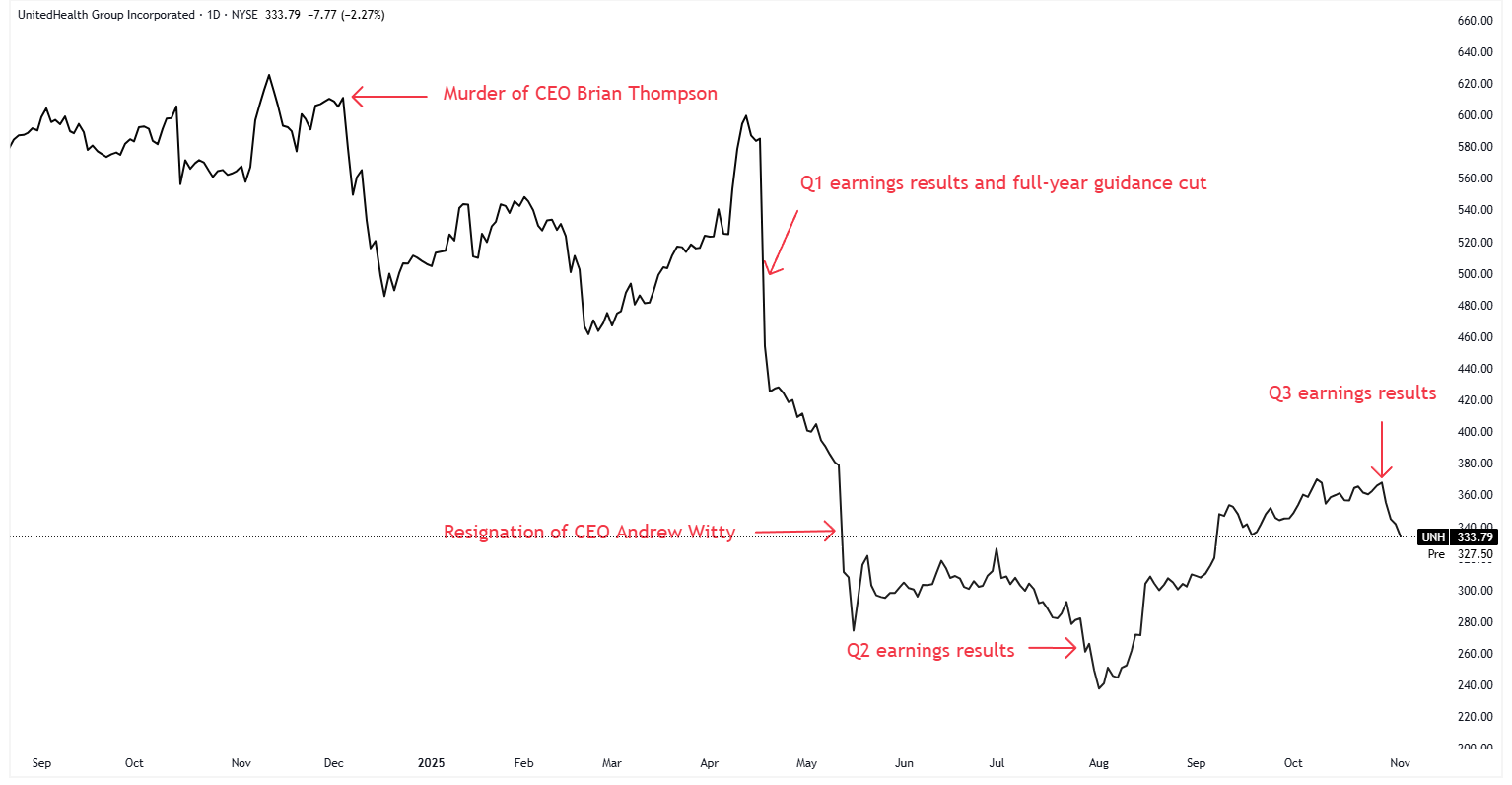
Source: TradingView
UnitedHealth Shows Signs of Recovery
While UnitedHealth’s stock remains down roughly 33% year-to-date, the company is beginning to signal renewed confidence in its earnings trajectory, a move that could help UNH move past the volatility experienced earlier in the year.
Investors appear cautiously optimistic that the company’s diversified business model and continued digital investments can help offset ongoing cost pressures. With higher medical utilization already factored into forecasts and AI-driven efficiency gains starting to materialize, Q3 earnings results could mark the start of recovery.
For now, UnitedHealth’s Q3 results show a company that is adapting, not rebounding, as it goes through one of the most challenging healthcare environments in decades.
UnitedHealth’s Q3 Beat Fails to Ease Margin and Cost Pressures
UnitedHealth’s Q3 earnings delivered modest upside, mainly from higher premiums rather than organic growth. The company raised full-year guidance slightly, but profitability remains under pressure. Net margins fell, and the medical cost ratio stayed elevated, reflecting rising patient care costs and utilisation levels.
While the stock has rebounded more than 60% from August low of $234.60 to its recent high of $381.00, the price remains well below its $630 peak, attracting value investors hoping for mean reversion. However, the quality of earnings and margin sustainability are raising investor caution despite the upbeat headline numbers. The primary concern lies in margin pressures across UnitedHealth’s insurance and healthcare operations.
Nonetheless, the stock appears attractive in the range between $300 and $330 and we see a potential of a gradual share price recovery to $440 over the next six to twelve months.
In summary, while Q3 results show stabilisation, UnitedHealth’s path to sustainable margin recovery and growth remains uncertain amid rising medical costs, political risks, and expensive valuation multiples.
Professional investors looking for magnified exposure to UnitedHealth may consider Leverage Shares +3x Long UnitedHealth ETP.
Note a piè di pagina:
UnitedHealth Group: https://www.unitedhealthgroup.com/newsroom/2025/2025-10-28-uhg-reports-third-quarter-2025-results-and-raises-full-year-2025-earnings-outlook.html
UnitedHealth Group: chrome-extension://efaidnbmnnnibpcajpcglclefindmkaj/https://www.unitedhealthgroup.com/content/dam/UHG/PDF/investors/2025/unh-reports-third-quarter-2025-results-and-raises-full-year-2025-earnings-outlook.pdf
Capitale a rischio. Potreste perdere tutto il vostro investimento. Consultate l'avvertenza completa sui rischi qui.
 Market Insights

