



Capitale a rischio. Potreste perdere tutto il vostro investimento. Consultate l'avvertenza completa sui rischi qui.
Meta Earnings Surge and AI Ambitions Scale Up
Meta’s fourth-quarter earnings did more than beat expectations, they reframed the investment debate around the company. The social media giant delivered decisive earnings beat and issued first-quarter revenue guidance that comfortably cleared Wall Street forecasts. Yet the real takeaway is that Meta is scaling its artificial intelligence ambitions to a level few companies can finance, and even fewer can execute successfully.
For the December quarter, Meta reported earnings per share of $8.88, well ahead of consensus estimates of $8.20. Revenue reached a record $59.9 billion, up 24% year over year and above expectations, highlighting the continued resilience of its core advertising business. Advertising alone generated $58.1 billion, or nearly 97% of total revenue, a clear reminder that, for all the focus on artificial intelligence, Meta remains one of the most powerful advertising platforms in the world. 1
User engagement, often a silent driver of ad pricing power, remained solid. Daily active people across Meta’s apps averaged 3.58 billion, broadly in line with expectations and reinforcing the company’s unparalleled global reach. 1
Forward Outlook Validates the Bull Case
What truly lit a fire under the stock, however, was guidance.
Meta expects first-quarter revenue to land between $53.5 billion and $56.5 billion, well ahead of analyst estimates near $51.4 billion. CFO Susan Li attributed the strength to sustained advertising demand carrying through the end of Q4 and into early 2026, an important signal that digital ad spending remains robust even as macro uncertainty lingers. 1
Meta is not just benefiting from cyclical recovery in advertising, but from structural improvements in ad performance, driven by AI-powered targeting and measurement tools. In other words, AI is already paying rent.
Meta Doubles Down on AI
If the earnings beat was reassuring, Meta’s capital expenditure plans were staggering.
The company expects to spend between $115 billion and $135 billion on capex in 2026, nearly double its 2025 spend of $72 billion and well above analyst expectations. The bulk of that investment will go toward AI infrastructure, including data centres and Meta’s rapidly expanding Superintelligence Labs.
CEO Mark Zuckerberg was explicit about the ambition. Meta plans to release its latest AI models over the coming months, with an emphasis not just on near-term quality but on demonstrating rapid iteration and capability improvement throughout the year. Internally, the company is testing a new frontier model, code-named Avocado, widely seen as a successor to Llama after a lukewarm developer response to Llama 4.
Meta’s AI push has not been subtle. The company invested $14.3 billion in Scale AI to bring its founder, Alexandr Wang, into the fold and has signed multi-billion-dollar infrastructure deals to support its data centre buildout. This places Meta squarely alongside hyperscalers like Microsoft, Google, and Amazon in the race to industrial-scale AI.
The bet is clear: near-term margin pressure in exchange for long-term platform dominance.
Reality Labs: Still a Drag, But a Smaller One
Not everything in the quarter was rosy. Reality Labs once again delivered heavy losses, posting an operating loss of $6.0 billion on revenue of $955 million. Since late 2020, the division has accumulated nearly $80 billion in operating losses, a figure that continues to test investor patience.
That said, Meta appears to be recalibrating. Layoffs in the VR unit earlier this month and a shift in focus toward AI-powered wearables, such as Ray-Ban Meta smart glasses, suggest a more disciplined approach. Zuckerberg acknowledged that 2026 is likely to mark the peak of Reality Labs losses, with gradual improvement expected thereafter.
This signals that Meta’s era of unchecked metaverse spending is firmly in the rear-view mirror.
Risks Remain, but the Market Is Willing to Pay
Meta did flag meaningful regulatory and legal risks, particularly in the U.S. and Europe, with several high-profile trials related to youth social media usage set to begin this year. The company acknowledged that these cases could result in material financial losses.
Still, investors appear comfortable looking past those risks for now. With an operating margin north of 80%, a balance sheet capable of funding enormous AI investments, and advertising growth that continues to surprise to the upside, Meta is once again being valued as a growth compounder rather than a mature platform under siege.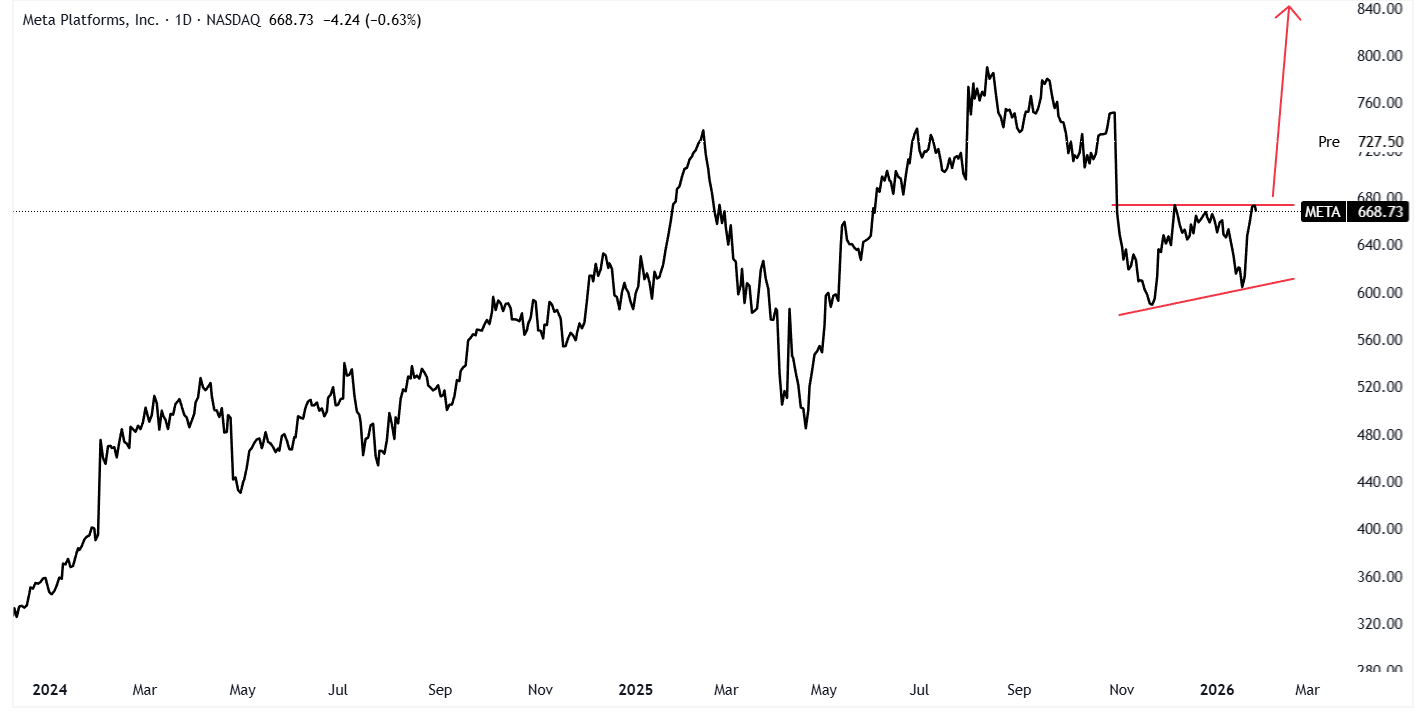
Source: TradingView. Meta daily price chart as of 29 January 2026.
Bottom Line
The core business is firing on all cylinders, AI is already enhancing monetisation, and management is signalling a willingness to spend aggressively to secure long-term leadership in artificial intelligence. The scale of that investment raises execution risk, but it also creates a moat that few competitors can match.
After entering a corrective phase in late 2025, during which the stock fell more than 27% between August and November, Meta now appears positioned for a confidence reset. The strength of the Q4 results should help restore investor conviction, with upside toward the $840–$850 range looking achievable over the next 12 months.
Professional investors looking for magnified exposure to Meta may consider Leverage Shares +3x Long Facebook ETP or -3x Short Facebook
Note a piè di pagina:
Meta Investor Relations: https://investor.atmeta.com/investor-news/press-release-details/2026/Meta-Reports-Fourth-Quarter-and-Full-Year-2025-Results/default.aspx
Capitale a rischio. Potreste perdere tutto il vostro investimento. Consultate l'avvertenza completa sui rischi qui.
 Market Insights

