


Capital à risque. Vous pouvez perdre la totalité de votre investissement. Consultez l'avertissement complet sur les risques ici.
Microsoft Q3 Earnings Beat, but $190 Billion Capex Raises Concerns
Microsoft’s latest earnings show a clear trend in Big Tech’s AI era: strong growth and demand, but at a very high cost to stay competitive.
Key Earnings Highlights:
Earnings per share: $4.27 adjusted vs. $4.06 expected
Revenue: $82.89 billion vs. $81.39 billion expected
The Q3 earnings results were very impressive. Microsoft beat Wall Street expectations on both revenue and earnings, while Azure once again delivered stronger-than-expected growth, reinforcing its role at the core of enterprise AI and cloud infrastructure.
However, despite these strong headlines, investors quickly focused on the most important number. Microsoft now expects capital spending to reach around $190 billion in 2026, well above what analysts had anticipated, driven by rising memory costs and the massive investment required to scale AI infrastructure. 1
This was a clear signal that leading the AI race demands unprecedented levels of spending.
Azure growth proves Microsoft’s AI engine is accelerating
The clearest sign of Microsoft’s strength came from Azure, which once again delivered better-than-expected growth and demonstrated that enterprise demand for both traditional cloud services and AI workloads remain robust.
Azure is becoming more than just Microsoft’s cloud platform, it is transforming into the infrastructure backbone for enterprise artificial intelligence. That positions Microsoft not simply as a software provider, but as a foundational enabler of AI adoption across industries.
Microsoft’s broader AI momentum was equally striking. Annualized AI revenue surged to $37 billion, while Microsoft 365 Copilot paid seats climbed beyond 20 million. This signals that AI monetization is no longer theoretical. Microsoft is successfully embedding AI into recurring enterprise productivity ecosystems, turning what was once viewed as a speculative growth potential into a rapidly commercializing reality. 1
Microsoft Stock Falls as AI Costs Surge and Margins Shrink
Despite the impressive operational performance, Microsoft shares have dropped sharply, suggesting that investors are becoming very sensitive to the cost of AI leadership.
Microsoft projected $190 billion in capital expenditures for 2026, which was the true shock from the results. This massive spending increase has been triggered by rising memory costs, global hardware shortages, and the immense expense of scaling data centre infrastructure capable of supporting next-generation AI demand. 2
That spending surge immediately reignited concerns about margin pressure.
Gross margin fell to its weakest level in years as depreciation costs from Microsoft’s infrastructure buildout intensified, while forward guidance also suggested narrower operating margins ahead. Microsoft is proving that AI demand is real, but it is simultaneously showing that AI leadership comes with enormous near-term financial trade-offs.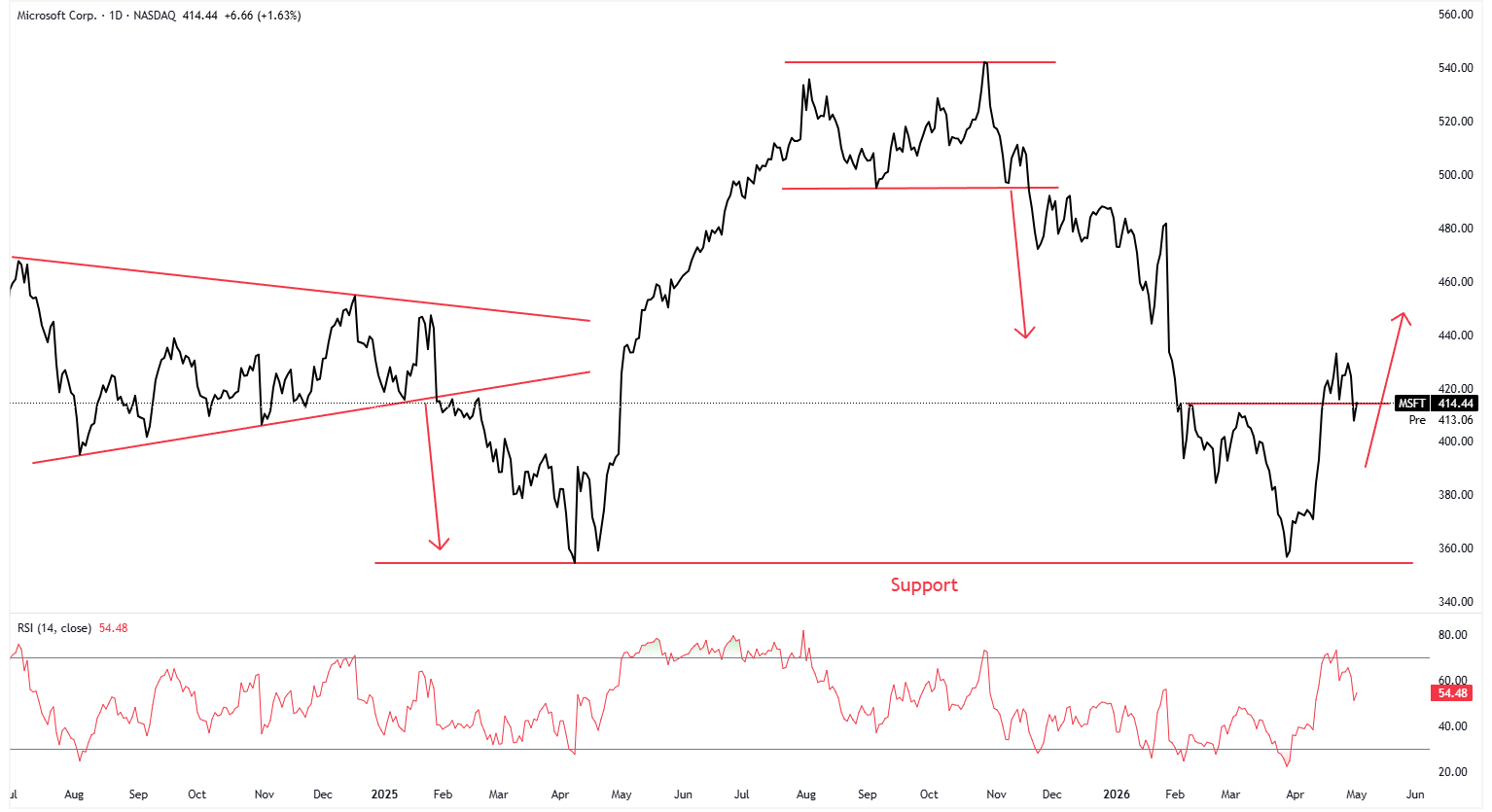
Source: TradingView. Microsoft daily price chart as of 03 May 2026.
Why Microsoft stock fell despite a strong quarter
Microsoft’s post-earnings decline highlights how much investor expectations have changed.
In previous quarters, outperforming revenue and earnings estimates may have been enough. Today, investors are focused on whether AI spending can generate sufficient returns without permanently pressuring profitability.
The market is no longer questioning Microsoft’s ability to grow, it is questioning the price of that growth, and how quickly the company can convert its infrastructure-heavy AI dominance into durable margins.
Strong Azure growth, rising Copilot adoption, and exploding AI revenue all support the long-term bull case, but softer revenue guidance and massive capex expansion have raised the bar.
Microsoft may still be winning the AI race but investors now want clearer evidence that winning will remain highly profitable.
Microsoft AI Growth Is Strong, but Efficiency Becomes Key Concern
Microsoft’s latest earnings confirmed that the company remains one of the most powerful winners in artificial intelligence.
Azure is accelerating. Copilot adoption is scaling rapidly. AI revenues are expanding at extraordinary speed.
But Microsoft is no longer judged solely by whether it can lead in AI, it is being judged by how efficiently it can do so.
The era of easy AI optimism is giving way to a more demanding phase, where capital discipline, infrastructure returns, and long-term margin resilience will matter just as much as growth.
In that sense, Microsoft’s quarter was both bullish and sobering.
The company is proving that AI demand is real, scalable, and monetizable. But it is also proving that dominating this new era may require one of the largest capital commitments in corporate history.
Key Takeaways
Microsoft’s strong earnings are overshadowed by rising AI infrastructure costs
$190 billion spending plan raises concerns over future margins
Investor focus turns from pure growth to efficiency and profitability
Professional investors looking for magnified exposure to Microsoft may consider Leverage Shares +3x Long Microsoft or -3x Short Microsoft ETPs.
Footnotes:
Microsoft Investor Relations: Earnings Release FY 26 Q3, 29 April 2026.
CNBC: Microsoft calls for $190 billion in 2026 capital spending on soaring memory prices, 29 April 2026.
Capital à risque. Vous pouvez perdre la totalité de votre investissement. Consultez l'avertissement complet sur les risques ici.
 Market Insights
 Education

