



Capital à risque. Vous pouvez perdre la totalité de votre investissement. Consultez l'avertissement complet sur les risques ici.

Middle East Tensions and Their Impact on Oil Prices
Escalation of the conflict in the Middle East over the weekend triggered a strong rebound in crude prices. The geo-political tension in the region, particularly the ongoing conflict between Israel and Iran-backed Hezbollah, have heightened concerns about regional oil supply disruptions and have fuelled speculation about potential disruptions of 3-4% of global oil supply. While the immediate impact on oil output has been minimal, the risk of a broader regional conflict could keep oil prices elevated.
Tightening Global Oil Inventories
Recent data indicates a significant tightening of global oil inventories, especially in the United States. According to data from the Organization for Economic Cooperation and Development (OECD) as of June 2024, commercial stocks of crude and refined products in advanced economies were 120 million barrels below the ten-year seasonal average, marking the lowest levels in nearly two years. In the U.S., crude inventories have dropped sharply, with a notable decline of 34.6 million barrels over eight weeks, reflecting the second-largest seasonal depletion in the past decade.
Demand Forecast Revisions Amid Economic Uncertainty
Despite the inventory drawdown, oil demand forecasts have been revised downward due to weaker-than-expected recovery in global manufacturing and freight activity. The International Energy Agency (IEA) has adjusted its global oil demand growth forecast for 2025, citing slower-than-anticipated economic recovery. The broader economic slowdown, coupled with concerns about the health of the global economy, has led to a more cautious outlook for oil consumption, despite upcoming interest rate cuts by central banks, which are likely to stimulate growth and in turn influence future oil demand.
OPEC+ Production Output Increase Plans
In June 2024, OPEC+ ministers agreed to gradually unwind production cuts starting in October 2024, with an increase of roughly 180,000 barrels per day (b/d) each month in Q4 2024 and 210,000 b/d each month through September 2025. However, these increases are conditional and could be adjusted based on market conditions. The decision to proceed with these increases or delay them will impact crude prices in the near-term.
OPEC+ Strategic Dilemma on Production Decisions
As OPEC+ prepares to make its decision, it faces a crossroads that could significantly impact global oil markets. The most prudent approach might be to delay production increases until there is clearer evidence of sustained economic recovery and stronger oil demand. Alternatively, if the group is confident in the long-term outlook, it might proceed with the planned increases, betting that the market can absorb the additional supply without a substantial drop in prices. The coming weeks will be crucial in determining the direction of global oil markets and testing OPEC+'s ability to manage supply amid ongoing uncertainties.
Source: TradingView
Crude Oil Long Term Outlook
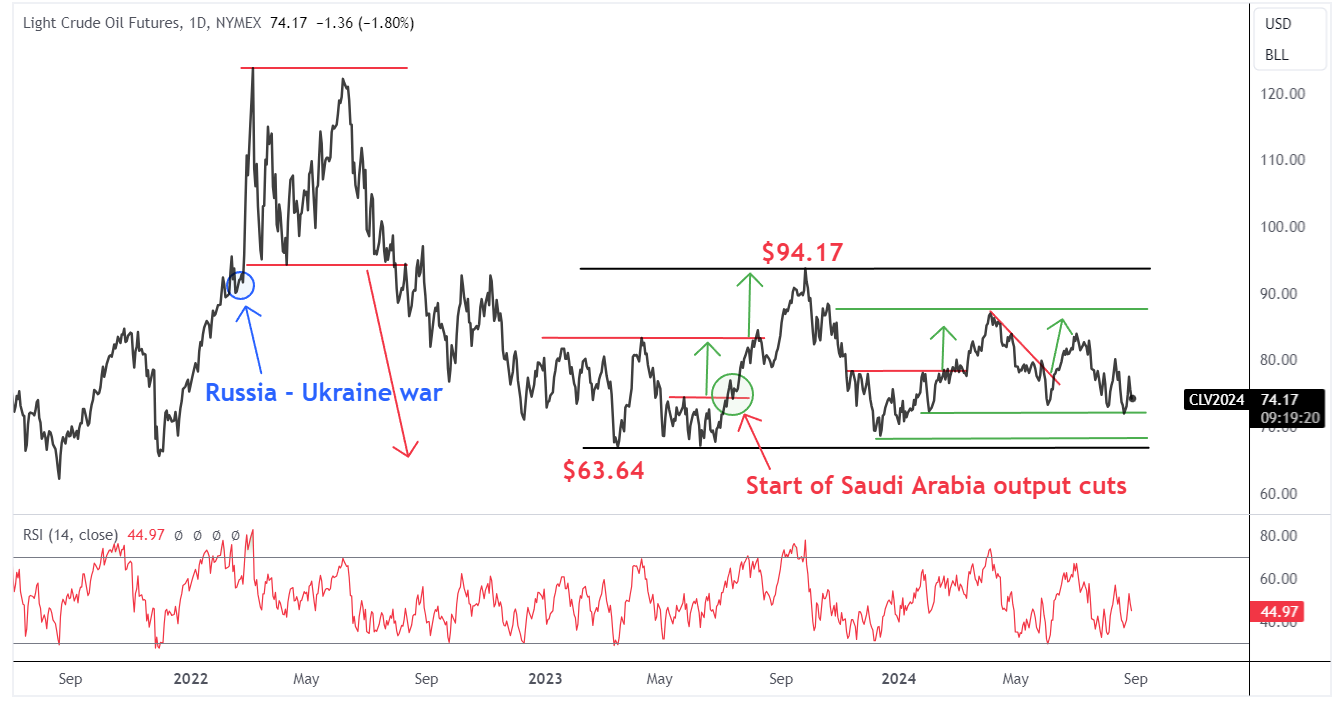
Oil prices have declined in recent months, briefly erasing year-to-date gains, as concerns over slowing demand growth in China, increased production from non-OPEC+ countries, and OPEC+'s intentions to ease output restrictions have weighed on the market. While the cartel has previously supported prices by cutting supply at the expense of losing market share, their tentative plan to boost production could signal a shift in strategy.
Although crude oil markets are currently in a supply deficit, they are expected to reach their tightest point soon. By the fourth quarter of 2024, the market is likely to achieve equilibrium, with a potential surplus forecasted for 2025.
Amid the current conflicting macroeconomic indicators and forecasts, we anticipate that West Texas Intermediate (WTI) prices will remain range-bound between $68 and $82 per barrel throughout the remainder of 2024. Looking ahead to 2025, crude prices could settle within a slightly lower range, provided that the geo-political conflicts around the world do not escalate further, which we see as the major upside risk to oil prices.
Capital à risque. Vous pouvez perdre la totalité de votre investissement. Consultez l'avertissement complet sur les risques ici.
 Market Insights

