



Capital en riesgo. Puede perder la totalidad de su inversión. Consulte la advertencia de riesgo completa aquí.
Long-running tensions between Iran and Israel came to a head on the 12th of June 2025 after the latter attacked dozens of Iranian nuclear facilities, military bases and infrastructure installations and key military commanders as well as air defence systems and missile infrastructure. Over the course of the next twelve days, Iran launched hundreds of ballistic missiles1 and around a thousand drones at Israeli targets while Israel launched hundreds of airstrikes in return. U.S. forces in the region also contributed to the defence of Israel via warships at sea and missile batteries on land, finally culminating in a series of airstrikes by U.S. bombers on Iran’s nuclear facilities on the 22nd. On the 24th, a ceasefire was agreed upon by all sides.
Seemingly, this was on the nick of time. In addition to the substantial human costs were financial: missile defence alone was estimated to have cost Israel around $200 million per day2, with Boeing-developed Arrow missiles costing around $3-4 million per interception and David’s Sling – jointly developed by Israel’s Rafale and U.S.-based Raytheon – costing around $700,000 per month. In addition, each fighter jet launched in the battle cost around $10,000 per hour in fuel costs, with munitions deployed costing more. Near the end of this 12-day war, Israel’s arsenal was reported to be running low on interceptor missiles3 while the U.S. is estimated to have incurred around $800 million4 in costs after expending 15-20% of its global interceptor missile stockpile in the defence of Israel.
As seen in recent times throughout the region, the cessation of a shooting match doesn’t necessarily imply that the root causes of the conflict have been addressed. Like many other nations in the region, the U.S. and Israel have consistently been matched in military expenditure growth trends – with high spending highly likely in the immediate future.
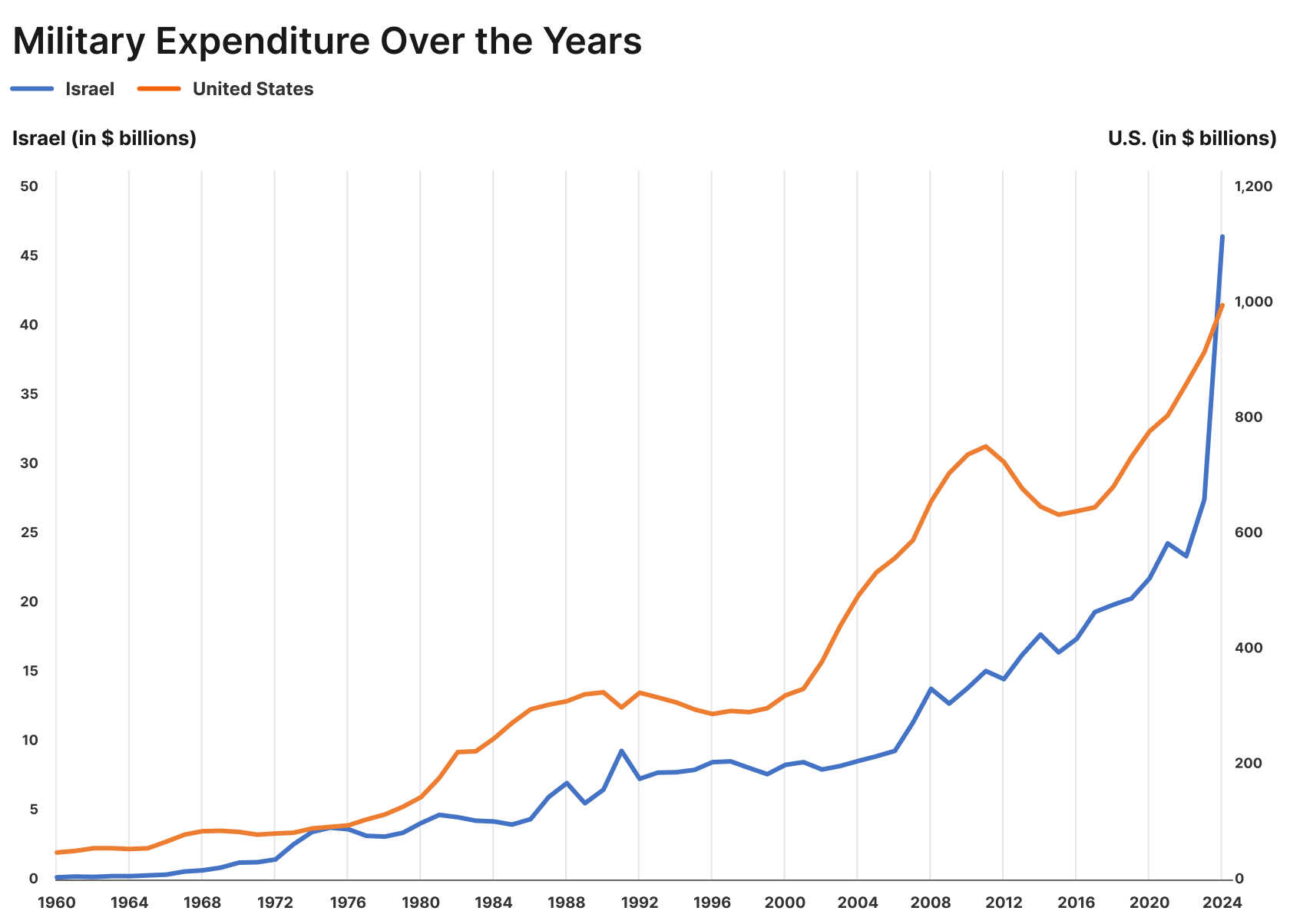
Military Spending TrendsWith the historically deep involvement of the U.S. in the Middle East, U.S. and Israeli military spending have been roughly correlated for over fifty years now.
Source: World Bank, TradingEconomics, Leverage Shares analysis
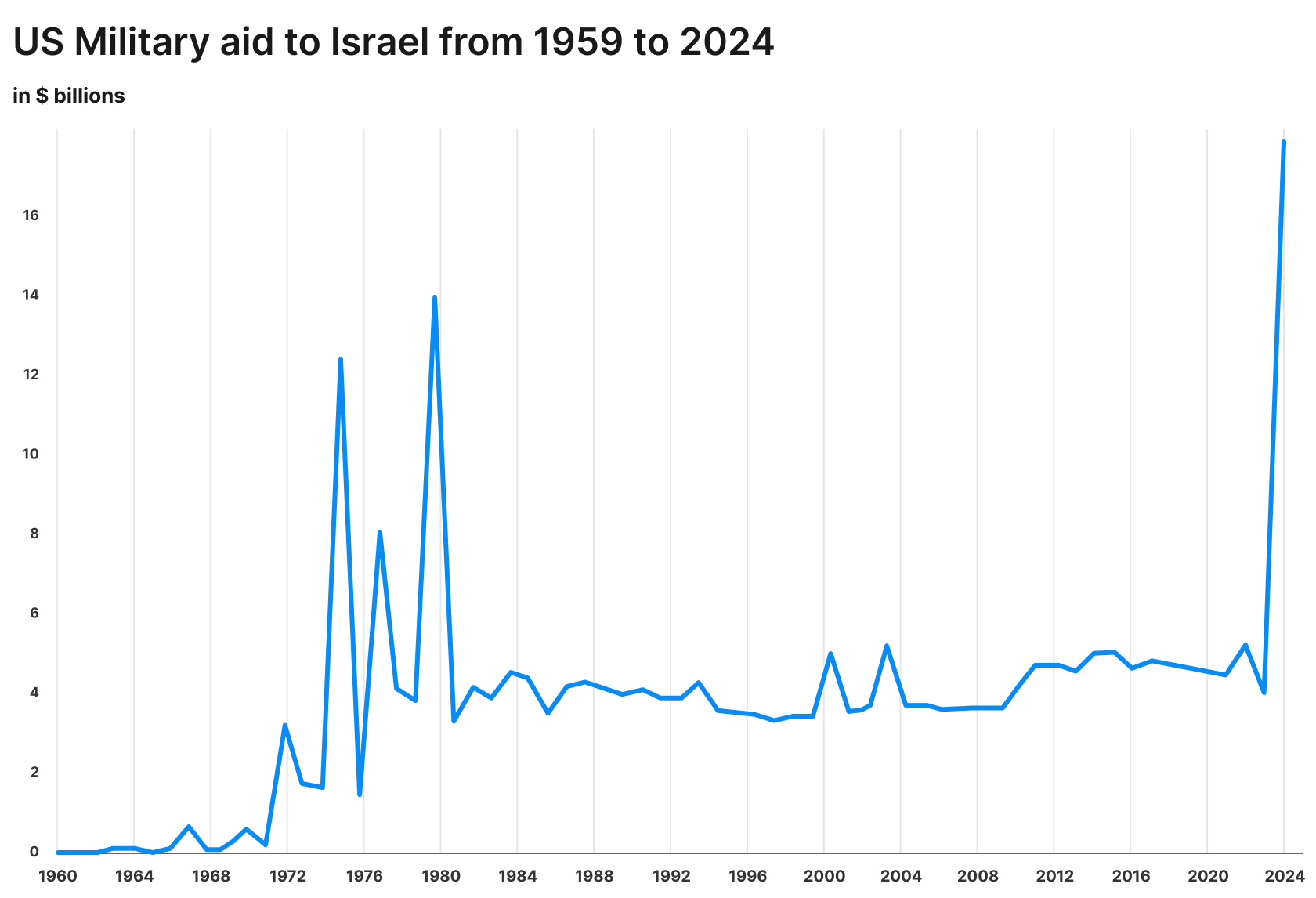
There is, however, a difference in scale: Israel’s military spending for 2024 was $24 billion while the U.S.’ was over $997 billion. To essentially maintain a parity in military effectiveness, the U.S. government has been supplementing Israel’s military budget with military aid for over half a century. Between 1959 and 2024, the Watson Institute for International & Public Affairs at Brown University estimated5 that total U.S. military aid to Israel accounted for $251.2 billion when adjusted for inflation to 2024 dollars.
Source: Brown University
This is only part of a larger aid – both military and non-military – historically provided to Israel which started with military loans in 1958 and went up to military grants in 1974, which is also when repayments of military loans made to Israel were waived. In April 2025, the U.S. Department of State stated6 that Israel is the largest recipient of military assistance under the U.S. Foreign Military Financing (FMF) programme. Since 2009, Israel has received $3.9 billion in funding every year for missile defence as part of an agreement set to end by 2028 – of which 25% is allowed to be spent on Israeli-origin systems. This is set to decrease to zero by 2028, i.e. all future aid and grants under FMF are to be spent on U.S.-origin and -made systems.
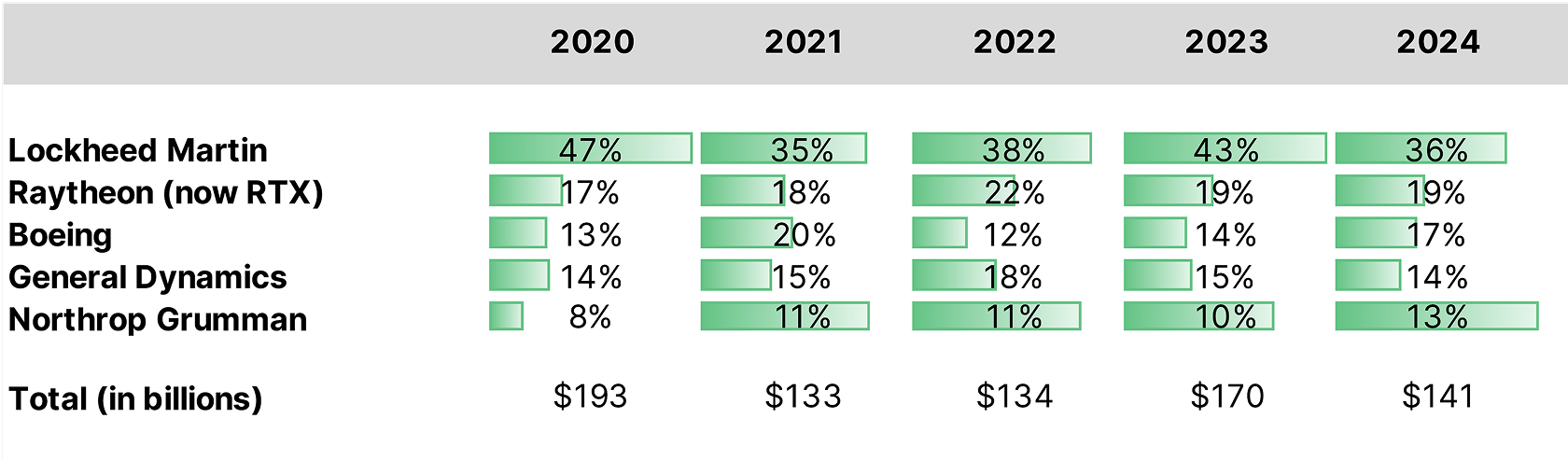
In a roundabout way, this adds to the bonanza for U.S. weapons manufacturers. From 2020 to 2024, it is estimated7 that private firms received $2.4 trillion in contracts from the Pentagon, of which $771 billion in Pentagon contracts went to just five firms: Lockheed Martin, RTX (formerly Raytheon), Boeing, General Dynamics, and Northrop Grumman. Among the five, Boeing averages at around 15% of all contracts by value while Raytheon averages at around 19%.
Source: Brown University, Leverage Shares analysis
Lockheed Martin’s high-priced jets tip the scale in contract value in its favour by averaging around 40%.
Boeing’s Stake in the Middle EastWith roughly half of its revenue originating from military sales, Boeing essentially stands to benefit from U.S. military pacts and agreements. It’s F-15 fighter jets are in service in the militaries of Israel, Qatar and Saudi Arabia. Despite its vintage, it continues to be a highly-favoured system in the region: late in 2024, Israel’s defence ministry signed a $5.2 billion deal to acquire 25 upgraded F-15s8.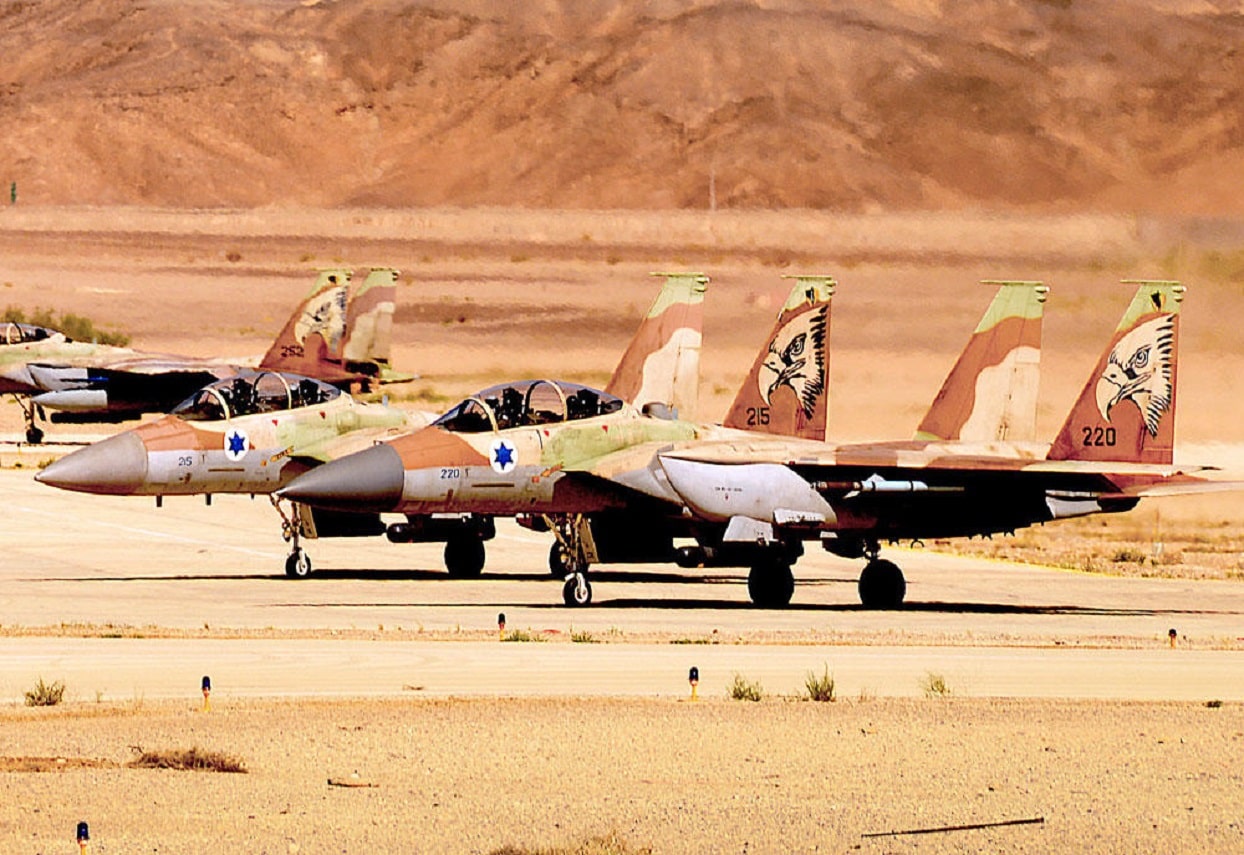
Source: U.S. Department of Defense, Creative Commons
Some of the munitions flown on Israeli military aircraft also originate from Boeing: in 2021, under a $735 million direct sale agreement9, Boeing supplied Israeli forces with conversion kits that turn unguided munitions into guided weapons – deliveries of which were accelerated as Israeli military operations escalated in 2023.
Since 2000, Israel has operated the Arrow missile family that was jointly developed with Boeing. With the capability to strike at targets at long ranges and altitudes, this system was heavily utilized during the 12-day war between Iran and Israel. Whilst it was historically only operated by Israel, the U.S. government in 2023 cleared a $3.5 billion deal10 that delivers Arrow-3 missile systems to Germany. Given that it’s a jointly-developed system, Boeing is expected to be a recipient of a portion of this amount; however, given the reported state of Israel’s missile inventory, deliveries might be delayed.
Earlier in May 2025, the U.S. and Saudi Arabia signed a $142 billion Defense Sales Agreement11, which includes air force advancement and missile capabilities. While details of how this breaks down is as yet unreleased, it can be assumed that Boeing will be a net beneficiary here as well.
“One Big Beautiful Bill” and BeyondThe recently-passed “One Big Beautiful Bill Act” included $150 billion in additional defence spending12, which included $25 billion to initiate deployment of the “Golden Dome” – the U.S. version of Israel’s battle-tested Iron Dome system – which is expected to cost at least $175 billion to complete. Given the success of Arrow, Boeing stands to potentially gain a number of contracts within the overall project.
Also included was $16 billion for the development of drones, AI and low-cost weapons. Boeing has at least two drone projects that are on the cusp of full integration. The first is the MQ-28 Ghost Bat – jointly developed with Australia – which acts as a “wingman” combat drone that is paired with fighter jets, that has evinced strong interest from the U.S. Navy13. The second is the MQ-25 Stingray – an aerial refueling drone – which the U.S. Navy is in the 4th year of integrating two squadrons of14. With this allocation, the adoption of Boeing’s drones might be accelerated. Other areas where Boeing could be expected to pick up some high-value contracts would be from the $25 billion allocation for munitions and $9 billion for air superiority aircraft development. Also added was $1 billion specifically for Boeing to continue development of the X-37 robotic spaceplane.
Furthermore, on the 30th of June, the U.S. government has approved the sale of $510 million in bomb kits to Israel15, in which the principal contractor is Boeing.
While the rest of the equity universe might be subject to uncertainty over inflation and other economic headwinds, it seems that Boeing is likely to continue to make inroads in expanding its revenue on account of geopolitical concerns. Investors might like to consider this company for their portfolios, if not already present. Professional investors in Europe with a tactical bent of mind might like to consider the +3X Long Boeing ETP (BA3), which gives leveraged exposure to the stock’s performance, which would be quite handy during the upsides of its trajectory. Meanwhile, the -1x Short Boeing ETP (BAS) replicates a short position in the stock without requiring a margin account, which would be quite useful during downsides of the stock’s trajectory.
(Author of cover image: Tomás Del Coro, 24 August 2015)
Footnotes:
- "How Israel used Iran's massive attacks to enhance its top ballistic missile shield", Business Insider, 26 June 2025
- "Israel’s War on Iran Is Costing Hundreds of Millions of Dollars a Day", Wall Street Journal, 19 June 2025
- "Israel Running Low on Arrow Interceptor Missiles Used to Defend Against Iranian Attacks, WSJ Reports", Haaretz, 18 June 2025
- "US Missile Defenses Heavily Depleted in Shielding Israel: report", Newsweek, 27 June 2025
- "United States Spending on Israel’s Military Operations and Related U.S. Operations in the Region, October 7, 2023 – September 30, 2024", Brown University, 7 October 2024
- "U.S. Security Cooperation with Israel", U.S. Department of State Fact Sheet, 25 April 2025
- "Profits of War: Top Beneficiaries of Pentagon Spending, 2020 – 2024", Brown University, 8 July 2025
- "Defense Ministry signs $5.2 billion deal to buy 25 advanced F-15IA fighter jets", Times of Israel, 7 November 2024
- "Boeing Accelerates Delivery of Up to 1,800 GPS-Guidance Bomb Kits to Israel", Bloomberg News, 19 October 2023
- "Israel says Arrow-3 missile-killer sale to Germany approved by U.S.", Reuters, 17 August 2023
- "Fact Sheet: President Donald J. Trump Secures Historic $600 Billion Investment Commitment in Saudi Arabia", U.S. White House, 13 May 2025
- "Congress passes Trump’s reconciliation megabill with $150B for defense", Breaking Defense, 3 July 2025
- "MQ-28 Ghost Bat Is Of “Strong Interest” To The U.S. Navy", The War Zone, 15 April 2025
- "Navy Establishing Two MQ-25 Squadrons For Detachments, Plans To Refuel Test E-2", Defense Daily, 2 August 2021
- "Israel – Munitions Guidance Kits and Munitions Support", U.S. Defense Security Cooperation Agency, 30 June 2025
Capital en riesgo. Puede perder la totalidad de su inversión. Consulte la advertencia de riesgo completa aquí.
 Market Insights

