



Capital en riesgo. Puede perder la totalidad de su inversión. Consulte la advertencia de riesgo completa aquí.
Key takeaways
Micron reported record Q4 revenue of $54.23 billion, up 379% year on year. 1
Adjusted EPS reached $33.42, while gross margin climbed to a record 87%.1
Fiscal Q1 revenue guidance of $61.5 billion signals that the AI memory boom is accelerating. 1
Micron Technology has delivered another blockbuster quarter, but the bigger story may be what comes next.
The memory-chip maker reported record fiscal fourth-quarter revenue of $54.23 billion, up from $41.46 billion in the previous quarter and $11.32 billion a year earlier. Non-GAAP earnings reached $33.42 per diluted share, compared with $3.03 a year earlier.1
The numbers were far above the levels investors had become accustomed to seeing from Micron, but the company did not stop there. Its outlook for fiscal Q1 2027 points to another substantial acceleration, suggesting that artificial intelligence demand is continuing to reshape the memory-chip industry.
Micron Earnings Surge as AI Demand Drives Record Profits
Micron reported $54.23 billion in revenue, a 31% increase from the previous quarter and almost five times the revenue recorded in fiscal Q4 2025.1
GAAP net income rose to $37.70 billion, compared with $3.20 billion a year earlier, while non-GAAP net income reached $38.40 billion.1
The improvement was also visible in margins. Micron reported a GAAP gross margin of 86.8%, compared with 84.6% in the previous quarter and 44.7% a year earlier. On a non-GAAP basis, gross margin reached 87%.1
That is important because memory chips are historically a cyclical business. When supply becomes tight and pricing improves, profits can rise extremely quickly. The latest results show just how powerful that operating leverage has become during the current AI-driven memory cycle.
Micron HBM Demand Surges as AI Memory Supply Tightens
High-bandwidth memory, or HBM, has become particularly important because advanced AI accelerators require large amounts of extremely fast memory.
Micron has been expanding its HBM business alongside traditional DRAM and NAND products, and the latest results suggest that demand is running ahead of available supply.
Micron's long-term supply agreements had increased to $32 billion, up from $22 billion in June. The agreements are largely backed by customer cash deposits, giving Micron greater visibility over future demand.2
Instead of waiting for customers to place orders quarter by quarter, Micron is securing demand through longer-term agreements.
Micron Data Center Business Surges on AI Demand
The strongest growth came from Micron's data-center-related operations.
Revenue from the Core Data Center business reached $18.0 billion, compared with $11.52 billion in the previous quarter and just $1.58 billion a year earlier. Its gross margin reached 90%, while operating margin climbed to 85%.1
The Cloud Memory business generated another $16.28 billion of revenue, with an 83% gross margin.1
The figures underline how dramatically AI infrastructure is changing Micron's revenue mix.
Large technology companies are investing heavily in data centres, AI accelerators and networking infrastructure. All of that computing power requires memory, and sophisticated AI workloads require more advanced forms of memory.
This puts Micron in an unusual position. The company is benefiting not only from the number of AI chips being deployed, but also from the increasing amount of memory required by each generation of AI infrastructure.
Micron Rises Q1 2027 Guidance as Memory Shortage Persists
Perhaps the most important part of the earnings report was the outlook.
Micron expects fiscal Q1 2027 revenue of $61.5 billion, plus or minus $1.5 billion. It expects non-GAAP gross margin of approximately 86.25% and non-GAAP diluted EPS of $38.15, plus or minus $1.00.1
In other words, Micron is expecting revenue to increase by roughly 13% sequentially from the already-record fiscal Q4 level.
That is a remarkable pace for a company of Micron's size. It also suggests that management sees the current memory shortage continuing rather than quickly moving back towards a more balanced market.
Micron expects supply-demand conditions to remain tight through fiscal 2027 and 2028, while the company has already secured agreements covering most of its 2027 output.2
That gives investors an important clue about the potential duration of the current memory cycle.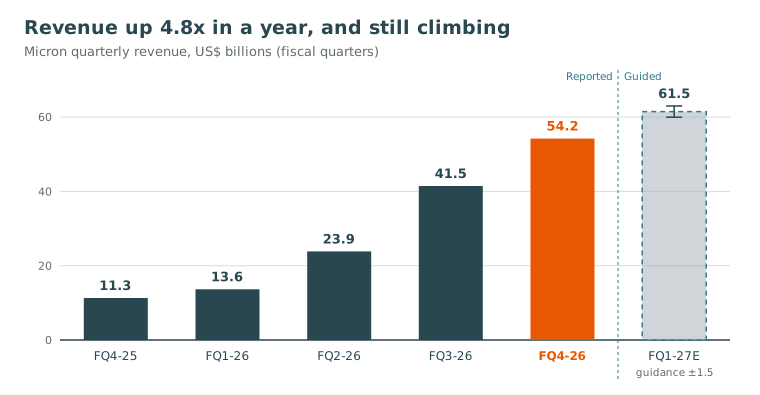
Source: Micron earnings releases; FQ1-27 company guidance, as of September 30, 2026.
Earnings Growth is Slowing and Margins Face Pressure
The Q1 guidance is extremely strong in absolute terms, but the sequential growth rate deserves attention.
Micron's adjusted EPS increased 33% from Q3 to Q4, while the Q1 guidance implies roughly 14% sequential growth. 3
That does not mean demand is weakening. Rather, it shows how difficult it becomes to maintain the same growth rate as the earnings base gets larger.
Margins also provide an early warning. Micron expects adjusted gross margin of approximately 86.25% in Q1, compared with 87% in Q4. Operating expenses are expected at around $2.06 billion, while the company expects operating expenses to increase by approximately $2.5 billion during fiscal 2027.3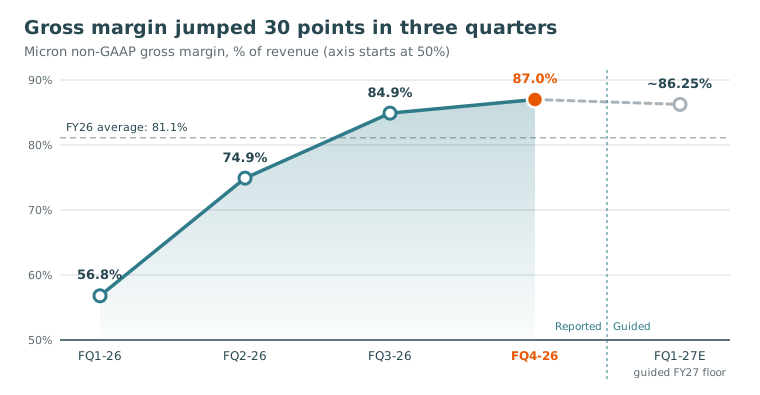
Source: Micron F-26 releases and FQ1-27 estimates, as of September 30, 2026.
HBM4 Could Become the Next Major Growth Driver
Micron is also moving further into the next generation of high-bandwidth memory.
The company said HBM4 is already in high-volume shipments for its lead customer's platform, while qualification samples have been shipped to additional customers. It also said development of HBM4E is progressing, with volume production expected in calendar 2027.4
As AI models become larger and more complex, the ability to move data quickly between processors and memory becomes very important. HBM is designed specifically for this type of high-performance computing environment.
Micron is therefore positioned across several parts of the AI memory stack, from conventional server DRAM to high-bandwidth memory and high-performance SSD storage.
Micron Boosts Capex to Meet Surging AI Memory Demand
There is, however, another number investors should watch closely: capital expenditure.
Micron spent $10.77 billion on net capital expenditure in fiscal Q4 and $27.37 billion for the full fiscal year.1
The company needs to invest heavily because demand is so strong. But increasing capacity is not risk-free.
Memory manufacturing is extremely capital intensive. If Micron, Samsung or SK Hynix eventually add too much capacity at the same time, the supply shortage can turn into oversupply. That is precisely what has historically made memory stocks so cyclical.
For now, Micron appears to believe demand will remain strong enough to justify additional investment.
Micron plans to invest more than $250 billion in US facilities through 2035, while also expanding capacity in other locations.² The challenge will be timing that investment correctly.
Conclusion
Micron delivered an extraordinary quarter, alongside guidance pointing to another substantial increase in sales. Management expects memory supply-demand conditions to remain exceptionally tight as AI infrastructure absorbs capacity.
The numbers push back against concerns that AI infrastructure demand is already rolling over. Investors had also spent much of the year pricing in exactly that strength, with Micron entering the report after a huge rally.
But the valuation debate is likely to become focused on how sustainable these earnings are.
A memory company generating extraordinary profits during a period of tight supply can produce spectacular earnings growth. The difficult question is whether those earnings can remain elevated when new manufacturing capacity eventually enters the market.
That is why the 2027 and 2028 supply outlook would be more important than the fiscal Q4 numbers themselves.
Micron post earnings market reaction was muted as the 10-year Treasuries crossed 5.3%. Earnings are still rising fast enough to support AI valuations, but they are being asked to clear a high hurdle from Treasuries. Nonetheless, our long-term outlook on the stock remains positive and we see a potential for the share price to rise to $1,300 - $1,350 over time.
Professional investors looking for magnified exposure to Micron may consider Leverage Shares +2x Long Micron ETP.
Footnotes:
Micron Technology, Press Release: Micron Technology, Inc. Reports Record Fiscal Fourth-Quarter and Full-Year 2026 Results, as of September 30, 2026.
Reuters, Micron’s AI-fueled revenue forecast blows past estimates, backlog swells, as of September 30, 2026.
Investing.com, Micron forecasts stronger first quarter on strong AI demand, as of September 30, 2026.
Micron Technology, Micron Technology, Inc. Reports Record Results for the Third Quarter of Fiscal 2026, as of June 24, 2026.
Capital en riesgo. Puede perder la totalidad de su inversión. Consulte la advertencia de riesgo completa aquí.
 Market Insights

