


While ASML Holding (ticker: ASML) is a Dutch semiconductor manufacturing equipment provider and Taiwan Semiconductor Manufacturing Company (ticker: TSM) are companies centred in geographically distinct locations and occupy entirely different places in the semiconductor manufacturing ecosystem, both companies have one common trait when they reported their Q1 2026 earnings on consecutive days, beginning with ASML on the 15th of April. Despite topping expectations by a margin that would be deemed substantive (and generally was by the media), neither company’s stock prices registered a significant uptick after the earnings release. In both cases, a distinct bearish sentiment was implied immediately afterward.
Both companies have distinct trends in line items but with a lot more in common in terms of global position and implications therein.
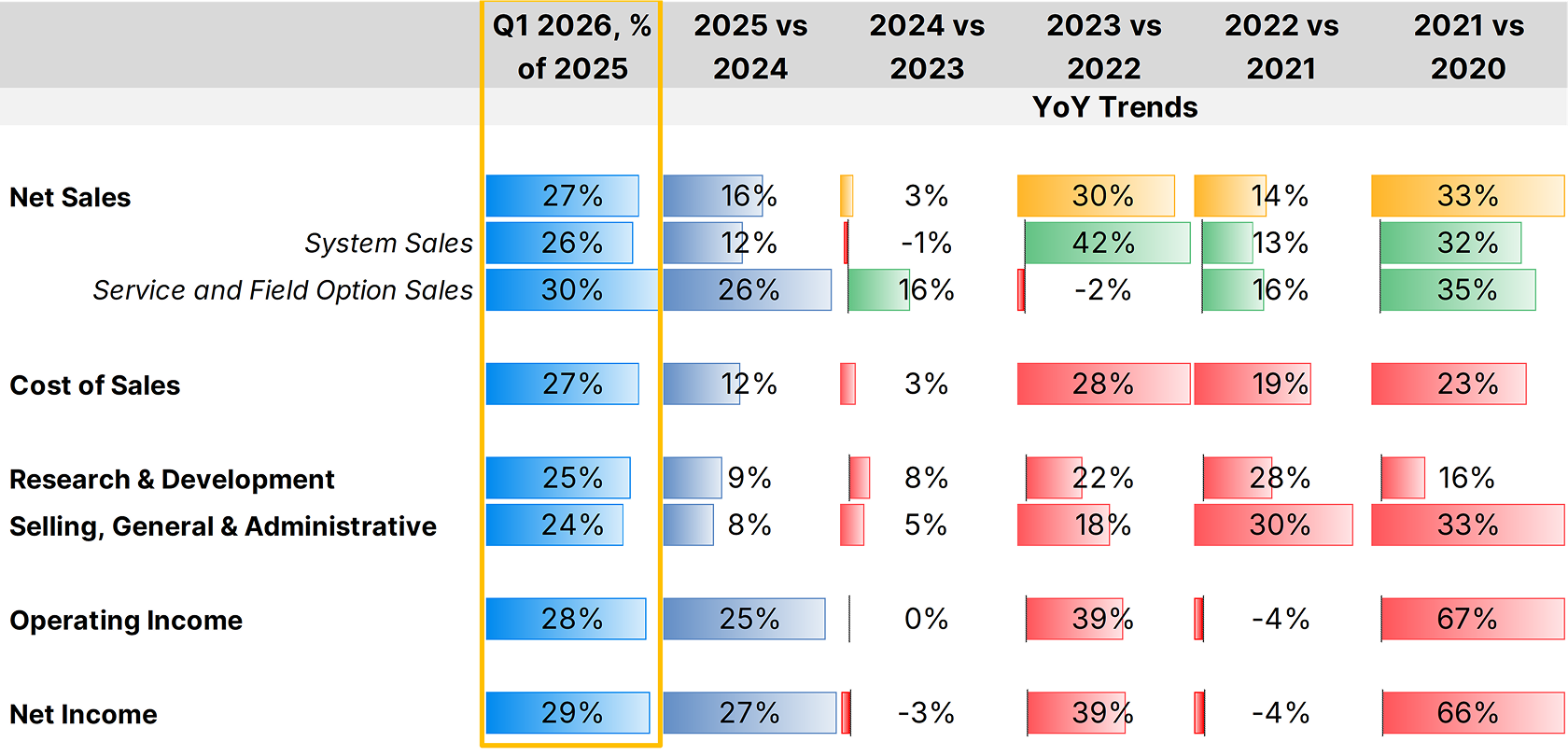
Trend AnalysisEarly trends in ASML indicate that net sales (or revenue) could close Fiscal Year (FY) 2026 at roughly half the growth exhibited in FY 2025:
Source: Company Information; Leverage Shares analysis
ASML-made lithography machines are extensively used in the manufacturing of advanced chips and generally constitute a highly cyclical business: the machines sold are expensive, long-lived and go on to generate income for the company via maintenance costs, et al, which are captured in the "Service and Field Option Sales" line item – which is currently trending at 20% growth for FY2026.
Expenses such as R&D expenditure and selling costs are running at par with the previous FY while the relatively higher ticket price of machines sold are aiding in boosting net income to trend at 16% growth which is, again, lower than that seen through most of the 2020s.
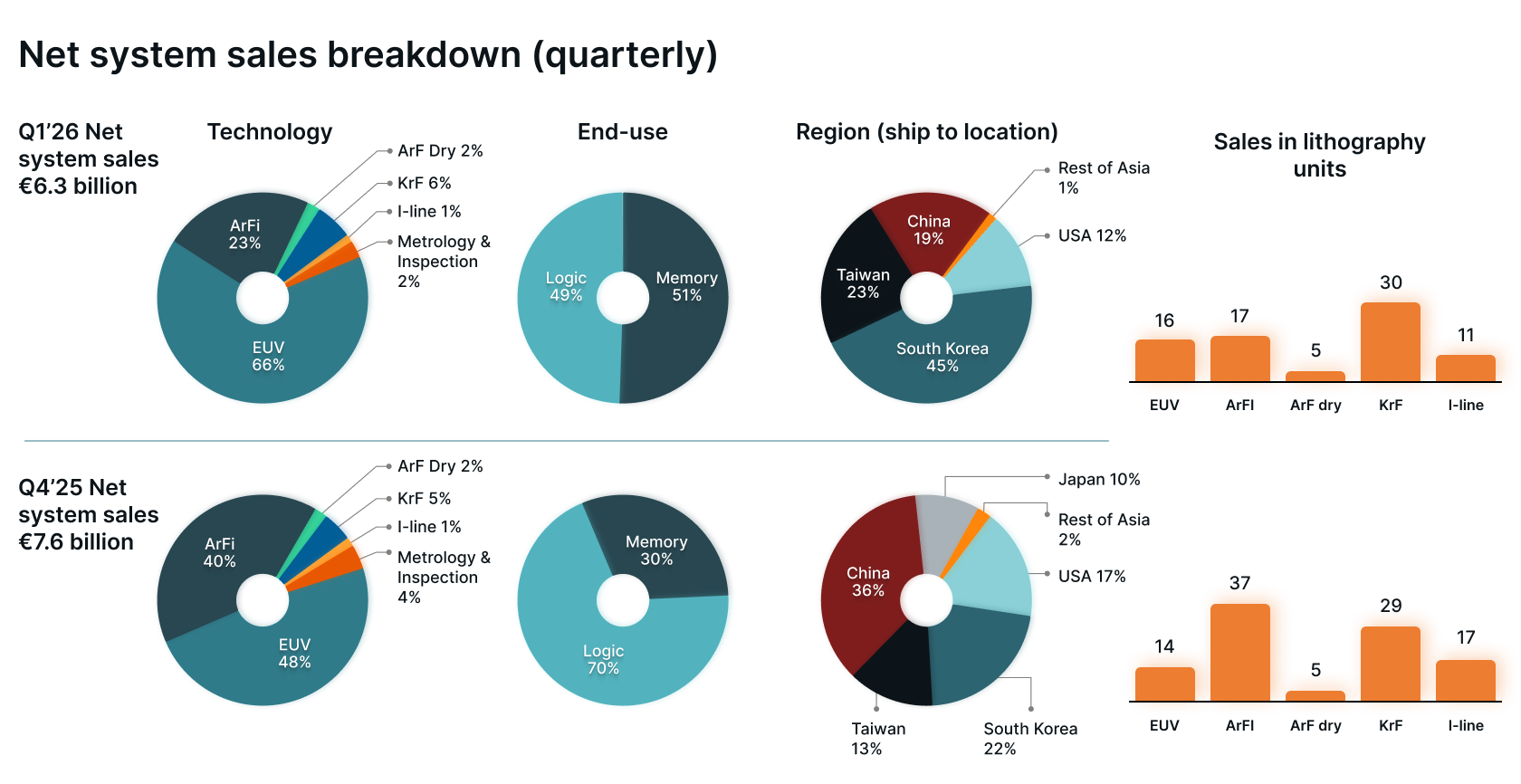
A very noticeable change, at least in this quarter, is the composition of the purpose for which machines are being acquired by clients: memory manufacturing dominates over the sale of machines for the manufacturing of GPUs ("Graphics Processing Units") that are the core of the "brain" employed for running AI.
Source: ASML Q1 2026 Presentation. Image redesign by Leverage Shares
Within a single quarter, machines for the manufacturing of memory chips have gone from 30% of all system sales to 51%. This is borne out by the massive increase in sales share in South Korea from 22% to 45%, where Samsung Electronics and SK Hynix have been ramping up production of memory chips. Furthermore, of relevance is the fact pattern that EUV ("extreme ultraviolet") lithography machines comprise 66% of all sales now (up from 48%). ASML is the world's sole supplier of EUV machines employed in the manufacturing of advanced chips. While companies such as Japan’s Nikon and Canon supply lithography tools as well, they are generally deemed not sufficiently capable enough for the top layers of the wafer technology employed in AI-relevant chips.
Meanwhile, TSMC in Q1 2026 presents a pristine picture of what could unfold for the company in the ongoing FY:
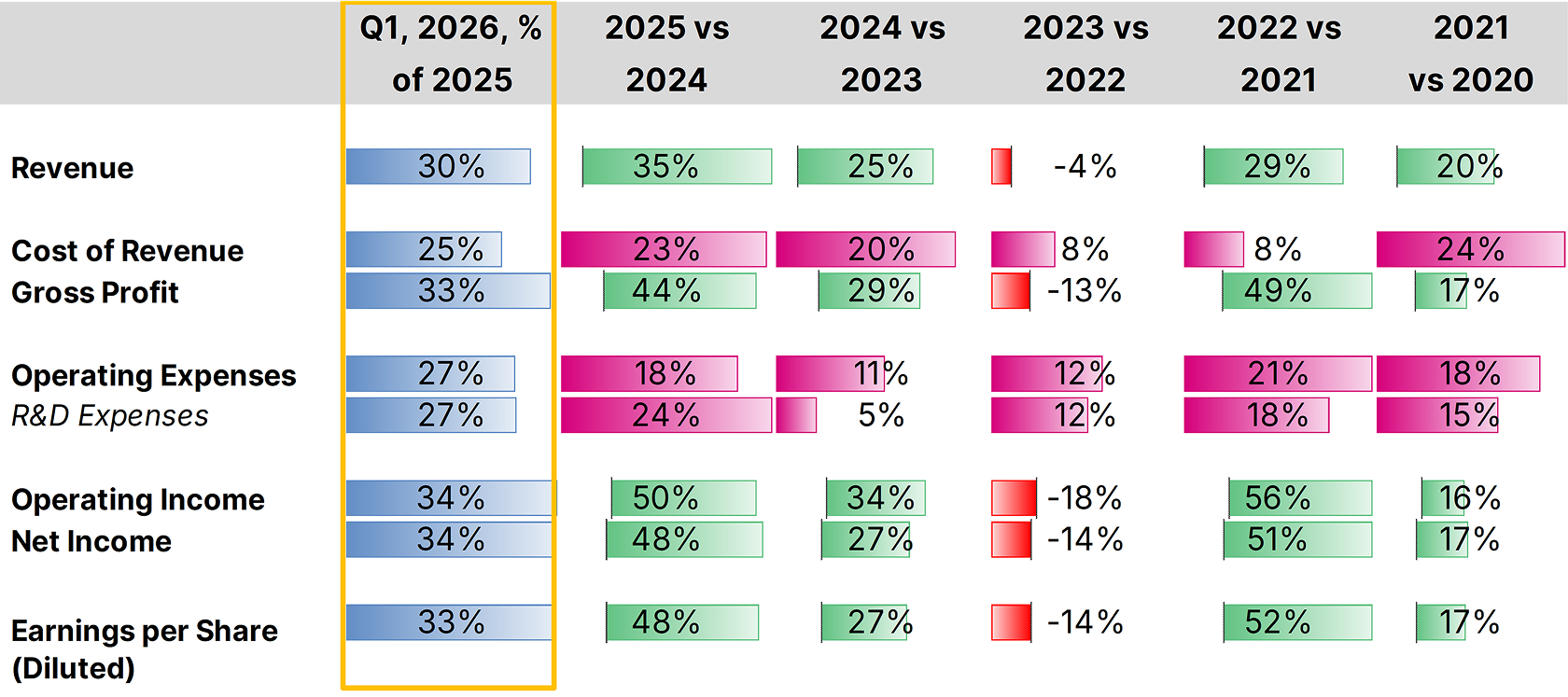
Source: Company Information; Leverage Shares analysis
In a single quarter, a little under a third of the entire previous FY's revenue has been achieved while cost of revenue and operating expenses exhibit an early trend of running mostly flat for the current FY. Net Income and Earnings Per Share (diluted) are already at a third of that was achieved across the entirety of FY 2025 – a strong year.
If early trends were to prevail, the company would have seen around 20% growth, which runs a third below the growth projected in their outlook. However, the “bump up” is largely due to the company's report of high-capacity utilization of its facilities which the lowers of the per-unit cost of what TSMC produces for its clients.
Towards the end of 2018, the company had mostly produced chips for smartphones (53% of revenue), a decidedly more mass-marketable and accessible product than High-Performance Computing (HPC) – which includes AI chips for Nvidia and AMD – now accounting for 61% of total revenue.
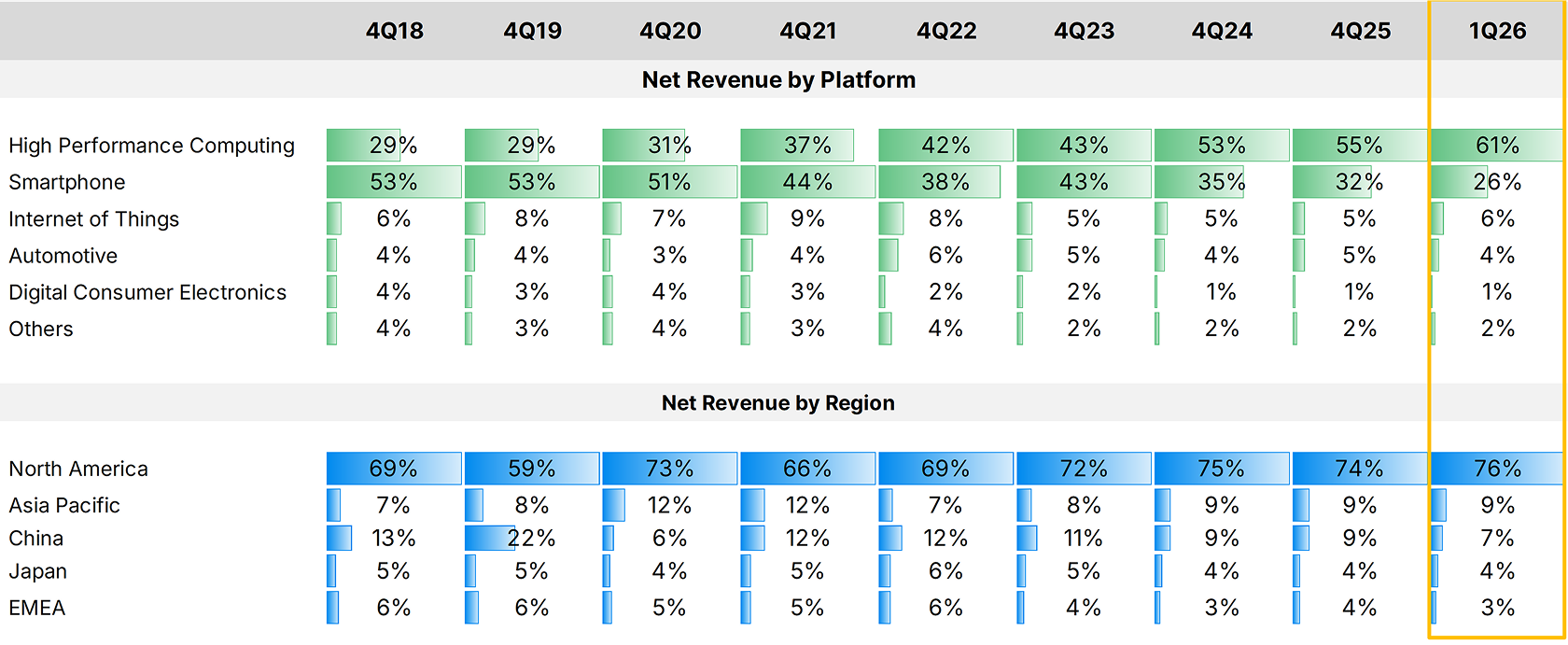
Source: Company Information; Leverage Shares analysis
Furthermore, 3nm and 5nm technologies – highly favoured for AI chips – together made up 61% of wafer revenue and are becoming TSMC's highest-margin products. Combined with strong pricing power due to limited 2nm/3nm capacity, the company's gross profit margins have seen substantial expansion to 66.2% and is projected to remain around this value for the entire FY.
Consequences of ConcentrationWhen considering TSMC’s geographical revenue share, one region stands out: China has been in a long and steady decline, going from nearly a fourth of all revenue in 2019 to a single-digit share likely to draw down further.
This is the beginning of where the commonality rises. ASML’s data indicates that China has undergone a near-halving of revenue share in Q1 2026 relative to Q4 2025 as the company seemingly limits sales to previously-inked contracts (as indicated in the previous earnings call1) under weight of technology export restrictions. This represents a long-term bottleneck for the company: its ability to turn out high-quality products of strategic value effectively turns it into a pawn of global geopolitics, potentially leaving a significant portion of demand untapped.
TSMC's manufacturing prowess – which is almost entirely based in Taiwan – and the resulting value as a geopolitical asset has made them vulnerable in another way (and as discussed in the article for its Q3 2025 results2): they're constantly under pressure to build out manufacturing facilities in the U.S., thus adopting labour and cost economies that they haven't been able to execute successfully for well over 25 years.
Another aspect likely pertinent to investors are likely considering is the sustainability of demand. Purchases of ASML's machines are predicated on sustained demand for AI-relevant chips in datacenters, which TSMC’s data indicates predominantly emanates from the U.S., thus making it arguably one of the world's biggest markets for AI. The state of Maine has passed a "temporary" ban3 on the construction of datacenters. This was merely the legislative affirmation of a larger trend: between May 2024 and early 2026, local opposition in the U.S. has significantly impacted the datacenter industry, with $64 billion to $162 billion in projects being blocked or delayed. The grassroots of the movement against datacenters have a strong bipartisan flavour: around 55% of the local officials opposed to datacenters are Republicans4 (i.e. ostensibly the same party in power in the White House). The factors for this opposition have been well-documented5 in recent times: datacenters consume massive volumes of water and electricity that often has the communities they're situated in - usually rural and relatively impoverished - reeling from the effects of and footing the bill for.
In contrast: the likes of China and India might have strategic intents behind building datacenters (as opposed to the mostly commercial in the U.S.). However, given their economic size and talent availability, owning a stake in production of assets is a point of contention they would seek to negotiate but ASML and TSMC are likely unable to comply with, given the deep-running currents of geopolitics. Whether ASML or TSMC would ever be able to can currently be estimated as being somewhere between uncertain and unlikely.
This untapped demand, in turn, becomes the potential nucleus of permanent substitution. Given that semiconductors are the cornerstones of technology employed in modern economies, national demands must be met. In countries with high friction, sovereign policymaking trends and large talent pools, this will inevitably promote calls for self-reliance. Restrictions on China or even a "soft ban" on (for example) Indian enterprises acquiring the technology to meet domestic needs in the future under the banner of geopolitical wrangling will inevitably lead to the creation of alternatives.
Whenever it comes to ASML or TSMC, commentary inevitably mention the “moats” they’ve built without irony. Historically, the obstacles presented by moats were generally surmounted by careful planning. While companies think in quarters and fiscal years, countries necessarily think in decades at least.
Market ReactionThese two companies’ stocks – both of which are able as stocks in the country and as ADRs in the U.S. – differ in the manner in which the market received both the anticipation and the aftermath of the earnings.
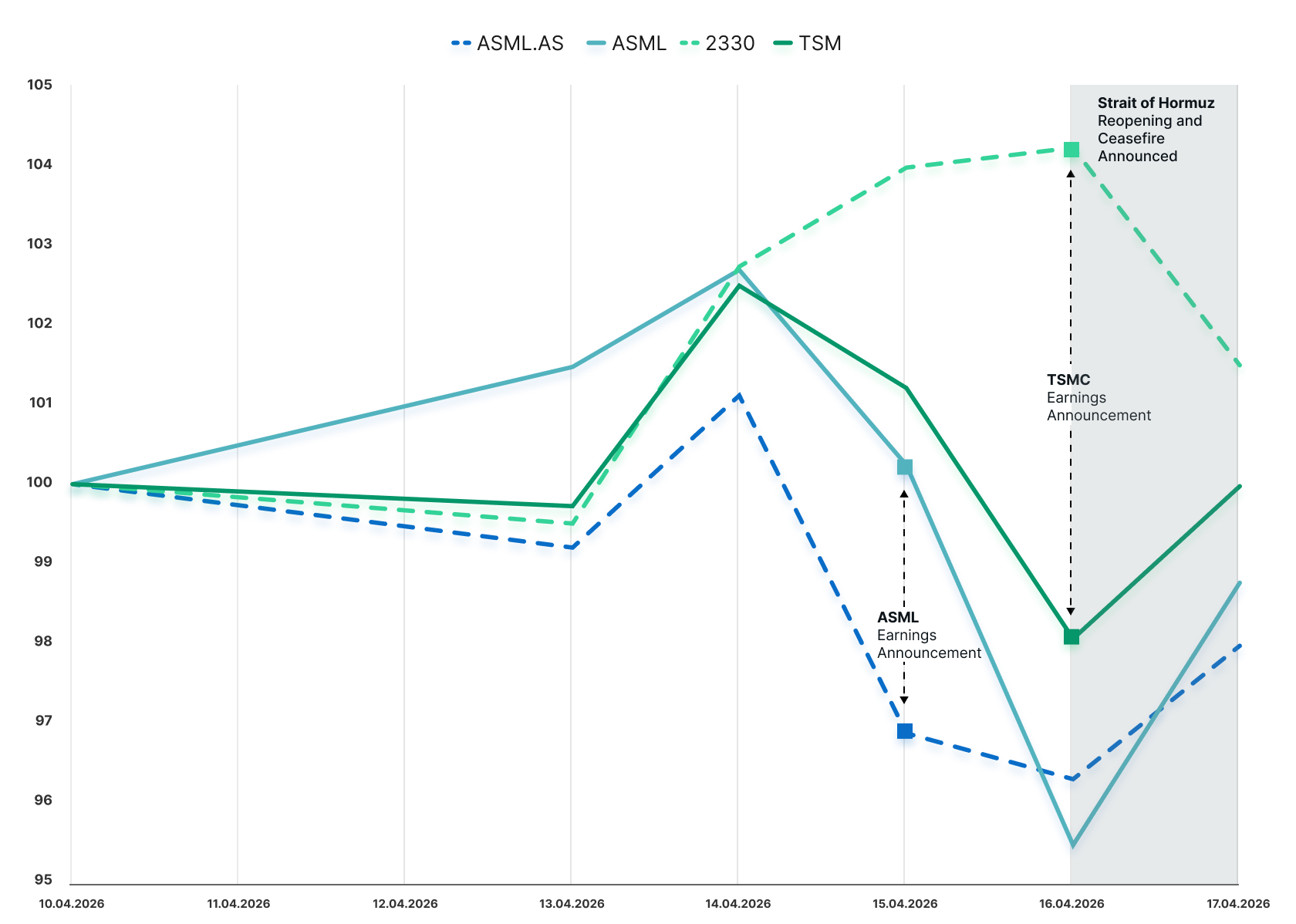
Source: Leverage Shares analysis
In the week when the earnings were released, ASML’s Amsterdam-listed stock (“ASML.AS”) displayed relatively cautious yet largely-bullish optimism, much like its ADR (“ASML”). Overall trajectories for both tickers leading into the earnings release over Q1 2026 was flat-to-bullish. In contrast, TSMC’s Taiwan-listed ticker (“2330”) adopted a substantially more bullish trajectory in the week, which was in line with the ticker’s performance relative to its ADR (“TSM”) in short spurts throughout Q1 2026.
In ASML’s case, post-earnings trajectory largely confirmed the outlook on global and broader growth on both its tickers. In TSMC’s case, the domestic ticker reflected the immediate correction outlook implied in the previous trading session over in the U.S. TSMC’s U.S. ticker lifted on the 17th of April when a ceasefire was announced in the Strait of Hormuz just before the U.S. market opened and shortly after Asian markets closed. ASML’s ticker both rebounded on the 17th in line with the rest of the market.
However, over the weekend, negotiations broke down quite rapidly, leaving this “relief rally” on all tickers potentially on the verge of being erased, along with additional bearish uncertainty possibly being piled on.
All told, the uncertainty behind widespread adoption given the high costs, the grassroots opposition, and geopolitical constraints as well as conflict combine together in an intricate mesh to potentially leave an impact on the forward valuation on the likes of ASML, TSMC and potentially other AI-adjacent stocks in this current earnings season.
Professional investors in Europe might consider the +3x Long ASML ETP (ASL3) and the -3x Short ASML ETP (ASMS) during bullish and bearish trends in ASML . Also available for consideration are the +3x Long Taiwan Semiconductor ETP (TSM3) and the -3x Short Taiwan Semiconductor ETP (TSMS) during bullish and bearish trends in TSMC's stock. For a broader yet leveraged exposure, the +4X Long Semiconductor ETP (SOXL) and the -4X Short Semiconductor ETP (SOXS) are at hand.
Footnotes:
- "Did ASML Reveal That It Might Be Exiting China?", Leverage Shares, 2 February 2026
- "Why TSMC's FY 2025 Results Didn't Excite Markets", Leverage Shares, 20 January 2026
- "Data centers are spreading around the country. Now, data-center bans are, too", CNN, 12 April 2026
- "The AI Data-Center Rebellion Is Growing Fast and Getting Violent – What Investors Need to Know", MarketWise, 15 April 2026
- "A bottle of water per email: the hidden environmental costs of using AI chatbots", Washington Post, 18 September 2024
 Education
 Market Insights

