



Many investors have come across the term leverage trading, an investment tool used in both financial and mainstream media. Let's explore this concept in detail.
WHAT IS LEVERAGE TRADING?
Leverage trading allows investors to increase their market exposure by borrowing funds from their broker in addition to their existing balances. This can potentially amplify both gains and losses. Put differently, it’s using borrowed capital on top of your own equity (cash) to magnify the potential returns of your bet.
WHAT IS A LEVERAGE RATIO?
In simple terms, it is the ratio between the amount of money you can trade over the amount of money you have. For instance, a 10:1 leverage ratio means you trading up to $10 000 for every $1 000 exposure to your broker. This will allow you to increase your equity (money) up to $10k. Now your buying power is up 10x allowing you to make much larger investments.
HOW DOES LEVERAGE TRADING WORK?
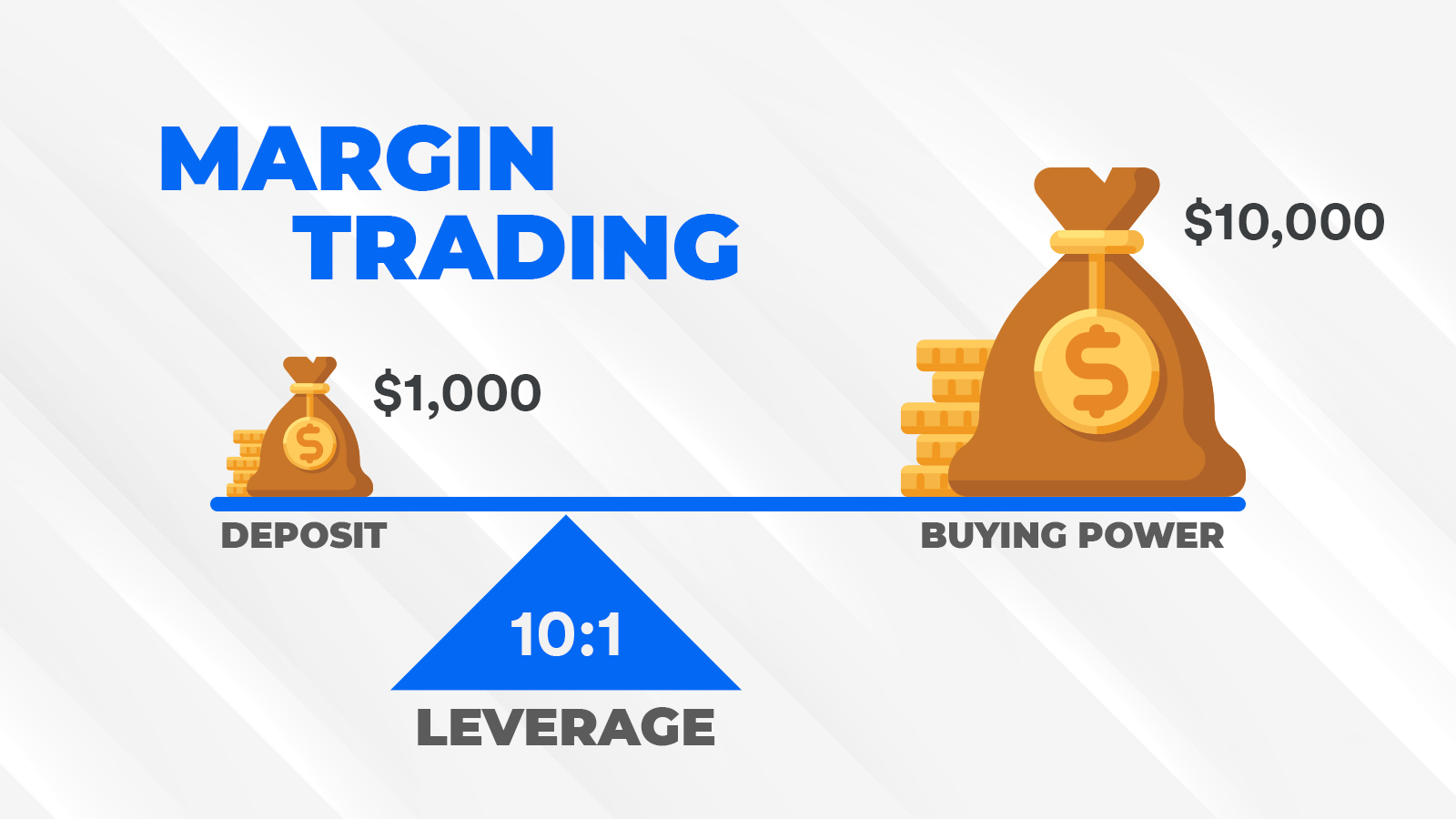
Leverage works by using a deposit, known as margin, to provide you with increased exposure. Let’s continue with our previous example. Suppose that you currently have $1000, but you feel that is not enough if you aim for 10% return or $100 gain. If you decide to use 10:1 leverage to boost the return of your initial investment, the broker will take your $1 000 and lend you the rest or $9 000. In essence, bumping up your buying power or equity to $10k. Now if you successfully achieved that same return your profit will be $1000 or ten times larger with the use of leverage. Hence, while leverage can potentially increase profits, it's important to note that it can also amplify losses. It acts as a double-edged sword, increasing both potential gains and risks. So, the next question that comes to mind is
HOW MUCH LEVERAGE SHOULD I USE?
Choose the leverage you are comfortable with depending on your experience, financial knowledge, and comfort level.
Obviously, beginner investors should be careful as leverage amplifies your potential gains as well as possible losses.
HOW LEVERAGE TRADING APPLIES TO MULTIPLE ASSET CLASSES
Leverage can be used across a variety of financial markets stocks, indices, forex, treasuries, CFDs, and ETPs. Also, you can use leverage in investing outside your margin account. Leverage exchange-traded funds (ETPs) use borrowed funds to deliver returns of 2x, 3x or even 5x vs their benchmark indices. There are many advantages of using ETPs in comparison to other investment vehicles that use leverage.
Benefits of using ETPs vs other financial instruments.
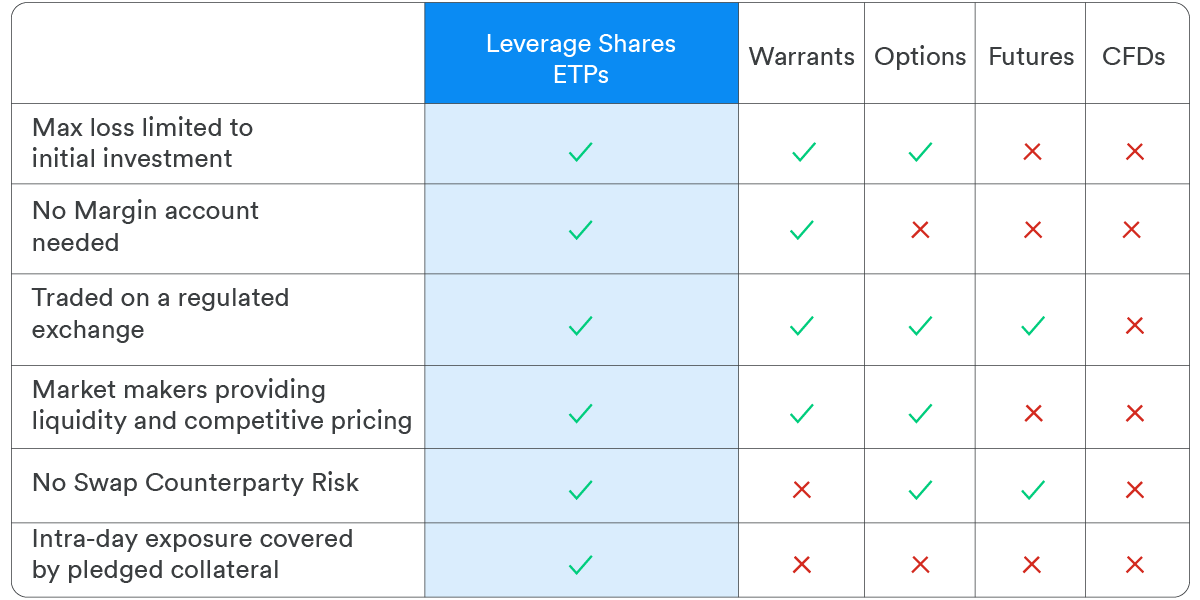
Max loss, in essence like a stop loss, up to your original investment
No need for a margin account, which requires a large sum to be deposited in advance in your broker account
Trade on an exchange – there are multiple maker makers providing liquidity – facilitating easily going in and out of a trade
Fees are quite low as these products are usually passively managed
Collateralized – covered by pledged collateral
BOTTOM LINE
Borrowing money enables you to make investments on a much larger scale.
The drawback being it is a double-edged sword as it magnifies your winner as well as possible losses.
ETPs unlike other financial products offer a practical and elegant solution to most problems created by the use of leverage.
 Education

