


When you trade a leveraged ETP, you are aiming for amplified daily returns, such as three times the daily move of a stock. Those amplified returns come with their own cost structure. In this guide, we break down how leveraged ETP fees work, how they can affect your returns, and what those costs pay for compared with a standard UCITS ETF.
How leveraged ETP fees work
Like a standard ETF, a leveraged ETP charges an annual management fee. For example, the Leverage Shares 3x Long NVIDIA ETP charges an annual management fee of 0.75%.
The management fee is not the only ongoing cost. Leverage Shares ETPs build leverage through margin borrowing: each ETP holds the underlying shares directly and borrows to buy more of them, rather than using swaps or other derivatives. That borrowing carries interest, which Leverage Shares pays at institutional margin rates, and the cost of maintaining the leveraged position is reflected in the index the ETP tracks. Short ETPs carry stock borrow costs instead.
These costs are taken from the ETP's net asset value (NAV) each day. NAV shows what the product is worth: the value of everything it holds, minus liabilities and costs, divided by the number of securities in issue. Each day, a small slice of the annual cost is deducted.
The best place to see the full picture is the product's Key Information Document (KID). Under EU PRIIPs rules, every packaged retail product, ETPs and ETFs alike, must publish one, with costs broken down in a standard format. For the 3x Long NVIDIA ETP, the September 2026 KID estimates management, administrative and operating costs at 0.0130% of your investment per day, with transaction costs adding a further 0.0002% per day. The 0.75% management fee on its own works out to roughly 0.002% per day, so most of the ongoing cost reflects the price of keeping leverage in place.
Example: Fee impact on a 3x leveraged ETP
Say Nvidia's stock rises 4% in a day. The 3x Long NVIDIA ETP (ticker 3NVD on Euronext Amsterdam and Borsa Italiana) aims to return about 12% before costs. Using the KID estimate, total costs for a one-day hold come to about 0.013%. After costs, the ETP's return is roughly 11.987%.
Now suppose you invest €1,000 in the same ETP. A 12% move before costs would take your position to about €1,120. After the daily cost deduction, your position would be worth roughly €1,119.87.
If Nvidia falls 4% in a day, the ETP aims for about a 12% drop. Your position would fall to roughly €880 before costs, and around €879.87 after the same daily deduction.
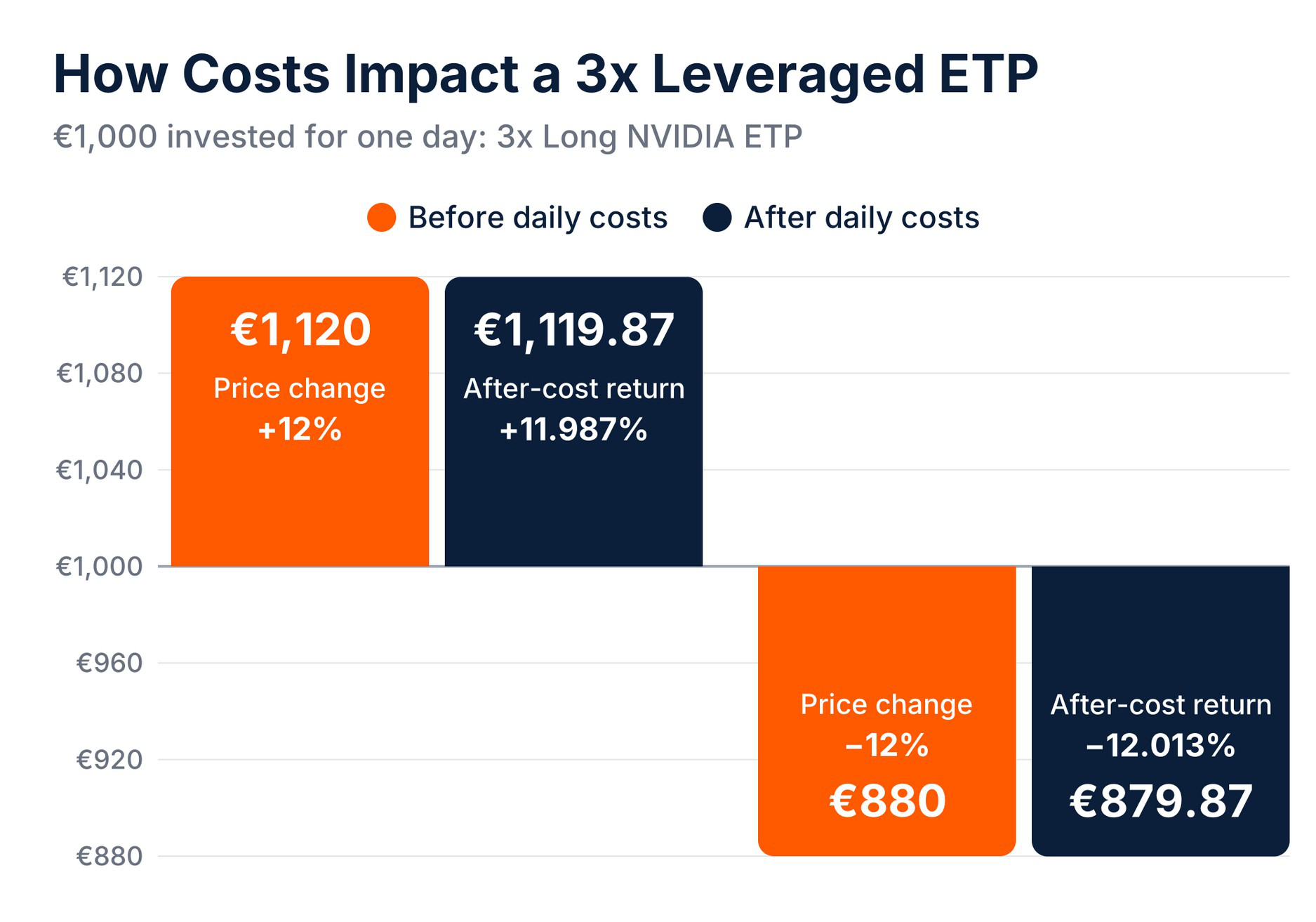
All figures are illustrative. Daily costs are based on the KID estimate for a one-day hold (about 0.013%) and exclude broker fees and spreads. Actual results depend on each product's costs, daily compounding, market path and, if you trade in a currency other than the ETP's base currency (USD), exchange rate movements.
Put another way, on a one-day hold the cost of about €0.13 sits against a €120 move in either direction. For a short-term trader, the size of the daily move matters far more than the daily cost.
Leveraged ETP fees vs standard ETFs and CFDs
A broad UCITS index ETF and a leveraged single-stock ETP are built for different jobs, and their costs reflect that. An index tracker simply holds a diversified basket, so its fees can be very low, often 0.20% a year or less for broad equity trackers. A leveraged ETP has to borrow, rebalance daily and manage collateral, and those costs show up in its ongoing charges.
For traders, a closer comparison is a contract for difference (CFD), another common way to get leveraged exposure to a single stock. A CFD has no management fee, but you pay a spread or commission on each trade, plus overnight financing on the full value of your position, typically a benchmark interest rate plus a broker markup, for every night it stays open, weekends included. Under rules first introduced by ESMA in 2018 and since made permanent by most national regulators, retail CFD leverage on individual shares is capped at 5:1, providers must close out positions when margin falls to 50% of the required minimum, and negative balance protection limits losses to the funds in your account. When ESMA introduced these rules in 2018, it cited national regulators' findings that 74% to 89% of retail CFD accounts typically lose money.
The table below shows how fees for leveraged ETPs typically compare with standard UCITS ETFs and CFDs:
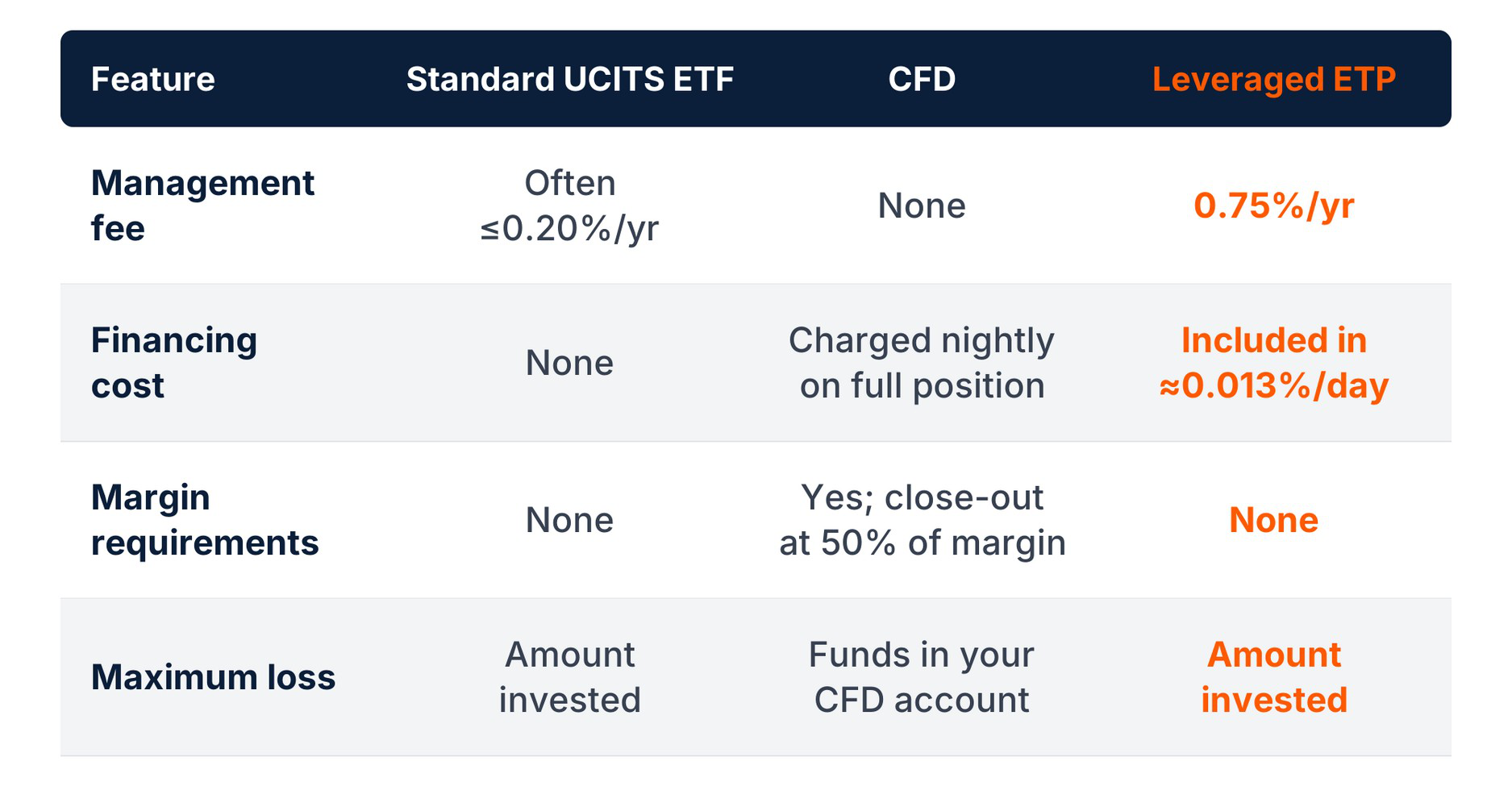
Leveraged ETP figures are examples based on the Leverage Shares 3x Long NVIDIA ETP KID (September 2026). CFD margin rules reflect retail measures first set by ESMA and now applied by most EU national regulators; CFD costs and terms vary by broker.
What the higher ETP cost pays for
Ongoing costs are only one side of the comparison. A leveraged ETP offers exposures that a standard UCITS ETF cannot, without the margin calls that come with a CFD.
• Targeted, single-stock exposure. UCITS diversification rules cap a fund's investment in any single issuer at 10% of its assets, so a UCITS ETF cannot be built around one company. An ETP can track one stock, and magnify its daily move.
• Capital efficiency. €1,000 in a 3x ETP gives you roughly €3,000 of exposure to the day's move in the underlying stock, leaving the rest of your capital free.
• Long or short. Many ETPs come with an inverse version. Alongside the 3x Long NVIDIA ETP, Leverage Shares lists a -3x Short NVIDIA ETP, so you can trade a falling share price as well as a rising one.
• Leverage without a margin account. You buy the ETP like a share through your broker. You cannot lose more than you invest, and there are no margin calls. An intraday rebalance mechanism, triggering at a 16.67% move in the 3x NVIDIA ETP, is designed to cushion extreme intraday swings.
• Physical backing, no swaps. Each Leverage Shares ETP holds the underlying shares (or cash, for short ETPs) and does not use derivatives to deliver its exposure.
• Access across Europe. The 3x NVIDIA ETP trades on the London Stock Exchange, Euronext Amsterdam, Deutsche Börse Xetra and Borsa Italiana, with EUR, GBP and USD lines.
Holding period and trading costs
Leveraged ETPs are designed for short-term trading, and the KID sets a recommended holding period of one day. Because they rebalance daily, returns over longer periods can differ from the leverage factor times the stock's return. This compounding effect can work in your favour in a steady trend, but tends to hurt in volatile markets. Learn more about daily rebalancing in leveraged ETPs and why a 3x ETP doesn't deliver 3x returns over a year.
As with any exchange-traded product, you will also pay your broker's dealing fee when you buy or sell, and there is usually a small gap between the bid and ask price, called the spread. If you trade a EUR or GBP line of a USD-based ETP, your broker may charge for currency conversion, and local transaction taxes may apply depending on where you live. For short-term traders, these costs usually matter more than the product's ongoing charges.
Key takeaways
• Leveraged ETPs have higher ongoing costs than standard ETFs, mainly because of the cost of borrowing to maintain the leverage factor.
• Costs are deducted from NAV each day. Over a one-day hold, the impact is small: about €0.13 per €1,000 invested in the 3x NVIDIA ETP.
• The KID shows the full cost picture, including financing, not just the management fee.
• In return, leveraged ETPs offer magnified single-stock exposure, long or short, with losses capped at the amount invested and no margin account.
• Trading costs such as broker fees, spreads and currency conversion can matter more to short-term traders than ongoing charges.
 Education
 Market Insights

