



The market’s reaction to Goldman Sachs’ (NYSE:GS) first quarter (Q1) earnings for FY2026 – made on the 13th of April 2026 – was striking: despite early trends that the company will repeat the results of Fiscal Year 2025 wherein net earnings registered strong growth over the previous year’s, the stock went on to fall by 2%.
There are two specific factors that could be attributed to this immediate conviction – one for the industry that the company operates in and one more generalized for the economy.
Trend AnalysisIn recent years, Goldman Sachs has been working on transitioning out of the consumer banking business altogether. Early in January, the company announced1 that it will be transitioning its Apple Card business – which represented the first consumer credit card by Goldman Sachs – to Chase over a period of 2 years. In 2025, it had entirely exited the General Motors card business as well.
Meanwhile, some line items have been merging as the company streamlines its business. For example, “Equity Investments” and “Debt Investments” are now reported in aggregate as the bank transitions from direct investments on its balance sheet to a scaled third-party funds-driven business. Previously, the bank would use its own balance sheet to make massive investments (known as “Principal Investments”) into opportunities. Going forward, it would increasingly raise money from outside investors and manage the investment in exchange for “Management Fees” and “Incentive Fees”. The line item merge in this instance is a signal of commitment to the market.
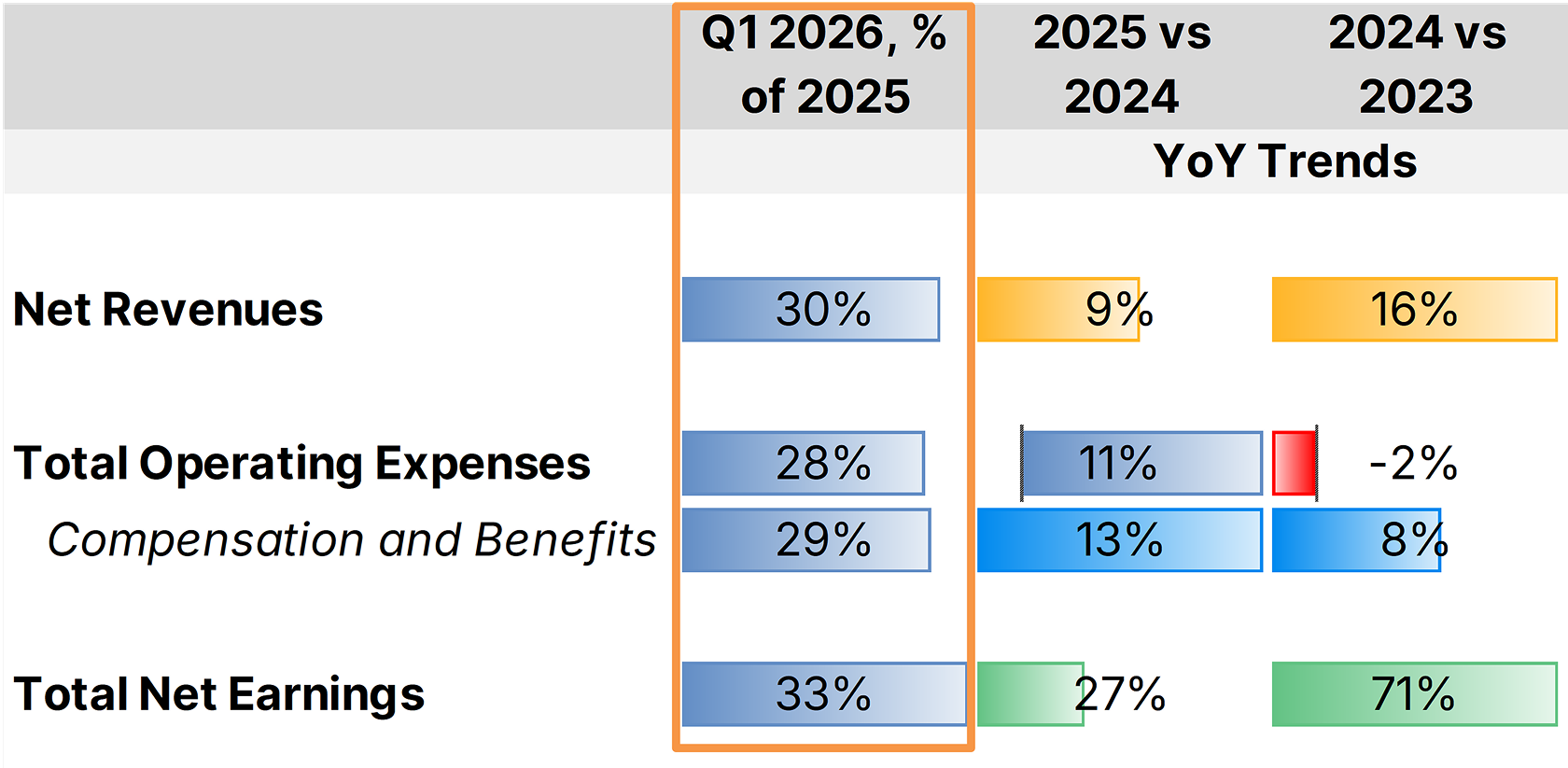
While the changes don’t alter the bottom line (i.e. earnings) or the top line (i.e. revenue) in past quarters, it does alter the horizon of the trend line analysis relative to more recent data.
Source: Company Information; Leverage Shares analysis
One potentially significant standout in trends is in the company’s steadfast commitment to compensation and benefits trending in tandem with top- and bottom-line changes. This is a tacit recognition that banks are less about technology or infrastructure and more about the people, be they an analyst in the operations team or a high-profile wealth advisor. When the bank does well – as a general rule – those within do well and effort will be expended to retain the best among them.
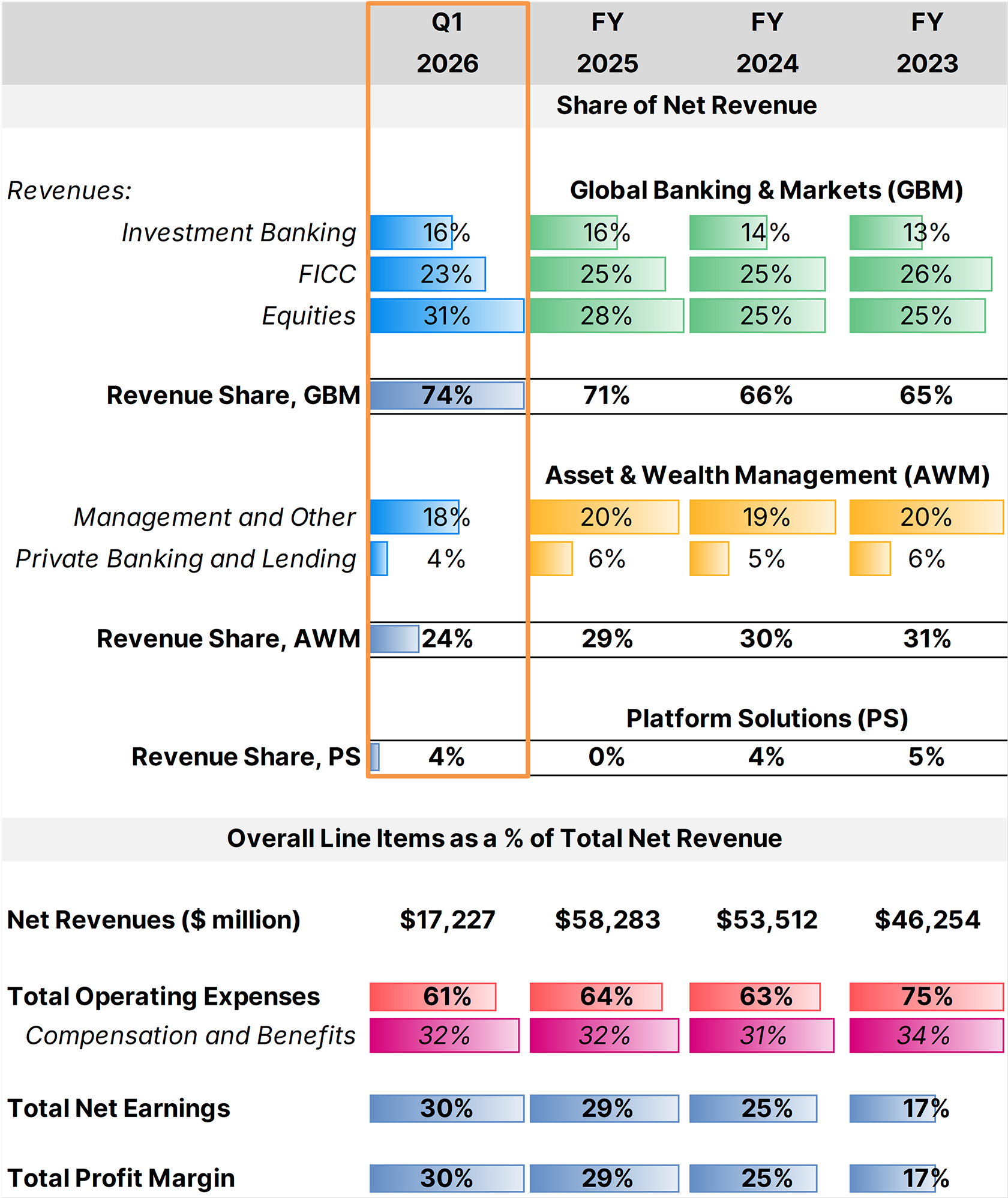
In terms of revenue share, key business segments and line items are seemingly a mixed bag, albeit with a positive overall tone:
Source: Company Information; Leverage Shares analysis
A strong pipeline in completed mergers & acquisitions (M&A) volume along with higher revenues in prime financing and “intermediation” – making markets, executing orders, and clearing transactions for clients – led the “Equities” segment within the Global Banking and Markets (GBM) division to rise 31% relative to Q1 of 2025. The Asset and Wealth Management (AWM) division was up 10% over Q1 2025 on the back of strong revenues from management and other fees.
Within GBM, the “Fixed Income, Currency and Commodities” (FICC) segment showed a 10% decline relative to Q1 2025 due to significantly lower net revenues in interest rate products, mortgages and credit products. Meanwhile, AWM’s “Private Banking and Lending” segment – which provides loans to wealth management clients against commercial and residential real estate, securities or other assets while raising deposits through said clients and Marcus – registered 12% lower than in Q1 2025. Amidst an overall positive picture for the company, these fact patterns stood out amidst market sentiment on numerous indicators.
Credit “Cockroaches” and Sticky InflationIn October 2025, JPMorgan CEO Jamie Dimon created a stir2 during JPMorgan Chase’s earnings call when he flagged the implosion of auto lender Tricolor Holdings and car-parts supplier First Brands Group as a crisis event for private credit. “I probably shouldn’t say this, but when you see one cockroach, there are probably more”, he told analysts on the call. “Everyone should be forewarned on this one.”
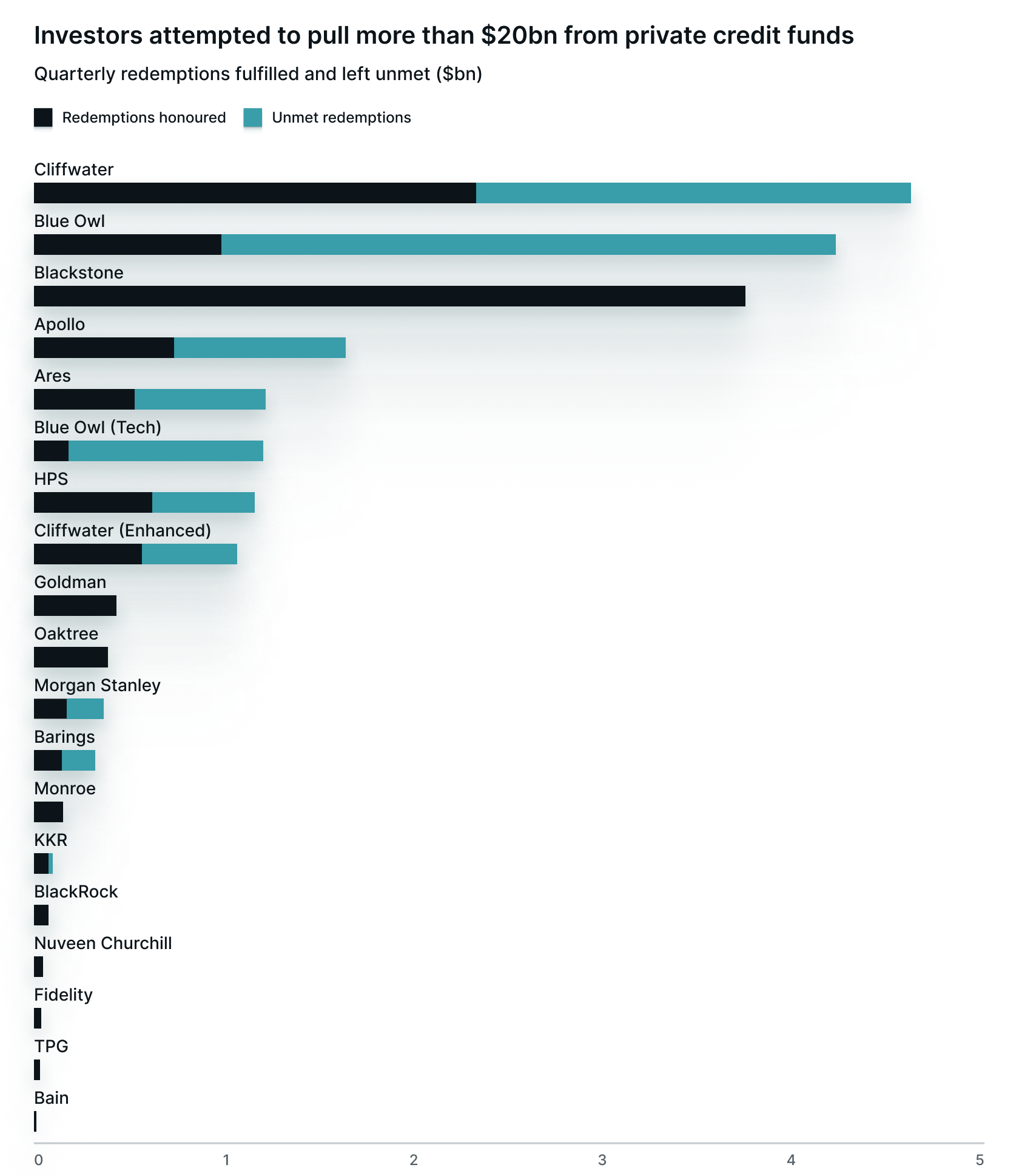
The term “cockroaches” rapidly went on to become a term employed across numerous media releases by the financial services industry. In Q1 2025, Jamie Dimon’s warning wasn’t exactly unfounded: private credit markets faced a record surge3 in redemption requests totalling over $20 billion, up 183% from Q4 2025.
Source: Financial Times. Image redesign by Leverage Shares
Major firms, including Blue Owl, BlackRock and Carlyle, capped withdrawals at 5% to manage liquidity, leaving roughly $7 billion in requests unmet. This highlights the increasing strain on the $2 trillion sector – which has a network of complex linkages with global investment banks.
In terms of size of redemption requests, Goldman Sachs was the largest fund manager that honoured redemption requests, which were a little under 5% of the fund’s value. In related filings within the SEC’s Edgar system, Goldman Sachs’ Private Credit platform stated that while it did see a 7% decline in overall quarterly inflows into its private credit fund in Q4 2025, this was a more moderate decrease relative to most of their peers. Furthermore, December inflows were 11% higher than its YTD average, the Q4 2025 redemption rate of 3.5% was lower than their peers who averaged above 5% and that the ratio of inflows to redemptions was 3.3x. The company asserts that “uncertain markets provoke a flight to quality in investors” and that February 2026 was its platform’s second-highest subscription month since its inception.
In ConclusionGoldman’s provision for credit losses rose nearly 10% from a year earlier to $315 million, marking its largest increase in loan loss provisions since 2020. During the earnings call, CEO David Solomon stated4 that while the environment for mergers and other deals has been resilient, the war in the Middle East is a point of concern to watch for. The resulting high prices of commodities could threaten future capital markets deals like mergers or debt issuance while inflation trends will impact numerous other parts of the market that the company operates in. Solomon also said that market churn from the war had cooled IPO listings in March in particular.
As the earnings performance indicates, the company has diverse pools of revenue generation which can act as offsets or multipliers. Inflation – which has remained sticky particularly in the U.S. – is a potential risk for the company going forward as it generates 60% of its revenue from the Americas. If inflation stays elevated, consumption is impaired. Furthermore, the Fed’s rate stays “higher for longer”, which makes financing deals more expensive and the servicing of debt more burdensome. Thus, inflation becomes something of a “two-headed” beast for the likes of U.S.’ top global banks.
If inflation remains sticky and the Fed rate stays “higher for longer”, the recessionary outlook strengthens. This is when financial services stocks typically attract higher interest. While banks do get hit by recessionary effects, their historied swift and surgical approach to limiting costs and pivoting towards less risky activities – which having a diversified pool of revenues helps in doing – typically mean that they are affected less and recover faster. On top of that, Goldman Sachs also pays dividends, which tend to be another plus of investors. Goldman’s board declared that a quarterly dividend of $4.50 will paid out towards the end of June.
All in all, while markets are reacting to the potential gloom in the macro environment painted in the picture presented by the bank, the market’s immediate reaction was certainly premature; the market went on to add 2.11% to the stock’s price on the 14th of April – potentially in recognition of both the diversified revenue base and the value of holding on the stock on basis of the aforementioned merits. Nonetheless, it bears noting that no stock exists in a bubble. if markets turn bearish, Goldman Sachs’ stock would likely see volatility.
Professional investors in Europe might consider the 2x Long Goldman Sachs ETP (GS2) and the -1x Short Goldman Sachs ETP (SGS) during bullish and bearish trends in GS’ stock price.
Footnotes:
"Goldman Sachs Announces Agreement to Transition Apple Card Program to Chase", Goldman Sachs Pressroom, 7 January 2026
"Dimon’s ‘Cockroach’ Fear Revives Threat of Growing Credit Cracks", Bloomberg News, 14 October 2025
"The $20bn+ exodus from private credit", Financial Times, 10 April 2026
"Goldman Sachs tops estimates on record equities trading", CNBC, 13 April 2026
 Education

