




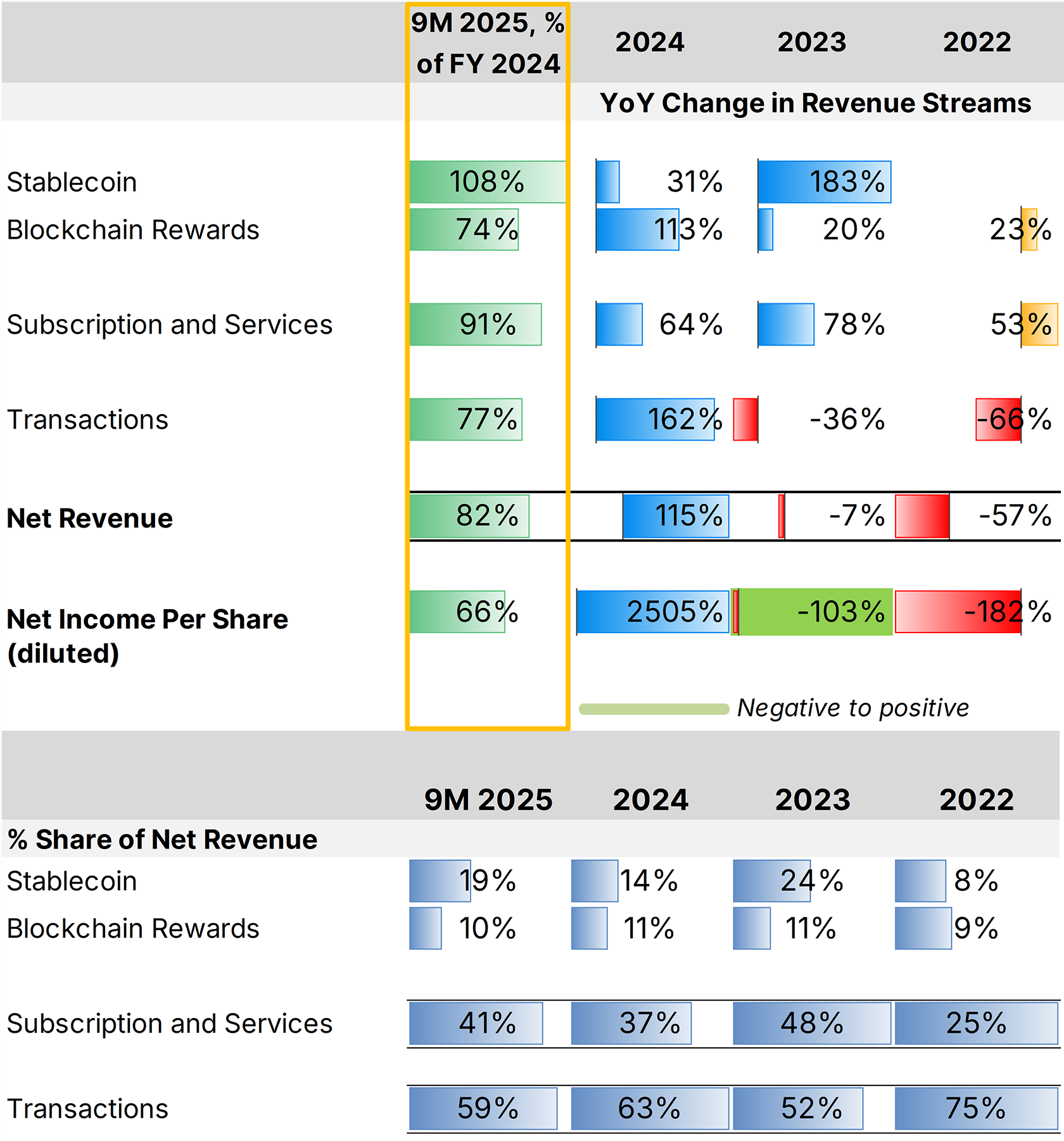
Since the release of its third quarter (Q3) results of its Fiscal Year (FY) 2025, global cryptocurrency brokerage Coinbase Inc’s (ticker: COIN) stock has been trending bearish. The fiscals for the first nine months (9M) of the current FY are a decided mixed bag:
Source: Company Information; Leverage Shares analysis
If trends were to continue, revenues are look at a mere 10% increase over the previous FY – which had seen a 115% growth – while net income per share is trending towards a 12% decline over the previous FY – which had seen a solid 2,505% growth.
Stablecoins are by far the biggest growth driver in revenue while transaction-based revenue are running at around par relative to previous FY. Non-trading revenue from subscriptions and services – stablecoins, staking, custody services and subscription-based offerings for trading, staking, et al – witnessed a strong growth trend.
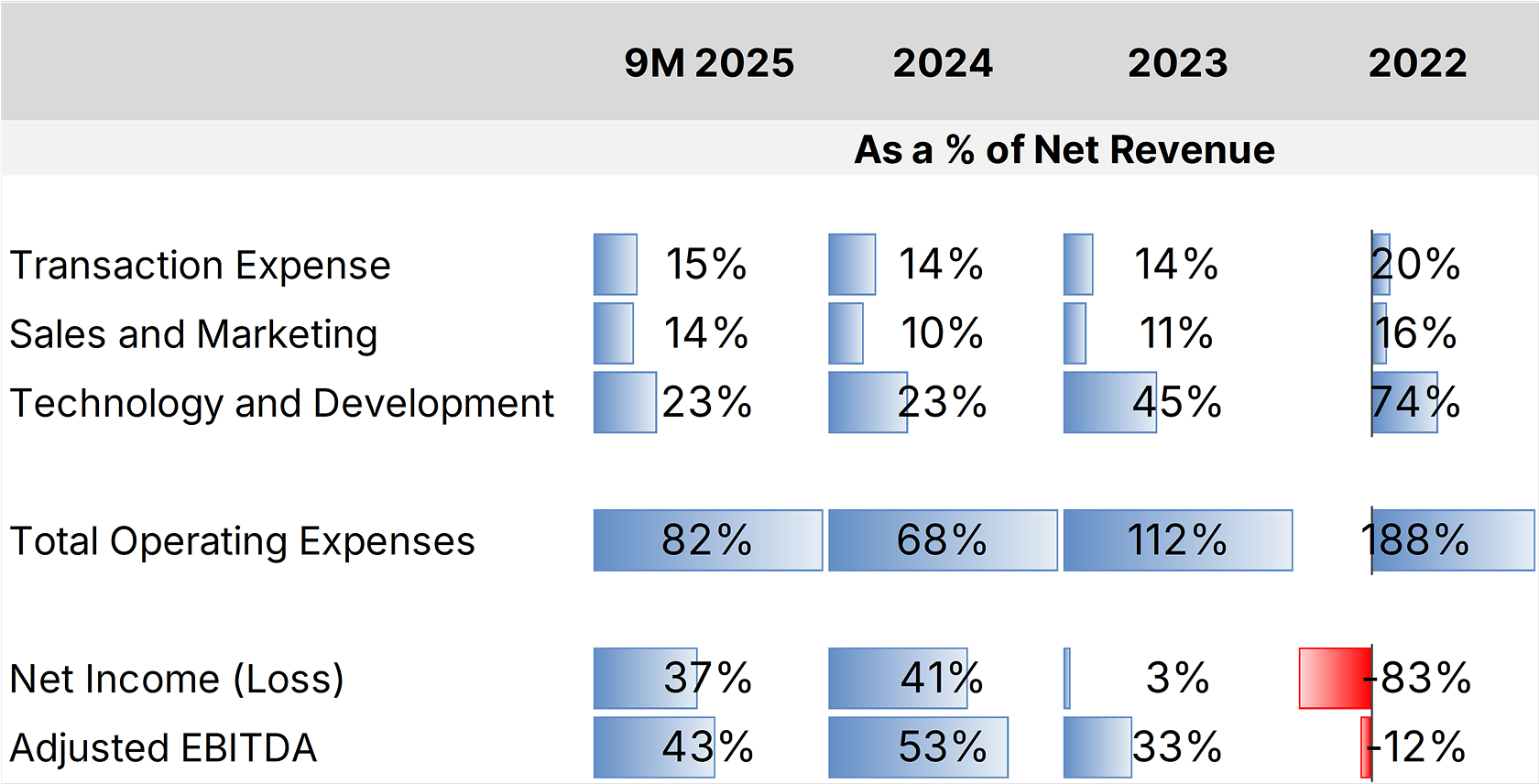
The buildup of the stablecoin business has also helped cement Coinbase’s allure among institutional investors, which also raised transaction rebates and commissions paid out for providing liquidity on its international exchange by 289%. However, in overall terms, revenue share of expenses have been stable for a while now.
Source: Company Information; Leverage Shares analysis
The spike in total operative expenses leading to the reduction in pass-throughs to net income is attributable to the $308 million charge in Q2 stemming from a customer data breach incident involving its support staff. While the incident might be considered done and over with, legal fees and other expenses relating to the incident still accounted for $48 million of the $61.3 million in “other operating expenses” in Q3 2025.
The ongoing depression in leading cryptocurrencies is currently impacting the fair value of assets held by the company and fueling concerns over the company’s forward growth outlook.
The “Uptober” That Wasn’tHistorically, October is one of Bitcoin’s strongest months with an average gain of about 22.5% over the past decade1, thus earning the month the moniker “Uptober” among crypto enthusiasts. This is generally attributable to retail investors diversifying their holdings into Bitcoin (BTC) in the course of the buildup to Q3 earnings reports being released, key decisions by the Federal Reserve, and so forth.
This October, however, was different: Bitcoin went on to trade around 14% below its record high from earlier in the month and disproved the touted appeal of the cryptocurrency as a safe haven during periods of macro uncertainty. While strong ETF inflows boosted the value earlier in the month, profit-taking by long-term holders is generally assumed to have snowballed into the drop that continues into November. Other prominent cryptocurrencies also experienced major drops.
Also impacting the current outlook were a wave of leverage washouts and record liquidations in crypto derivatives markets in mid-October. Given the volatile nature of the crypto market, there might have been some hints of this foreshadowed in Coinbase’s latest earnings release: while there was a 59% increase in payment processing and account verification expenses relative to the same period in the previous FY as the company paid validators for the increased interest in cryptocurrencies, there was also a 170% increase in expenses incurred from transaction reversal losses.
A factor that might have turned long-term crypto holders against Bitcoin is the “Prince Holdings” case: on the 14th of October, the U.S. and British governments moved together to apply sanctions on all parties related to Cambodia-based Prince Holding Group, declaring it a “transnational criminal organization”2. Led by the mysterious China-born Chen Zi – who relinquished Chinese citizenship and went on to acquire Cambodian, Cypriot, Vanuatu and British passports3 – who established banks, casinos and real estate holdings in Cambodia, Prince Holdings and its associates were accused of running a vast network of “pig butchering” scams, wherein trafficked workers from all over the world (mainly China, Vietnam and Malaysia) are forced into targeting people with romance or business cons and launder the proceeds through cryptocurrency4 while sequestered in vast compounds in various parts of Southeast Asia.
While Britain froze business and property assets worth more than $130 million that were held under Prince Holdings’ associates’ names, Taiwan, Singapore and Hong Kong also swooped in with national seizures as high as $350 million. The United States, in turn, went on to seize nearly $15 billion in Bitcoin that were held by Chen Zi’s company and associates. These assets were the epicenter of a dispute between China and the United States, with the latter accusing the U.S. government of carrying out a cyberattack to “steal” them5.
The seeming ease with which the Bitcoin were seized by government agencies had something of a chilling effect on Bitcoin’s consideration as a safe asset that is potentially inviolate from government reach. Discontent over government overreach is added to concerns over privacy which is ill-afforded by Bitcoin’s transparent payment system and blockchain. These concerns – potentially brought to a head over the Prince Holdings case – has led to a massive uptick in interest in ZCash (ZEC), which has a privacy-focused protocol. ZCash experienced a parabolic, fundamentals-driven rally which is being attributed to a perception that the cryptocurrency is effectively a form of "insurance against Bitcoin." Institutional interest in the Grayscale ZCash Trust saw its Assets Under Management (AUM) grow by 228% in October.
What’s in Store for Coinbase and BitcoinDespite the drop in conviction over privacy, institutional interest in Bitcoin as an alternative (or a complement) to traditional dollar assets is expected to remain strong, with clearer regulatory guidance in key markets in the U.S. expected to drive new capital. Meanwhile, in the United Arab Emirates – a favoured destination for important voices in the crypto space – introduced a new Crypto-Asset Reporting Framework (CARF) in September 2025, which aims to align the country with global tax transparency standards and create pathways for enforcing for accountability and compliance. However, this arguably runs counter to the anonymity principles that were originally inherent within the allure behind Bitcoin, which ZCash is now filling.
In November 2025, Nasdaq-listed biotech company Leap Therapeutics announced a rebrand to Cypherpunk Technologies, which announced a strategic pivot to acquire a digital asset treasury focused on ZCash6 and spending $50 million to purchase over 203,000 ZEC. This move — led by funds including Winklevoss Capital — signals the first institutional "MicroStrategy-style" treasury bet on a privacy coin, giving ZCash significant legitimacy.
While Coinbase is likely to take a hit in fair value consideration if convictions in Bitcoin continues to erode over privacy concerns, increasing institutional interest would possibly be a support for revenues while interest in ZCash could likely drive up transaction revenues. Whether these developments would cancel each other out or net out as a hit on the bottom line leading to a loss in investor conviction in Coinbase itself is likely to be a matter of intense conjecture – and volatility – in the quarter and year to come.
Professional investors in Europe might consider the +3X Coinbase ETP (CON3) and the -3x Short Coinbase ETP (CO3S) during bullish and bearish runs in the stock respectively.
Furthermore, the Coinbase Options ETP (COIY) seeks to generate monthly income for investors by directly investing into Coinbase’s shares and selling put options on them.
Footnotes:
"‘Uptober’ Ends on a Down Note to the Dismay of Bitcoin Faithful", Bloomberg, 30 October 2025
"Chairman of Prince Group Indicted for Operating Cambodian Forced Labor Scam Compounds Engaged in Cryptocurrency Fraud Schemes", U.S. Department of Justice, 14 October 2025
"The mysterious figure accused of masterminding a $14bn crypto scam", BBC, 24 October 2025
"Cambodia's Prince Group denies link to scams after asset seizures", France 24, 12 November 2025
"China accuses US of carrying out $13bn bitcoin hack", Nikkei Business Asia, 12 November 2025
"Leap Therapeutics Rebrands as Cypherpunk; Expands Leadership Team to Drive New Zcash Treasury Strategy", PR Newswire, 12 November 2025
 Education
 Market Insights

