



Your capital is at risk if you invest. You could lose all your investment. Please see the full risk warning here.
Leverage Shares ETPs come equipped with an “airbag mechanism” built into the administration of every product. This feature is triggered when the underlying stock loses more than x% (in long leveraged ETPs) or appreciates by more than x% (in short ETPs) during a trading session compared to previous day’s close.
The air bag mechanism is designed to limit the impact of losses on the value of Short and Leveraged (S&L) ETPs during extreme market moves. S&L ETPs are designed in a way that investors cannot lose more than what they invest and curtail losses during adverse and volatile moves. This is achieved by a mechanism known as the air bag - which is a safety mechanism that is built into each product.
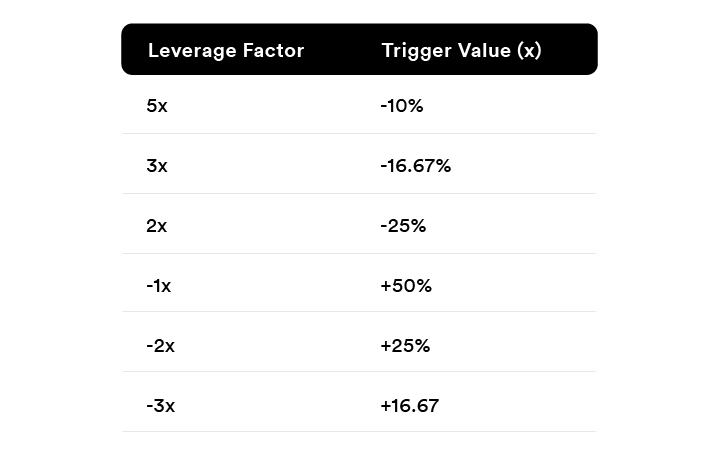
The air bag activates if Leverage Shares ETPs lose 50% of its value in a day. The precise level of the Air Bag is different for each ETP. For instance, a product with a leverage factor of 5x long would trigger the air bag mechanism if the underlying instrument declines 10%, for a product with a leverage factor 3x, the air bag would be activated if the underlying declines 16.66%, and for an ETP with a leverage factor of 2x the underlying needs to decline 25%, etc.
The respective trigger values are as follows:
Therefore, if an investor purchases an ETP with 5x leverage and the underlying moves unfavourably by 20% during the trading day, the investor is protected as the ETP won’t lose its entire value. Or, if the underlying moves unfavourably by 25% in a day, it does not mean the investor would lose its entire investment and owe an extra 25%. However, investors using CFDs or Spread bets would be liable for the entire loss incurred.
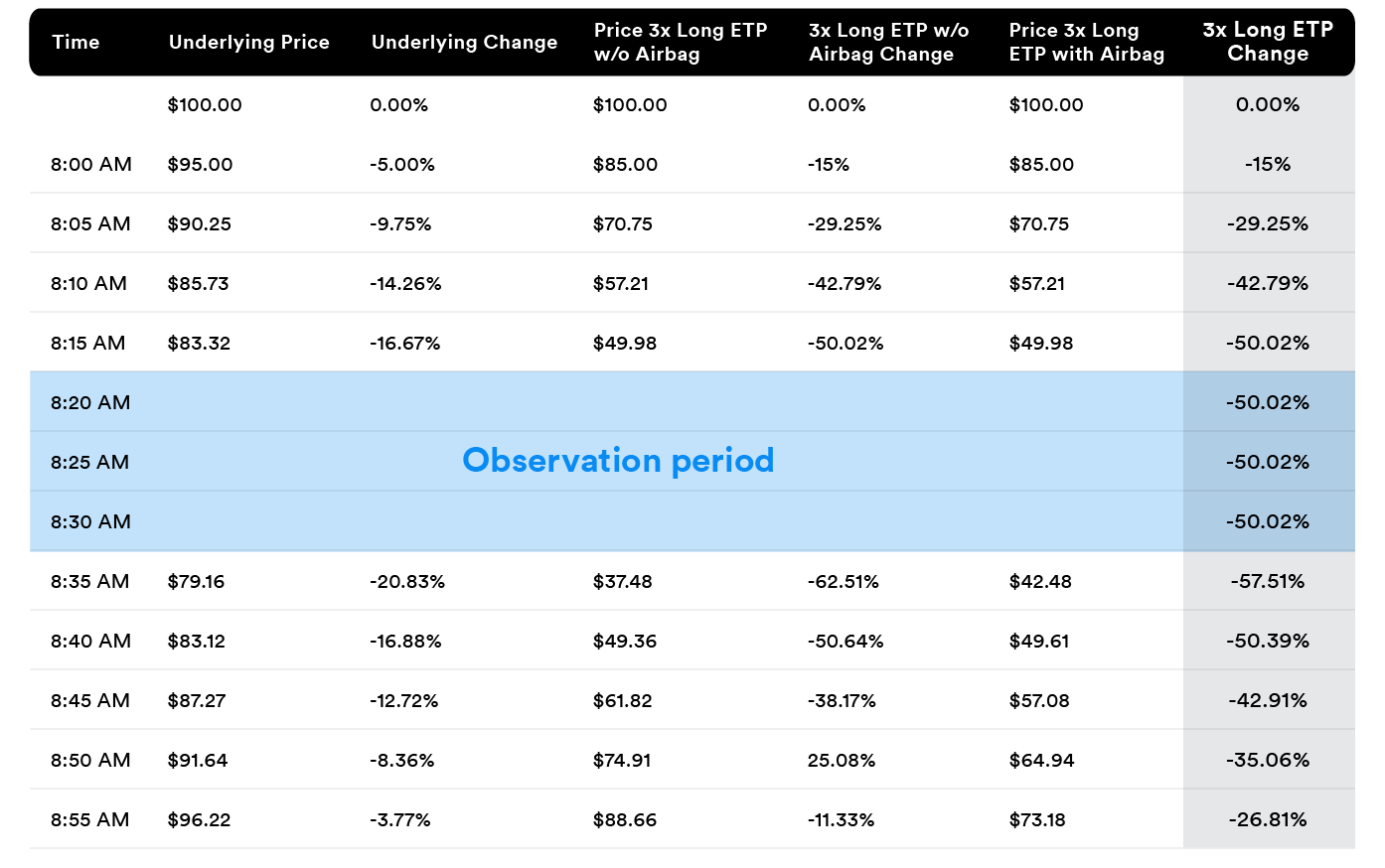
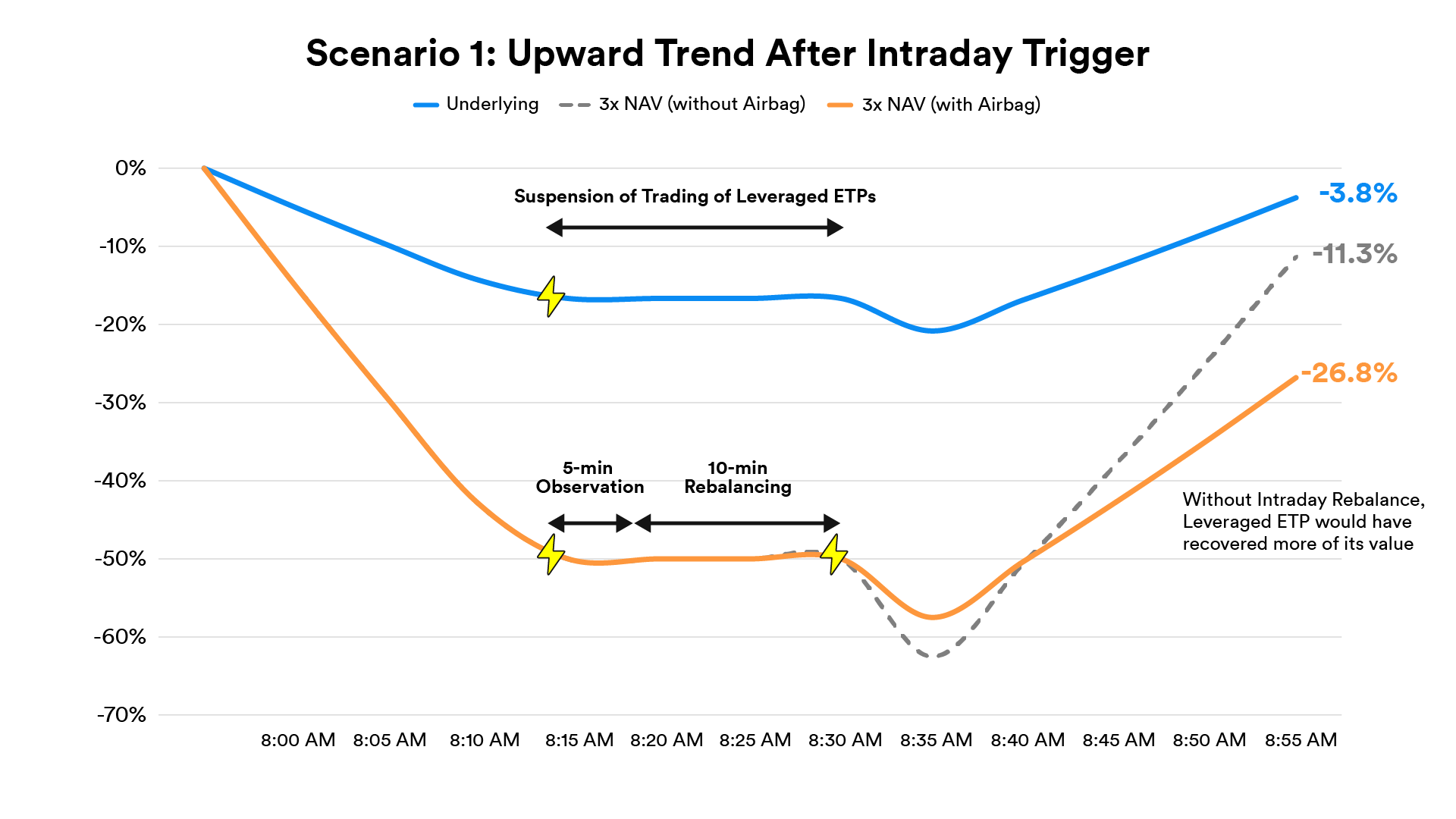
The air bag mechanism is triggered when the underlying asset reaches the stated air bag trigger level. Whenever the air bag gets activated, trading halts, and a 15-minute observation period begins. During the observation period the lowest level of the underlying asset for a long ETP, or the highest level for a short ETP is recorded. When trading resumes, the ETP is rebalanced, and it starts trading as if it were a new trading day. From then on, the performance of the product’s price will depend on how much the underlying asset rises or falls from the observed level. The airbag is beneficial if the underlying asset moves further against the investor and helps reduce subsequent losses as they are applied to the new, lower product price. However, after an air bag event subsequent gains will also be reduced, and investors may not fully benefit from the rebound.
*However, an overnight collapse in the underlying stock could make the ETP worthless, as the stop-loss mechanism cannot be triggered outside of ETP trading hours. The most a client can lose is the full value of his/her investment (in fact, a bit less than that as there is a principal amount guaranteed, which varies per product).
Let’s consider, the price of a hypothetical underlying stock closes at $100, and an investor owns +3x Long ETPs with built in airbag and +3x Long ETPs without airbag. The next day the underlying stock falls sharply lower throughout the day and triggers the air bag mechanism. After the airbag is activated, the underlying stock reverses course and trades higher.
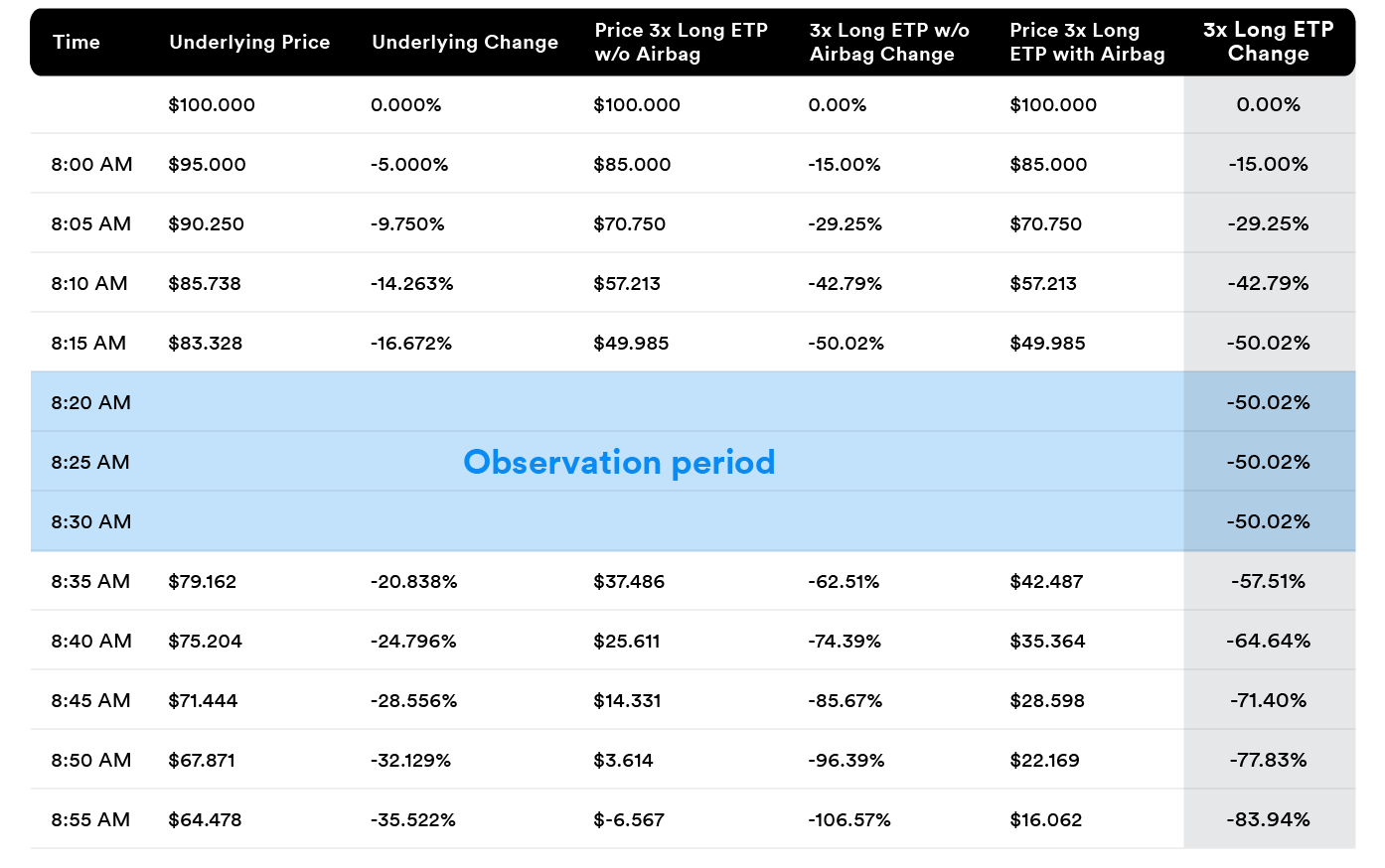
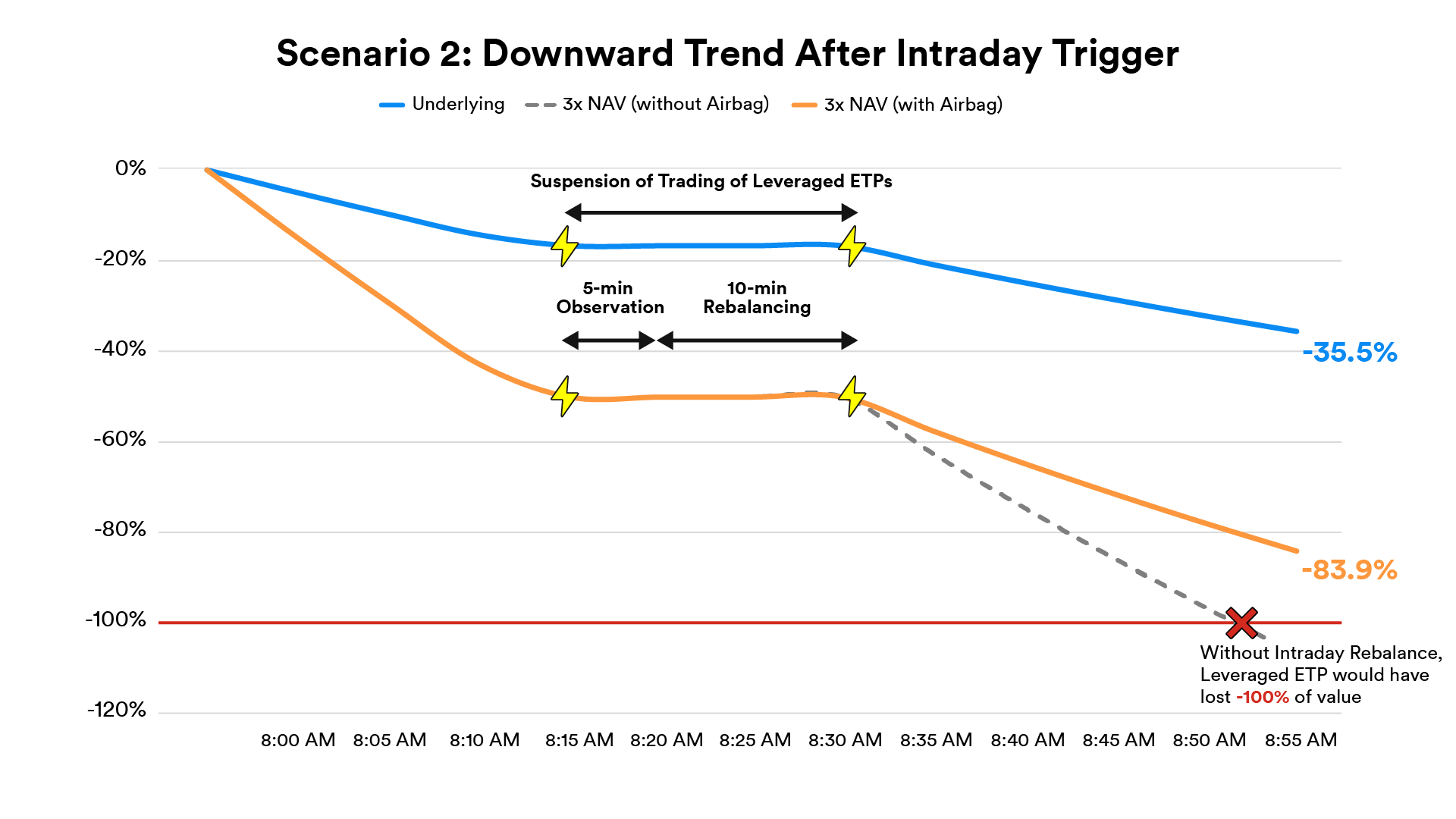
Let’s consider, the price of a hypothetical underlying stock closes at $100, and an investor owns +3x Long ETPs with built in airbag and +3x Long ETPs without airbag. The next day the underlying stock falls sharply lower throughout the day and triggers the air bag mechanism. After the airbag is activated, the underlying stock continues to trade lower.
Your capital is at risk if you invest. You could lose all your investment. Please see the full risk warning here.
 Market Insights

