


Your capital is at risk if you invest. You could lose all your investment. Please see the full risk warning here.
Space Exploration Technologies Corp's (ticker: SPCX) second public quarterly earnings release on the 20th of October – marking nine months (9M) of its Fiscal Year (FY) 2026 – prompted a 7% price rise the next day. Since the 20th till the 27th (a full week later), the stock has given up those gains and is running flat.
The results were heralded as holding a number of positives but, upon consideration of all the facts, the lukewarm reaction might be merited.
Trend Analysis
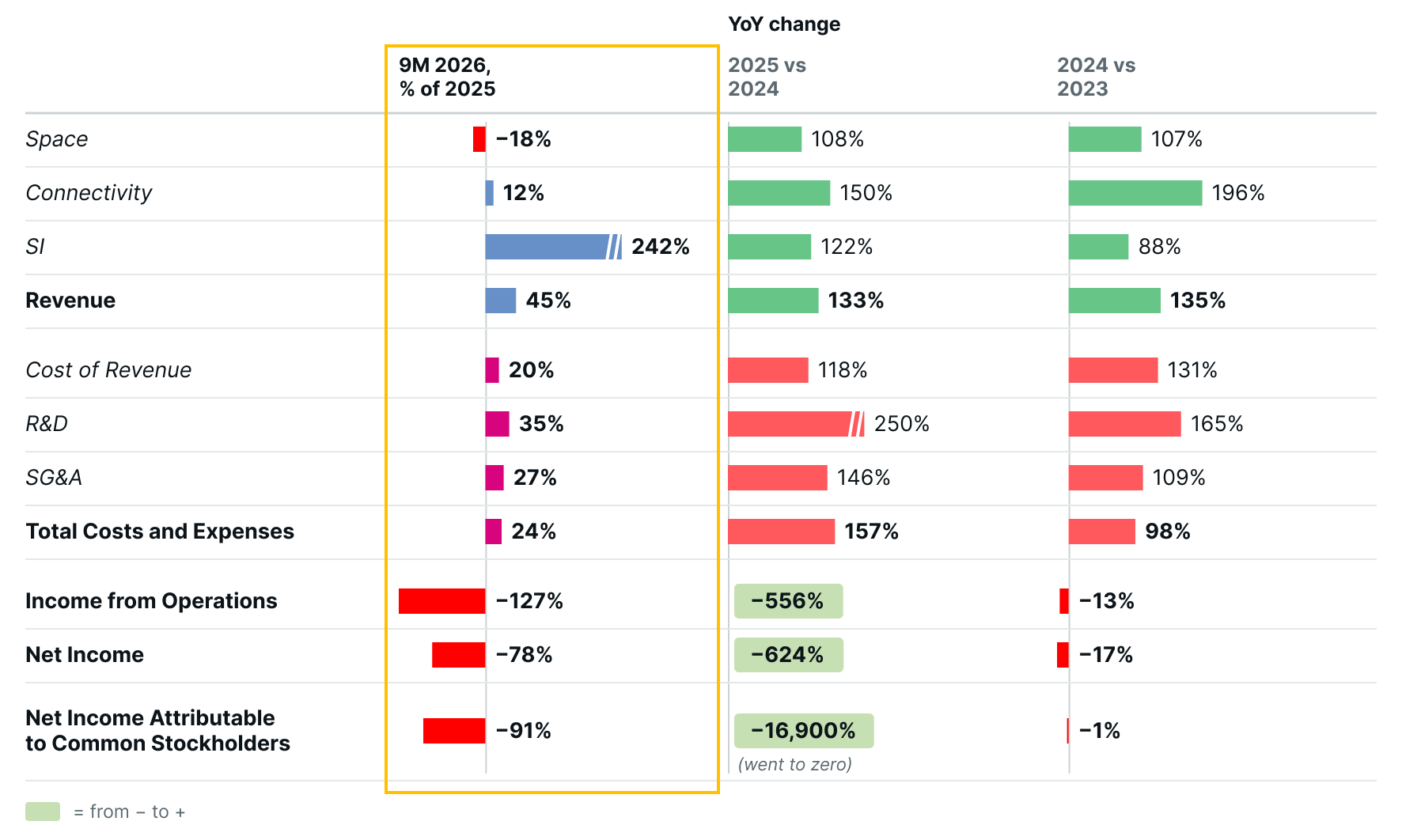
As of 9M 2026, revenues for the full year are trending to be 40% lower than the previous FY.
Source: Company Information; Leverage Shares analysis
2025 was the year net income was flat at near-zero despite total costs and expenses showing a massive spike while operating income ran deeply negative. As of 9M 2026, operating income is running positive at $705 million and net income is a loss at over a billion.
The single most encouraging line item was revenue from "Super Intelligence" (SI), a term that was announced by President Trump as a replacement for "Artificial Intelligence" and subsequently adopted by SpaceX CEO Elon Musk. AI-related income has become a major contributor to top-line revenues.
Source: Company Information; Leverage Shares analysis
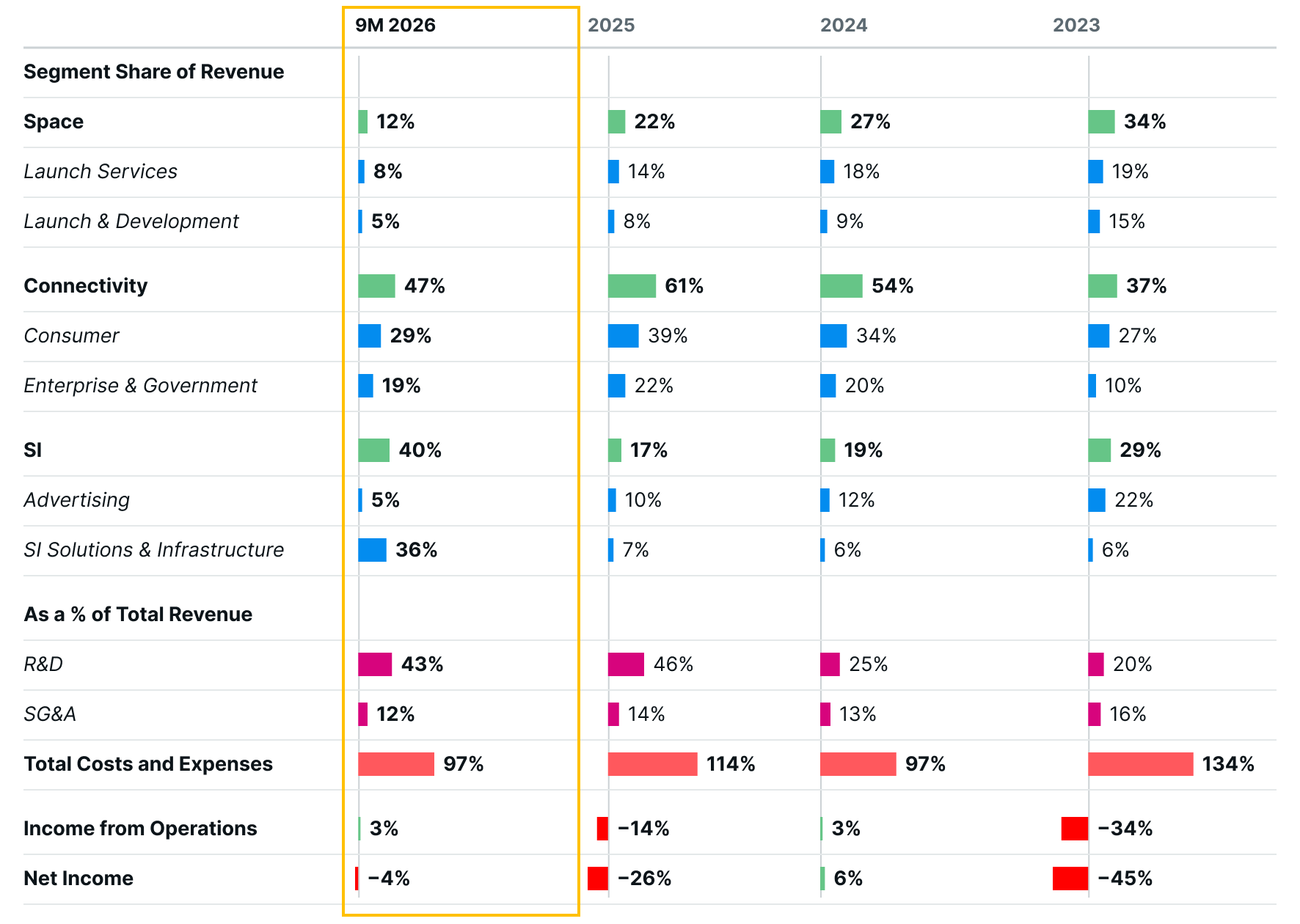
AI-driven revenue went to a solid $7.56 billion in Q3 2026 versus $813 million a year ago. In the quarter, SpaceX also closed its $60 billion purchase of AI coding startup Cursor.
Within "SI", AI-driven advertising – made available by the likes of X, once known as "Twitter" and now owned by Musk – was a minor contributor to revenue. A substantial portion of "SI" revenue was accrued from renting capacity to other AI rivals such as Google and Anthropic (as shown in "SI Solutions & Infrastructure" segment).
However, infrastructure costs dim the edge of this revenue explosion significantly. Across 9M 2026, capex was approximately $48 billion – reflecting a major ramp-up in datacenter infrastructure, Nvidia GPUs, and expansion of its Connectivity segment offering Starlink, which generated nearly all of the company's profit in 2026. While Q3 2026 revenue jumped to $5.25 billion from $3.1 billion a year earlier, operating income in the connectivity unit approximately doubled to $2.37 billion, given that mature infrastructure cost less and delivers more bottom line.
The Problem with Starlink
With Starlink, SpaceX has a "Palantir-shaped" problem: 40% of its Q3 2026 revenue was from government contracts while it isn't entirely clear if consumer subscribers were truly retail users or government contractors. This is important, especially as reports have surfaced (and confirmed by government sources) that access to Starlink was limited to Ukraine – in line with the Trump administration's demands – in a bid to halt its escalations in the grinding conflict along the Russia-Ukraine front. Thus, Starlink is more a tool of geopolitical power projection than an entity free to do business around the world. While China's market can be expected to remain closed, there are signs that the world's most populous nation – India – could also be ready to turn its back on the company.
In recent weeks, New Delhi had witnessed a political protest that went on to result in some violence, as well as a government response leading to detentions and court trials being set in motion. The protest has become extraordinarily unpopular – and viral – almost uniformly across India's media landscape and citizenry. What contributed to the virality was Musk wading in to complain on X that Starlink wasn't allowed to access the Indian market, a sarcastic remark that the country's top business magnate Mukesh Ambani was the actual Prime Minister, which was followed by seeming support for this unpopular political demonstration.
This was interpreted across India's diverse media landscape as a bid to pressurize the country into making concessions for the establishment in the US and its allies. Connections were also made with the wave of reportage across US- and Europe-based media publications seemingly made immediately in unison claiming that the protest had mass support and that India's democracy was teetering under the current administration. The involvement of the US government and its allies in fomenting political unrest for commercial and geopolitical gains is now a topic of mainstream conversation in a republic of 1.4 billion people.
Throughout the course of the conflict in Ukraine and the Middle East, India has been highly wary of geopolitical coercions and is reading quite deeply into access limitations that Ukraine had faced to potentially arrive at the conclusion that Starlink is going to be a problem for national security and sovereignty. Numerous Indian business leaders have held conferences to indicate that satellite connectivity will be made available as soon as the Indian government clears the path for spectrum auctions and that the likes of Starlink offer nothing new.
If the US government can put its thumb on the scale via Starlink, similar attempts could be done via SpaceX's AI solutions offering. Both connectivity and AI could be viewed through the lens of geopolitical control - which doesn't gel with the company's claims of massive business growth in the offing. A tool of geopolitical control cannot expect to access a totally global market.
In Conclusion
In Q4 2026, SpaceX had indicated during the call that it expects $35 billion to $40 billion - nearly the same as what it had spent in the past three quarters – in capital expenditure. Reportedly, it has been approaching banks and lenders for funding to purchase Nvidia's artificial intelligence chips. CEO Musk stated that this was because debt markets “have almost entirely shut off access to money for any company that doesn’t have substantial revenue independent of AI data centers.” As the numbers indicate, AI is almost running neck-and-neck with its most profitable segment – Connectivity.
Thus, more so than a rocketry and satellite communications company, SpaceX is quietly positioning itself as an AI services company. While the company had announced that it is buying 800 MHz of low-band spectrum for a US mobile network, and that the Federal Communications Commission (FCC) approved the buildout of a 15,000-satellite constellation, this would serve into a densely contested low-margin market while greener, more profitable pastures in China and India would likely be out of consideration.
While Musk had stated on the Q3 2026 earnings call that total annual recurring revenue by the end of next year will be between $500 billion and $1 trillion, projections for full-year 2027 revenue are running at about $110 billion. While the latter is almost double from trends for the current year, it's far short of the company's claims.
Government alignment guarantees business but not growth. The market is beginning to figure out that this is a key distinction in a world that is rapidly de-globalizing. Meanwhile, conviction in AI – the largest component of its stated Total Addressable Market (TAM) in its unique S-1 document – is being tested and the stock is gently deflating the lofty valuation generated in the aftermath of its very glitzy IPO.
While it would be inaccurate to say that a true bottom has been found for the ticker, it bears noting that the company is untrammelled in the US market. The US market isn't insubstantial but it's nowhere close to the true size of the global market. Currently, the market is essentially beginning to discount some of the claims made versus what the reality could be. More volatility with a bearish tilt can be expected for the rest of the year.
Professional investors might consider the +3x Long SpaceX ETP (ELON) and the -3x Short SpaceX ETP (SP3S) during bullish and bearish trends in TSMC’s stock.
Your capital is at risk if you invest. You could lose all your investment. Please see the full risk warning here.
 Market Insights

