


Your capital is at risk if you invest. You could lose all your investment. Please see the full risk warning here.
At first blush, Dutch semiconductor manufacturing equipment provider ASML Holding’s (ticker: ASML) earnings for its third quarter (Q3) – released on the 14th of October – should have been a valuation booster. Instead, the stock price dropped 5% with support at successive levels lower being attempted and not sustaining. Being the sole supplier in the world of extreme ultraviolet lithography (EUV) photolithography machines needed to manufacture advanced chips, the company can be envisioned as occupying the outer ring of the long-running AI Hype. Thus, the post-earnings trajectory, could arguably be interpreted as a warning sign.
Trend Analysis
As of the first nine months (9M) of 2026, sales during Q3 2026 surged to break trends out of the relative stable growth in the prior six months.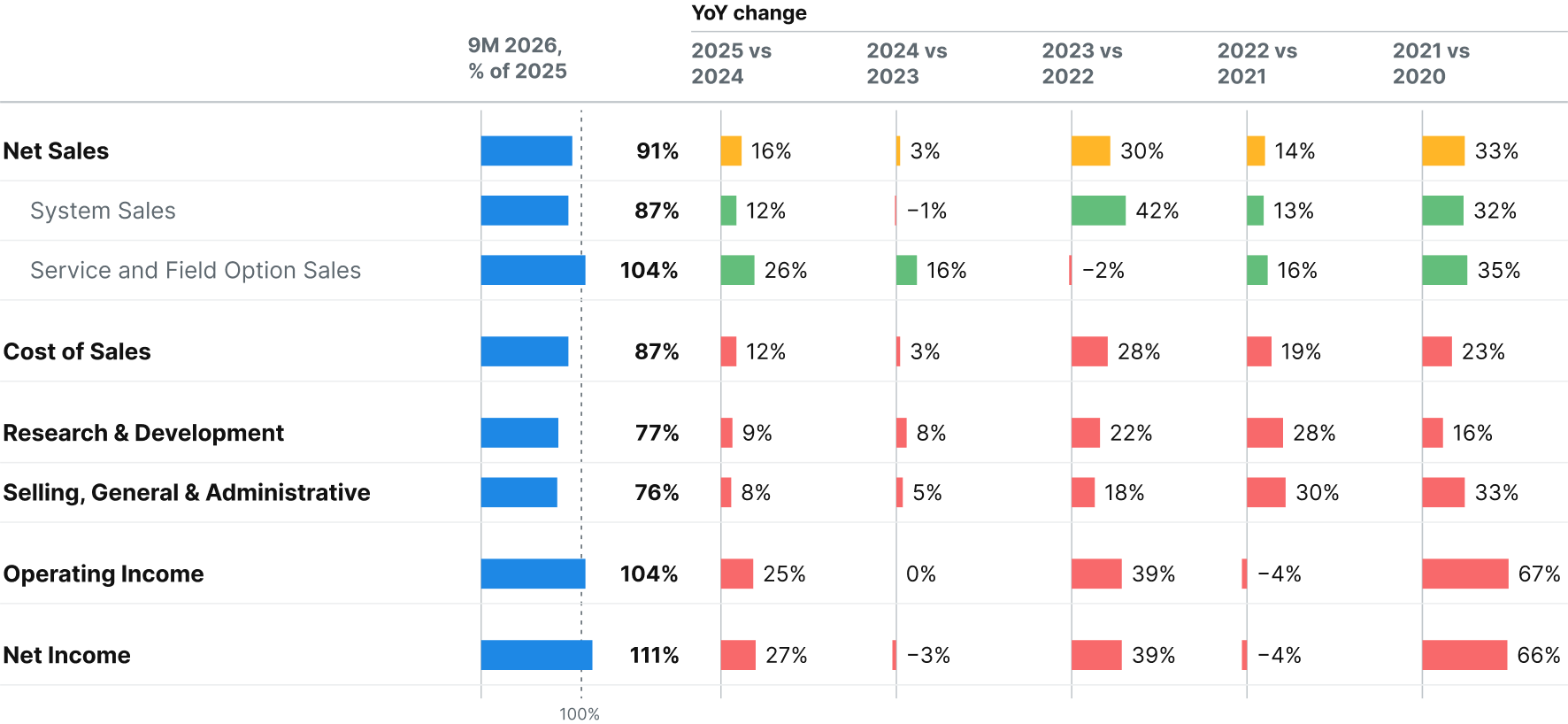
Source: Company Information; Leverage Shares analysis
Installed Base Management sales – which equals ASML’s net service and field option sales – have widened the lead over sales of EUV machines. However, the sale of lithography machines continues to grow, with a 31% quarter-on-quarter increase to a net 113 machines.
Servicing is a higher-margin activity than the sales of machines. With servicing decisively in the lead, trends indicate that 2026 will close with a 20% growth in sales over the previous year while net income is trending at 48% growth. CEO Christophe Fouquet stated that the company expects total net sales for 2026 to be between €44 billion and €45 billion – which is in excess of trends so far and indicative that servicing will continue to be a money-spinner through the end of the year, thus yielding a gross margin around 56%.
In the Q2 release, the company had indicated that low NA EUV and DUV immersion capacity – notably used in the manufacturing of DRAM memory chips and 3-5 nm AI chips – was planned for an increase on the back of customer demand. In the latest release, however, the company indicated that they’ll explore means for capacity increase only after the end of FY 2027. Hidden with the upbeat top and bottom line, this slight softening of buildout stands out.
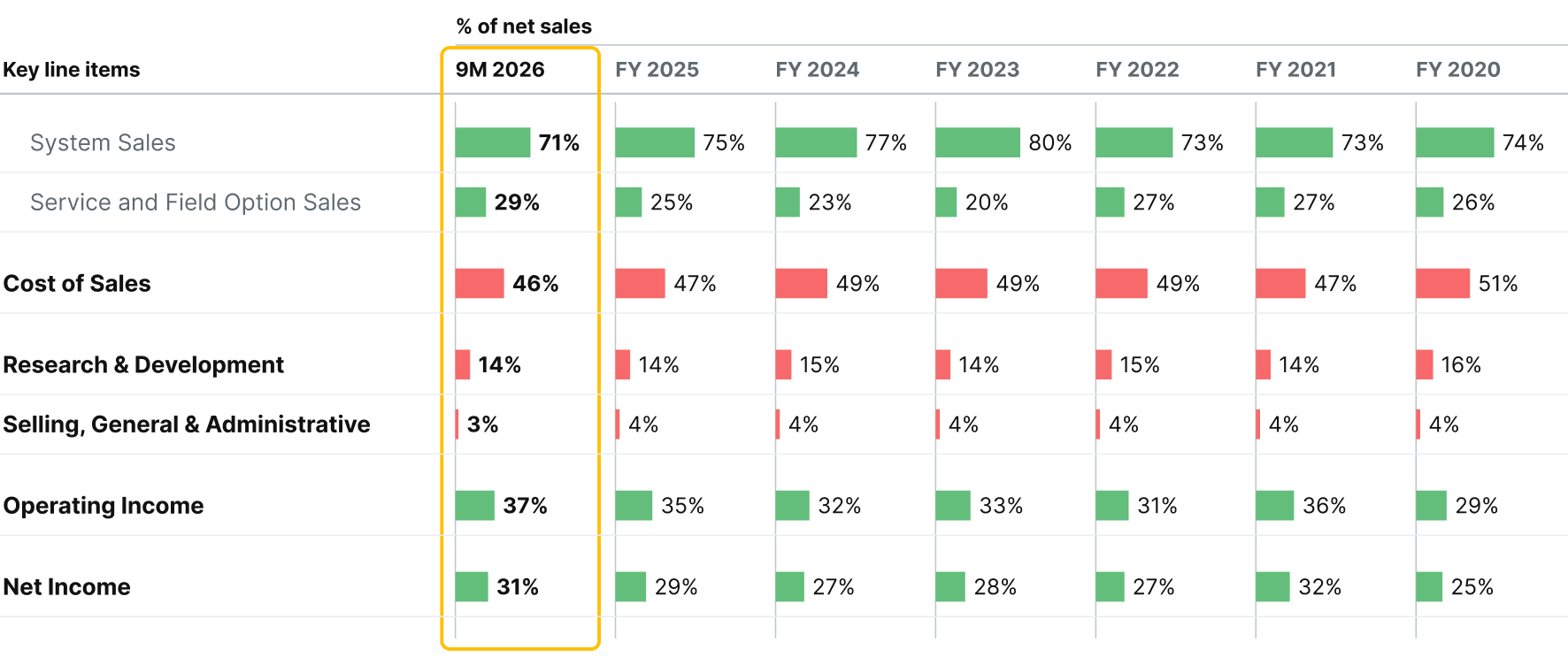
The overall relationship between line items and net sales indicate contribution to servicing rising to levels not seen throughout the decade so far.
 Source: Company Information; Leverage Shares analysis
Meanwhile, research and administrative costs continue to be a picture of stability.
China’s Return to the Balance Sheet
When considering the breakdown of system sales, another hint that possibly stands as grounds for caution is evident: South Korea accounted for 43% of all system sales in the previous quarter (Q2 2026), with Taiwan coming a distant second at 30%. In Q3 2026, South Korea’s share has slipped to 31% while Taiwan stands largely unchanged at 32%.
Sales of systems to China, on the other hand, stands out in that it increased from 14% to 23% in a single quarter. Both ChangXin Memory Technologies (better known as CXMT) and Yangtze Memory Technologies (YMTC) have begun stockpiling memory production technology at the non-proscribed DUV level, with further acquisitions planned in the second half of the year.
The acceleration is warranted: given the ongoing tension over exports of chipmaking technologies to China, there is a possibility that continued technology exports would be curtailed. This is likely the reason why CEO Fouquet, however, held that China’s net share of revenue would remain at 20% – a figure forecasted and held by the company over the past three quarters.
Like before, the China question went largely unaddressed in the earnings call.
Market Reaction
Despite the glowing top and bottom lines and the company’s announcement about plans for production capacity enhancement, the key nuance over the timing wasn’t missed: the delaying of capacity expansion despite estimating in the earlier quarter that production capacity is currently 30% lower than client demand. Deferring plans to supply demand is read as a signal that the AI Hype – and the potential being touted in AI-driven improvement – isn’t being supported by moves being made by the industry’s AI leaders. So far in this earnings season, Tesla’s earnings data revealed that it had spent well below its stated capex guidance for the year despite its claims of accelerating investment into the AI theme. As a relatively late starter in the AI infrastructure buildout – and the most beleaguered in its core business – this is interpreted as yet another confirmatory signal over the fragility of the hype.
If AI is fragile and liable for an unwind on spending, this would trickle down to ASML. While there are commitments to purchase, these are only good as the balance sheet flexibility the companies have towards speculative spending on technologies. If there isn’t an appetite for it, this hits ASML’s bottom line.
This is the other end of the AI unwind that ASML’s stock valuation is being tested. It could get choppier as 2027 begins.
Professional investors might consider the +3X Long ASML ETP (ASL3) and the -3X ASML ETP (ASMS) during bullish and bearish trends in the stock. For a broader yet leveraged exposure, the +4X Long Semiconductor ETP (SOXL) and the -4X Short Semiconductor ETP (SOXS) are at hand.
Your capital is at risk if you invest. You could lose all your investment. Please see the full risk warning here.
 Market Insights
 Education

