


Your capital is at risk if you invest. You could lose all your investment. Please see the full risk warning here.
Key Takeaways
Revenue beats expectations: Meta generated $64.6 billion in Q3 revenue, up 26% year on year.¹
AI drives advertising growth: Higher ad impressions, pricing and AI-powered recommendations strengthen the core business.¹
Spending remains the big risk: Legal charges, negative free cash flow and up to $145 billion in 2026 capital expenditure raise the stakes.¹
Meta Platforms delivered another strong quarter of revenue growth, demonstrating the power of its advertising business and the commercial potential of artificial intelligence. Yet the third-quarter 2026 results also exposed the growing cost of building the next generation of AI infrastructure, with a multibillion-dollar legal charge further complicating the earnings picture.¹
Revenue climbed 26% year on year to $64.60 billion, exceeding market expectations. However, operating income fell 37% to $12.99 billion, while capital expenditure reached $34.91 billion and free cash flow turned negative.² The results highlight the challenge facing Meta: turning its AI leadership and vast user base into sustainable earnings growth without allowing soaring infrastructure spending and legal costs to erode profitability.
The implications extend beyond META stock. Across the technology sector, investors expect tangible financial returns from the billions being invested in AI, rather than relying on growth ambitions alone.
Meta Q3 2026 Earnings Beat Estimates
Meta generated $64.60 billion in revenue during the third quarter, compared with $51.24 billion a year earlier. Revenue increased 26% year on year, exceeding the approximately $63.3 billion expected by analysts.²
The underlying advertising business remained resilient. Ad impressions across the Family of Apps increased 10% year on year, while the average price per advertisement rose 14%.² This combination suggests Meta is benefiting from both greater advertising delivery and improved monetisation, rather than relying on audience growth alone.
The company also reported 3.64 billion daily active people across Facebook, Instagram, Messenger and WhatsApp, up 3% from a year earlier.² That enormous audience gives Meta an advantage in attracting advertisers and deploying AI-powered recommendations across its platforms.
The numbers demonstrate why Meta remains one of the most powerful businesses in digital advertising. AI is already helping improve content recommendations, user engagement and advertising efficiency.
However, strong revenue growth does not automatically translate into higher profits. The extent to which growth reaches the bottom line depends on spending on AI infrastructure, research and development, legal costs and other operating expenses.
AI Spending Reaches a Critical Point
The biggest strategic decision for Meta is also its largest financial challenge. The company is committing unprecedented resources to AI infrastructure, including computing capacity, data centres and advanced models, in an effort to compete at the forefront of the technology race.
Capital expenditure reached $34.91 billion in Q3, compared with $19.4 billion in the same period last year. Management raised the lower end of its 2026 capital expenditure forecast from $130 billion to $135 billion, while retaining the upper end at $145 billion.²
That is an extraordinary spending commitment, particularly as other major technology companies are also investing heavily in AI infrastructure.
The financial implications extend beyond the initial purchase of chips and construction of data centres. Infrastructure must be maintained, computing resources consume electricity, and AI models require continuous development. These costs can weigh on profitability before new services generate sufficient revenue.
The strategy of Meta rests on two potential sources of returns. First, AI can improve the performance of the existing advertising business. Better recommendations, more relevant advertisements and improved campaign automation can increase revenue without requiring the company to build an entirely new business model. Second, new AI products could open additional revenue streams through subscriptions, commerce and business services.³
The first opportunity is already visible in the latest advertising figures. The second remains a longer-term proposition.
Improving advertising efficiency can generate incremental returns relatively quickly, while building a profitable AI platform requires sustained adoption, reliable infrastructure and a business model capable of covering substantial computing costs.
We need evidence that incremental revenue and operating efficiencies are keeping pace with investment. If expenditure continues to rise faster than monetisation, even strong headline revenue growth could struggle to translate into attractive earnings and cash flow.
Muse AI Could Open a New Revenue Stream Beyond Advertising
One of the most important developments in the latest Meta earnings report was progress with Muse, the company’s AI assistant, and Muse Wonder, a new frontier model. Chief Executive Mark Zuckerberg said more than 10 million people in the United States and Canada had registered for Muse, with around 25% of registered users engaging with the assistant daily.³
Meta is exploring ways to monetise Muse earlier through shopping, commercial transactions, advanced features and business applications. The opportunity lies in connecting AI assistance with existing platforms where users discover products, interact with businesses and make purchasing decisions.³
However, AI services require substantial computing capacity, creating significant operating costs. Muse therefore remains a potential growth engine rather than an established profit contributor. Its long-term value will depend on sustained user engagement, successful monetisation and the ability to generate revenue that justifies the infrastructure required to support it.
Meta Stock Risks: Legal Settlements and Margin Pressure
Meta recorded a $9.89 billion charge related to an agreement with US state attorneys general over litigation concerning teen mental health and social media. Total costs and expenses rose 68% year on year to $51.61 billion, while operating income fell to $12.99 billion from $20.54 billion. The operating margin declined to 20% from 40%.²
Excluding the latest legal charge, Meta said operating income would have been approximately $22.88 billion and diluted earnings per share would have reached $7.40.² This adjusted view offers a clearer perspective on operating performance before the exceptional legal expense, although it does not remove the economic impact of litigation from the investment case.
The difference between reported and adjusted earnings is very important when evaluating a company undergoing a major investment cycle. We separate the exceptional charges from recurring costs while still accounting for the possibility that legal expenses and regulatory challenges may continue.
Legal risks remain significant. On the day of the earnings release, a New Mexico judge ordered Meta to pay $25 billion in a separate privacy-related case, which the company intends to appeal.⁴ Further legal liabilities could weigh on future earnings and cash allocation as Meta continues investing heavily in AI.
These developments add another layer of risk to a business already facing heavy AI spending. Even if advertising continues to perform well, future legal liabilities could affect earnings, cash allocation and investor sentiment.
Meta Free Cash Flow Turns Negative Amid Surging Capex
The investment programme of Meta is beginning to affect cash generation more visibly. Operating cash flow remained strong at $32.79 billion in Q3, but capital expenditure contributed to negative free cash flow of $2.12 billion.² A year earlier, free cash flow was positive at approximately $10.6 billion.³
Negative free cash flow does not automatically signal financial weakness, especially when a company is investing heavily in assets intended to support future growth. Meta ended September with $82.45 billion in cash, cash equivalents and marketable securities.² That provides a substantial financial cushion.
Nevertheless, the combination of rising infrastructure expenditure, legal obligations and uncertain AI monetisation makes future cash generation an important measure of success.
Meta Q4 Guidance. Strong Growth, but Higher Spending Remains a Risk
Meta expects fourth-quarter 2026 revenue of $73 billion to $76 billion, a range that points to continued strong demand for its advertising services.² The midpoint is broadly in line with or slightly above some analyst estimates, depending on the consensus measure used.
Management also raised its full-year 2026 expense forecast to $175 billion to $179 billion, incorporating the legal charge recognised during the third quarter. Excluding that charge, the company continues to expect operating income for 2026 to exceed the 2025 level.²
Looking further ahead, management expects to continue investing aggressively in both the core business and AI initiatives. It has not provided full-year 2027 revenue guidance, leaving investors without a precise estimate of how quickly the new investment programme will translate into sales and earnings.²
The outlook therefore presents two competing signals. Advertising growth remains robust, and AI is already supporting the core business. At the same time, capital expenditure and legal uncertainty make the path from revenue growth to sustainable free cash flow less predictable.
For META stock, the next phase will depend on whether the company can demonstrate improving returns on its AI investments while protecting profitability. Strong user engagement and advertising demand provide a solid foundation, but they do not guarantee that the spending programme will deliver the returns investors expect.
Technical Analysis
Meta has been trading in a wide range between $520 and $796 over the past year. The share price rebounded to its resistance in September, but the stock pulled back ahead of the results and shed another 11% post earnings.
Further weakness towards $580 could unfold in the short-term, where buying interest is likely to start building up, and a subsequent rebound to $740 is likely to follow. Over the medium-term, the price action is likely to remain within the boundaries of its current trading range, with the $740 - $780 zone likely to continue to attract profit taking.
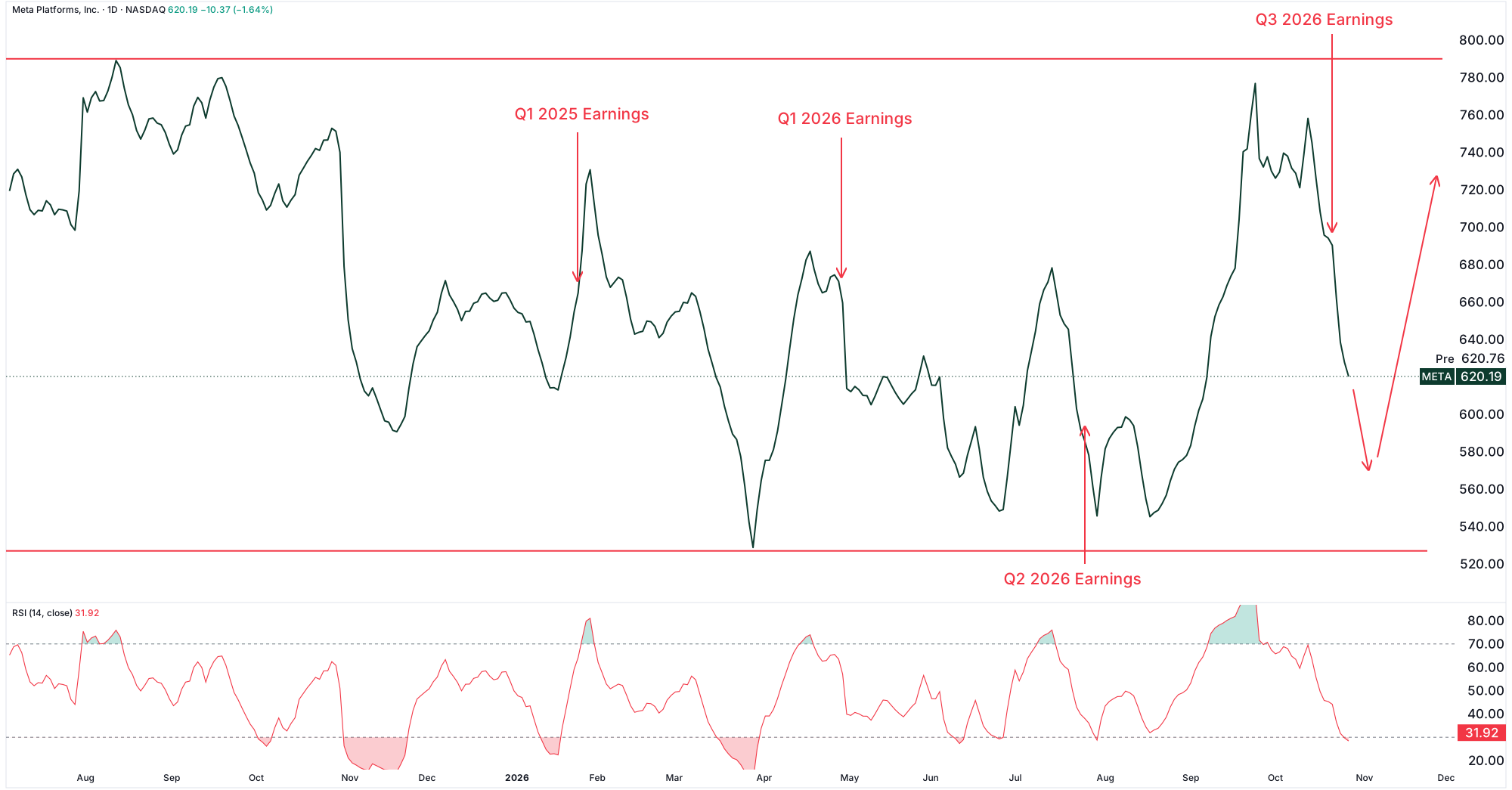
Source: TradingView. Meta daily price chart as of October 28, 2026.
Professional investors looking for magnified exposure to Meta may consider Leverage Shares +3x Long Facebook or -3x Short Facebook ETPs.
Footnotes
1. Meta Investor Relations, Meta Reports Third Quarter 2026 Results, as of October 21, 2026.
2. PR Newswire, Meta Reports Third Quarter 2026 Results, as of October 21, 2026.
3. Fortune, Meta’s revenue surges to $64.6 billion, but billions in settlement and skyrocketing AI spending turn screws on profit, free cash flow, as of October 21, 2026.
4. Associated Press, Meta Q3 revenue tops estimates and Zackerberg says Muse accounts have topped 10 million, as of October 22, 2026.
Your capital is at risk if you invest. You could lose all your investment. Please see the full risk warning here.
 Market Insights
 Education

