


Your capital is at risk if you invest. You could lose all your investment. Please see the full risk warning here.
After Taiwan Semiconductor Manufacturing Company (ticker: TSM) announced its Q3 2026 earnings on the 15th of October, the market’s reaction to the stock repeated the past quarter’s: ambivalence and a downturn of around 2% in the week that followed. This was yet another record quarter but the conviction in the premium fab for advanced chips didn’t rise.
Trend Analysis
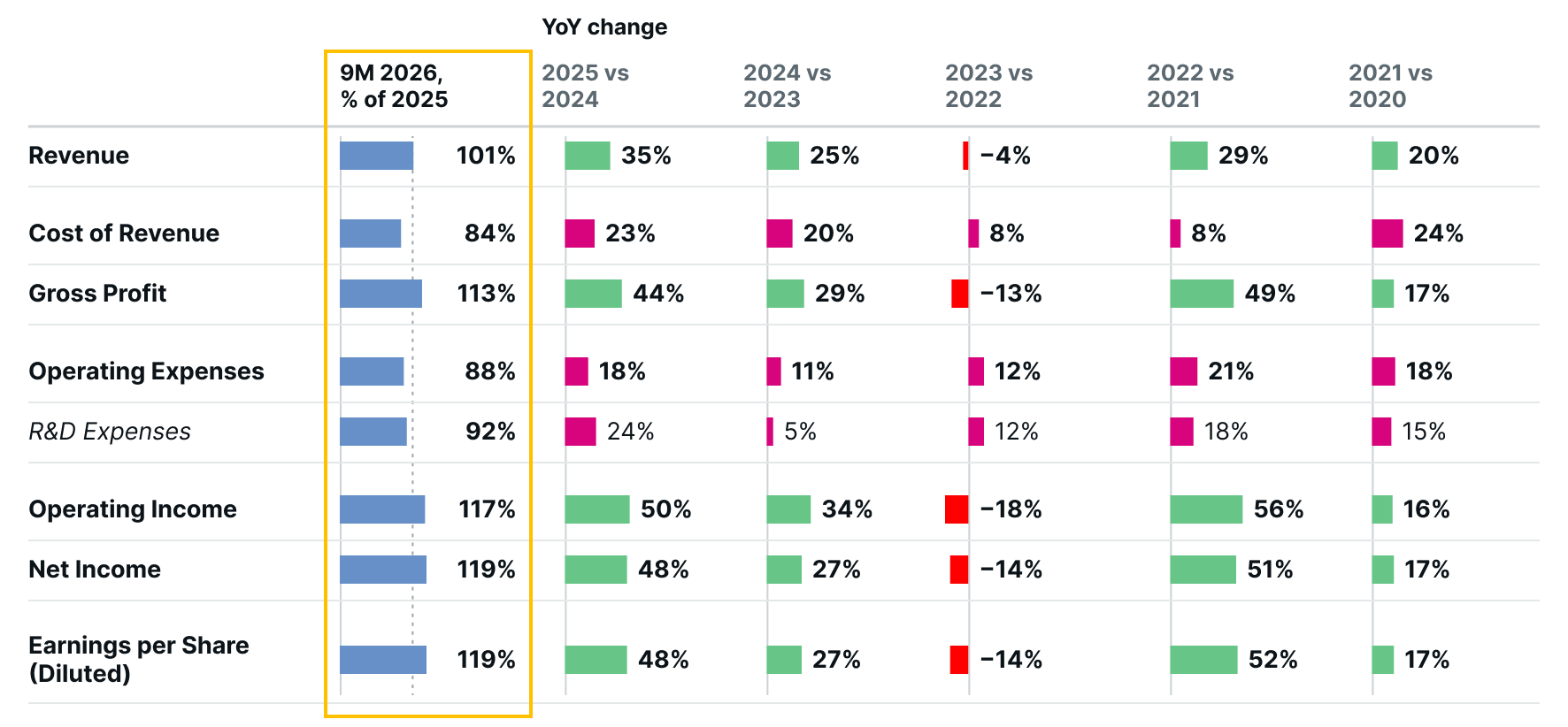
As of the first nine months (9M) of the year, revenue growth trends as of the first half of the year spiked due to increased sales in Q3 2026:
Source: Company Information; Leverage Shares analysis
If trends continue, revenue and net income for the full Fiscal Year (FY) 2026 would show a growth of 35% and 59% over the previous year. While the revenue is in line with the previous year, net income growth was a little above that in the previous year.
The factors behind this spike were in the company’s growing dependence on AI-relevant manufacturing, which now dominates its revenue mix.
 Source: Company Information; Leverage Shares analysis
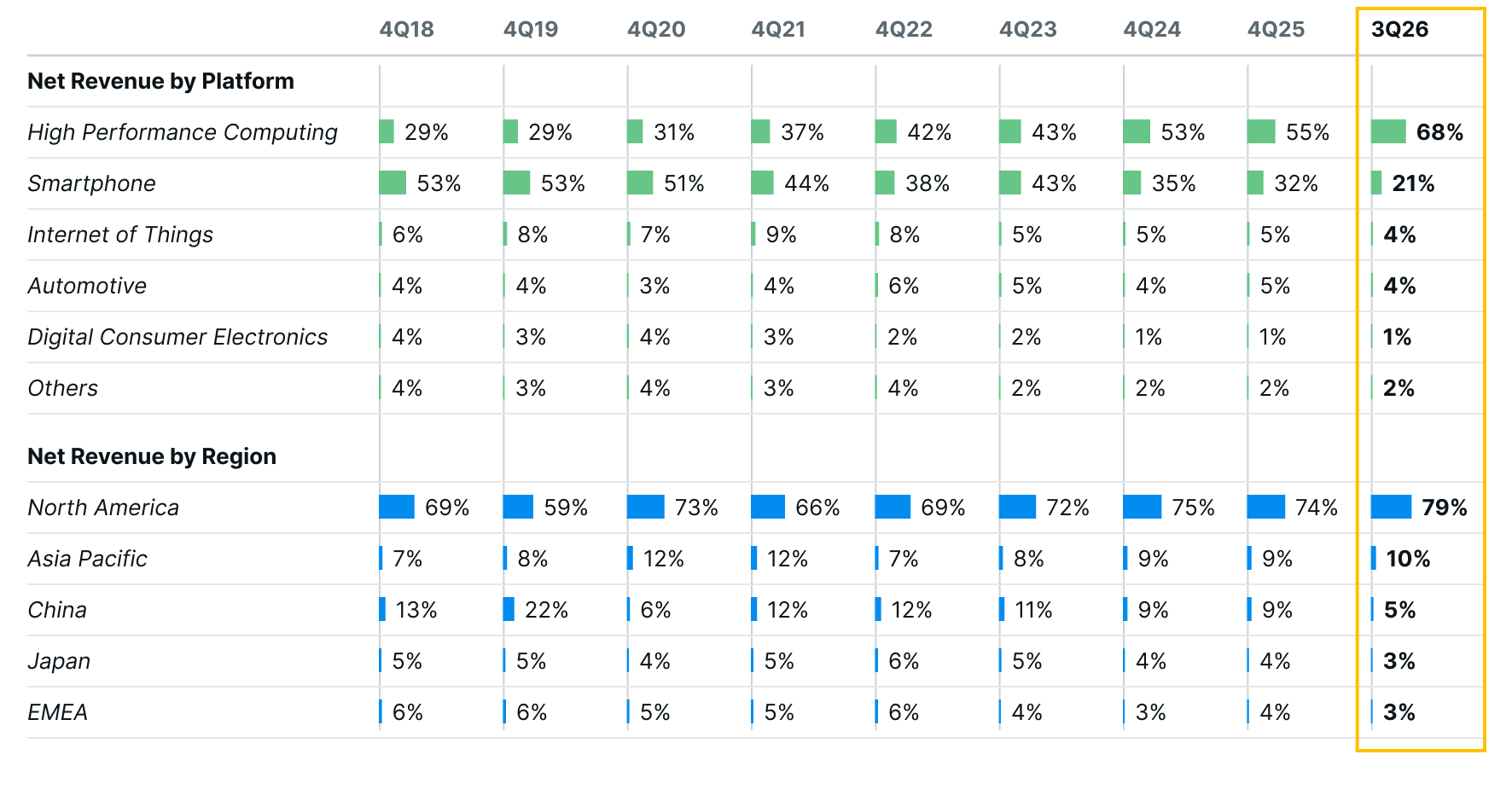
In Q3, TSMC’s smartphone segment – the mainstay of its business nearly a decade ago – is a shadow of its former self. The High-Performance Computing (HPC) segment – which processes advanced chips – now makes for 7 out of 10 dollars the company earns. In regional share, North America shows no signs of receding in prominence – and now accounts for nearly 8 out of 10 dollars in revenue.
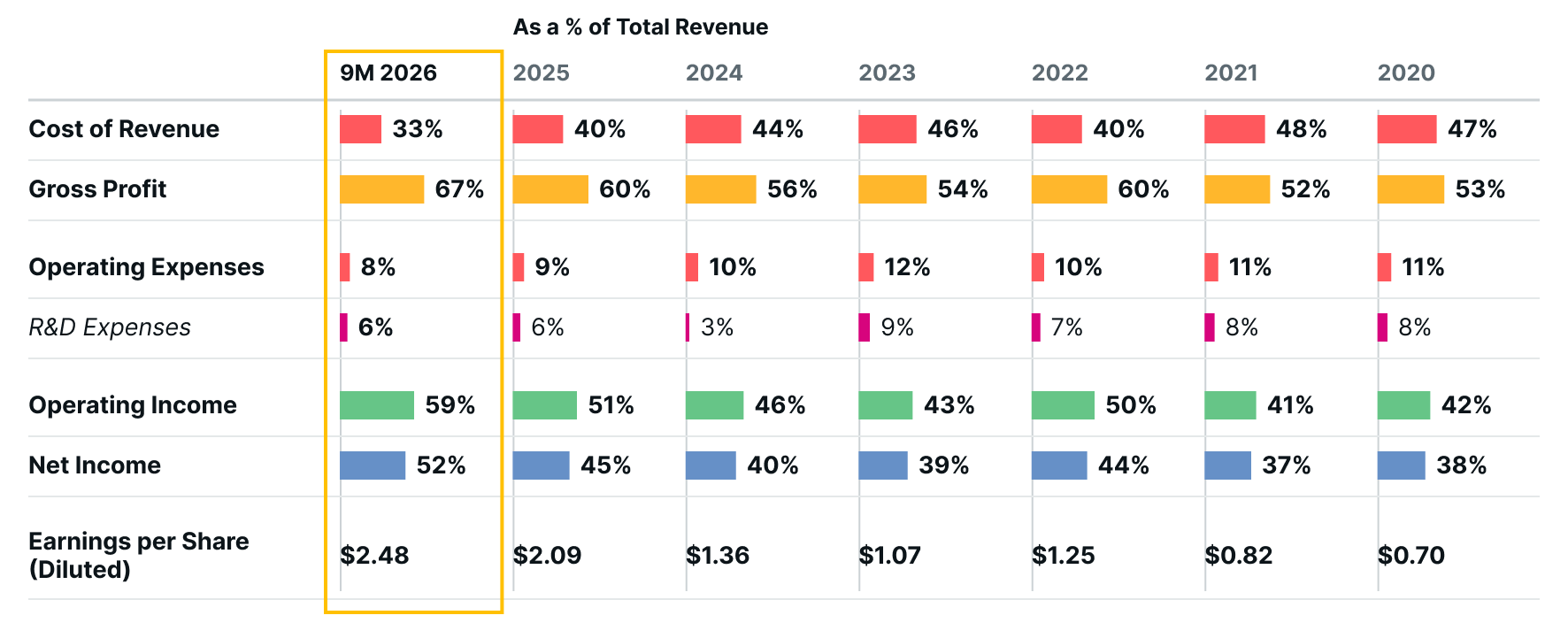
Concentration in platform, however, seems to have served the company well in passthrough efficiency:
Source: Company Information; Leverage Shares analysis
Cost of revenue per dollar in revenue has been stable through most of the year, and at the lowest level throughout the decade with nearly half of all revenue landing up in net income. In other words, the company’s profitability has remained high as it continues to accrue higher margins for its AI-relevant output.
What Drove Market Reaction
During Q2 2026, the company’s outlook for Q3 2026 stated an expectation of revenue in the $44.6-45.8 billion range, which was realized and exceeded by securing $46.7 billion. The product mix is profitable but, given the client mix and the dominant platform segment driving sales, not wholly unexpected or already priced in. The company also expects gross profit margin for Q4 2026 to remain the same as that projected for, i.e. 65% and 67%.
Additionally, the company also reported completing construction of its second fab in Arizona, with mass production expected to begin in the Q3 2027. This is a potential risk factor for the company: if AI demand - which will be borne on the back of frontier labs delivering all that was promised in terms of cost and labour savings - doesn't hold, this is a $200-plus billion investment into a facility that will deliver nowhere close to the profit margins TSMC has managed to establish painstaking over decades via its extensive complex of fabs in Taiwan. The vast majority of its business is now driven by corporate spends; if demand falls and clients ask for cheaper supply, its facilities (and balance sheets) will be under severe strain.
What has been driving market reaction bearish in the immediate aftermath of the earnings release is scepticism being laid across the AI industry: model efficiency continues to be unsatisfactory and cost benefits from AI investments continue to be elusive. This means that the rationale for datacenter buildouts will continue to be shaky. Hyperscalers and cloud providers will likely quietly pull back and negotiate for lower sales volumes going forward. As highlighted in the article about TSMC, Tesla's pullback in capex on AI infrastructure is a warning signs hidden under layers of flowery language.
Across the past one month, TSMC’s stock price has declined by around 3%; it’s a measured pullback and might be the shape of the trajectory to come over the next few months.
Professional investors might consider the +3x Long Taiwan Semiconductor ETP (TSM3) and the -3x Taiwan Semiconductor ETP (TSMS) during bullish and bearish trends in TSMC’s stock. For a broader yet leveraged exposure, the +4X Long Semiconductor ETP (SOXL) and the -4X Short Semiconductor ETP (SOXS) are at hand.
Your capital is at risk if you invest. You could lose all your investment. Please see the full risk warning here.
 Market Insights

