Article by Edward Sheldon
Exploring the Space Investment Theme Ahead of the SpaceX IPO
June 9, 2026 | Research Insights
In recent months, space has been one of the hottest investment themes in the market. It’s not hard to see why – the $1.75 trillion SpaceX IPO has captured the imagination of investors worldwide and signaled a new era for the commercial space economy.
But what are the opportunities in space? And how big could the space industry potentially be in the future?
Satellite Broadband and Mass Connectivity
From an investment perspective, the satellite sector stands out as one of the most dynamic and high-growth segments of the space economy. Today, space satellites are helping solve some of the world’s greatest challenges.
Take internet access, for example. While this is taken for granted in the Western world, there are still large swathes of the global population that are unable to get online (in Africa less than 40% of the population have access to the internet today1).
Satellite broadband can help to fix this. Its key advantage is that it doesn’t require any ground-based infrastructure to access it.
This means that it has the potential to provide internet access to underserved areas. Note that SpaceX’s Starlink is capable of delivering broadband connectivity anywhere on Earth with just a Starlink Kit.

Space satellites can also help provide internet to those who are travelling by air. Previously, those flying often had to go without the internet due to the lack of network reception.
Today, however, airlines across the world are adopting Starlink to enhance the passenger experience. Recently, dozens of major carriers – including American Airlines, Virgin Atlantic, and Singapore Air – have committed to or completed fleet-wide rollouts.
It’s a similar story for those at sea. In the past, those at sea typically had to go without internet for long periods due to a lack of network reception.
Recently, however, major global shipping giants like Maersk, Hapag-Lloyd, and Mitsui O.S.K. Lines (MOL) have rolled out Starlink connectively. As a result, those at sea can now expect the same level of connectivity as they would have ashore.
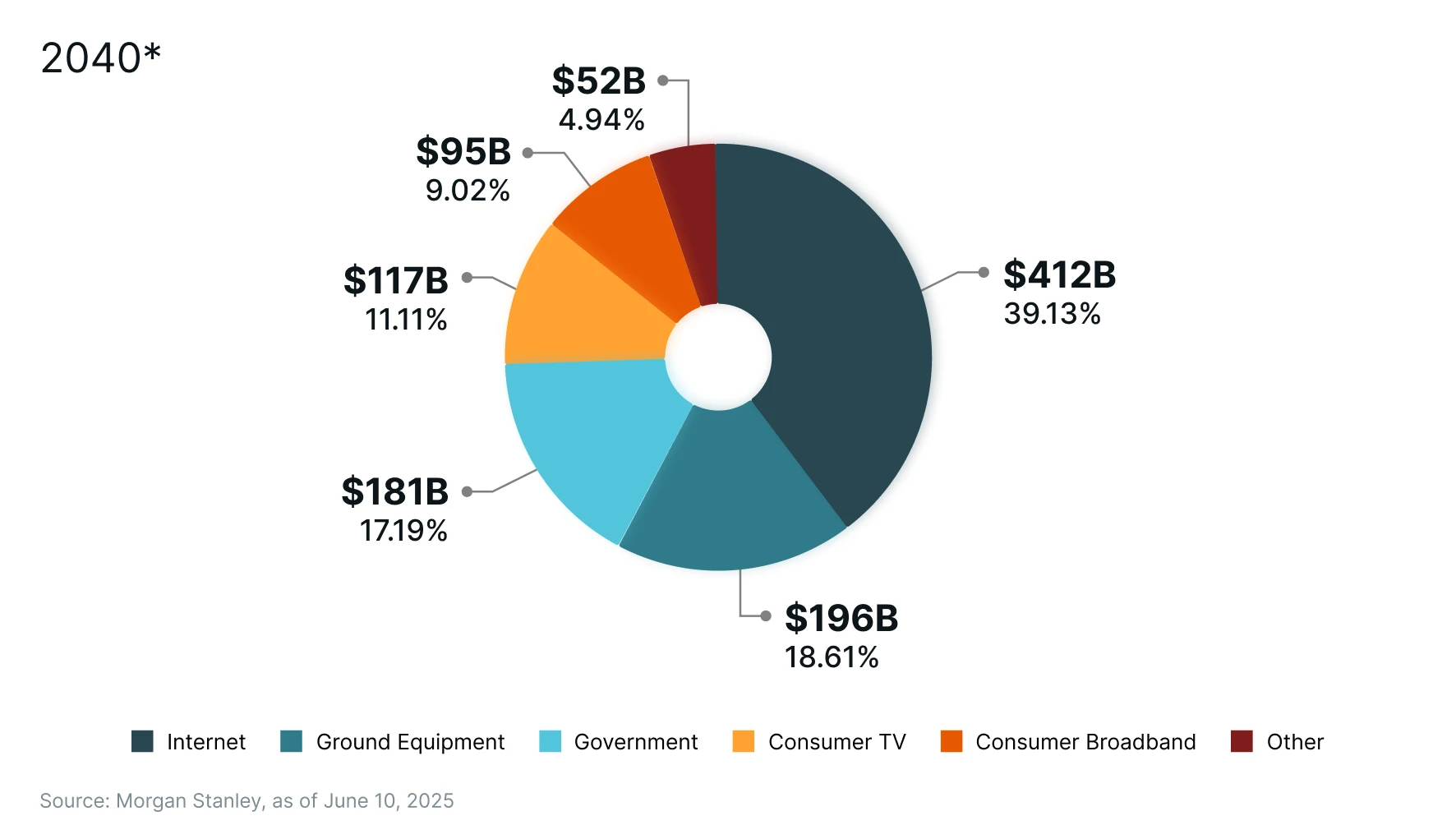
It’s worth noting that Morgan Stanley estimates that satellite broadband will represent around 40% of the global space economy by 20402. It sees global revenues here eclipsing $400 billion.
Sustainability and ESG
Another major challenge that satellites are helping to solve is the transition to a low carbon economy. Here, satellite imagery can be used to track greenhouse gas emissions from countries, regions, or businesses – this can help identify areas where emissions are high so that strategies can be developed to reduce them.
Satellite technology can also play an important role in sustainable farming. Here, satellite imagery can be used to monitor crop health and to identify areas where water and fertilizer are being used inefficiently.

Defense and Security
Defense is another potential driver of space revenues. From missile tracking to communication networks, space is quickly becoming a core domain for national security.
When it comes to missile defense, space satellites allow military forces to detect, track, and intercept threats globally by overcoming the line-of-sight limitations of ground-based radar. Without them, intercepting a fast-moving modern missile would be nearly impossible.
As for communication, modern warfare relies heavily on the instantaneous transmission of data between sensors, command centers, and frontline assets. This is where space adds value – satellites can bypass the physical limitations of Earth, acting as high-speed data relays that connect forces across continents in a fraction of a second.
It’s worth pointing out that in 2025, SpaceX won a $5.9 billion contract with the Pentagon as part of the US Space Force's National Security Space Launch (NSSL) Phase 3 (Lane 2) program3. This will see SpaceX use its Falcon 9 and Falcon Heavy rockets to loft highly classified payloads into orbit including spy satellites, advanced military communications hardware, and early-warning systems.
Artificial Intelligence
Space could also be a major artificial intelligence infrastructure frontier in the future. Looking ahead, SpaceX plans to move AI compute infrastructure to space as soon as 2028.
The rationale behind this goal is that AI infrastructure in space will be able to utilize the power of the Sun. According to SpaceX, AI compute satellites in Sun-synchronous orbit will be able to handle energy-intensive AI workloads at far greater scale and efficiency than terrestrial alternatives.
In its IPO Prospectus4, SpaceX notes that on Earth, the massive expansion of data center capacity to support growing compute demand is significantly outpacing electricity generation. It points out that between 2008 and 2023, electricity generation in the US was essentially flat while between 2023 and 2025, it only grew by 3% on an annualized basis.
SpaceX believes that space offers a solution to this energy supply and demand imbalance. By establishing a lunar presence, it will enable terawatt-scale annual AI compute growth.

Other Space Opportunities
Looking beyond the opportunities associated with satellite broadband, sustainability, defense, and AI, space offers many other exciting possibilities including:
Tourism: Space travel is now far more accessible than it was in the past so this side of the industry could grow rapidly.
Logistics: In the future, freight could be delivered by rocket instead of by plane or truck, reducing transportation times dramatically.
Mining: Mining companies could send equipment to asteroids to extract minerals as they are typically rich in heavy industrial metals like iron and nickel, as well as platinum-group metals such as platinum, palladium, and iridium.
Manufacturing: Space-based manufacturing has a number of advantages over traditional Earth-based manufacturing (extreme temperatures, reduced gravity, etc.), so it could be used to manufacture products that are difficult to manufacture on Earth (e.g. infrastructure).
A $1 Trillion+ Industry in the Future?
Overall, the opportunities associated with space are vast. So, we could be looking at a very large industry in the future.
According to Morgan Stanley, the global space industry could be generating revenue of over $1 trillion by 20402. McKinsey believes that the market could be even larger – they have a revenue forecast of $1.8 trillion by 20355.
For investors, SpaceX is one way to play the theme. It offers access to satellite broadband (Starlink), AI data centers, government defense contracts, and more.
However, there are plenty of other options for those who are not comfortable with its huge valuation. Other stocks that offer exposure to the space theme include Amazon, Rocket Lab, Lockheed Martin, and Planet Labs.
Footnotes:
1ITU, Facts and Figures 2025, as of June 9, 2026
2Morgan Stanley, Creating Space, as of June 10, 2025
3Reuters, SpaceX, ULA, Blue Origin clinch $13.5 billion-dollar Pentagon launch contracts, as of April 5, 2025
4SEC.gov, Space Exploration Technologies Corp., as of May 20, 2026
5McKinsey & Company, Space: The $1.8 trillion opportunity for global economic growth, as of April 8, 2024