Article by Edward Sheldon
DRAM ETF: What Stocks Are in It and Why Is It So Popular?
July 27, 2026 | Research Insights
Launched in spring 2026 as the first ETF dedicated purely to memory stocks1, the Roundhill Memory ETF (ticker: DRAM*) has taken Wall Street by storm. Today, it has assets under management (AUM) of around $25 billion1 – roughly six times the AUM of the Roundhill Magnificent Seven ETF1.
If you're wondering what stocks sit inside the DRAM ETF*, how it works, and whether the hype is justified, you're in the right place. In this post, we’ll break down:
- What the DRAM ETF* is and how it targets the memory sector
- The key stocks and heavyweights making up its top holdings
- Why it has exploded in popularity
- The potential risks to keep in mind
What is the DRAM ETF?
The DRAM Memory ETF* – often just called “DRAM” – is a memory stock-focused fund from Roundhill Investments. It’s designed to offer exposure to semiconductor companies producing and supplying Dynamic Random-Access Memory (DRAM), NAND flash memory, and High-Bandwidth Memory (HBM).
Listed on the Cboe, the ETF is actively managed. In terms of performance, it has returned around 160%1 since its launch on April 2, 2026.
What does the DRAM ETF have in it?
The DRAM ETF currently has 21 different memory stocks in it1. These stocks are from a range of countries including the US, South Korea, Taiwan, and Japan.
Micron, Samsung, and SK Hynix – the “Big Three” memory stocks – dominate the ETF, representing about 75% of the portfolio1. Other holdings include Seagate, Western Digital, SanDisk, and Kioxia1.
What are the Top 5 Stock Holdings in the DRAM Memory ETF?
As of July 21, 2026, the top five holdings1 in the DRAM ETF were:
- Micron Technology (27% of the portfolio)
- Samsung Electronics (26%)
- SK Hynix (22%)
- Seagate Technology Holdings (5%)
- Western Digital (5%)
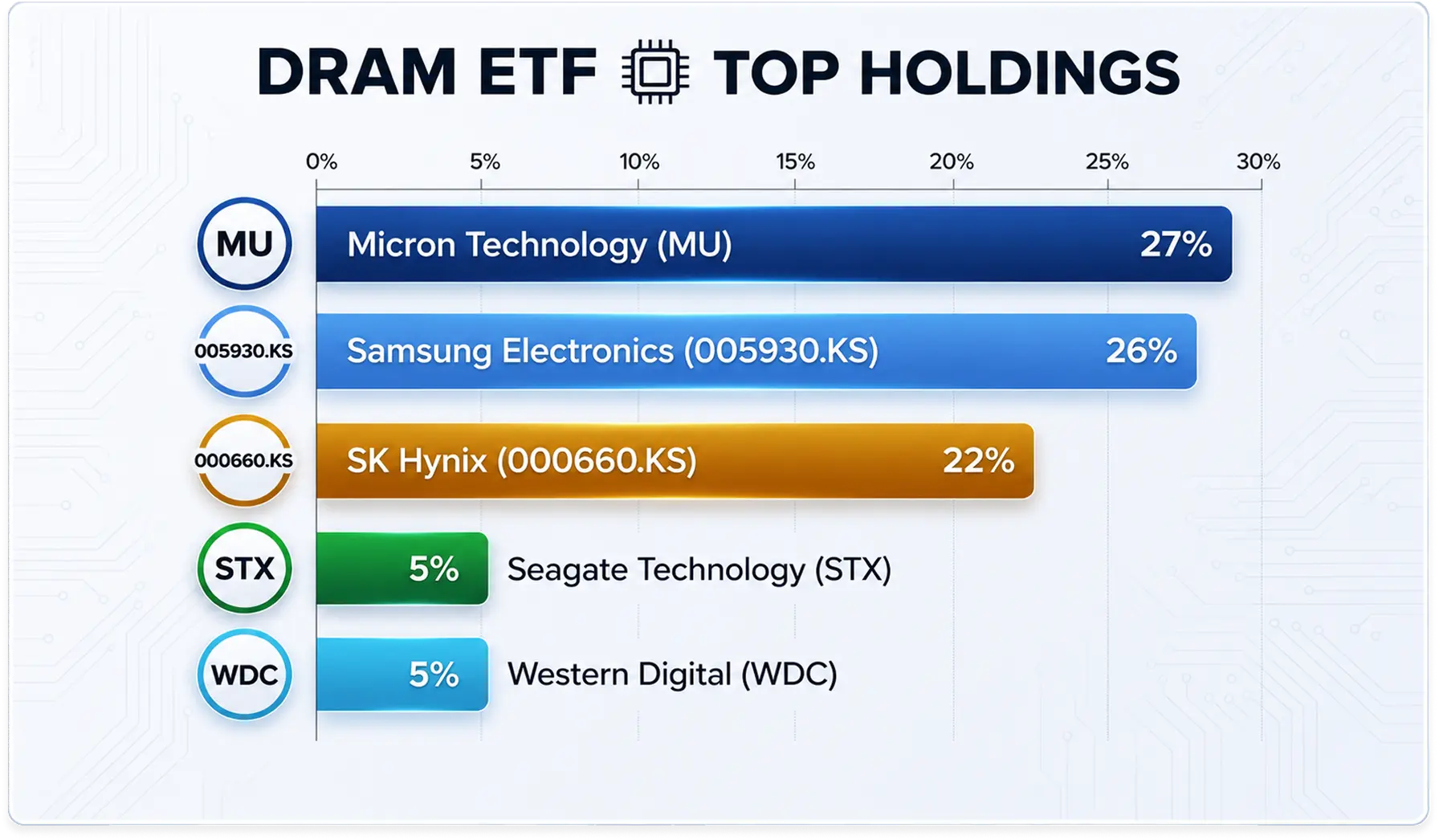
Source: Roundhill Investments, DRAM Memory ETF, as of July 21, 2026
How is DRAM Managed?
DRAM is an actively-managed ETF. The fund uses a proprietary selection process based on market share and revenue tied to the industry with portfolio weightings based on modified market-cap subject to a 25% cap on any single company1.
To pursue its active investment strategy, the fund may hold stocks or derivatives such as swaps or forwards. Rebalancing occurs at least quarterly1.
Why is the DRAM ETF So Popular?
The DRAM ETF is popular with investors for a number of reasons. One is that it offers an easy way to gain exposure to the memory theme.
Another is that it provides access to South-Korean memory powerhouses such as SK Hynix and Samsung. So, it eliminates the hassle associated with investing in international stocks.
Strong performance has also generated interest in the product. Since its launch, it has returned around 160%1.
Additionally, there’s the fact that most memory companies are seeing prolific growth at the moment. With generative AI creating high demand for memory, companies like Micron and SK Hynix are enjoying huge growth in revenues and earnings.
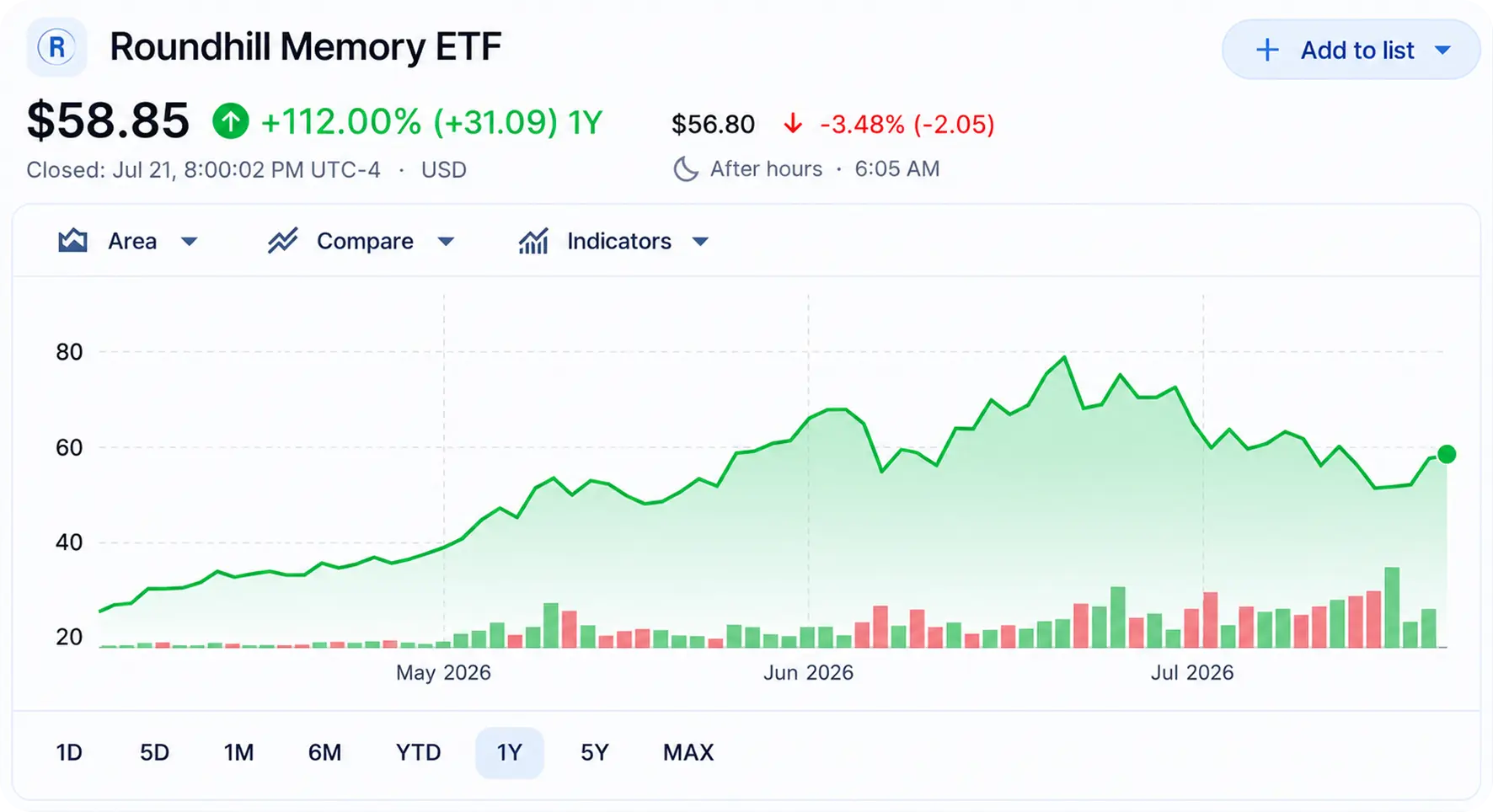
Source: Google Finance, as of July 22, 2026
Is DRAM an AI ETF?
Memory has become one of the most important components in the entire AI infrastructure supply chain. Generative AI models don't just require processing power; they need massive amounts of high-bandwidth memory (HBM) to feed data to accelerator chips quickly, enabling models to analyze complex datasets in real time.
Given the role of memory in the AI supply chain, DRAM could be considered an AI ETF. It is not a broad AI ETF however – it only provides access to one specific area of the artificial intelligence market.
What are the Risks With DRAM?
There are numerous risks to be aware of with the DRAM ETF. One is that demand for memory has historically been very cyclical. So, while demand is high today, there are no guarantees that this environment will last. Looking ahead, demand could moderate if hyperscalers cut back on AI spending and/or AI systems become more efficient.
Industry supply and demand dynamics are another key risk to consider. Today, demand for memory is far outpacing supply. Supply could catch up at some point, however. This may lead to less pricing power for companies in the industry.
Portfolio concentration is also a risk factor. With this ETF, around 75% of the portfolio is allocated to just three stocks – Micron, Samsung, and SK Hynix. This means that stock-specific risk is high. If one or more of these stocks were to underperform significantly, overall performance could be compromised.
Finally, investors should be aware that memory stocks have been volatile recently. With these stocks, one-day moves of 5-10% are quite common. This volatility is reflected in the DRAM stock price. While it has risen significantly since the launch of the product, it has been very volatile at times.
Footnotes:
1Roundhill Investments, DRAM Memory ETF, as of July 22, 2026
*The Trust, and the Adviser are not affiliated with the Roundhill ETF Trust, the Roundhill Memory ETF (DRAM), Roundhill Investments, Roundhill Financial Inc., or Exchange Traded Concepts, LLC. None of the Trust, the Adviser, or their respective affiliates claim any ownership interest in any trademarks owned by Roundhill ETF Trust, DRAM, Roundhill Investments, Roundhill Financial Inc., or Exchange Traded Concepts, LLC, or their affiliates. All rights in the trademarks are reserved by their respective owners.