


Capital en riesgo. Puede perder la totalidad de su inversión. Consulte la advertencia de riesgo completa aquí.
Key Takeaways
Intel beat Q4 earnings expectations, but weak Q1 guidance drove a sharp sell-off.
Data Centre and AI growth is accelerating, while the PC business remains under pressure.
Operational progress is real, but supply constraints and execution risks persist near term.
Intel Q4 Earnings Beat Fails to Calm Markets as Weak Guidance Spooks Investors
Intel’s fourth-quarter earnings delivered a headline beat, but markets were focused firmly on what comes next. Despite exceeding expectations on both revenue and earnings, the semiconductor giant’s soft first-quarter guidance triggered a sharp sell-off, sending Intel shares down more than 13% in one of their steepest single-day declines in recent years.
The reaction highlights a familiar theme for Intel: progress is visible, but confidence remains fragile.
Q4 Results: Earnings Beat, Margins Improve
Intel reported adjusted earnings of $0.15 per share, comfortably ahead of Wall Street estimates of $0.08. Revenue came in at $13.7 billion, also topping consensus forecasts of roughly $13.4 billion, despite declining 4% year over year.
Operationally, the quarter showed signs of stabilisation. Adjusted operating income reached $1.21 billion, far exceeding expectations, while operating margins improved to 4.2%, up from 2.9% a year earlier. Free cash flow swung sharply positive to $2.22 billion, a notable improvement from a negative figure in the prior-year period.
For full-year 2025, Intel posted flat revenue of $52.9 billion and adjusted EPS of $0.42, a significant recovery from a loss in 2024.
Guidance Disappoints as Supply Constraints Bite
While the fourth-quarter results were solid, Intel’s first-quarter outlook quickly overshadowed them.
The company guided for Q1 revenue between $11.7 billion and $12.7 billion, below expectations of approximately $12.5 billion. Adjusted earnings per share are expected to be around zero, compared with consensus forecasts of $0.05-$0.06.
Chief Financial Officer David Zinsner pointed directly to near-term supply challenges, noting that Intel expects available supply to be at its lowest point in Q1, before improving in the second quarter and beyond.
For investors, the message was clear: operational momentum is improving, but near-term execution risks remain elevated.
Segment Performance: Data Centre Strength Offsets PC Weakness
Intel’s performance across business lines continued to reflect a company in transition.
Data Center and AI (DCAI) revenue rose 9% year over year to $4.7 billion, driven by stronger demand for server CPUs amid rising AI infrastructure investment.
Client Computing Group (CCG) revenue declined 7% to $8.2 billion, reflecting continued softness in the global PC market.
The divergence highlights Intel’s growing exposure to AI-related infrastructure, even as its traditional PC business struggles to regain momentum.
Foundry Ambitions and the Strategic Importance of Intel 18A
Much of the longer-term optimism around Intel is tied to its manufacturing roadmap. In 2025 there has been a serious progress on Intel 18A, the company’s most advanced process node and a cornerstone of its foundry strategy.
Intel has already launched its Core Ultra Series 3 processors, the first AI PC platform built on 18A technology, with more than 200 designs expected from global OEMs. Demand has been strong and Intel is working aggressively to boost supply.
Looking ahead, management suggested that customers for the next generation 14A process could emerge in the second half of the year, signalling a potential inflection point for Intel’s ambitions to compete with Taiwan Semiconductor Manufacturing at the leading edge.
Investor Expectations Reset After a Strong Rally
The severity of the market reaction reflects the elevated expectations heading into the earnings result. Intel shares had risen more than 200% since last April, fuelled by optimism around its turnaround under new leadership, progress in advanced manufacturing, and high-profile investments from Nvidia, SoftBank, and the US government.
Against that backdrop, even a modest guidance miss was enough to trigger a sharp reassessment.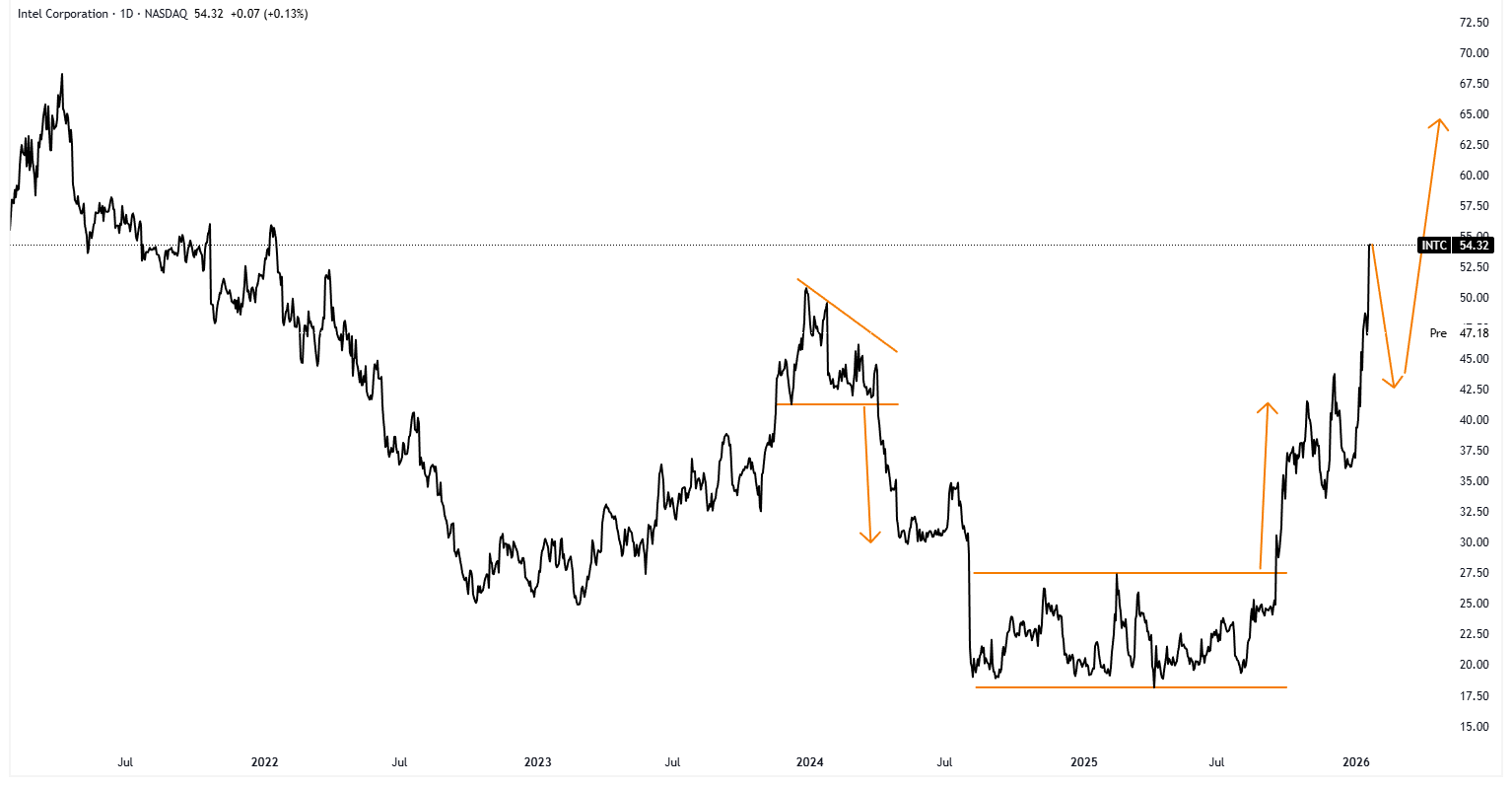
Source: TradingView. Intel daily price chart as of 23 January 2026.
Bottom Line: Progress Is Real, but Patience Is Still Required
Intel’s Q4 earnings confirmed that the company is moving in the right direction operationally. Margins are improving, free cash flow has turned positive, and the Data Centre and AI business is gaining traction.
However, the weak first-quarter outlook highlights the persistent challenges of executing a complex manufacturing turnaround while going through supply constraints. For now, Intel remains a long-term transformation story. We view any near-term share price weakness toward the $42-$43 range as an attractive entry opportunity, with a long-term upside target of $65 as execution on manufacturing and AI-driven growth continues.
Professional investors looking for magnified exposure to Intel may consider Leverage Shares +3x Long Intel or -3x Short Intel ETP.
Capital en riesgo. Puede perder la totalidad de su inversión. Consulte la advertencia de riesgo completa aquí.
 Market Insights

