



Capital en riesgo. Puede perder la totalidad de su inversión. Consulte la advertencia de riesgo completa aquí.
Alibaba missed earnings expectations for Q4 on both the top and bottom line.
Revenue: 236.5 billion Chinese yuan ($32.6 Billion), versus expectations of 237.2 billion yuan.
Net income: 12.4 billion yuan, significantly below expectations of 24.7 billion yuan.
Quarterly Results Fall Short of Estimates
Alibaba’s latest earnings report disappointed investors as both revenue and earnings came in below expectations. For the fiscal fourth quarter ended March 31, Alibaba posted adjusted earnings of 12.52 yuan ($1.73) per American Depositary Share, just shy of the 12.94 yuan forecasted by analysts. Revenue totalled 236.45 billion yuan, up 7% year-over-year, but slightly under the expected 237.24 billion yuan. The reaction from the market was negative, with U.S.-listed Alibaba shares down 6% since the earnings release, though they remain up more than 46% year-to-date.
Consumer Caution Pressures Core E-commerce Business
The results reflect a challenging macroeconomic environment in China, where consumer sentiment continues to be undermined by a prolonged property crisis and economic uncertainty. This has prompted Chinese consumers to become more price-sensitive, spurring intense competition among e-commerce giants like JD.com and Pinduoduo. Alibaba’s domestic e-commerce division, Taobao and Tmall Group, managed to post a 9% increase in revenue for the quarter, supported by growth in consumer engagement and a rising number of orders.
In a bid to remain competitive, Alibaba is expanding into “instant retail” - a fast-growing segment of the market where products are delivered within an hour. The company recently launched this service on its Taobao platform and is incentivizing users through coupons and promotions. Executives emphasized that they would continue to invest heavily in this segment, viewing it as a key growth area with the potential to reach one billion consumers.
AI and Cloud Services Drive Future Outlook
Another bright spot in Alibaba’s performance was its Cloud Intelligence Unit, which reported an 18% year-on-year revenue increase to 30.13 billion yuan. The acceleration in growth was supported by increased adoption of AI-related products and strong demand in the public cloud segment.
Alibaba is solidifying its position in China’s AI space. In April, the company released Qwen 3, the latest version of its open-source AI model, which is powering tools like its AI assistant Quark. In its Investor Relations presentation, management noted that AI-related product revenue has experienced triple-digit growth for seven consecutive quarters. CEO Eddie Wu also revealed that Alibaba plans to invest over $50 billion in tech infrastructure over the next three years to support its AI ambitions.
International Operations and Trade Tensions
While Alibaba’s international commerce arm AliExpress posted 22% revenue growth, it missed forecasts of 26.4%. While the shortfall might be related to the impact of U.S. tariffs on cross-border operations, Alibaba refrained from directly addressing this. CEO Eddie Wu did acknowledge that uncertainties in global trade regulations could pose a headwind, particularly for the AliExpress platform.
The broader geopolitical environment remains a significant concern. Tensions between the U.S. and China have resulted in a tit-for-tat tariff regime that has clouded the outlook for global commerce. Although there was an agreement this month to suspend most tariffs, the instability has already affected sentiment during the reported quarter.
Source: TradingView
Technical Analysis
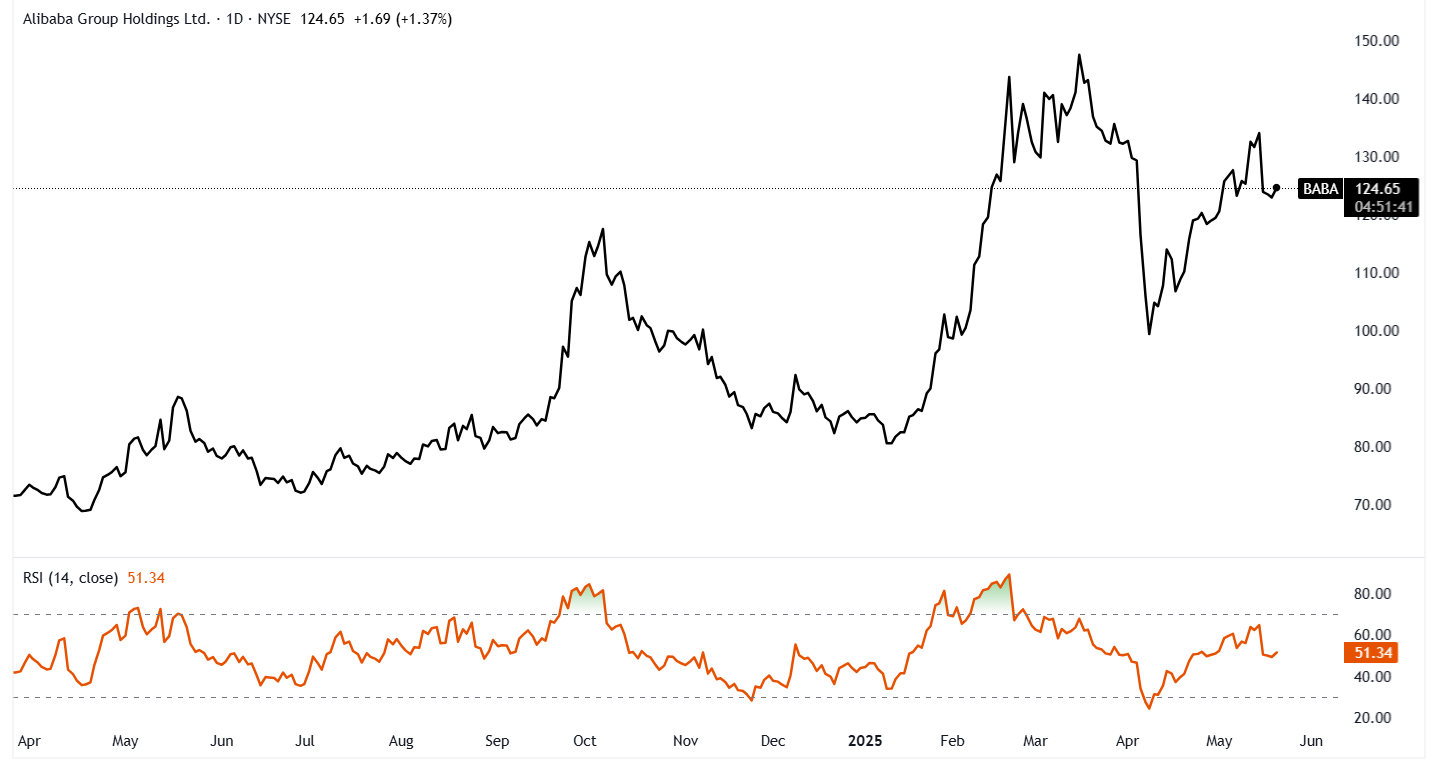
The mixed results pushed Alibaba stock down, with the price roughly 6% lower since the earnings release. However, Alibaba’s stock is still 45% higher this year, driven in part by confidence in its expanding AI capabilities and potential to serve enterprise and consumer markets through its cloud platform. However, shares remain below their mid-March highs as investor concerns persist regarding competitive pressures and macroeconomic volatility.
From a technical analysis perspective, the stock has been consolidating within the boundaries of a wide trading range between $58.01 and $125.84 over the past three years. Price action broke above its key level of resistance in February 2025, suggesting that the down trend from the October 2020 high is over. The breakout has bullish implications and suggests that higher price levels are likely to unfold over the long-term. Based on the breakout, the initial upside price target is in the range between $160.00 and $165.00.
Looking Ahead: Key Drivers and Risks
Alibaba is heading into an important period with the upcoming “618” shopping festival on June 18, which is a major event in China’s retail calendar. The company has already started pre-sales, and management hopes its continued push into instant commerce and integration with platforms like Xiaohongshu will boost consumer engagement.
At the same time, Alibaba faces an uphill battle as it seeks to regain market dominance amid stiff competition and an unpredictable economic environment. While growth in cloud and AI is compelling over the long-term, the company will need to execute carefully and manage near-term challenges to meet high investor expectations.
Professional investors looking for magnified exposure to Alibaba may consider Leverage Shares +3x Long Alibaba or -3x Short Alibaba ETPs.
Footnotes:
Alibaba Investor Relations: https://data.alibabagroup.com/ecms-files/1532295521/83f92d1d-d36f-4ecd-a56c-2d3c59cb251a/Alibaba%20Group%20Announces%20March%20Quarter%202025%20and%20Fiscal%20Year%202025%20Results.pdf
Capital en riesgo. Puede perder la totalidad de su inversión. Consulte la advertencia de riesgo completa aquí.
 Market Insights

