- Leverage & Inverse ETPs
- Instruments
- White Label
- Why Us
Your capital is at risk if you invest. You could lose all your investment. Please see the full risk warning here.

Exchange Traded Funds (ETFs) have long been a part of many an investment plan for investors across the world. As per iShares, ETFs now account for nearly $9 trillion in Asset Under Management (AUM) around the world as Q2 2023 ended.
Websim is the retail division of Intermonte, the primary intermediary of the Italian stock exchange for institutional investors. Leverage Shares often features in its speculative analysis based on macros/fundamentals. However, the information is published in Italian. To provide better information for our non-Italian investors, we bring to you a quick translation of the analysis they present to Italian retail investors. To ensure rapid delivery, text in the charts will not be translated. The views expressed here are of Websim. Leverage Shares in no way endorses these views. If you are unsure about the suitability of an investment, please seek financial advice. View the original at
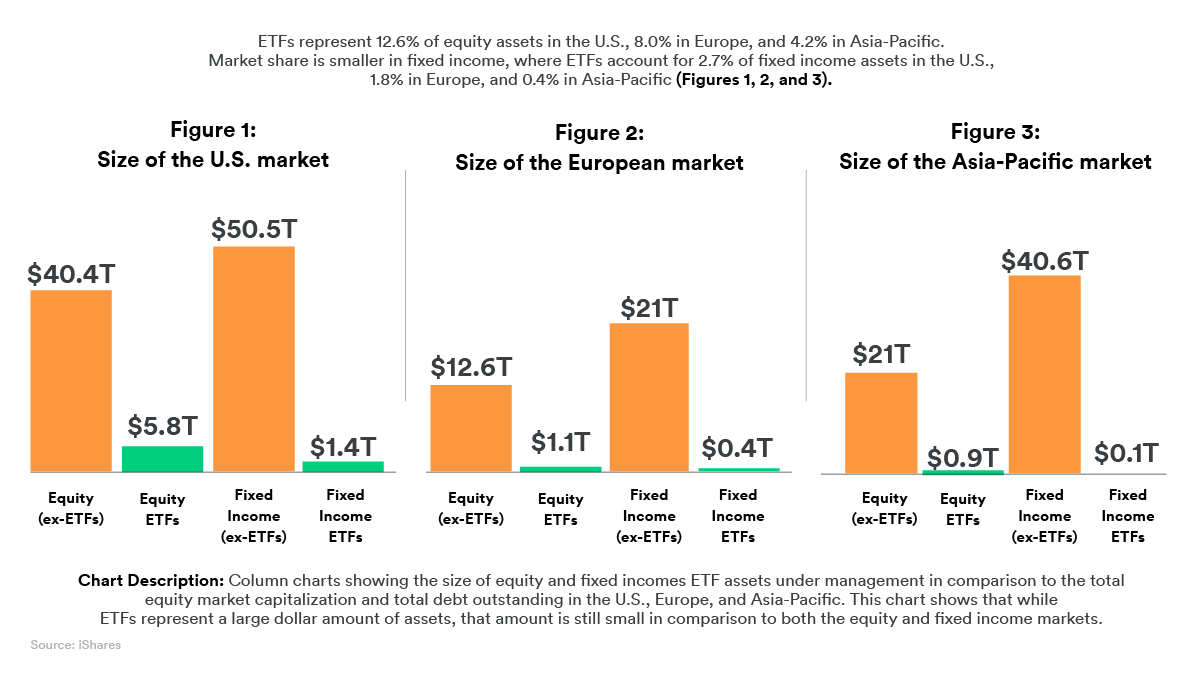
The value inherent in ETFs has been plain to most investors for years now. For a small fee (usually defined in percentage terms as Total Expense Ratio or TER) charged by the ETF issuer, investors receive diversified coverage across a large number of instruments in line with a “theme”. For instance, an ETF built around the S&P 500 offers exposure to stocks of the 500 largest publicly-traded companies across sectors. Since an ETF typically “track” an index which is, in turn, governed by rules that determine the weightage of each security within the index, the ETF’s investment strategy is driven by a rules-based approach readily accessible by the investor – thus affording the investor a high level of transparency regarding the usage of the capital they provide to the issuer.
Now, given that an ETF tracks a “theme” that could be affected by macroeconomic or even specific events, the prospect of betting on the trajectory of the theme arises. Professional investors can employ “leveraged ETFs” to do this. As per the U.S. Securities and Exchange Commission (SEC), these “leveraged and inverse ETFs” are very different from traditional ETFs:
Leveraged ETFs deliver multiples of the daily performance of the benchmark they track. For example, a 2x (two times) leveraged ETF seeks to deliver double the daily performance of the benchmark.
Inverse ETFs (also called “short” funds) deliver the opposite of the daily performance of the benchmark they track.
Leveraged inverse ETFs (also known as “ultra short” funds) deliver a multiple of the inverse of the benchmark’s daily performance.
The key element for investors to bear in mind is that “leveraged and inverse” ETFs deliver multiples of the daily performance of the benchmark they’re tracking. These instruments are thus “reset” daily, which tends to create confusion among some investors. Let us consider a simple example to illustrate this.
Assume the benchmark has a price of $50 today (Day 0) while 2X Leveraged ETF tracking this benchmark has a price of $10. The next day (Day 1), the benchmark goes up by 3% to reach $51.50. The 2X Leveraged ETF delivers twice the performance to reach $10.60. The day after (Day 2), the benchmark goes up by another 2% to reach $52.53. The 2X Leveraged ETF now delivers twice the performance to reach $11.02.
Many investors will add 3% and 2% together to arrive at the conclusion that the benchmark has risen 5% over two days. This is incorrect: by virtue of daily compounding, the benchmark has actually risen by 5.06% over this period. Similarly, the 2X Leveraged ETF has risen by 10.24%. Upon dividing the rise in the 2X Leveraged ETF by that seen in the benchmark, it can be seen that a 2X Leveraged ETF has delivered 2.02 times the performance (and not 2 times) of the benchmark over two days! This is not a mistake: the issuer of the Leveraged ETF is obligated to deliver multiples of the daily performance of the benchmark. The benefit seen in net performance across two days is a result of daily compounding.
Of course, it bears noting that “excess performance” over multiple days isn’t always the norm. Readers can refer to a fuller explanation of how rebalancing and compounding works in a variety of market circumstances in an earlier article here.
A core tenet in the consideration of ETFs versus Leveraged ETFs can be stated thus: investing into an ETF is equivalent to holding a conviction in the performance of the “theme” or benchmark the ETF tracks. Buying the S&P 500 is equivalent to “buying” the conviction that markets will rise over time. Many jurisdictions, in fact, reward the holding of ETFs in (say) pension plans with favourable tax treatments. However, investing into Leveraged ETPs is equivalent to “betting” on performance of the “theme” or benchmark in a short time frame. In other words, ETFs tend to be strategic investments while Leveraged ETFs tend to be tactical. Virtually every jurisdiction that has Leveraged ETFs available to investors will carry the disclaimer that no Leveraged ETF should be held for more than a day. The ideal means of investment, as per regulators, is that investors should sell their Leveraged ETFs near the end of trading hours and go back in the next day, if they wish to. Of course, given that it is a suggestion and not a requirement, many investors simply continue to hold on to their position in Leveraged ETFs for a period greater than 1 day.
The “official” nature of Leveraged and Inverse ETFs also differ by jurisdiction. For instance, Leveraged and Inverse ETFs aren’t themselves necessarily or universally considered to be ETFs. To provide the “leverage factor”, the issuer typically purchases the magnified exposure either via derivatives or futures contracts – thus making leveraged and inverse ETFs “debt instruments” as opposed to ETFs, which are considered to be “collective investment vehicles”. Another confusing trend lies in the naming conventions adopted by the industry. For instance, a leveraged/inverse instrument with a broad index as benchmark that is also tracked by many ETFs is generally called a “Leveraged/Inverse ETF” but this doesn’t mean that it is an ETF itself. An instrument magnifying the performance of a smaller set of securities (typically 10 distinct tickers) without a weighing methodology is typically termed an Exchange Traded Note (ETN) while an instrument with an even smaller set of tickers (or even one ticker) as the benchmark would be termed an Exchange Traded Product (ETP).
Regardless of the confusing nomenclature and the tactical nature of these instruments, the Leveraged & Inverse (L&I) market has been witnessing a steady growth. As of the end of June this year, it has been estimated that over 1,200 listed instruments hold over $125 billion in AUM globally.
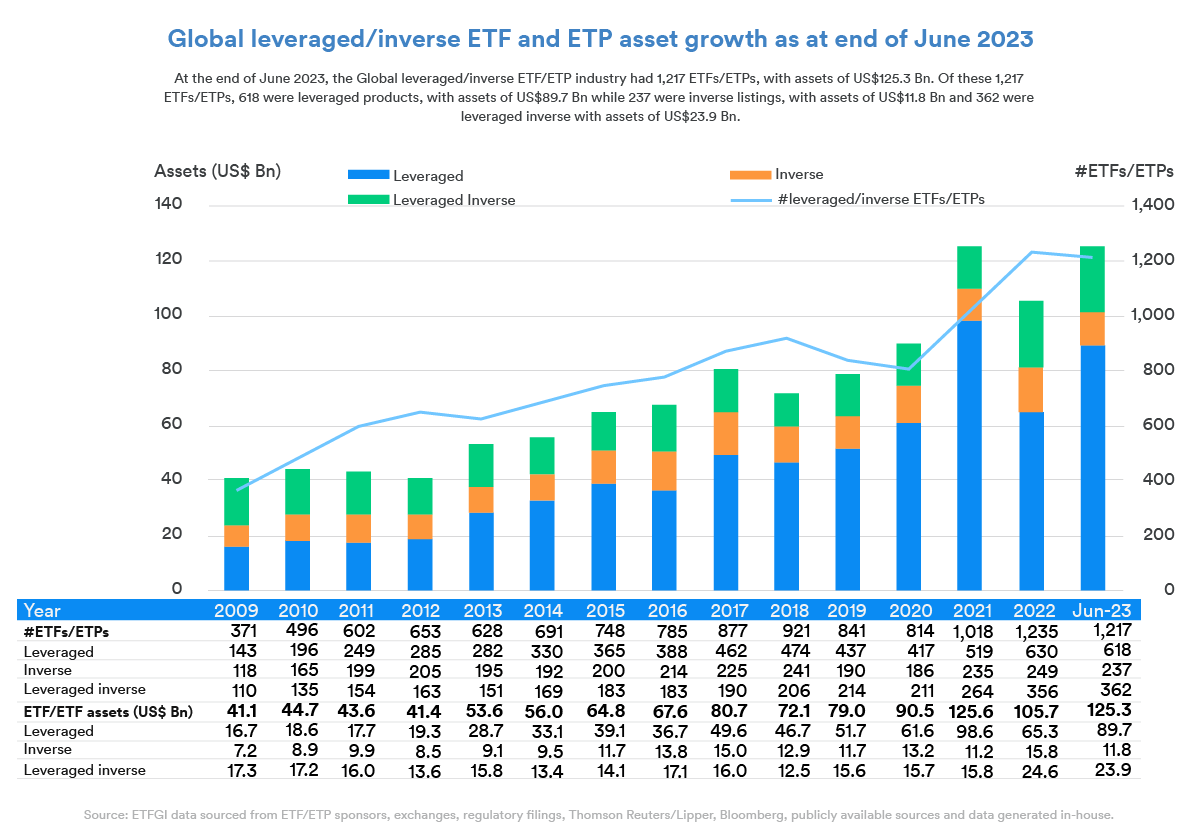
It should also not be assumed that all L&I instruments track equity indices as benchmarks: about 15% of all AUM is held in instruments tracking commodities, fixed income and even active trading strategies as benchmarks.

Overall, be it “Leveraged & Inverse” ETFs, ETNs or ETPs, the landscape is a target-rich environment for professional investors with a penchant for actively managing their portfolio’s performance. Leverage Shares has issued about 10% of all leveraged/inverse instruments in the market today. Please click here to learn about our leveraged/inverse, non-leveraged and custom ETPs.
Your capital is at risk if you invest. You could lose all your investment. Please see the full risk warning here.
Share this:



INVESTOR TYPE:
LOCATION:
Please confirm the Terms and Conditions
by clicking on “I agree”.
This website is for informational purposes only.
This website is accessible to retail investors in the EU for informational purposes only. Leverage Shares does not directly distribute to retail investors. Retail clients should not rely on any of the information provided and should seek independent financial advice.
Information contained in this website is intended only to provide general and preliminary information and does not constitute any legal or investment advice, an offer to sell or solicitation to buy any security, including shares of any Exchange Traded Products (“ETPs”).
An investment in the promoted ETPs may only be made based on the ETPs´ legal documentation and will be subject to terms and conditions contained therein.
The information provided on this site is not directed to any United States person or any person in the United States, any state thereof, or any of its territories or possessions. The ETPs shown on this website are not available for sale in the U.S. or to a U.S. person.
I acknowledge having my legal residence in the selected location.
Leverage Shares does not directly distribute to retail investors.
Please contact your financial adviser, or other investment professional, if you would like to discuss whether these products may be suitable for you.
This website is intended for U.S. residents.
The content on this website is for informational purposes only and is educational in nature.
The material contained on this website is not intended as a recommendation to buy, sell or hold any security or to adopt any investment strategy.
Please confirm the Terms and Conditions by clicking on “I agree”.
This website is for informational purposes only.
Information contained in this website is intended only to provide general and preliminary information to EU regulated firms such as Investment Intermediaries and Asset Managers. This information does not constitute an offer to sell or solicitation to buy any security, including shares of any Exchange Traded Products (“ETPs”).
An investment in the promoted ETPs may only be made based on the ETPs´ legal documentation and will be subject to terms and conditions contained therein.
The information provided on this site is not directed to any United States person or any person in the United States, any state thereof, or any of its territories or possessions. The ETPs shown on this website are not available for sale in the U.S. or to a U.S. person.
I acknowledge having my legal residence in the selected location.
Please confirm you have read and accept the Terms and Conditions by clicking on
“I agree”.
This website is for informational purposes only.
Information contained in this website is directed only at institutional investors and investment professionals intended only to provide general and preliminary information to such as FCA regulated firms such as Independent Financial Advisors (IFAs) and Wealth Managers. Nothing on this website is intended to information does not constitute an offer to sell or solicitation to buy any security, including shares of any Exchange Traded Products (“ETPs”).
An investment in the promoted ETPs may only be made based on the ETPs legal documentation and will be subject to terms and conditions contained therein.
The information provided on this site is not directed to any United States person or any person in the United States, any state thereof, or any of its territories or possessions. The ETPs shown on this website are not available for sale in the U.S. or to a U.S. person.
I confirm I am a professional investor and acknowledge having my legal residence in the selected location.
This website is intended for U.S. residents.
The content on this website is for informational purposes only and is educational in nature.
The material contained on this website is not intended as a recommendation to buy, sell or hold any security or to adopt any investment strategy.
Never miss out on important announcements. Get premium content ahead of the crowd. Enjoy exclusive insights via the newsletter only.