



Your capital is at risk if you invest. You could lose all your investment. Please see the full risk warning here.
The terms Exchange Traded Fund (ETF) and Exchange-Traded Product (ETP) might seem interchangeable, they actually represent distinct categories of investment instruments, each with its unique characteristics, advantages, and considerations. While these instruments are traded on an exchange and provide exposure to shares and other assets such as indices and commodities, there are a few important differences in terms of complexity and risk.
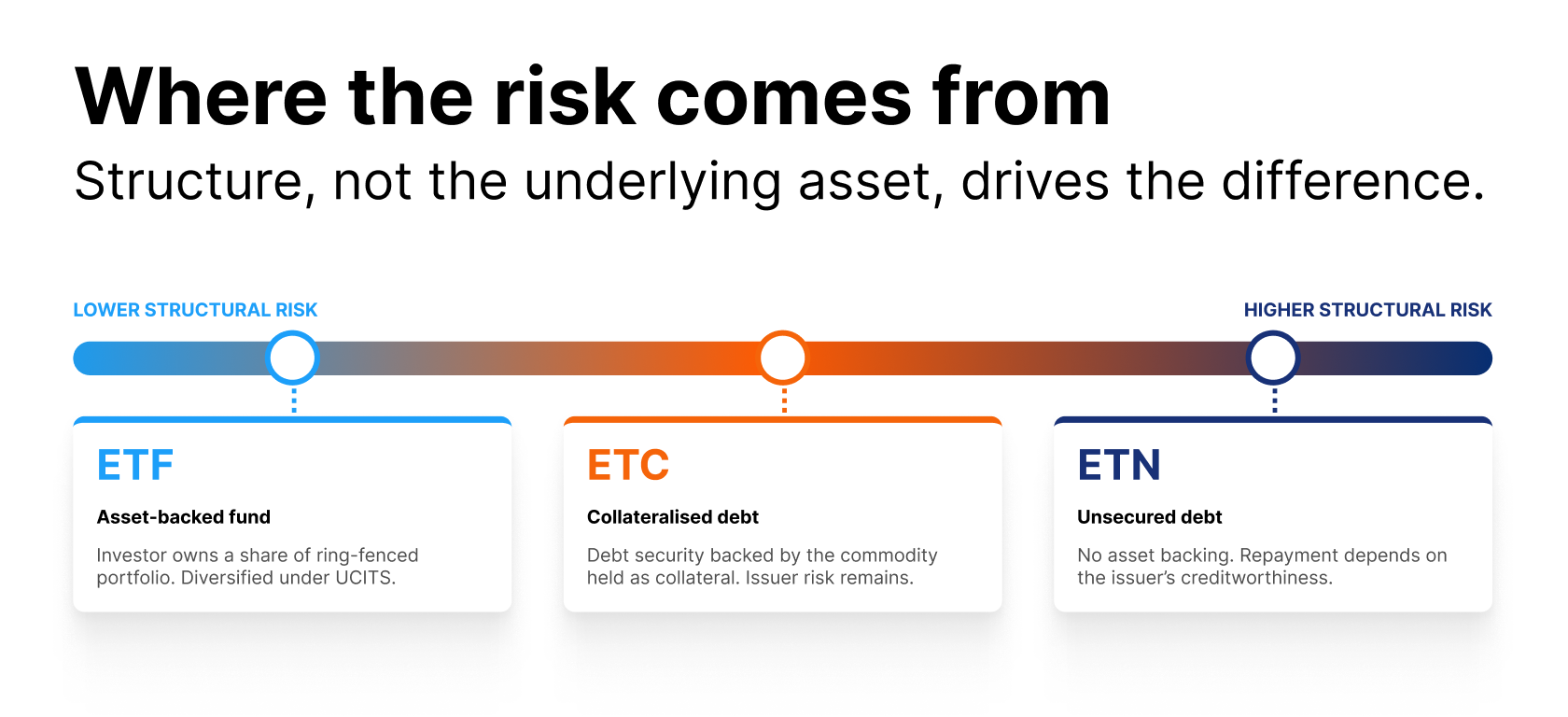
The short answerETP is the umbrella term. ETF, ETC and ETN are the three products under it. An ETF is a fund, while an ETC and an ETN are debt securities. That single structural difference is what drives most of the difference in risk.
ETPs are a broader category that encompasses a number of investment instruments. The ETPs cover a wider range of products such as ETFs, Exchange Traded Notes (ETNs), and Exchange Traded Commodities (ETCs). Therefore, ETFs are a subset of ETPs.
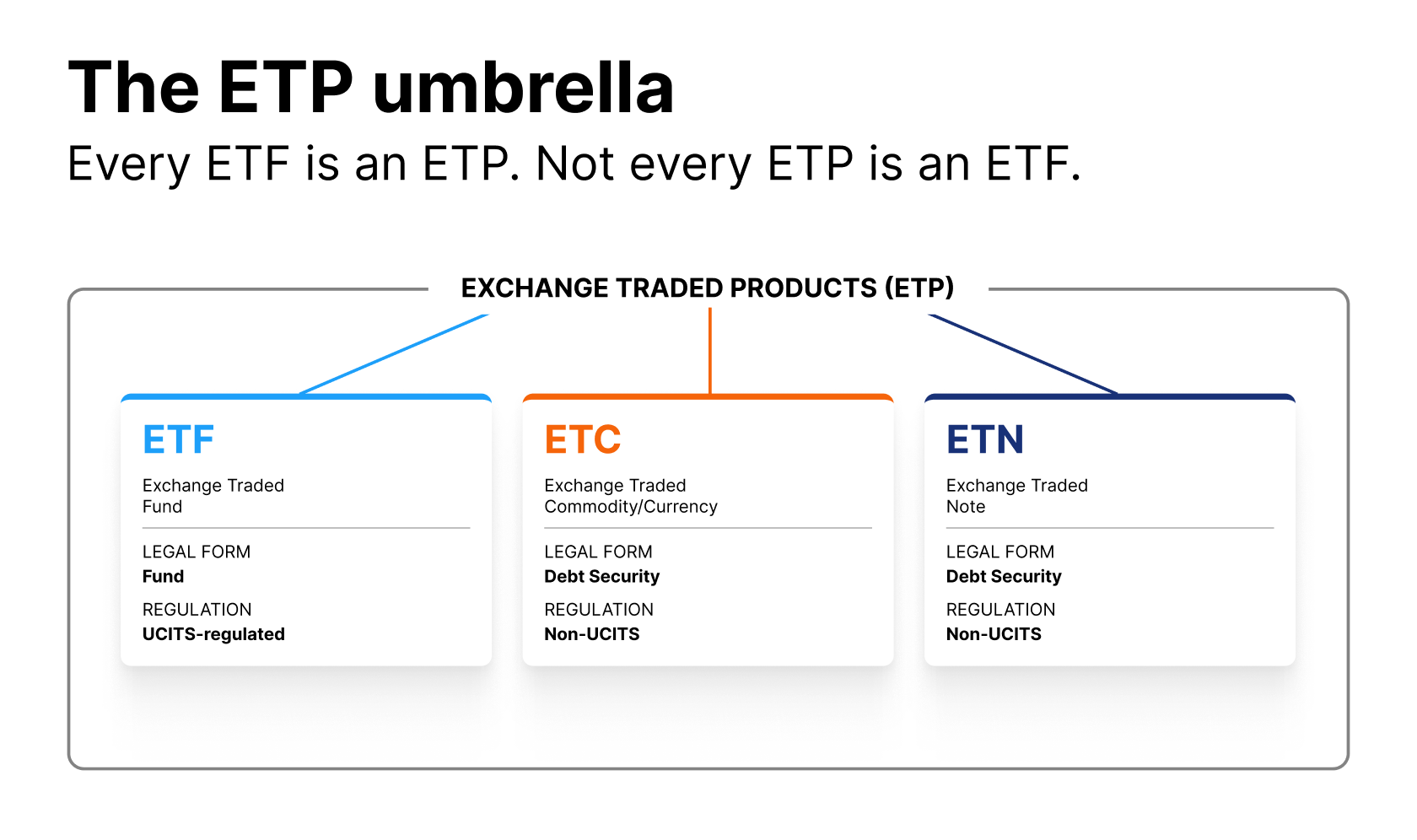
ETPs are best defined as open-ended investments listed on the exchange and traded and settled like shares. Open-ended means that the number of units on issue can increase or decrease in response to demand and supply. ETPs are passive investments aiming to replicate the performance of a given market, generally by tracking an underlying benchmark index and usually trading at or close to net asset value (NAV).
Exchange Traded Funds
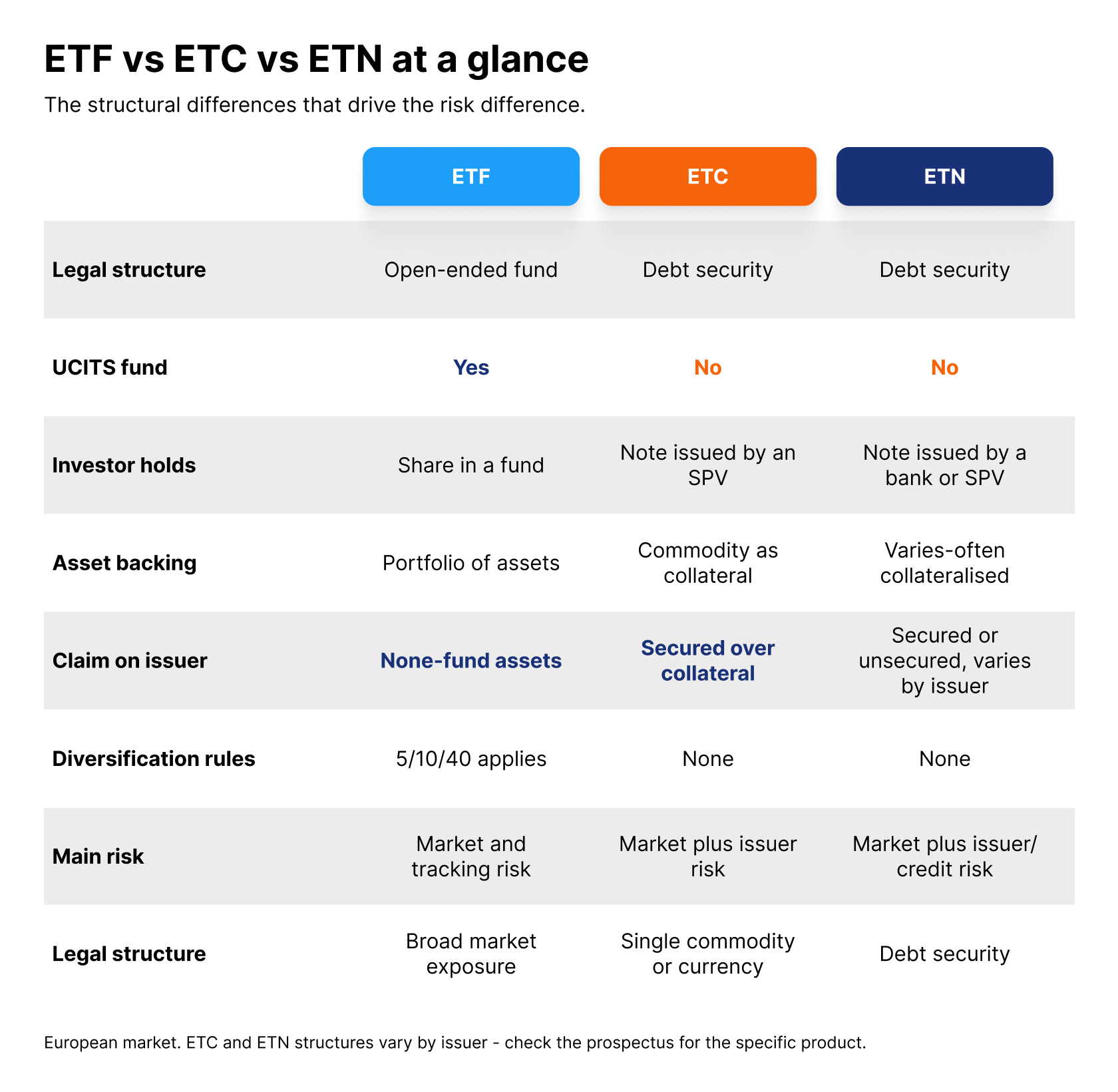
ETFs are open-ended funds that track an underlying index, commodity, or a basket of assets and are regulated in Europe under UCITS (Undertakings for Collective Investment in Transferable Securities). ETFs offer the diversification benefits of mutual funds with the added advantage of real-time trading on stock exchanges. They are generally considered to be lower risk due to its diversification and asset backing.
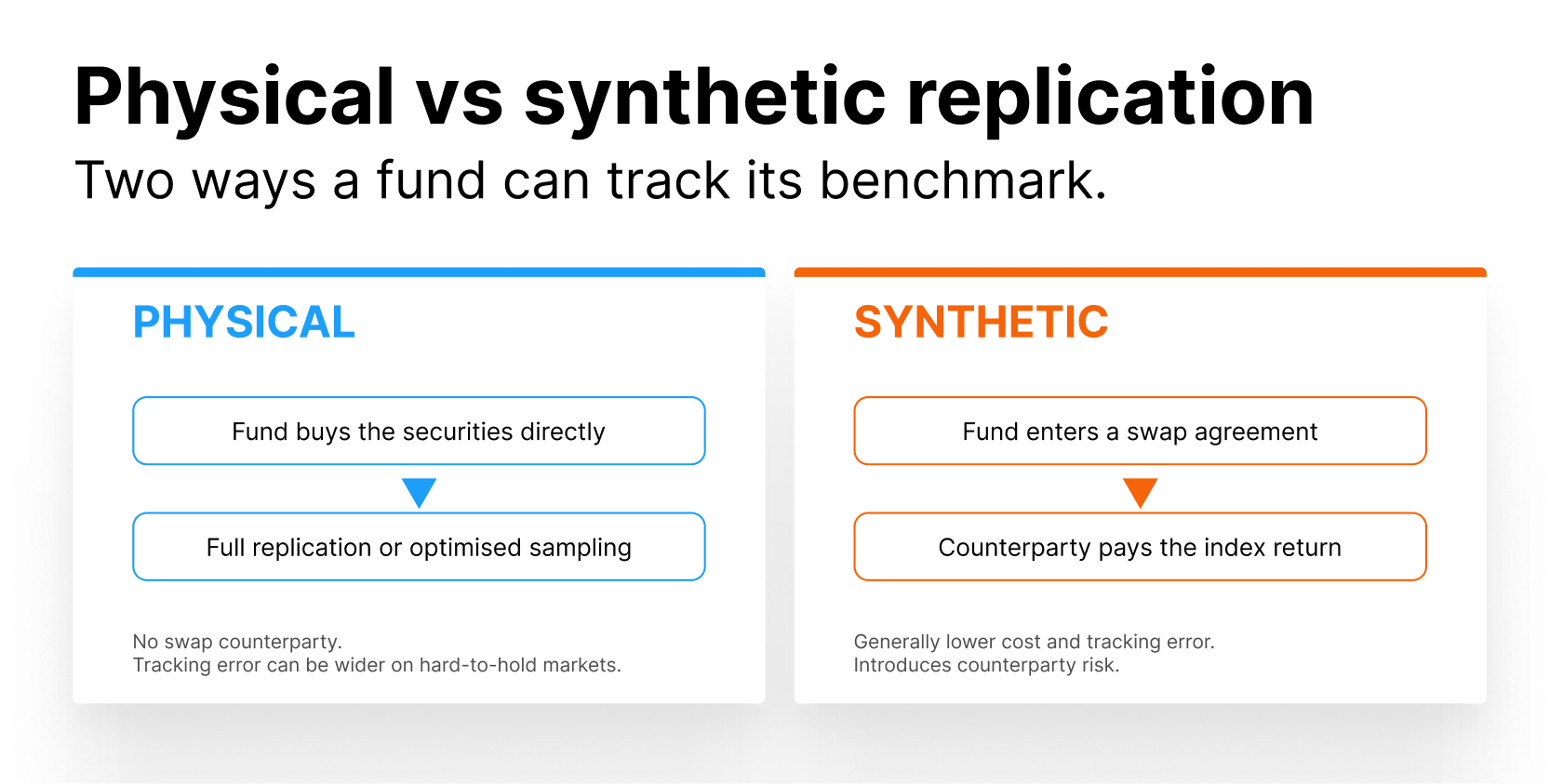
In order to achieve their investment objectives, ETF providers can either use physical or synthetic replication. Physical replication can be achieved either through full replication or optimised sampling. When using synthetic replication, ETF providers enter into a swap agreement with single or multiple counterparties. Synthetic replication generally reduces costs and tracking error but increases counterparty risk.
Exchange Traded Commodities/Currencies
ETCs are similar to ETFs and offer the same advantages; however, they track the performance of a single commodity or a basket of commodities. In order to achieve their investment objectives ETCs either use a physical/spot approach or futures contracts. Unlike ETFs, in Europe ETCs are not regulated under UCITS, which makes them somewhat less stringent in compliance.
The main difference between ETFs and ETCs is that the latter are debt securities instead of funds. The debt instruments are underwritten by a bank for the issuer of the ETC and the commodities tracked by the ETC serve as collateral for the note.
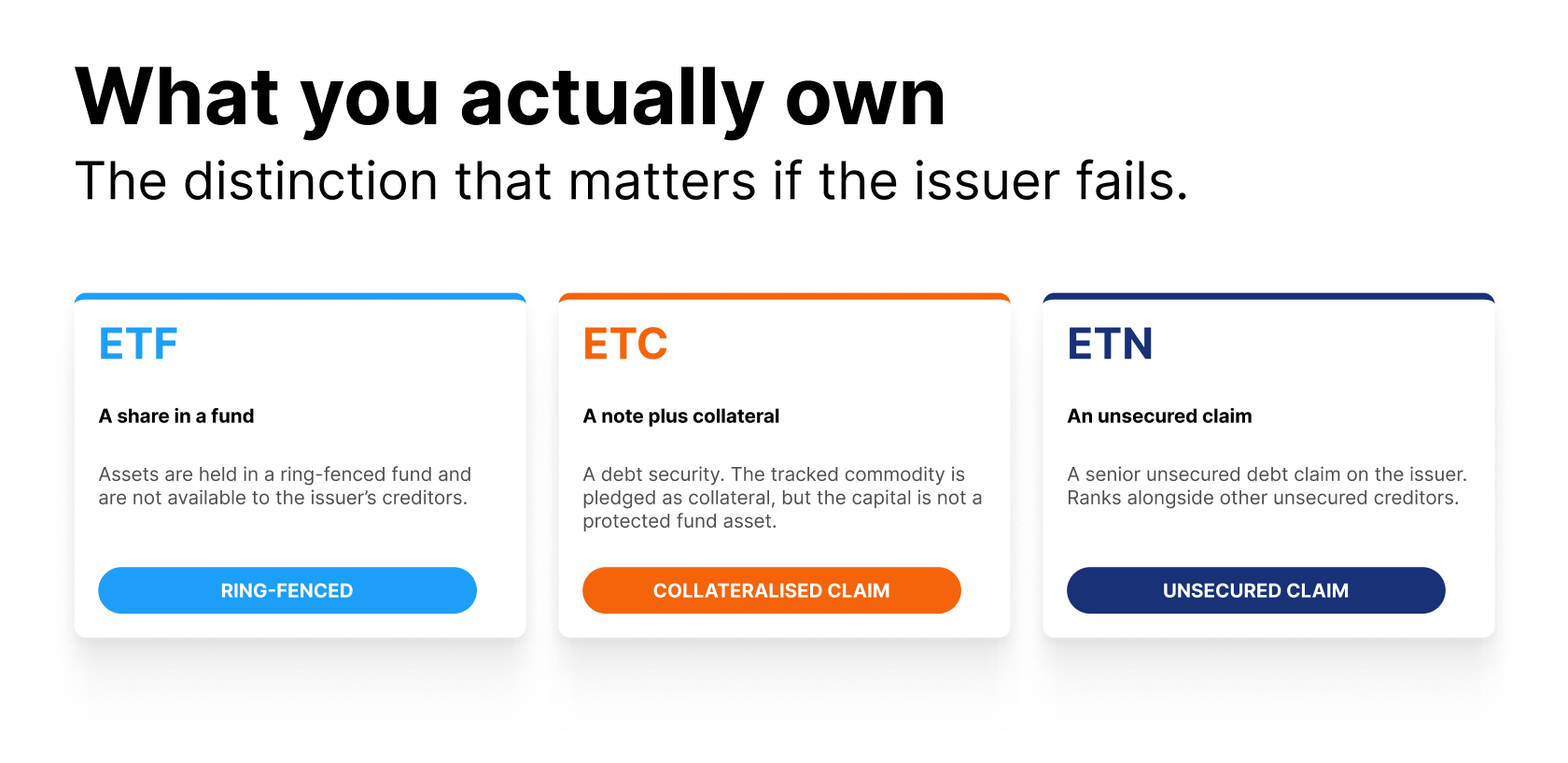
The capital invested in an ETC is not a fund asset which is protected in case of insolvency of the issuer. Commodity ETFs invest directly in and hold physical commodities, while ETCs don’t buy or sell the commodity or futures contract directly. The assets of the ETCs are a debenture issued by a bank, collateralized by the commodity the ETC tracks.
ETC are generally riskier than ETFs due to potential counterparty/issuer risk.
This is also why a single-commodity ETF does not exist under UCITS. Because a UCITS fund must stay diversified and cannot hold physical commodities directly, exposure to one commodity such as gold or oil is structured as an ETC rather than a fund.
Exchange Traded Notes
ETNs are generally senior, unsecured, unsubordinated debt issued by a financial institution and listed on the exchange. They are not asset-backed but are supported by the creditworthiness of the issuing institution, therefore, adding credit risk. The underwriting bank agrees to pay an index return, minus fees. ETNs are not subject to UCITS and do not have to comply with its diversification requirements. These products are generally riskier than ETFs and ETCs due to the credit risk and lack of asset backing.
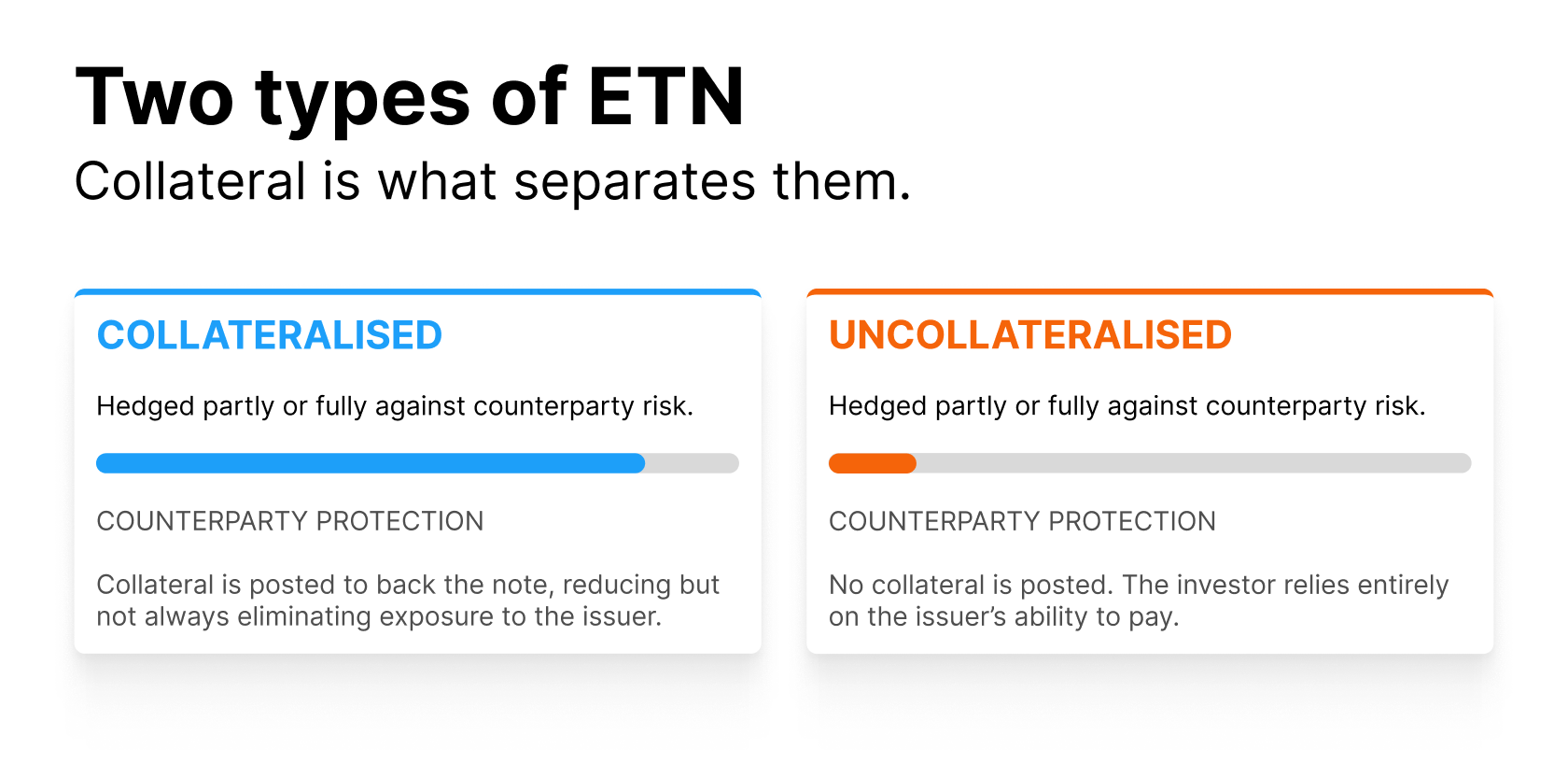
There are two types of ETNs: namely collateralised and uncollateralised notes. Collateralised ETNs are hedged partly or fully against counterparty risk whereas uncollateralised ETNs are fully exposed to counterparty risk. Investors should therefore make sure they fully understand the underlying risk of the ETN before investing.
Putting it together
The ranking below reflects structural risk only, coming from how the product is built. A broadly diversified ETF and a leveraged ETN tracking the same index carry very different market risk, whatever the wrapper.
Key takeaways
Every ETF is an ETP, but not every ETP is an ETF
ETFs are funds. ETCs and ETNs are debt securities.
Only ETFs are regulated under UCITS and subject to its diversification rules.
Collateral reduces, but does not remove, counterparty exposure on an ETN.
Your capital is at risk if you invest. You could lose all your investment. Please see the full risk warning here.
 Market Insights

