



Your capital is at risk if you invest. You could lose all your investment. Please see the full risk warning here.
Anthropic’s valuation – in the bull case – presently rests on a razor-thin model edge defined by three structural and architectural pillars: inference efficiency (compute-to-intelligence ratio), long-horizon agentic reliability, and enterprise protocol standardization.
Anthropic’s premium is driven less by raw general intelligence – where frontier models have largely reached parity – and more by domain dominance in high-ROI enterprise workflows. The core thesis behind enterprise adoption: rather than competing purely on raw parameter count or consumer multimodality, Anthropic’s late-2026 model lineup – anchored by Claude Sonnet 5.5, Claude Opus 5.5, and Claude Fable 5.2 / Mythos 5.2 (released November 9, 2026) – is stated to be engineered to maximize economic margin per task.
Anthropic’s Valuation Edge vs the Competition
Coding is the highest-margin, stickiest enterprise use case, and Anthropic holds roughly 54% of the enterprise coding market1. Claude Opus 4.6 leads on SWE-bench Verified (80.8%) and graduate-level scientific reasoning (GPQA Diamond at 91.3%), making Claude the default engine behind major developer platforms like
Furthermore, unlike consumer-heavy rivals, Anthropic monetizes through high-volume B2B APIs and enterprise seats. Its self-reported annualized run-rate (ARR) surged from around $14 billion in February 2026 to around $47 billion by May 2026 (ahead of OpenAI’s estimated $25–$30 billion run rate). Through measures such as constitutional AI, strict prompt-injection defenses, and default zero-data-retention across all API tiers, Anthropic has become the preferred vendor for heavily regulated industries (e.g., finance, pharma, and public entities).
Independent evaluations – such as Artificial Analysis’s Intelligence Index v4.3.2 – has Anthropic’s Opus 5.5 ranking at #1 and Sonnet 5.5 ranking at #3, highlighting the company’s lead in real-world execution over synthetic trivia.
However, OpenAI and Google have both responded to Anthropic’s late-2026 enterprise push with aggressive architectural counter-moves—splitting their lineups into ultra-heavy frontier models (GPT-6 Astra, Gemini 4 Carbon) and high-efficiency workhorses (GPT-6.1 Sol, Gemini 4 Hydrogen) that directly attack Anthropic on cost-per-task, specialized domain ceilings, and security. The spec sheet and AI analysis specialists now show that Anthropic is being pushed on a number of parameters that matter.
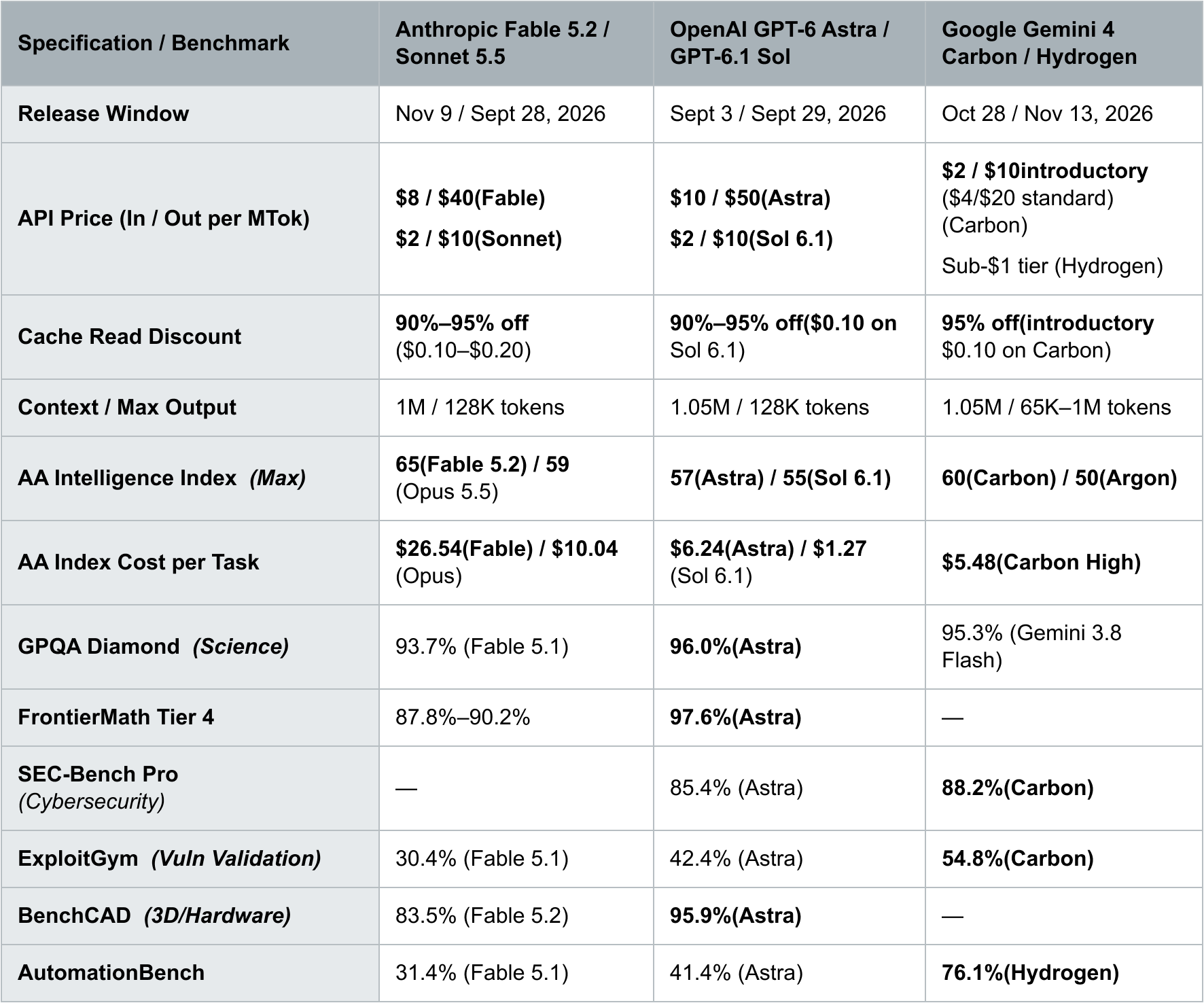 Sources: OpenAI GPT-6 Astra & GPT-6.1 Sol Release Cards (Sept 2026); Google DeepMind Gemini 4 Carbon & Hydrogen Releases (Oct–Nov 2026); Artificial Analysis Intelligence Index (Nov 2026)
While OpenAI’s GPT-6.1 Sol matches Anthropic’s Sonnet 5.5 on total cost, independent testing by Artificial Analysis shows Sol 6.1 completes the full suite of tasks on the “Intelligence Index” at $1.27 per task – nearly 8x cheaper than Claude Opus 5.5 ($10.04) and 20x cheaper than Fable 5.2 ($26.54) at maximum reasoning settings.
Meanwhile, Google is leveraging its vertical ownership of custom TPUs and structured the Gemini 4 lineup (Argon, Carbon, and Hydrogen) to neutralize Anthropic’s enterprise security and efficiency advantages: Gemini 4 Carbon – which sits right behind Fable 5.2 at #2 overall on the Artificial Analysis Intelligence Index (60 vs. 65) – at an introductory price of $2/$10 per MTok (rising to $4/$20 standard), fully half the price of Fable 5.2 ($8/$40).
Strategic Takeaways for Valuation
Even when competitors narrow the gap on single-turn benchmarks, bulls can consider four system-level capabilities that lock in enterprise workflows:
Fable 5.2 is explicitly architected for multi-hour unattended execution – planning, spawning subagents, and self-correcting – across complex repositories or financial models.
Anthropic created and open-sourced Model Context Protocol (MCP) has become the de facto standard for connecting LLMs to live enterprise systems such as Slack, Figma, Asana, Hex, Amplitude, as well as internal SQL/Git repositories.
Claude’s native GUI interaction allows enterprises to automate legacy desktop software that lacks modern APIs.
Anthropic’s Mythos architecture is designed to prevent open-weight competitors from training on Claude’s reasoning traces – thus creating a high-margin, regulated enterprise tier that rivals struggle to penetrate.
However, while Anthropic’s moat is “Workflow Friction” but it isn’t permanent supremacy: OpenAI and Google are beginning to deliver 90–95% of Fable’s capability at 15%–20% of Anthropic’s billed per-task compute cost. Anthropic’s valuation thus depends on whether enterprise engineering teams stay locked into Claude Code and MCP despite cheaper, near-equal alternatives from Google and OpenAI.
The switching costs aren’t insubstantial; thus, the bull case can be expected to count on enterprise lock-in to be support for the valuation upon listing debut over the next two quarters.
Investors in Europe might consider the 3x Long Anthropic ETP (ANT3) for magnified exposure during the upside of the stock’s trajectory.
Footnotes
“Anthropic and Democratization of Technology: How Claude Is Rewriting the Rules”, Investing.com, May 29, 2026
Your capital is at risk if you invest. You could lose all your investment. Please see the full risk warning here.
 Market Insights

