


Your capital is at risk if you invest. You could lose all your investment. Please see the full risk warning here.
On Monday, 23 November, NVIDIA's board reinstated Jensen Huang as CEO, effective immediately.1 The stock surged more than 30% at the US market open.2 It closed the day 31% higher.3 Investors holding leveraged short positions on NVIDIA took heavy losses.
Trading in the Leverage Shares -3x Short NVIDIA ETP (NV3S) was halted shortly before 2.30pm UK time.2 It resumed trading after around 15 minutes, once its exposure had been reset by its intraday rebalance mechanism, known as the airbag mechanism.4
This article explains what the airbag did that day, how it works for both long and short ETPs, and what it cannot do.
Why leveraged ETPs need an airbag mechanism
A leveraged ETP multiplies the daily move of its underlying. That works in both directions, so a large enough move against the position can erase the product's entire value in a single session.
The breaking point is 100% divided by the leverage factor. A 3x or -3x ETP is wiped out by a 33.3% move against it in one day, and a 5x ETP by a 20% move.
Once a product's value reaches zero, it cannot recover, even if the underlying reverses later in the day. Leveraged ETPs normally reset their exposure once a day, at the close. The airbag adds an extra reset during the trading session, when an extreme move makes waiting until the close too risky.
How the airbag mechanism works
The airbag mechanism is an intraday rebalance built into Leverage Shares ETPs. It triggers when the underlying moves against the ETP by a set percentage compared with the previous day's close: a fall for long ETPs and a rise for short ETPs.
Trigger levels are set at roughly the point where an ETP without a reset would have lost half its value. The trigger is measured on the underlying, not on the ETP. If the underlying jumps past the trigger in one move, the ETP can lose far more than 50% before the reset takes effect.
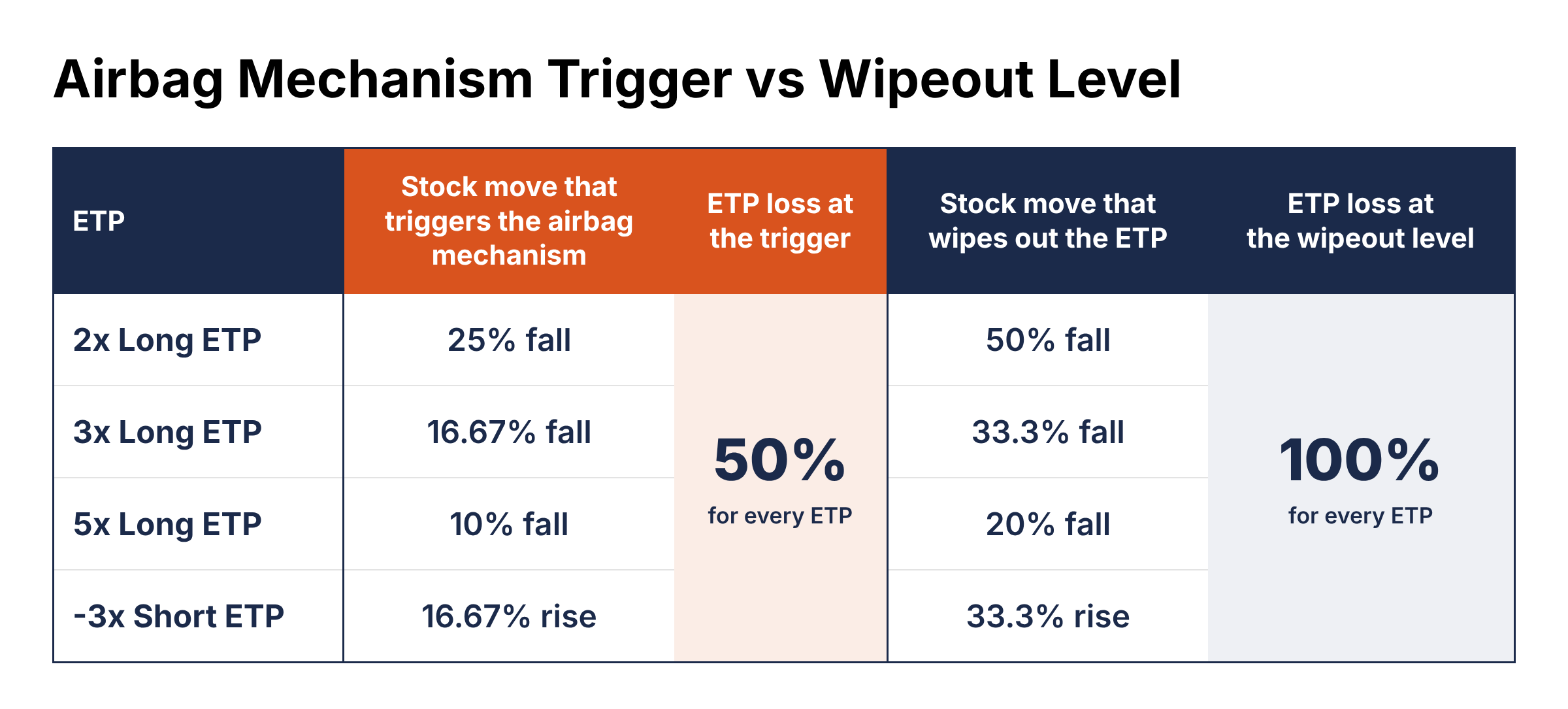
Stock moves compared with the previous day's close. ETP losses before fees. Source: Leverage Shares, as of 25 November 2026.
For both the 3x Long NVIDIA ETP and the -3x Short NVIDIA ETP, the trigger is a 16.67% move in NVIDIA's share price: a fall for the long ETP and a rise for the short. Trigger levels apply to most, but not all, products, and the exact level for each ETP is set out in its prospectus.
When the trigger is hit, the airbag runs in four steps:
1. Trigger: the underlying moves against the ETP by the trigger level, compared with the previous day's close.
2. Pause: trading in the ETP is halted.
3. Rebalance: starting five minutes after the trigger, Leverage Shares rebalances the ETP's exposure over a 10-minute window, at the average price it achieves in the market.
4. Resume: the ETP resumes trading as if it were a new trading day, with its leverage restored.
For some products, including NV3S, the airbag mechanism can also trigger at the US market open, if the underlying opens beyond the trigger level. This currently applies to some, but not all, products.
The airbag mechanism can trigger more than once in the same session if the move continues. For a shorter overview of the basics, see the earlier Leverage Shares explainer on the air bag mechanism.
What the airbag mechanism did on 23 November
NVIDIA had fallen 39% over November through 20 November, and the -3x Short NVIDIA ETP had gained strongly as a result.4 The reinstatement news reversed that move in one session.
1. Monday, 23 November: NVIDIA's board announced Huang's return, effective immediately.1
2. Shortly before 2.30pm UK time: trading in NV3S was halted.2
3. 2.30pm UK time, the US open: NVIDIA traded at $163, about 30% above its previous close of $125.01 and well past the 16.67% trigger.5
4. 2.35pm to 2.45pm UK time: the ETP's exposure was rebalanced at an average NVIDIA price of $159.32.5
5. After around 15 minutes: NV3S resumed trading as if it were a new trading day.4
NVIDIA opened 33.1% above its previous close and climbed as high as 36.5% at 3.25pm UK time, beyond the 33.3% move that would wipe out a -3x Short ETP that had not reset. It closed the day 31.6% higher.
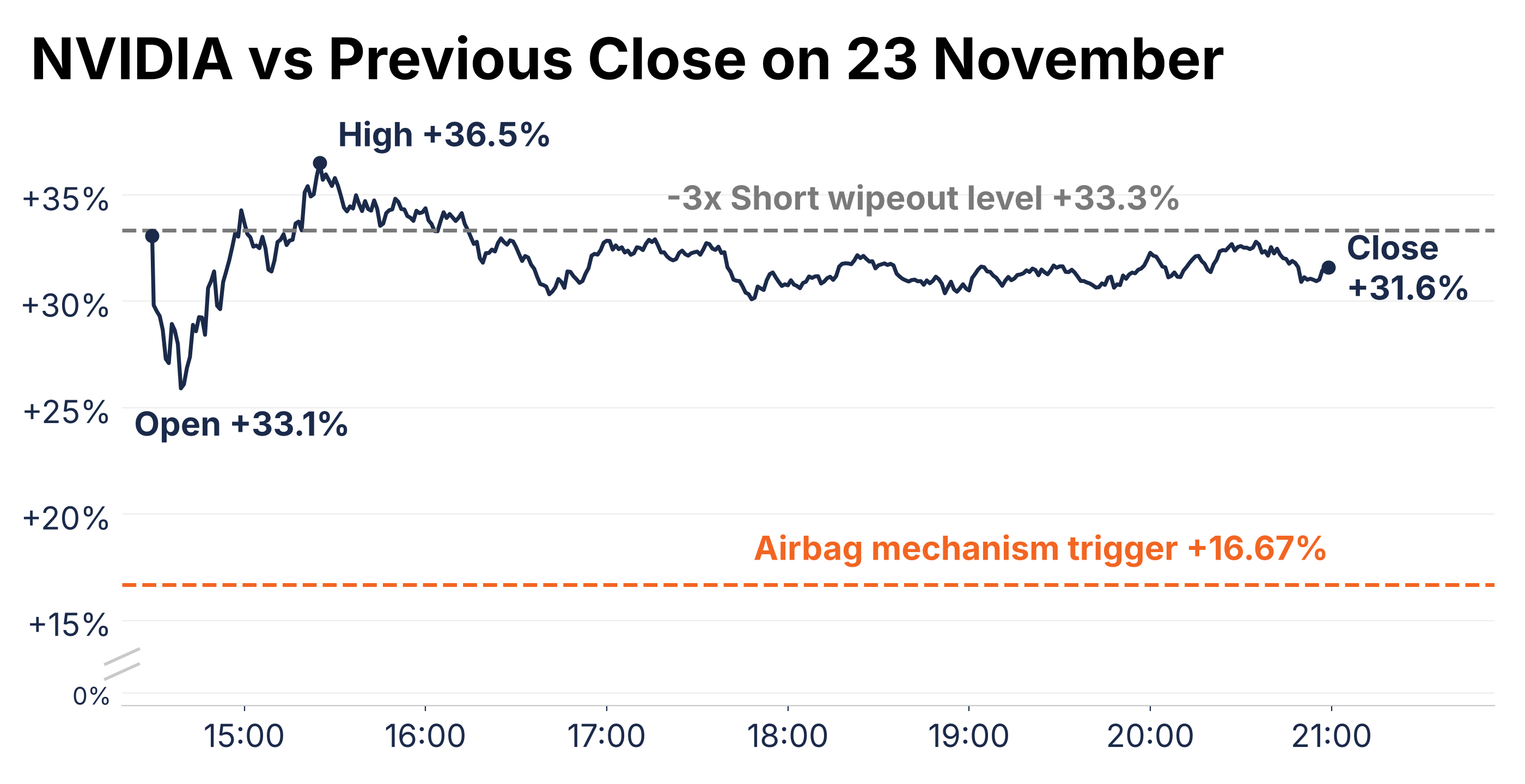
1-minute prices, UK time. Source: Yahoo Finance, as of 23 November 2026.
The airbag mechanism did not prevent the loss. NVIDIA's jump came while the US market was closed, so when the airbag mechanism triggered at the open, the stock was already about 30% higher. Most of the damage was done before the reset. What the reset changed was what came next.
At $163, a -3x exposure was only a further rise of around 2% in NVIDIA away from zero, and NVIDIA later climbed as high as $171.50. Without the reset, that move would have wiped the product out. After the reset, NV3S traded with its normal -3x exposure from $159.32. The rise from there to the day's high, about 7.6%, cost it around 23% of its remaining value rather than all of it. NV3S's NAV ended the day down 82.77%.6
A simplified example shows how this works. A -3x Short ETP starts the day at $100. The stock opens 30% higher, taking the ETP to $10. The rebalance is completed at an average price 31% above the previous close, so the ETP resets at $7.
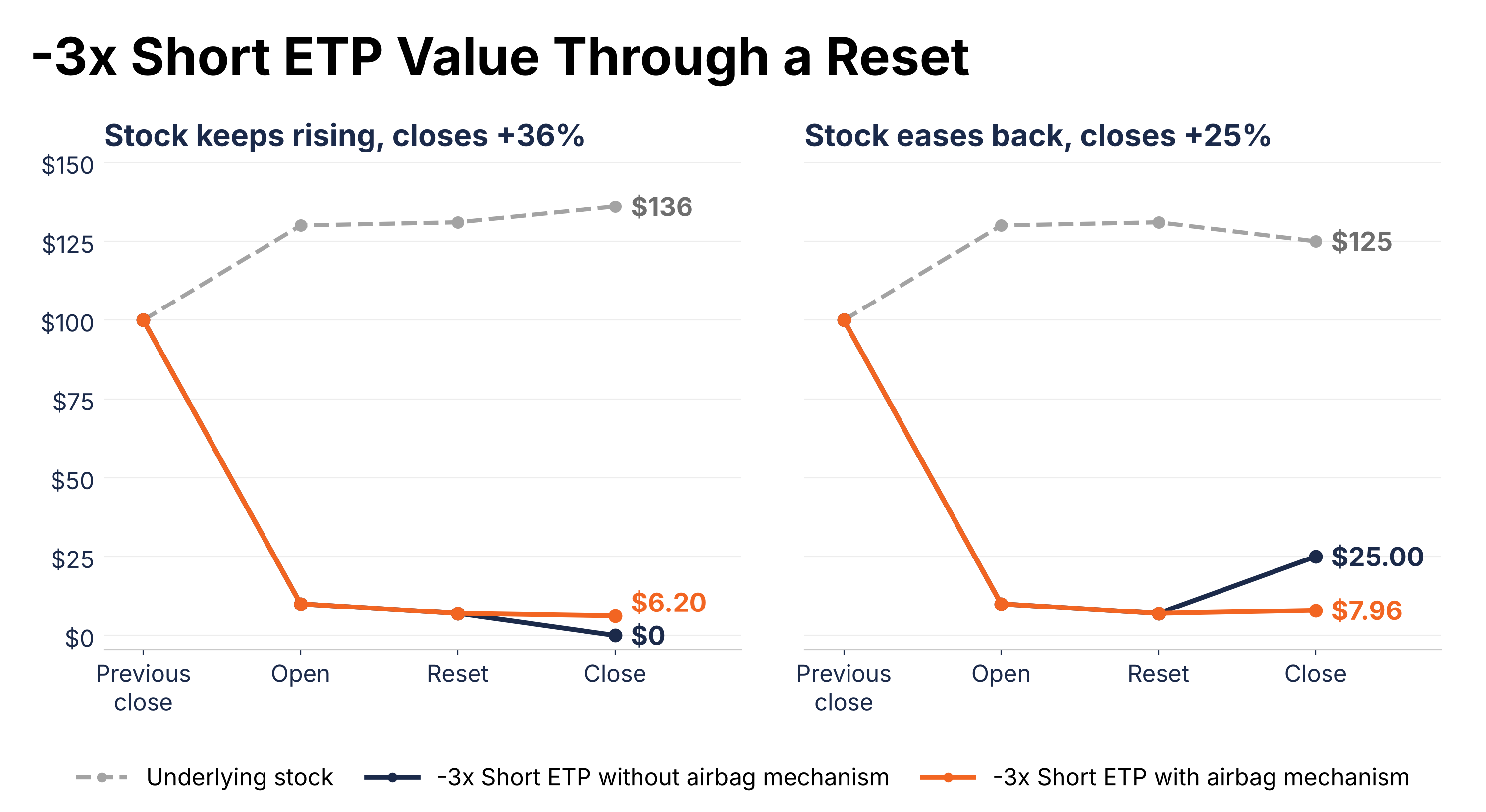
Hypothetical example for illustration only. The stock and the ETP both start at $100.
The same mechanism works for long ETPs, such as the 3x Long NVIDIA ETP (3NVD on Euronext Amsterdam and Borsa Italiana), when the stock falls. A 3x Long ETP starts the day at $100. The stock falls past the 16.67% trigger, and the rebalance is completed at an average price 17% below the previous close, so the ETP resets at $49.
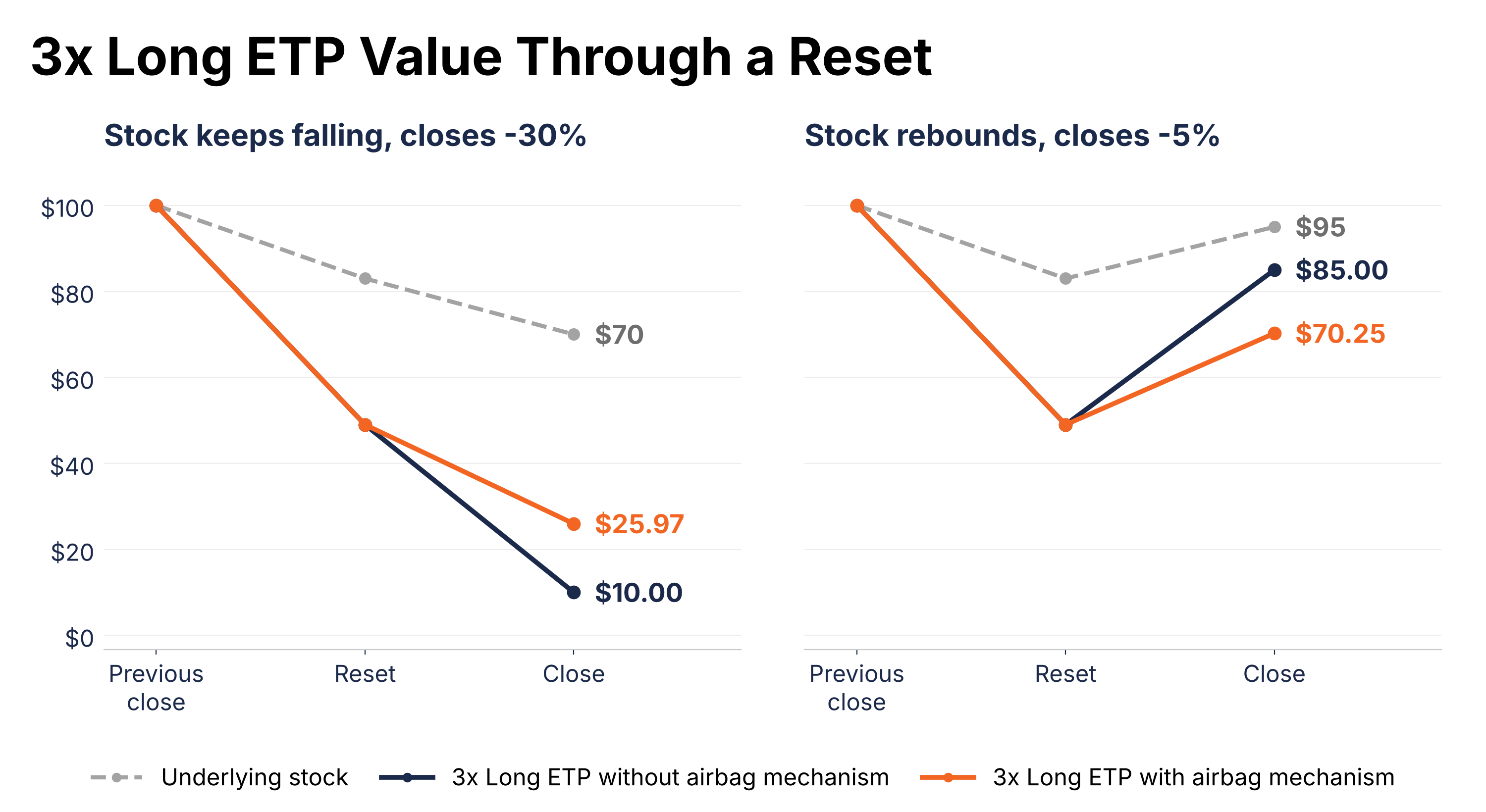
Hypothetical example for illustration only. The stock and the ETP both start at $100.
In both examples, the first case shows what the reset is for. If the move keeps going, the short ETP closes at $6.20 instead of zero, and the long ETP at $25.97 instead of $10. The second case shows what it costs. If the stock turns back after the reset, the ETP recovers less than it would have without it, because it rebuilt its exposure from a smaller base.
What the airbag mechanism can and cannot do
The airbag reduces the risk of an ETP going to zero during the trading day. It is not a stop-loss, and it does not guarantee any part of an investment. Five points are worth keeping in mind:
• It does not stop losses at 50%. The trigger is based on the underlying's move, so a price gap can push an ETP's loss well beyond 50% before the reset, as 23 November showed.
• It cannot act outside trading hours. A move that happens overnight is already in the price by the time the airbag mechanism can act. For products that do not trigger at the open, such a move can take an ETP to zero.
• It has a cost in a sharp rebound. If the underlying reverses after the reset, the ETP recovers less than it would without the reset.
• Replication is not perfect. The rebalance is carried out by trading in the market over several minutes, so the result can differ from the index's theoretical calculation.
• Losses are limited to the amount invested. You cannot lose more than you put in, and there are no margin calls.
Leveraged and inverse ETPs are designed for short-term exposure and should be monitored daily. Knowing how the airbag works, and where it stops, helps set the right expectations before the next extreme move.
Key takeaways
• A 3x or -3x ETP is wiped out by a 33.3% move against it in one day. The airbag mechanism is designed to reset exposure during the session before that point, but it cannot act on a price gap.
• The trigger is measured on the underlying. For the 3x Long and -3x Short NVIDIA ETPs, it is a 16.67% move in NVIDIA against the position.
• On 23 November, NVIDIA opened past the trigger, so the airbag mechanism triggered at the US open. NV3S's NAV fell 82.77% on the day, but after the reset, NVIDIA's further rise cost the ETP part of its value rather than all of it.
• The airbag mechanism is not a stop-loss. It cannot prevent losses from gaps, cannot act outside trading hours, and costs part of the recovery if the stock reverses.
• You cannot lose more than you invest in a Leverage Shares ETP, and no margin account is needed.
Sources
1. NVIDIA: NVIDIA Board Reinstates Jensen Huang as President, CEO and Board Director
2. ETF Stream: Trading of 3x short Nvidia ETPs halted as Jensen Huang reinstated as CEO
3. CNBC: Jensen Huang reinstated as Nvidia CEO. Stock skyrockets 31%
4. Bloomberg: Nvidia's Big Rebound Hammers Leveraged Funds Betting on a Fall
5. Leverage Shares plc: Intraday Rebalance Notice - -3x NVDA (RNS, 23 November 2026)
6. Leverage Shares: -3x Short NVIDIA ETP, NAV as of 23 November 2026
Your capital is at risk if you invest. You could lose all your investment. Please see the full risk warning here.
 Market Insights

