


Your capital is at risk if you invest. You could lose all your investment. Please see the full risk warning here.
Shortly before the release of its third quarter (Q3) earnings for its Fiscal Year (FY) 2026, Elon Musk-led Tesla, Inc's (ticker: TSLA) staged a demonstration of its upcoming vehicle the Roadster on the 15th of October at the SpaceX Rocket Test and Development Center in McGregor, Texas. Equipped with SpaceX-inspired cold-gas thrusters and carbon-overlay pressure vessels, the prototype demonstrated a claimed 0 to 60 mph acceleration time of 0.81 seconds and performed controlled aerial manoeuvres, a flip off a ramp, and drove upside down using an underbody suction system that generates about 2Gs of force.
The stock went on to rise in the aftermath of this unique demonstration. However, in the immediate aftermath of the earnings release on the 21st, the pre-session trading the next day showed signs that some of these accrued gains might be tested and surrendered.
Trend Analysis
As of the first nine months (9M) of FY 2026, trends indicate the company is steadily settling towards lower overall revenues and higher expenses: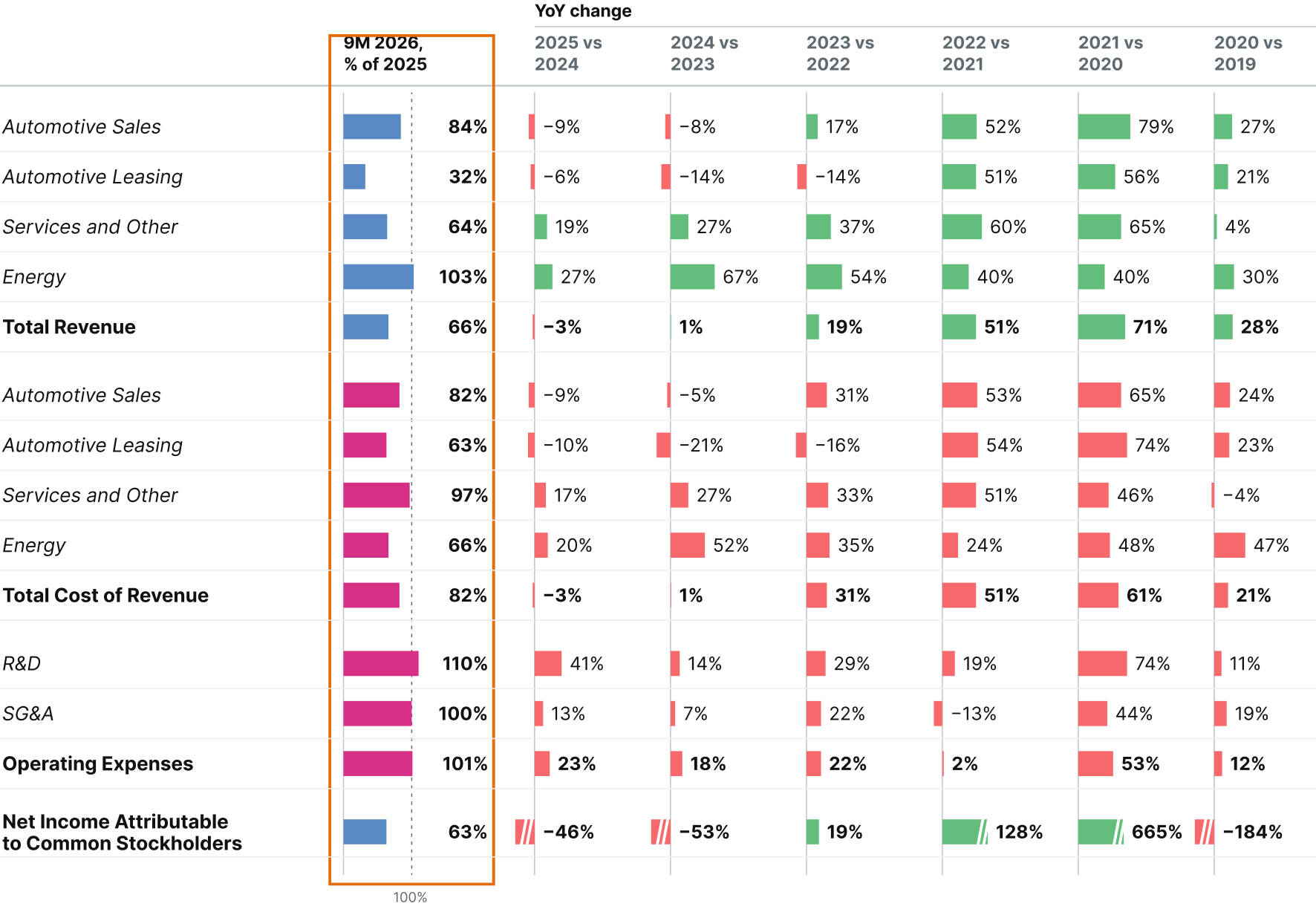
Source: Company Information; Leverage Shares analysis
While automotive sales are trending towards a 16% growth over the past FY and energy is trending at over 25% growth, leasing and services are trending downwards. Meanwhile, total cost of revenues is trending towards a 8-9% growth over the past FY – with operating expenses overall looking at 25% increase. As a result, net income per share is trending to close 16% below that for FY 2025.
While total cost of revenue is poised to be 6% higher than the past year’s, revenue is trending to be 14% lower. Meanwhile operating expenses for the full FY are trending to be 28% higher than previous year and net income is set to be 16% lower.
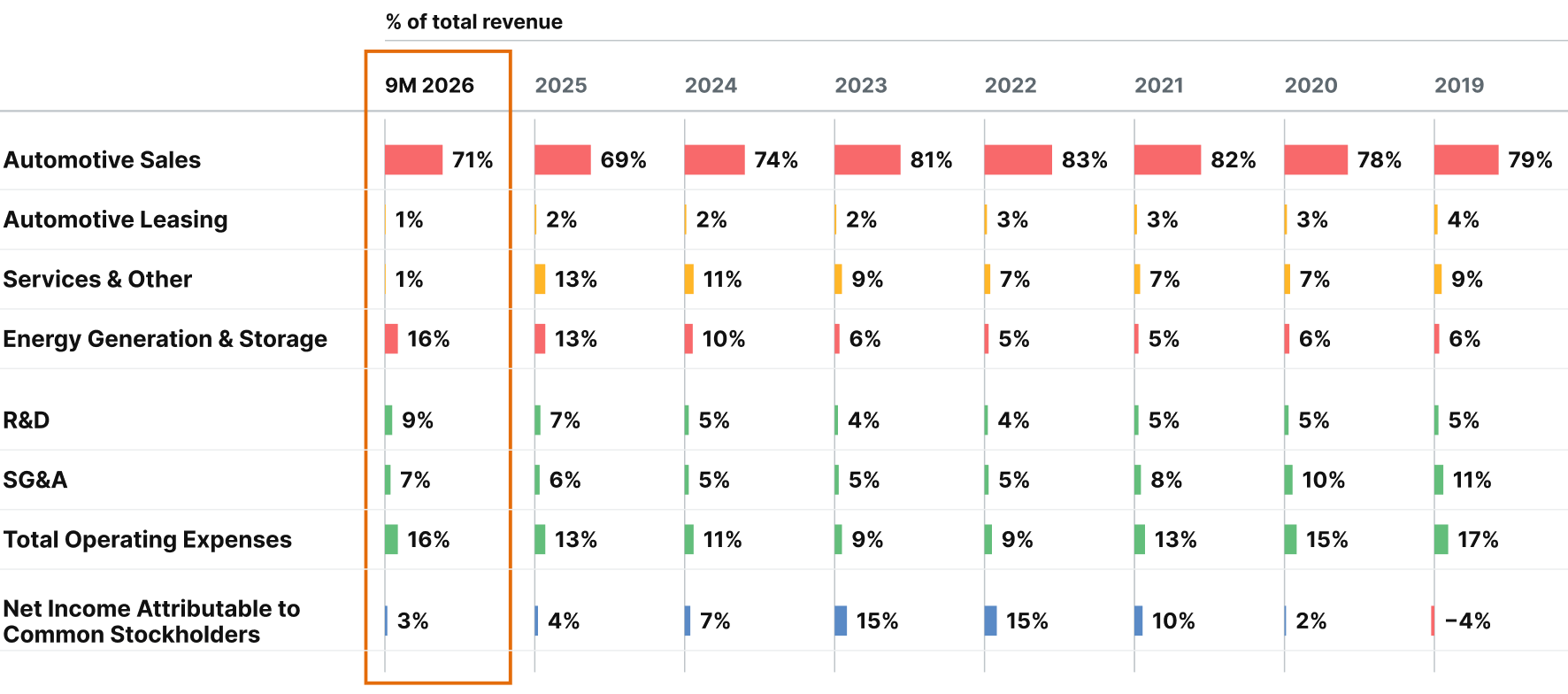
When considering line item percentage share of total revenue, the company has been resolute throughout the FY in showing the lowest level of passthrough into net income attributable to common stockholders since 2020.
 Source: Company Information; Leverage Shares analysis
In Q3, free cash flow went back into positive territory with a massive $1.5 billion. While capital expenditure (capex) into infrastructure for AI, autonomous vehicles, and robotics doubled to $4.7 billion, this figure is be below the consensus level anticipated by analysts.
Tesla’s Full Self-Driving (FSD) software continues to show strong uptake, with the company reporting that 75% of vehicles delivered in North America included a subscription to “FSD (Supervised)”. Rather than being claimed as a fully autonomous solution now, the company has bowed to regulatory pressure over concerns over safety. FSD users are now required to be prepared to take control while the software is running.
However, the company has stated that there will be a rough path ahead.
Roadster, Macros and a Merger
In Q3, automotive revenues represented a 3% decrease in YoY terms and a 2.1% drop in deliveries – and a potential sign that the expiring of automotive credits is beginning to pinch. Despite strong performance by Energy Generation & Storage in the YTD, revenue earned by this segment is a 19% drop in YoY terms – which is a sign that growth might be flagging. Past sales of Tesla vehicles helped to provide a substantial enough pool of vehicles to give it a 33% bump in YoY terms.
While the Roadster demonstration/“re-reveal” was possibly meant to excite investors, the company indicates that Roadsters (advertised as being “The Best of the Last Human-Driven Cars”) won’t be available until at least 2028 – thus continuing a trend of receding timelines over the past several years. Therefore, its utility as a product to prop up sagging sales won’t be visible yet. Also left entirely unanswered is if a rocket-assisted “flying car” would be road-legal. Thus, in terms of catalogue freshness, there’s little to inspire increased consumer interest at a time when other carmakers continue to roll out new models.
While CEO Elon Musk has claimed that its autonomous Cybercab fleet in Austin, Texas has grown by factor of 10 after beginning commercial service on the 3rd of September, the National Highway Traffic Safety Administration (NHTSA) issued Tesla a special order with a lengthy list of queries on how the company “self-certified” the Cybercab as being compliant with federal safety standards. After Tesla asked for an extension to November 20, the NHTSA granted 30 days instead, making answers necessary by the end of the October.
Meanwhile, CEO Musk stated that the company was in for “a few rough quarters” due to the expiring incentive and other macroeconomic factors – by which he presumably means that the relative long-term dearness of EVs (“Electric Vehicles”) relative to conventional vehicles makes a purchase more difficult as interest rates and inflation remain high as conflict in the Middle East and Ukraine squeeze energy flows and pass down higher costs on consumers.
CEO Musk also revealed that he believes it would be a “good idea” if Tesla and SpaceX were to merge, with the two companies already having formed special committees to discuss the possibility. However, he claimed that he wouldn’t be involved in the process and that there are substantial hurdles to overcome before this could happen. Given that the boundaries between the two companies’ AI endeavours – along with a few other areas of commonality – have always been hazy, the exploration of this decision begs the question as to whether the SpaceX was ever needed in the first place.
In Conclusion
With the company itself indicating that it will be in rough going over the next couple of quarters and a catalogue that won’t see a refresh until 2028, it’s increasingly difficult to determine where the market will see a striking upside for the stock which is still commands a relatively steep premium relative to other carmakers. Given that, a merger with SpaceX – where nearly 40% of profit driver Starlink’s revenue is sourced from government contracts – might be the valuation bump the two companies’ primary common owner – Musk himself – could be looking for.
All in all, despite an audacious and interesting Roadster demonstration, it may have been for naught, given the company’s own admissions. A fair degree of choppiness with a bearish tinge shouldn’t be a surprising feature in the coming quarters.
Professional investors might consider the 3X Tesla ETP (TSL3) during upsides of the stock’s trajectory and the -3x Short Tesla ETP (TS3S) during the downsides.
Also available is the Tesla Options ETP (TSL), which aims to generate monthly income by buying Tesla shares, selling up to 5% ‘out-of-the-money’ (OTM) weekly put options on Tesla and paying a return on the premia collected.
Your capital is at risk if you invest. You could lose all your investment. Please see the full risk warning here.
 Market Insights
 Education

