



Your capital is at risk if you invest. You could lose all your investment. Please see the full risk warning here.
U.S. Treasury yields experienced a decline on Thursday as market participants absorbed a multitude of economic data and evaluated the implications of the Federal Reserve's recent policy statement, which refrained from raising interest rates on Wednesday.
The latest data released on Thursday revealed that initial jobless claims exceeded 262,000 last week, reaching the highest level observed since October 2021—a clear indication of a weakening labour market. Moreover, U.S. industrial output contracted by 0.2% last month, following a 0.5% increase in the previous month. However, there was a positive note as retail sales for May showed a 0.3% rise, demonstrating the economy's resilience.
In its announcement on Wednesday, the Federal Reserve chose to keep interest rates unchanged within the range of 5% to 5.25%. This decision marked the first pause since the initiation of the interest rate hiking cycle. Nonetheless, the Fed hinted that a 50-basis point rate increase could be appropriate, with no expected rate cuts throughout the year. The tone of the Fed's post-meeting statement, along with the dot plot, caught the market off guard, as investors had anticipated at most one additional 25-basis point hike remaining in this cycle.
According to the CME FedWatch tool, markets are currently pricing in a 64.5% probability of a 25-basis point interest rate hike by Fed officials at their upcoming meeting on the 26 th of July. However, according to the futures the likelihood of another 25-basis point hike following the July meeting remains relatively low.
While the Fed may potentially implement one or two more rate hikes by year-end, if there is not significant deterioration in economic data, we are nearing the peak of interest rates, and a shift in Federal Reserve policy is coming. This presents an opportune moment to consider incorporating bonds, particularly those with long durations, into portfolios as they exhibit heightened sensitivity. The time to grab a sizable rate of return on a fixed-income asset has come. Exchange traded funds (ETFs) and exchange-traded products (ETPs), which track specific Treasury indices, offer cost-effective avenues for obtaining broad exposure to a highly efficient and liquid market.
It is important to note that Treasury prices and yields move in opposite directions. When interest rates decline, bond prices rise, resulting in capital appreciation for Treasury holders. Consequently, longer-dated Treasuries hold greater interest rate sensitivity, enabling investors to reap larger gains through price appreciation, even if they generate lower yields in the short term compared to shorter-duration Treasuries.
Taking advantage of a potential decline in interest rates, acquiring longer-dated Treasuries such as 10-year or 20-year notes appears enticing. Investing in bonds can be advantageous for several reasons, particularly in the current market environment. Overall, bonds can play a valuable role in a well-diversified investment portfolio by providing income, stability, and risk mitigation, especially during uncertain market conditions.
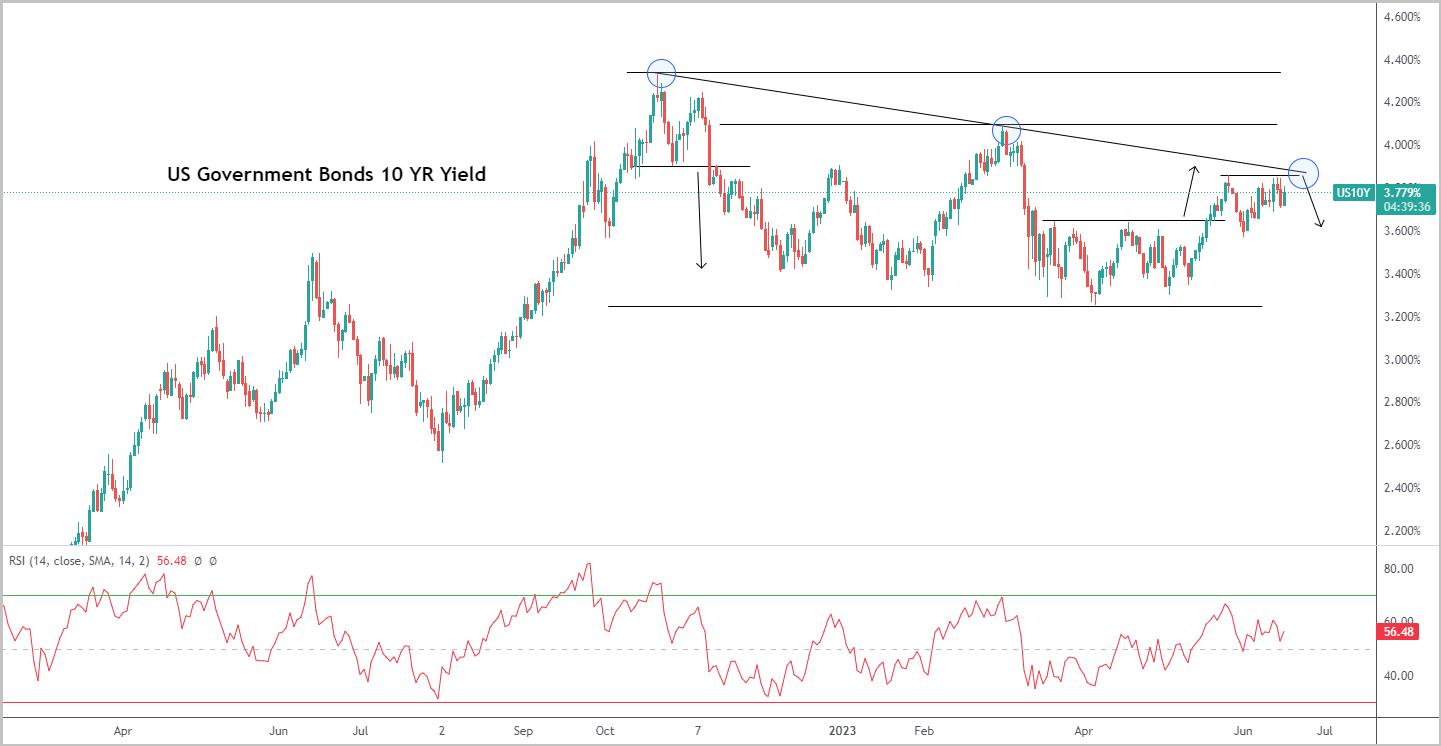
Source: Tradingview
By carefully evaluating their investment goals, risk appetite, and time horizon, investors can effectively incorporate bonds into their investment strategy to achieve a well-rounded portfolio that aligns with their financial objectives.
Bond exchange-traded products (ETPs) offer investors diversification, accessibility, transparency, income generation, liquidity, and cost efficiency. These benefits make bond ETPs an attractive option for investors looking to gain exposure to a diversified portfolio of bonds while enjoying the advantages of listed and tradable investment vehicles.
Active traders looking for magnified exposure to U.S. 10-Year Treasury Bond Yields may consider our +5x Long 7-10 Year Treasury Bond and -5x Short 7-10 Year Treasury Bond ETPs.
Your capital is at risk if you invest. You could lose all your investment. Please see the full risk warning here.
 Market Insights
 Education

