- Leverage & Inverse ETPs
- Instruments
- White Label
- Why Us
Your capital is at risk if you invest. You could lose all your investment. Please see the full risk warning here.

While Nvidia’s (NVDA) executives might be celebrating this earnings season, many professional investors have many reasons to give pause. Central to this is the contention that the company’s outlook versus that of the stock is increasingly divorced.
The Good: Solid Earnings and a Shift in Consumer Mix
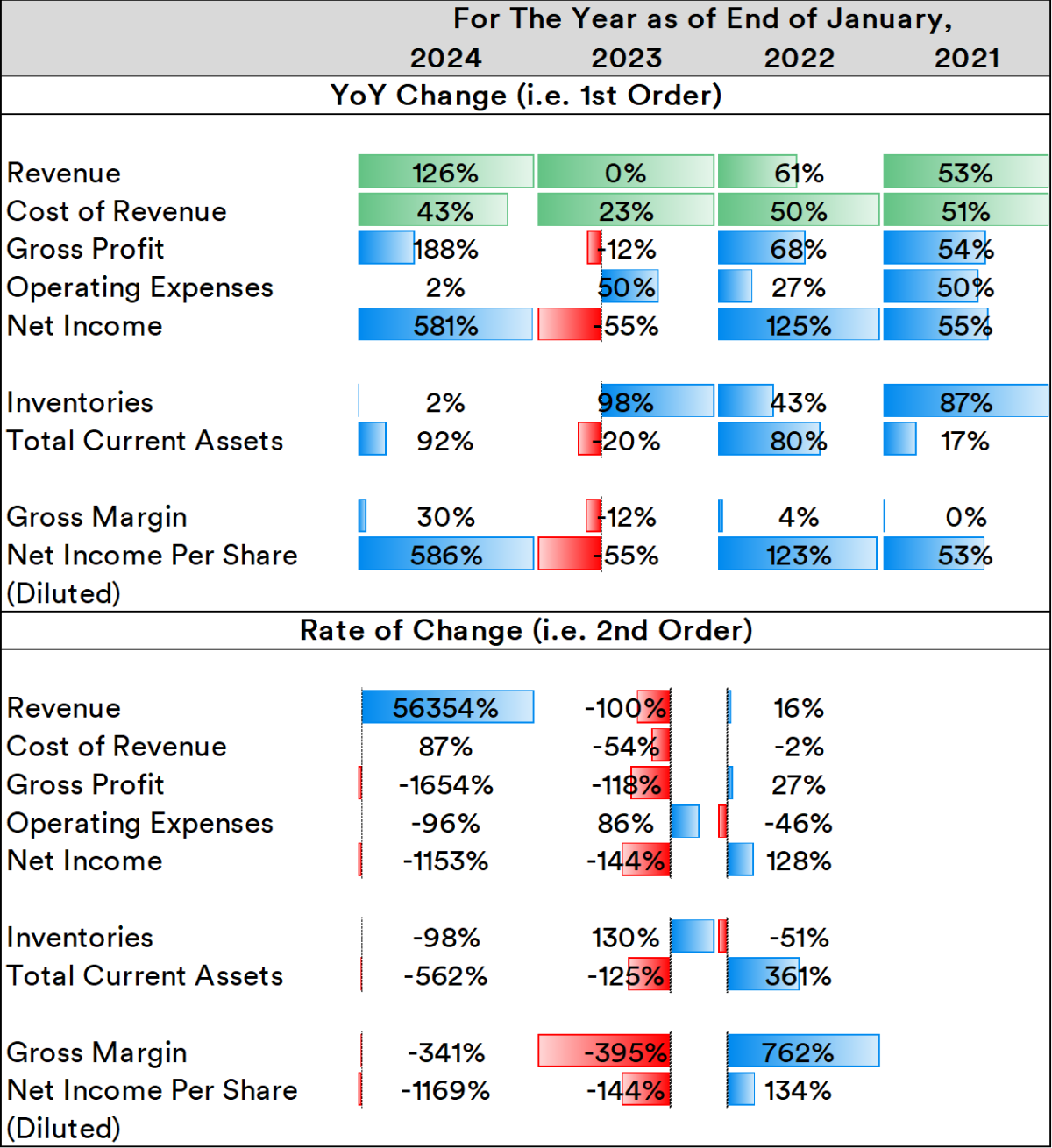
Key line items are examined with a “first-order” matrix to inspect their year-on-year change as well as a “second-order” matrix to winnow out sustained growth trends. The conclusions therein are singularly interesting:
Websim is the retail division of Intermonte, the primary intermediary of the Italian stock exchange for institutional investors. Leverage Shares often features in its speculative analysis based on macros/fundamentals. However, the information is published in Italian. To provide better information for our non-Italian investors, we bring to you a quick translation of the analysis they present to Italian retail investors. To ensure rapid delivery, text in the charts will not be translated. The views expressed here are of Websim. Leverage Shares in no way endorses these views. If you are unsure about the suitability of an investment, please seek financial advice. View the original at
Source: Company Financials, Leverage Shares analysis
After Fiscal Year (FY) 2022, there has been explosive change in the largely-orderly shifts in trends. In the present FY:
Revenue growth outpaces cost of revenue threefold while cost of operations increases a paltry 2%;
Gross Profit and Net Income have shaken off the slumps seen in the previous FY to exhibit a massive outperformance well exceeding that of revenue-related trends, while the Gross Margin shows a 30% improvement over the previous FY at 73.8%;
Inventories are only up 2% while a massive pileup in Accounts Receivable pushes current assets to 5-year highs;
Net Income Per Share (or diluted EPS) has shown the biggest outperformance over all other trends with a nearly 700% markup relative to the previous FY.
The second-order trends, however, indicate how singular this moment is from historical trends. Virtually no single line item shows a sustained growth trend in any way, shape or form.
The company’s products had long been favoured by the gamer and crypto miner. Over the past couple of years, however, the consumer mix has decidedly shifted towards the “corporate”:
The data center segment registered a 217% first-order change to $47.5 billion, with numerous enterprise solutions in language models, generative AI and medical applications.
Language models and generative AI are writ large on its next biggest segment – Gaming – which delivered $10.4 billion this year (15% first-order change), with the bulk attributable to increasing inroads with game developers.
The second-largest first-order change (21%) and the smallest revenue contributor ($1.1 billion) was the automotive segment, with increased adoption by Chinese carmakers Great Wall Motors and Li Auto lying square and center.
The company’s massive boost in earnings, however, doesn’t translate to a massive dividend bonus for long-term investors. With dividends staying at $0.04, the yield is at the 0.02% mark. The company spent $9.5 billion in stock repurchases over the year – nearly identical to the $10 billion spent in the previous FY.
The Mixed: Nvidia isn’t the Most Valued Chip Stock
The semiconductor industry has been a substantial recipient of investor attention over the past couple of years, with “AI” being a dominant theme therein. The performance of a pool of 120 semiconductor/chipmaking-related stocks (which includes the company) depict this in stark terms.

Source: CSI Markets, Inc
Up until Q4 2022, market participants were fairly measured in their outlook for this sector. Despite Q1 2023 being a relatively bad period for stock performance, investor vigour contributed to a doubling of the Price-to-Earnings (PE) Ratios over the previous quarter. Barring a slight adjustment upwards in the next two quarters, massive net income accruals in Q4 2023 pushed the sector’s PE aggregate to a twelvefold of its value a year prior.
The company’s position within this sector, however, is mixed. As of the day before the earnings release, NVIDIA ranked:
10th in PE Ratio. California-based “fabless” chipmaker SiTime Corporation (SITM) ranked 1st.
5th in Price to Sales (PS) Ratio. Canada-based chip-scale photonic solutions provider Poet Technologies (Canadian ticker: PTK) ranked 1st.
5th in Price to Cashflow (PCF) Ratio. California-based semiconductor fabrication support specialist Ultra Clean Holdings, Inc (UCTT) ranked 1st.
The Bad (?): It’s Time to Rationalize
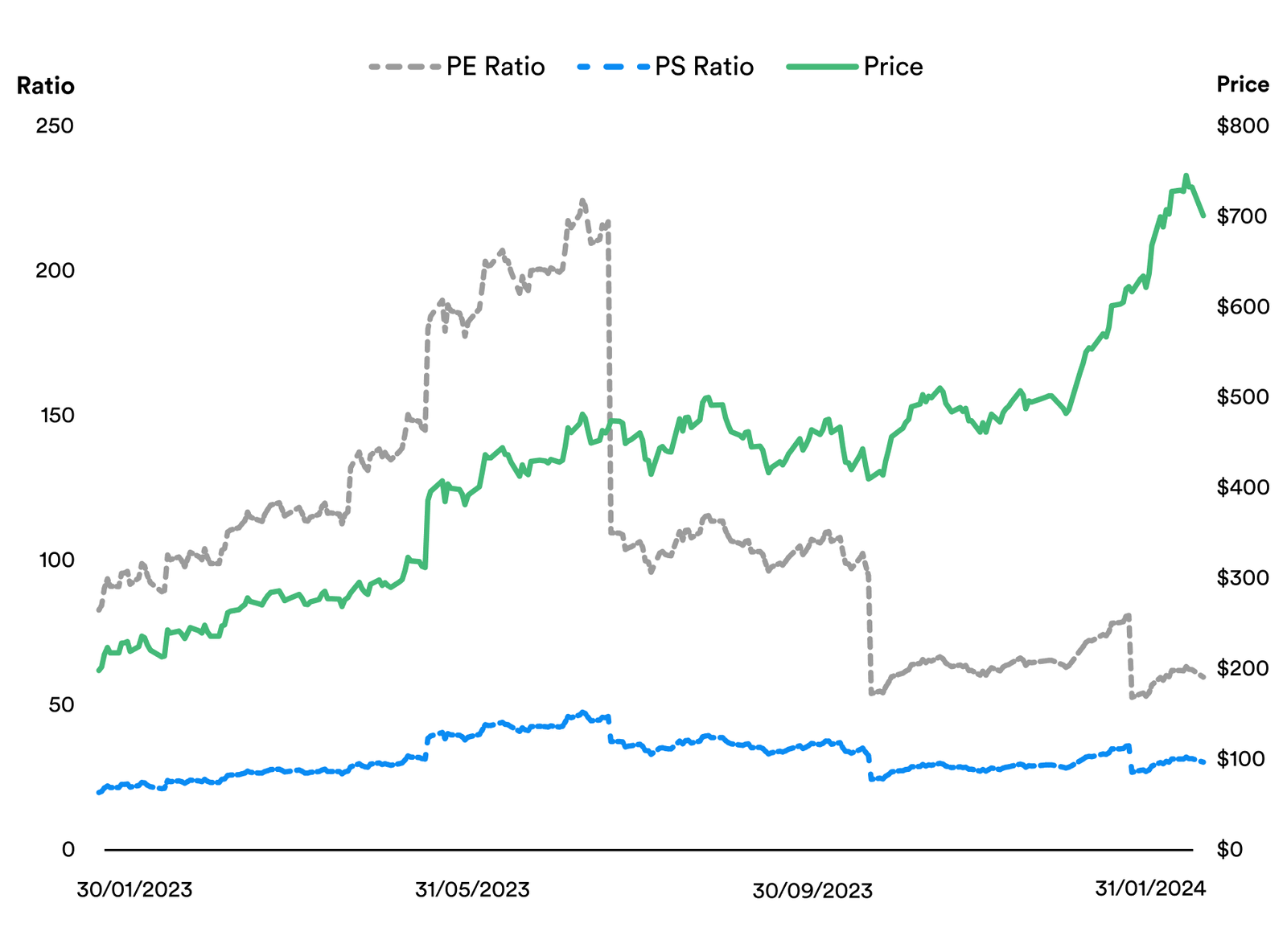
As the company’s consumer mix changed over 2023, so did the company’s PE Ratio.
Source: Leverage Shares analysis
As of the day before the earnings release, the PS Ratio was down 38% from a high of 45.5 while the PE Ratio was down 74% from a high of 222.
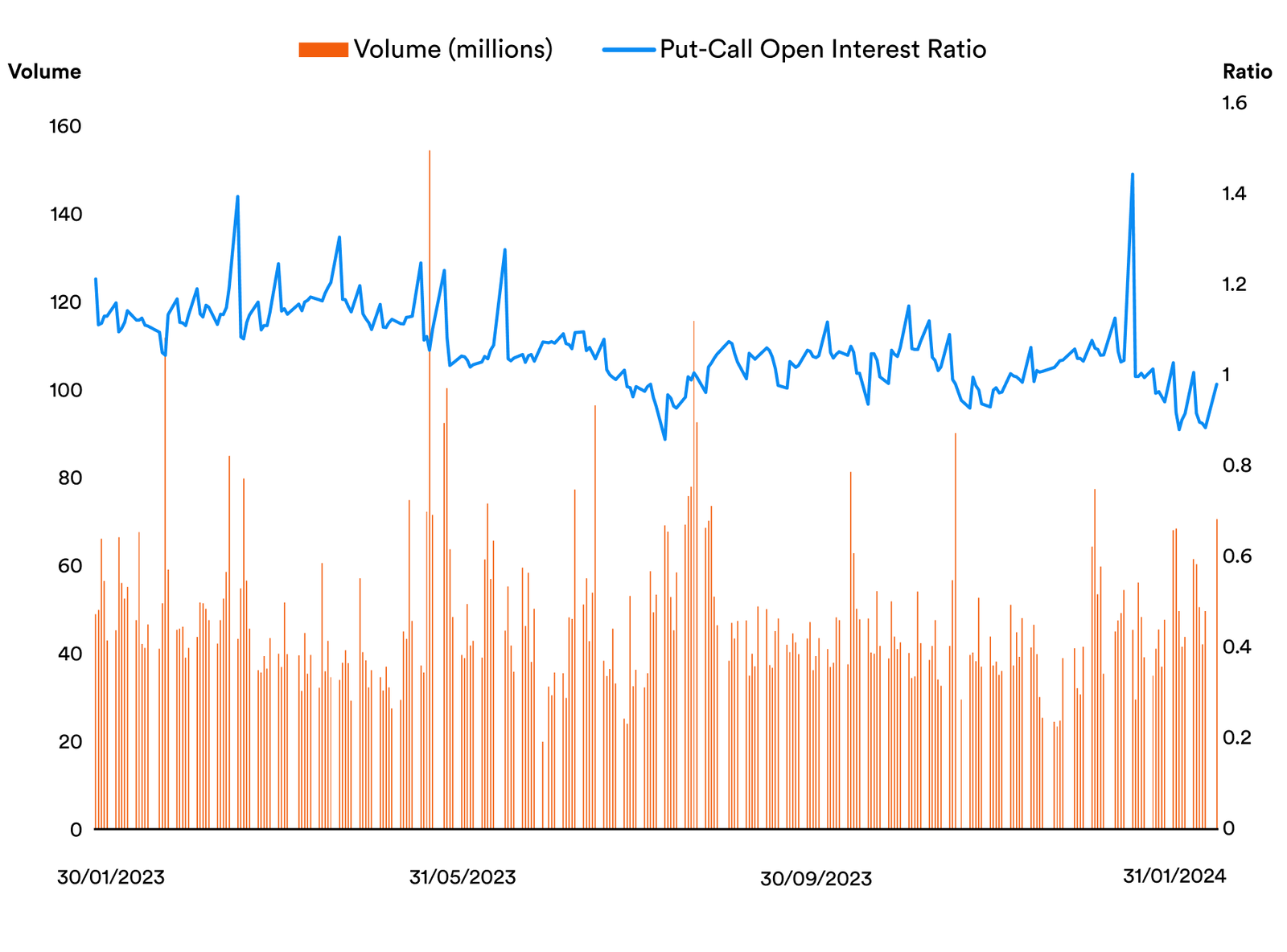
Traded volume was generally in the 45-65 million range except during options expiry/rollover and earnings release. When overlaid against the put-call interest ratio, the stock shows increasingly strong evenness in outlook. Through most of 2023, market participants were predominantly bearish on their outlook of stock valuation. In the current year, however, they have trended towards a ratio of 1.
Source: Leverage Shares analysis
As the PE Ratio rationalized, the Put-Call Ratio stabilized. Recent trends indicate that there is still a downward push on rationalizing the PE Ratio further.
The company predominantly operates as a designer while the bulk of the manufacturing/assembly of disparate components is carried out by Taiwan-based TSMC. Given that there is no single correct “architecture” and design is highly dependent on application, the company’s “high water mark” currently achieved via successful corporate outreach and collaborations comes with the caveat that its counterparts will constantly look towards optimizing cost and performance based on need.
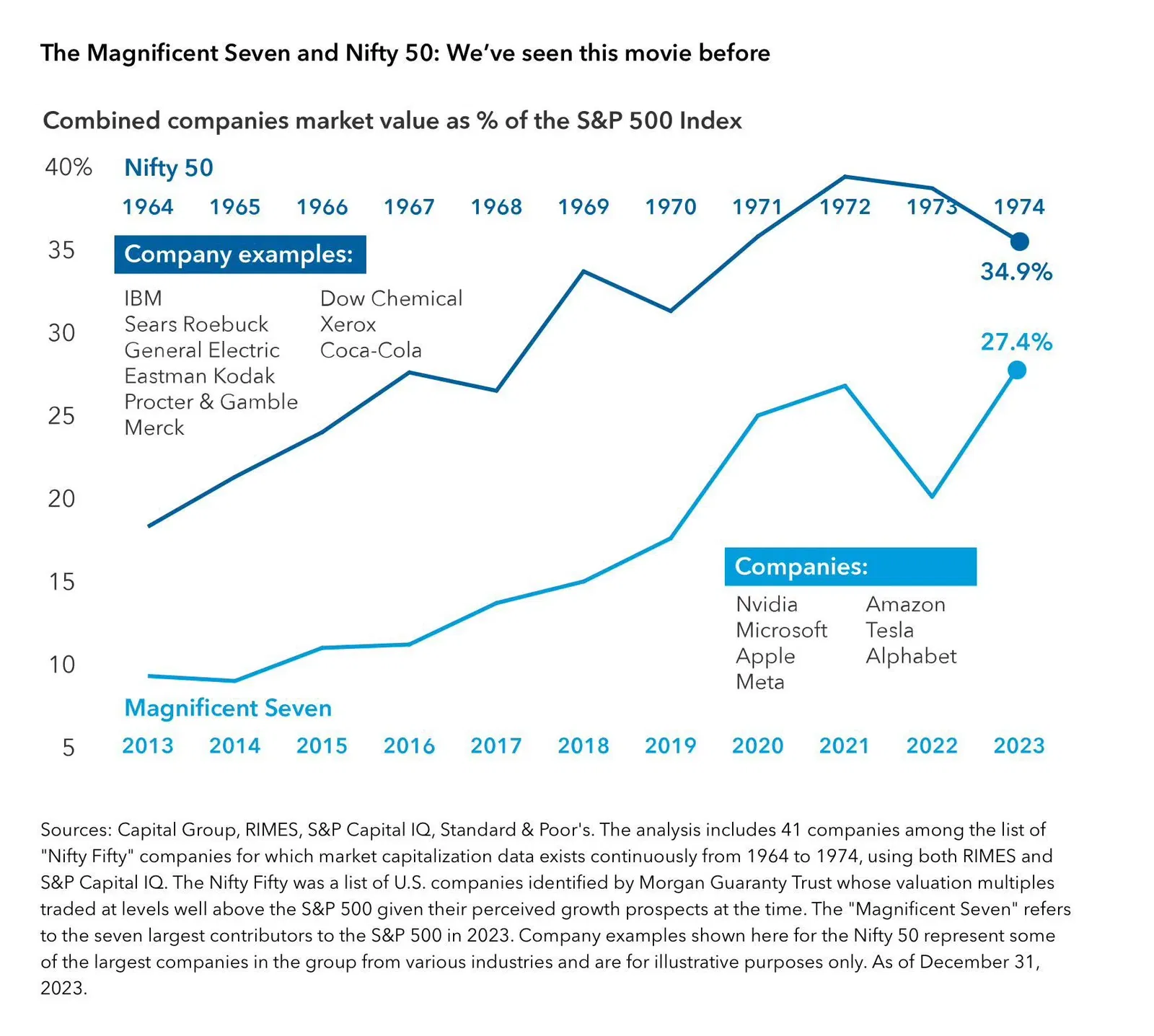
Another factor is the problem with the “Magnificent Seven”, which has become a refuge for hype-driven investors. Economist David Rosenberg contends1 that the Magnificent Seven’s frequent comparison with the dot-com stocks at the turn of the century is incorrect since the former are actually profitable. Instead, they should be compared with the American “Nifty Fifty” of the 1960s and 1970s (not to be confused with the Indian index) which were also mostly profitable. While the “Nifty Fifty” eventually tumbled over 60% between 1973 and 1975, most of the companies therein remained profitable all the way till the present. Much like the “Nifty Fifty” of yore, the Magnificent Seven is the dominant driver of today’s market.
Source: The Capital Group
Much like the “Nifty Fifty”, a rationalization is due.
In Conclusion
As a company, the company’s high earnings will likely stabilize on a forward-looking basis: corporate adhesion tends to be stable albeit and subject to significant interplay with requirement scoping and cost. A diverse set of corporate-centric hardware solutions can also be expected in the year to come.
As a stock, however, historically high ratio premia cannot be expected. Goldman Sachs reported2 that nearly every one of the 722 hedge funds surveyed with a total equity exposure of $2.6 trillion have been paring down their exposure to these stocks. A further 40-50% correction of the PE Ratio from the present level to the mid-twenties to early-thirties is likely on the cards while stock repurchases are likely to continue.
Footnotes:
Your capital is at risk if you invest. You could lose all your investment. Please see the full risk warning here.
Share this:



INVESTOR TYPE:
LOCATION:
Please confirm the Terms and Conditions
by clicking on “I agree”.
This website is for informational purposes only.
This website is accessible to retail investors in the EU for informational purposes only. Leverage Shares does not directly distribute to retail investors. Retail clients should not rely on any of the information provided and should seek independent financial advice.
Information contained in this website is intended only to provide general and preliminary information and does not constitute any legal or investment advice, an offer to sell or solicitation to buy any security, including shares of any Exchange Traded Products (“ETPs”).
An investment in the promoted ETPs may only be made based on the ETPs´ legal documentation and will be subject to terms and conditions contained therein.
The information provided on this site is not directed to any United States person or any person in the United States, any state thereof, or any of its territories or possessions. The ETPs shown on this website are not available for sale in the U.S. or to a U.S. person.
I acknowledge having my legal residence in the selected location.
Leverage Shares does not directly distribute to retail investors.
Please contact your financial adviser, or other investment professional, if you would like to discuss whether these products may be suitable for you.
This website is intended for U.S. residents.
The content on this website is for informational purposes only and is educational in nature.
The material contained on this website is not intended as a recommendation to buy, sell or hold any security or to adopt any investment strategy.
Please confirm the Terms and Conditions by clicking on “I agree”.
This website is for informational purposes only.
Information contained in this website is intended only to provide general and preliminary information to EU regulated firms such as Investment Intermediaries and Asset Managers. This information does not constitute an offer to sell or solicitation to buy any security, including shares of any Exchange Traded Products (“ETPs”).
An investment in the promoted ETPs may only be made based on the ETPs´ legal documentation and will be subject to terms and conditions contained therein.
The information provided on this site is not directed to any United States person or any person in the United States, any state thereof, or any of its territories or possessions. The ETPs shown on this website are not available for sale in the U.S. or to a U.S. person.
I acknowledge having my legal residence in the selected location.
Please confirm you have read and accept the Terms and Conditions by clicking on
“I agree”.
This website is for informational purposes only.
Information contained in this website is directed only at institutional investors and investment professionals intended only to provide general and preliminary information to such as FCA regulated firms such as Independent Financial Advisors (IFAs) and Wealth Managers. Nothing on this website is intended to information does not constitute an offer to sell or solicitation to buy any security, including shares of any Exchange Traded Products (“ETPs”).
An investment in the promoted ETPs may only be made based on the ETPs legal documentation and will be subject to terms and conditions contained therein.
The information provided on this site is not directed to any United States person or any person in the United States, any state thereof, or any of its territories or possessions. The ETPs shown on this website are not available for sale in the U.S. or to a U.S. person.
I confirm I am a professional investor and acknowledge having my legal residence in the selected location.
This website is intended for U.S. residents.
The content on this website is for informational purposes only and is educational in nature.
The material contained on this website is not intended as a recommendation to buy, sell or hold any security or to adopt any investment strategy.
Never miss out on important announcements. Get premium content ahead of the crowd. Enjoy exclusive insights via the newsletter only.