



Your capital is at risk if you invest. You could lose all your investment. Please see the full risk warning here.

Concerns over weak Chinese demand could be temporary.
Extension of supply cuts by OPEC+ and geo-political tension in the Middle East is likely to support prices.
Oil demand from China slows down
Oil prices have been trading in a narrow range over the past month as concerns of slowing crude demand in China neutralises the tighter supply outlook for 2024. Last Thursday data from China – the world’s biggest oil importer have shown that oil imports for January and February 2024 have risen compared to the same period of 2023; however, the data is lower than December, displaying a trend of weakening purchases.
OPEC+ extends production cuts
The Organisation of the Petroleum Exporting Countries (OPEC) and its allies have agreed last Sunday to extend voluntary oil output cuts of 2.2 million barrels per day into the second quarter. The decision of the oil cartel to tighten oil supply gives additional support to crude prices as concerns over global growth demand for oil and rising output outside the group, especially in the U.S. have been exerting downward pressure on prices.
Uncertainty over interest rate cuts from central banks
Fears of weak demand were exacerbated by the uncertainty over the path of U.S. interest rates, as non-farm payrolls data last Friday indicated that the U.S. labour market remains resilient. U.S. job growth rose by 275,000 new nonfarm payrolls in February, according to the Bureau of Labor Statistics, beating expectations of a 200,000 rise.
The unemployment rate also rose, and wage growth decelerated, showing that the U.S. economy might be slowing which supports the soft landing narrative and increased the probability of a June rate cut. Monetary policy is an important factor weighing on oil prices as lower interest rates could boost economic growth and increase oil demand.
Source: TradingView
IEA forecasts supply deficit for the rest of 2024
The latest report from the International Energy Agency (IEA) suggests the oil market would be tight for the rest of the year. The agency revised its forecast higher by 110,000 bpd from its prior outlook. IEA now anticipates oil demand growth to decline to 1.3 million bpd in 2024 in comparison to 2.3 million bpd growth in 2023.
The IEA lowered its 2024 supply forecast expecting oil supply to rise by 800K bpd to 102.9 million bpd in 2023. The upwardly revised demand growth and the lowered supply growth prognosis suggests a tighter market for the rest of the year.
Technical analysis
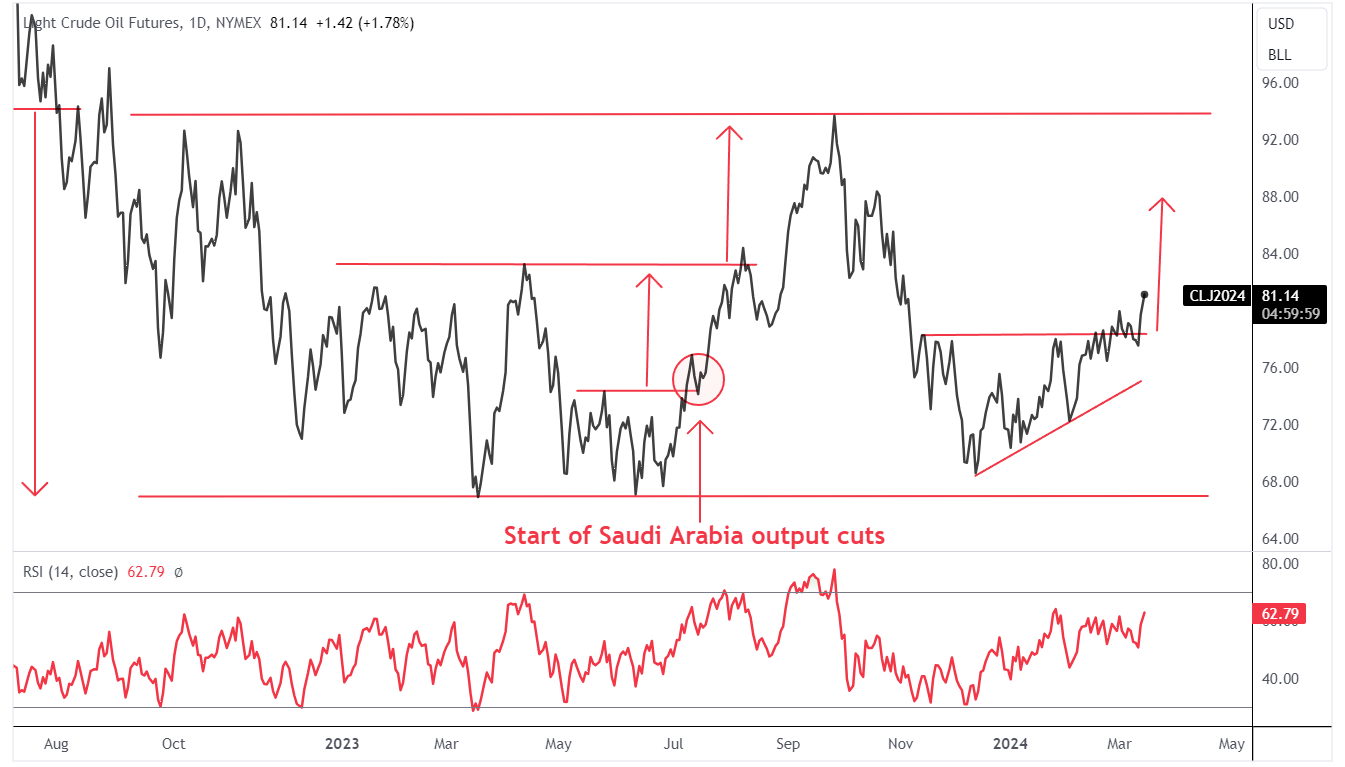
Oil prices have been consistently trading higher since mid-December 2023 advancing from a low of $67.71 to a $81.62 intra-day high on Thursday. Thursday’s price action decisively broke above a multiple key resistance of $79.77 confirming a large ascending triangle.
The pattern has bullish implications and points to higher price levels in the months ahead. The initial upside price target for WTI crude is $85.00; however, over the medium-term levels to $89.00 appear easily achievable.
Your capital is at risk if you invest. You could lose all your investment. Please see the full risk warning here.
 Market Insights

