



Your capital is at risk if you invest. You could lose all your investment. Please see the full risk warning here.
Can the Magnificent Seven Still Power U.S. Markets in 2025?
U.S. equities slipped on Wednesday during the busiest earnings day in S&P 500 history, with firms accounting for over $11.6 trillion in market value reporting results and another $10.6 trillion due Thursday. The magnitude of Wednesday’s line-up, including Microsoft, Alphabet, and Meta, makes this the first time total reporting value has entered the ten-trillion-dollar range.
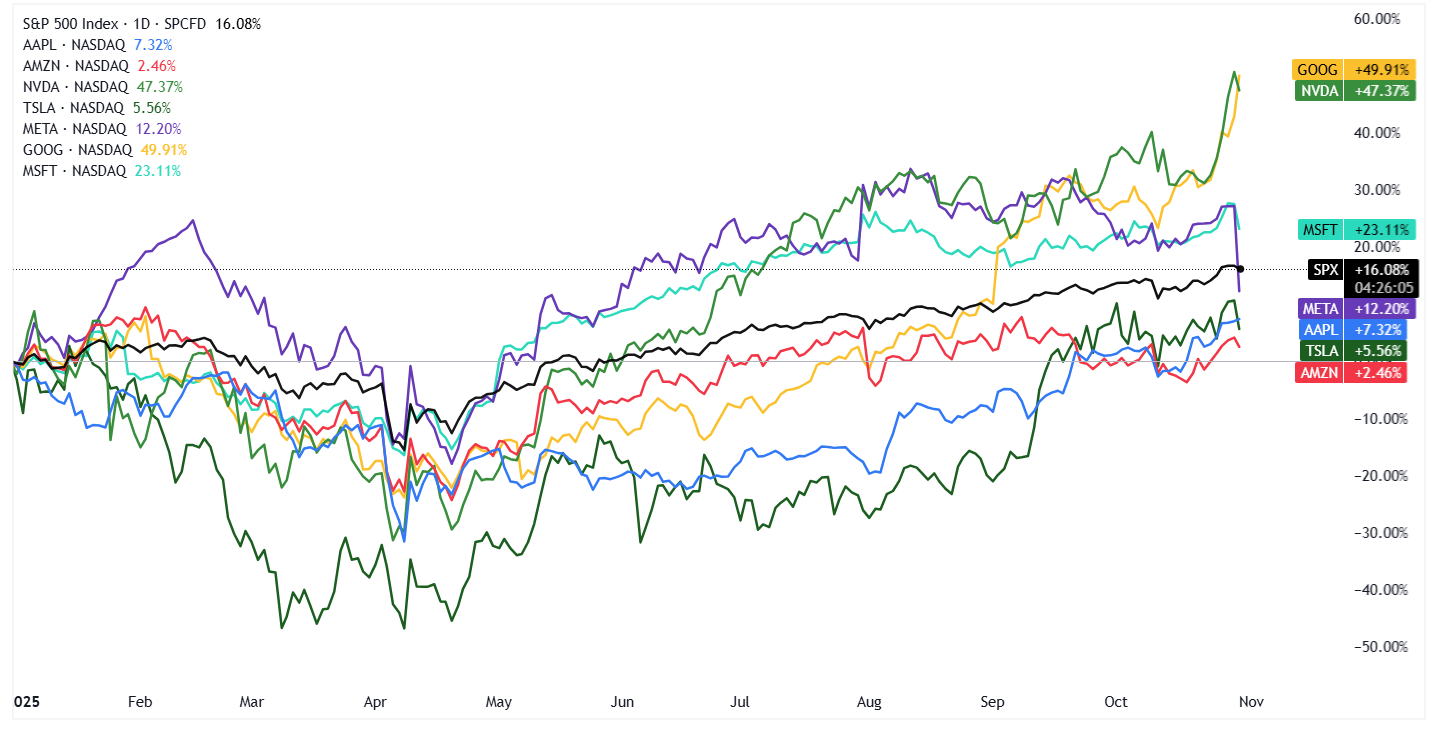
As the busiest week of this earnings season unfolds, a debate has reignited over whether the so-called Magnificent Seven can continue steering U.S. markets higher. With Microsoft, Alphabet, and Meta results already out and Apple and Amazon next in line, Wall Street’s gaze remains fixed on these mega-caps, whose combined weight is a quarter of the S&P 500 and still defines market direction.
Investors are trying to reassess just how much gas is left in the mega-cap engine that has powered the U.S. markets to record highs this year.
Source: TradingView
Big Tech: Strong Results, Soaring Costs
Earnings from the three major technology firms painted a mixed picture on Wednesday. Microsoft beat both revenue and profit expectations with $77.7 billion in revenue and EPS of $3.72, driven by 40% growth in Azure cloud. However, Microsoft shares declined after Azure growth met expectations but failed to exceed them, amid rising capex and margin concerns.
Alphabet delivered $102.4 billion in revenue and EPS of $2.87 on the back of a 34% jump in Google Cloud. The company showed that its heavy spending is fuelling growth in cloud and search advertising, and guided full-year capital expenditure to as much as $93 billion. Alphabet shares rose in the pre-market session on better-than-expected advertising and cloud growth, showing that markets are rewarding near-term profitability over long-term AI projects.
Meta added a note of volatility, with revenue of $51.24 billion beating forecasts but EPS hit by a one-time tax charge. The stock tumbled 8% in pre-market trading, after the company raised its full-year capital expenditure forecast to as high as $72 billion, to expand AI infrastructure, a move that mirrors the broader spending spree across the tech sector. Investors were mainly concerned with Meta’s high costs and limited visibility on returns.
Together, Microsoft, Alphabet, and Meta spent $78 billion last quarter, which is an 89% increase from a year earlier, highlighting the enormous cost of staying ahead in the AI race.
Valuations High, Patience Thin
This earnings season has shown that investors are growing less forgiving. Companies that merely meet expectations are being sold off, while those delivering strong beats are rewarded only modestly. With valuations stretched and momentum concentrated in a few mega-caps, even minor disappointments risk triggering sharp reversals.
Markets were subdued on Wednesday, trading near record highs, as investors digested the big tech results alongside the Federal Reserve’s signal that a December rate cut isn’t guaranteed. This is a big disappointment for investors betting on another rate cut by year end, lowering the probability of an extension of the market rally beyond this earnings cluster.
Much now depends on whether AI-driven capital spending can translate into durable revenue and margin expansion across the sector.
Earnings Overview
Half of S&P 500 companies have now reported third-quarter results, with 81% beating estimates. According to FactSet data, earnings are expected to jump 9.2% in the quarter and would mark the ninth consecutive quarter of positive earnings growth, but a decline from the 12% earnings growth in Q2.
Thursday’s lineup is big, but attention is squarely turning to Apple and Amazon, which will serve as the next key tests for sentiment.
A Record Month for Trading
October’s average daily trading volume is on track to hit an all-time high, signalling intense participation from both retail traders and institutions. Interestingly, much of this surge is coming from smaller, more speculative names, which is a sign that investors may be rotating beyond the tech giants that dominated 2023 and 2024.
At the same time, active mutual funds have trimmed their exposure to large-cap tech stocks, cutting their tech weighting to around 30%. That’s the biggest underweight in five years and highlights growing caution around valuations after a prolonged AI-driven rally.
Market Breadth Narrows Sharply
Beneath the market rally, participation has thinned dramatically. The S&P 500’s advance on Tuesday came with just 104 stocks rising, which is the weakest breadth since 1993. Nvidia’s 5% rally alone accounted for much of the index’s gain, while the equal-weighted S&P fell nearly 1%.
This widening gap between market leaders and laggards highlights a growing imbalance. The index now trades roughly 13% above its 200-day moving average, a level that in previous cycles has preceded modest pullbacks. The forward P/E ratio of 23.1 sits near its pandemic-era peak, and the valuation spread between the largest tech names and the rest of the market is at a record high.
Nvidia: The Market’s Pulse
Nvidia continues to set the tone for risk sentiment. After announcing $500 billion in AI processor bookings and seven new U.S. supercomputers, the stock surged again, this time after President Trump said he would discuss Nvidia’s Blackwell chips directly with China’s Xi Jinping and consider tariff reductions.
At current price levels, Nvidia has a staggering $5 trillion in market value, and it will stay there if its shares hold above $205.77. The company has effectively become a proxy for both the AI trade and investor confidence in U.S. equities.
Key Takeaways
Big Tech still leads: Microsoft, Alphabet, and Meta beat revenue forecasts, but AI spending is pushing capital expenditure to record levels.
Rally is concentrated: Market gains are driven by mega-cap AI-linked stocks, while smaller names lag.
Valuations are stretched: The S&P 500 trades well above its 200-day moving average, limiting short-term upside without broader earnings growth.
Momentum is top-heavy: Investor sentiment remains risk-on but selective, leaving the market vulnerable once earnings season winds down.
Professional investors looking for magnified exposure to the Magnificent Seven may consider Leverage Shares +5x Long Magnificent 7 or -3x Short Magnificent 7 ETPs.
Your capital is at risk if you invest. You could lose all your investment. Please see the full risk warning here.
 Market Insights
 Education

