



Your capital is at risk if you invest. You could lose all your investment. Please see the full risk warning here.
In the leadup to British semiconductor major Arm Holdings plc's (ticker: ARM) FY 2026 earnings release – made on the 6th of May after market close – the stock had risen by an astounding 60%. The earnings release, on the other hand, seems to have more-or-less only mildly exceeded analyst consensus: revenue for its fourth quarter (Q2) was $1.49 billion versus an expectation of $1.47 billion while adjusted earnings per share (EPS) $0.60 versus an expectation of $0.58.
The trends and the messaging are potentially either at odds or represent a massive shift in direction.
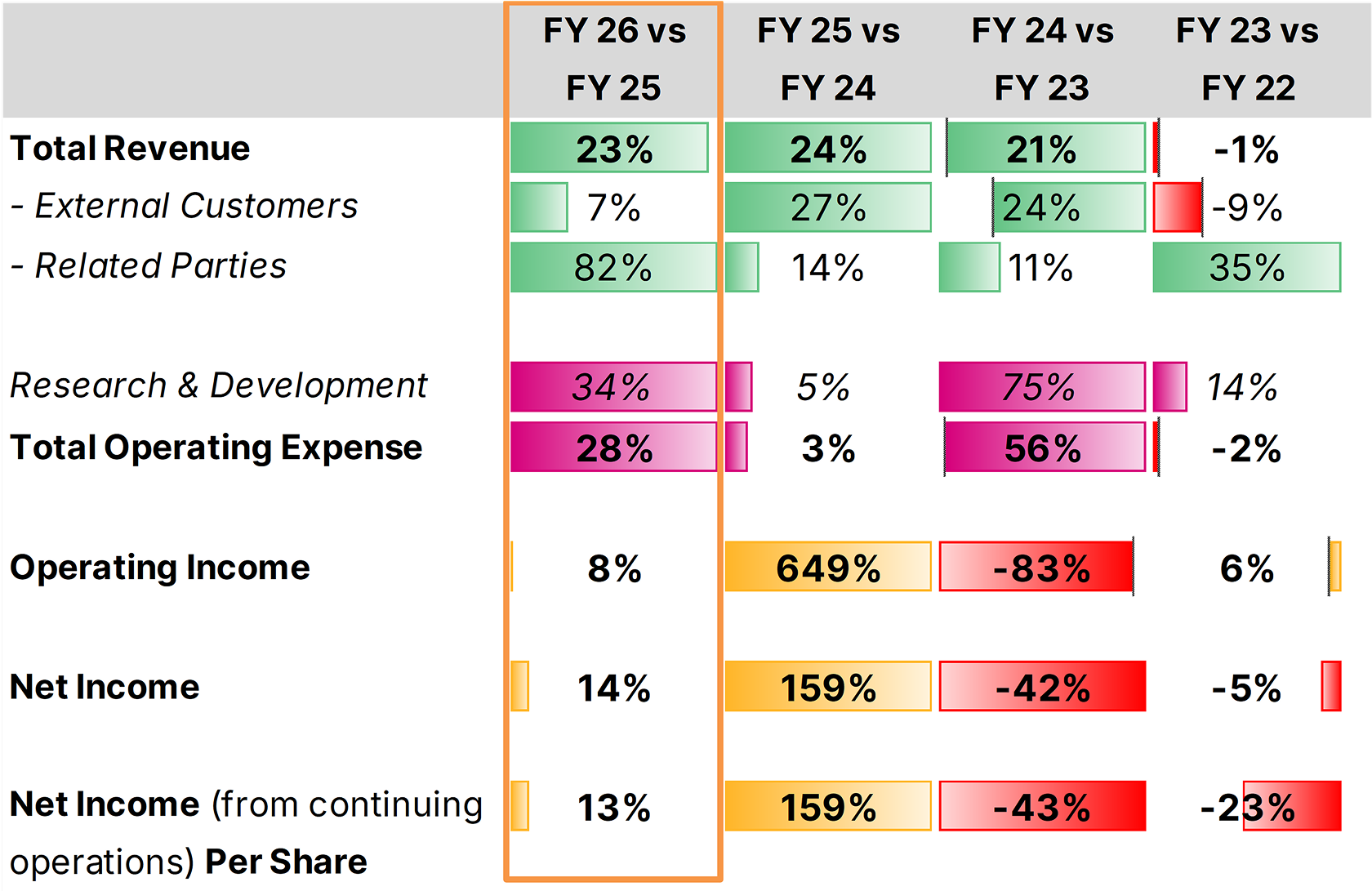
Trend AnalysisAt first blush, trends seem to indicate that the company's massive growth spurt in net income in FY25 isn't going to be repeated.
Source: Company Information; Leverage Shares analysis
However, this isn't quite the case and entirely explainable by the nature of Arm, which is a fabless holder of Intellectual Property (IP) and designs employed in chip design and manufacturing. Once a design is finished and the IP is acquired, it is a comparatively minor cost to deliver it to a chipmaker or foundry.
The human factor – and with it, Stock-Based Compensation (SBC) – becomes very relevant, particularly in FY 24, i.e. the year Arm had its Initial Public Offering (IPO). The company spent nearly $1.04 billion in SBC for FY24 as employee equity vested. Furthermore, legal, banking, and administrative fees associated with the IPO also ate into the bottom line (i.e. net income). In FY25, SBC was $820 million. Because SBC is an expense, a decrease in SBC directly increases Net Income. If "Adjusted Profit" were estimated for both these years by adding SBC back to Net Income from continuing operations, the "Adjusted Profit" for FY24 and FY25 would be $1.343 billion and $1.612 billion respectively, i.e. a 20% growth in profit relative to a 24% growth in revenue. Adding back the reported $1.052 billion in SBC to net income from continuing operations in FY26 yields $1.956 billion, i.e. a 23% increase in adjusted profit from a 23% increase in revenue in FY terms.
In FY24, 68% of SBC expenses were assigned to R&D ("engineers") and 28% were to SG&A ("sellers"/"management"). In FY25, it was 70% and 27%. In FY26, it's 72% and 25%.
Note: the balance of SBC is assigned to sales enablers (support, customer-facing implementors, et al). In FY25 and FY26, SBC share for this group was 3%.
When considering the in-tandem increase in adjusted profit relative to revenue growth, i.e. outside of GAAP language, the massive spikes and drops are wholly contextualized: since FY 24, the company has seen revenue growth in the 20-23% range, with around 40% of each year's net revenue translating steadily into "adjusted profit", which in turn combines net income and SBC.
In holistic terms and stripped of hype, the company is a picture of stability.
Geopolitical Considerations?In Arm's reporting language, "External Customers" have seen a substantial paring down from steady growth patterns seen in FY24 and FY25 while "Related Parties" have exhibited a nearly 93% growth over the averages exhibited across FY24 and FY25 combined.
Now, "External Customers" represents its clients in the U.S., Taiwan, South Korea, and Europe such as Apple, Qualcomm, NVIDIA, Amazon, et al. "Related Parties" almost exclusively refers to Arm China, which acts as an independent entity and the exclusive distributor of Arm's IP in China.
Market dynamics and geopolitics combine to explain this pattern thus: the global smartphone and industrial Internet of Things (IOT) markets are largely saturated, with unit volumes chips running relatively flat globally. Arm's IP is present at strength within these markets and revenues accrued herein represent most of revenue earned from "External Customers".
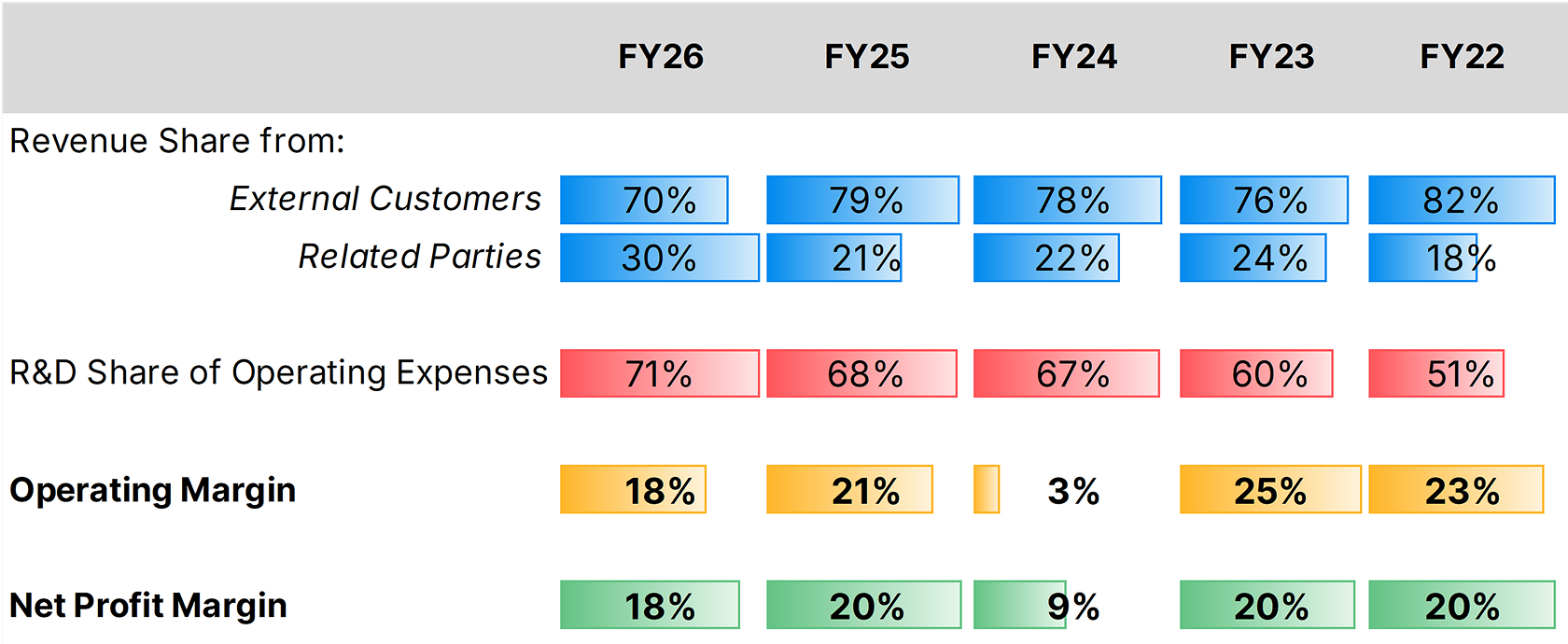
Meanwhile, "Related Parties" represent a ramp-up in buy-ins from Chinese chip designers, who might be signing front-loading massive multi-year IP licensing agreements to lock in access to Arm's technology while they still can in the face of upcoming export controls by the US or UK. In FY26, China's contribution to Arm's revenue in percentage terms has seen a near-doubling relative to FY22:
Source: Company Information; Leverage Shares analysis
This is seemingly confirmed in Arm's Q4 FY26 shareholder letter, wherein it was noted that revenue was impacted by the "timing and size of multiple high-value license agreements and contributions from backlog", which neatly can be ascribed to any number of agreements both struck in China or elsewhere.
Arm's Datacenter Era BeginsThe comparatively higher share of SBC for R&D in FY2026 might dovetail into what's in the offing for Arm's clients: steady inroads in datacenter, which presently constitute a minor share in its monetized IP portfolio.
CEO Rene Haas indicated during the earnings call that while IP and CSS ("Compute Subsystems") remain the foundation of the company's royalty growth, a third segment is being developed: production silicon, i.e. ready-to-manufacture computer chips designed directly by Arm themselves. The "Arm AGI CPU", launched at the "Arm Everywhere" in Q3 2026, has on-boarded Meta as a lead partner and co-developer in the course of a multi-generation roadmap with the very first generation bringing potentially substantial capital expenditure savings to datacenter clients. The company reports it has more than $2 billion of customer demand – 40% of FY26 revenue – across FY27 and FY28. The chip, purpose-built for AI Data Centers and "Agentic AI" workloads, is being used by Meta to optimize their infrastructure alongside their own custom MTIA accelerators.
CEO Haas also indicated that Arm-based compute, heavily driven by the hyperscaler-specific Neoverse CSS, now has 50% market share among top hyperscalers. This is slightly ambiguous messaging: this is arguably more by the employment of the likes of Nvidia and AMD's CPUs/GPU and Korean-designed memory (which have Arm's IP present in them), rather than an outright recognition of Arm's brand. Arm has long been a provider of IP to these companies, but it isn't the only source of IP for them.
In ConclusionWith physical silicon now being made available, Arm now aims to capture the much higher revenue associated with selling the physical hardware itself instead of just getting a small royalty fee per chip. TSMC is both the foundry for manufacturing of the silicon and also the core partner for Arm's Total Design ecosystem, wherein clients like Google or Amazon can buy into Arm's pre-designed CSS and have them manufactured at the foundry.
For over 35 years and arguably unlike other companies in the semiconductor industry, Arm Holdings operates more like a modern-day investment bank, wherein (typically) individual contributions to revenue are recognized and rewarded in direct relation to business brought in off solutions designed in-house but never really implemented in a proprietary manner. Now, it has far more "skin in the game" and growing more aligned with the way AMD and Nvidia operate.
The move from "value" to "growth" at least partly explains the massive 60% burst even before the earnings. However – and as noted in the recently published commentary1 on AMD's earnings – it bears noting that delivery implications effectively shifts to TSMC's ability to fulfill orders, the capture of client orders shifts during replacement/upgrade cycles at hyperscalers away from Nvidia/AMD, and so forth. Achieving "growth" is arguably more tricky than "delivering" value. For reasons potentially entirely specific to TSMC or the business relationship, TSMC has completed2 the sale of the stake it held in Arm's shares.
The massive front-loading of price into the stock is certainly a matter of concern while the pathway to sustainable demand for their AI-relevant products will bear scrutiny in the quarters to come. The Meta deal was just the beginning.
Professional investors in Europe might consider the +3x Long ARM ETP (ARM3) during bullish phases of the stock’s trajectory.
Footnotes:
"AMD Q1 2026: Datacenters Now Lead Growth", Leverage Shares, 7 May 2026
"Taiwan's TSMC exits Arm with $231 million share sale", Reuters, 29 April 2026
Your capital is at risk if you invest. You could lose all your investment. Please see the full risk warning here.
 Market Insights
 Education

