



Your capital is at risk if you invest. You could lose all your investment. Please see the full risk warning here.
In October, German inflation decelerated notably, surpassing market expectations. The inflation rate came at 3%, marking the lowest level since June 2021, while economists were expecting a more moderate decline to 3.3%. This outcome reinforces the European Central Bank's (ECB) assertion that its series of record interest rate hikes is beginning to yield the desired effects.
ECB President Christine Lagarde pointed to the anticipation of further inflation moderation as a key factor in the central bank's decision to pause its interest rate hikes last week, following ten consecutive increases. These rate hikes have been exerting a significant impact on financial conditions, leading to reduced demand, and aligning with the ECB's inflation target rate of 2%.
The German economy faced a contraction in the third quarter, raising concerns about the potential onset of a recession in Europe's largest economy. The Gross Domestic Product (GDP) shrank by 0.1% compared to the previous quarter, which was slightly less severe than the 0.2% decline projected by economists. The decline was attributed to a decrease in household spending.
The data shows the challenges Germany faces in recovering from a downturn induced by energy-related factors during the past winter, followed by two quarters of stagnation or minimal growth, as per revised data.
A recent survey of purchasing managers revealed that the manufacturing sector in Germany continues to grapple with declining new orders, exerting pressure on the broader Eurozone economy. The impact of higher interest rates is notably dampening demand for industrial goods, which Germany relies on more heavily than its European counterparts for economic growth. While the services sector had shown more resilience, business surveys by S&P Global indicate a slowdown in momentum. Also, there are signs of strain emerging in the labour market, which had previously been a bright spot.
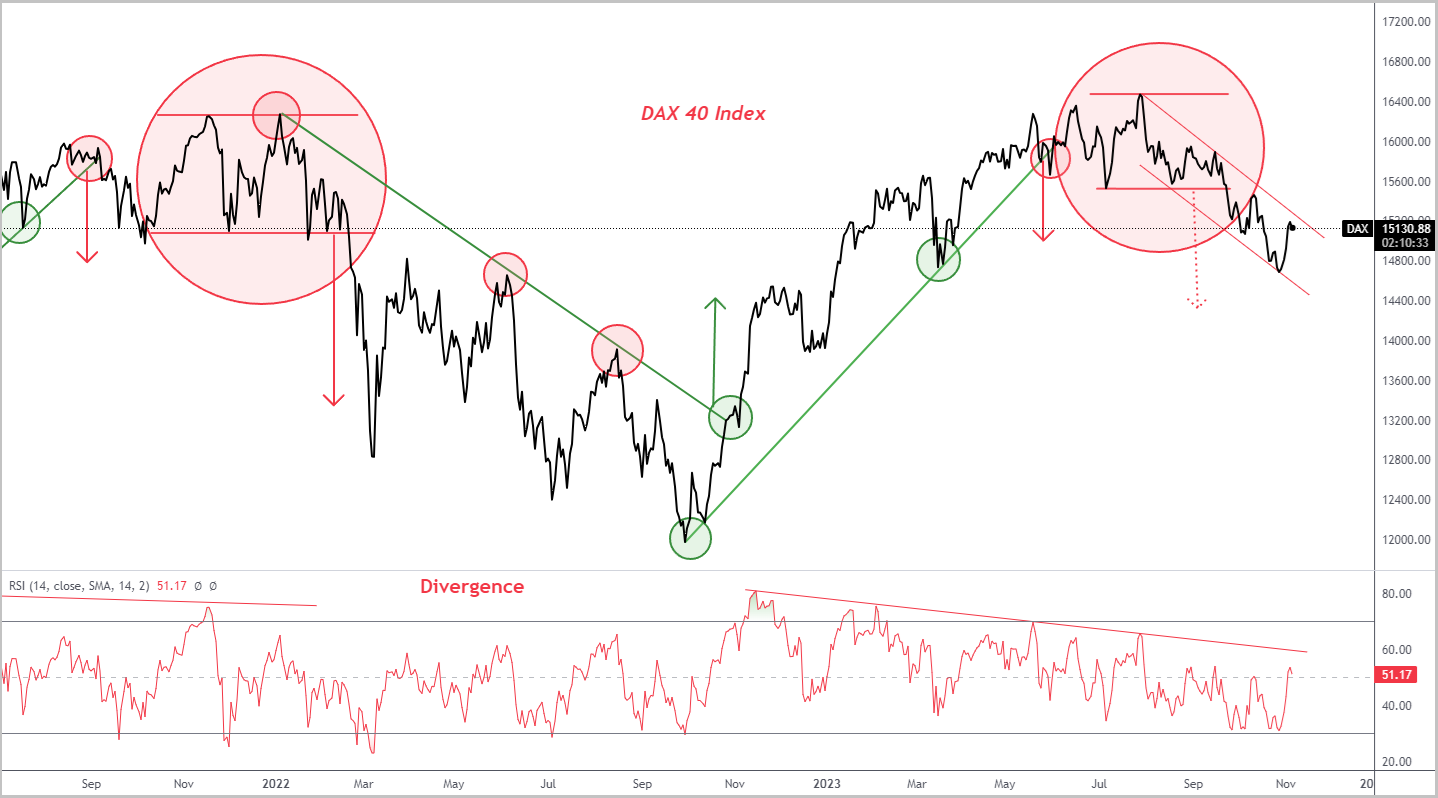
Source: TradingView, DAX 40 Yearly Chart
European equities experienced substantial gains last week, driven by robust corporate earnings and a perceived dovish shift from central banks following several policy meetings. Markets currently expect no more hikes and futures imply an 80% likelihood that the central bank will commence easing as early as April, reflecting concerns about the region slipping into a recession.
In a somewhat unexpected development, German factory orders increased again in September, offering a glimmer of hope that the manufacturing challenges facing Germany might be abating. Monday's data revealed a 0.2% rise in demand for the month, marking the second consecutive monthly gain and surpassing analysts' expectations, which had projected a 1.5% decline. However, it's worth noting that the August advance was revised downward by roughly 50%, down to 1.9%.
The statistics agency attributed September's improvement to a 4.2% surge in foreign orders, which offset a 5.9% decline in domestic orders. Over the entirety of the third quarter, there was a 3.9% decline in factory orders.
The DAX 40 index enjoyed a robust rally last week; however, the rate-repricing rally has taken a breather on Monday. Unless the resistance level of 15,575 is breached to the upside, the current rebound may be viewed as just another bear market rally.
Your capital is at risk if you invest. You could lose all your investment. Please see the full risk warning here.
 Market Insights
 Education

